11.22.2021 – memory depends

memory depends
have we intentionally
apprehended it
My cousin Joy has been on my mind since I stole a photograph of hers to use in yesterday’s haiku,

In the discussion about that haiku I commented on the camera versus memory when seeing things today.

I quoted from the author, Alain de Botton that using a camera blurs the distinction between looking and noticing, between seeing and possessing.

Mr. de Botton makes the point that the camera gives us the option of true knowledge, but it may also unwittingly make the effort of acquiring that knowledge seem superfluous

That is a great discussion for the here and now.

Having a camera with you in the here and now.

But what about the then?

The back then.

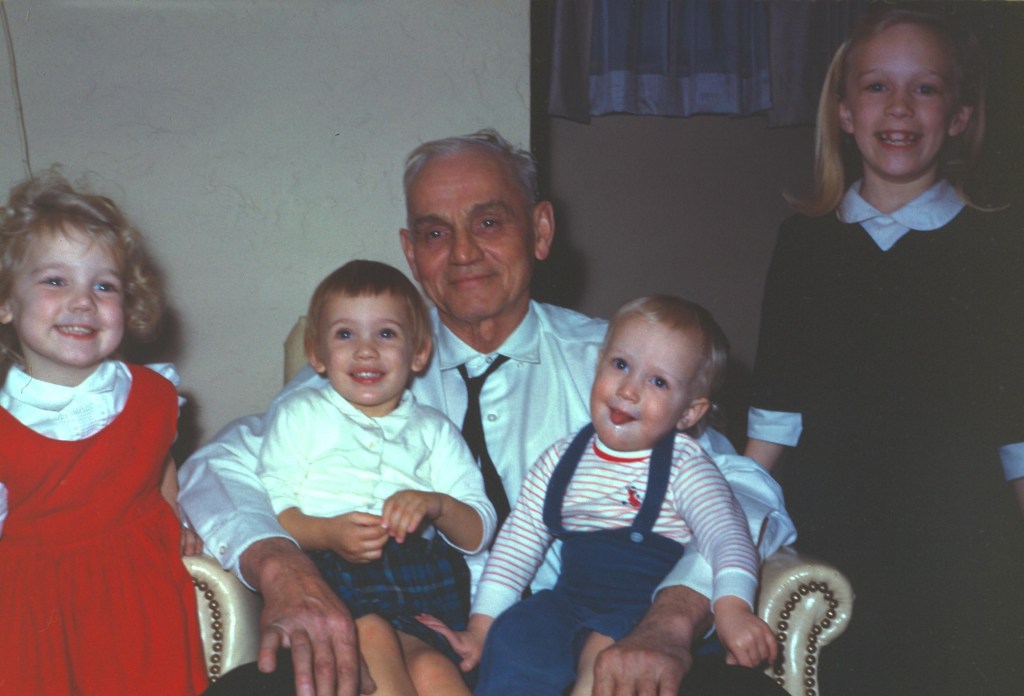
Here is a snapshot of sometime in 1962.

It is me and my cousin, Joy, sitting together on our Grandfathers lap.

My sister’s Lisa and Janet stand an either side.

I have NO memory of this photograph being taken.

I have NO Memory of seeing this photograph in the many many nights watching family slides.

Recently a nephew of mine digitized the family slides allowing us to travel back in time.

Otherwise I would have NO memory of this at all.

But I remember, with the help of the photograph, everything in the photograph.

My cousin and I we are the same age.

Our Mom’s were sisters.

I was my Mom’s 8th kid.

Joy was her Mom’s, my Aunt Mernie, 1st.

They were visiting from New Jersey.

This must have been a Sunday Dinner at my Grandma Hendrickson’s house.

Someone, my Dad most likely, arranged us altogether and said SMILE.

My character, even at age 2, seems to be pretty much set.

I can look at this picture and tell you what it smells like.

My Grandma’s house at that kinda moth-ball/natural gas smell due to the gas stove with no pilot light so you turned on the gas and lit the burner with a match.

As it was Sunday dinner it also smelled of my Grandma’s famous Pork and Beef roasts together in the same pan.

We were a meat and potatoes family to be sure.

But to be more accurate we were a mashed potatoes and GRAVY family.

Our parents would fill our plates and then cover everything on our plates with this pork-beef gravy that was what gravy was all about.

My Grandfather, that solid dutch guy (notice all the BLUE EYES??) in the picture, could eat mashed potatoes and gravy like it was an Olympic event.

Want to know the real kicker to this photograph?

Today, my cousin Joy and I are about the same age our Grandpa was when this photograph was taken.

I love this photograph and the memories it brings to mind ALONG with the memories it creates.

I have no memory of this day.

Looking I the photograph I remember everything.

Using the photograph, reseeing the scene, I can repossess the memory and the knowledge of the day.

It’s an effort.

Through the snapshot, I intentionally re-apprehend to my memory.

It is anything BUT superfluous.

*Adapted from the book, The Art of Travel (2002, Vintage Books) by Alain de Botton, and the passage:

True possession of a scene is a matter of making a conscious effort to notice elements and understand their construction.

We can see beauty well enough just by opening our eyes, but how long this beauty will survive in memory depends on how intentionally we have apprehended it.

The camera blurs the distinction between looking and noticing, between seeing and possessing; it may give us the option of true knowledge, but it may also unwittingly make the effort of acquiring that knowledge seem superfluous.

Adapted from the book, The Art of Travel (2002, Vintage Books) by Alain de Botton.

According to the website, GOOD READS, Any Baedeker will tell us where we ought to travel, but only Alain de Botton will tell us how and why.

As I said in the section on Architecture , what I find irresistible in reading Mr. de Botton is his use of language.

I get the feeling that if you made a spread sheet of all the words, adverbs and adjectives used by Mr. de Botton, you just might find that he used each word just once.

Neat trick in writing a book.

If I knew how to do that, hey, I would.

** More from the category TRAVEL — click here

11.21.2021 – We can see beauty

We can see beauty
well enough just by opening
our eyes, but how long

I stole this photo from my cousin Joy who lives up the Hudson River Valley.

I have to remind myself that there may be other places, maybe not nicer than where I live, but close.

I based this haiku and several others like from the writing in the book, The Art of Travel (2002, Vintage Books) by Alain de Botton, and the passage: True possession of a scene is a matter of making a conscious effort to notice elements and understand their construction.

We can see beauty well enough just by opening our eyes, but how long this beauty will survive in memory depends on how intentionally we have apprehended it.

Mr. de Botton goes on and says:

The camera blurs the distinction between looking and noticing, between seeing and possessing; it may give us the option of true knowledge, but it may also unwittingly make the effort of acquiring that knowledge seem superfluous.

When I go places and I think ‘I’ll take my camera’ I realize I am making a conscious decision to concentrate on using my camera instead of just looking.

Why look now when, if I take a picture, I can look later.

And a picture paints a 1000 words.

*Adapted from the book, The Art of Travel (2002, Vintage Books) by Alain de Botton.

According to the website, GOOD READS, Any Baedeker will tell us where we ought to travel, but only Alain de Botton will tell us how and why.

As I said in the section on Architecture , what I find irresistible in reading Mr. de Botton is his use of language.

I get the feeling that if you made a spread sheet of all the words, adverbs and adjectives used by Mr. de Botton, you just might find that he used each word just once.

Neat trick in writing a book.

If I knew how to do that, hey, I would.

** More from the category TRAVEL — click here

11.20.2021 – it’s an urge to say

it’s an urge to say
I was here, I saw this and
it mattered to me

Adapted from the book, The Art of Travel (2002, Vintage Books) by Alain de Botton, and the passage:

A dominant impulse on encountering beauty is to wish to hold on to it, to possess it and give it weight in one’s life. There is an urge to say, ‘I was here, I saw this and it mattered to me.’

But beauty is fugitive, being frequently found in places to which we may never return or else resulting from rare conjunctions of season, light and weather.

How then to possess it, how to hold on to the floating train, the halvalike bricks or the English valley?

The camera provides one option. Taking photographs can assuage the itch for possession sparked by the beauty of a place; our anxiety over losing a precious scene can decline with every click of the shutter.

According to the website, GOOD READS, Any Baedeker will tell us where we ought to travel, but only Alain de Botton will tell us how and why.

As I said in the section on Architecture , what I find irresistible in reading Mr. de Botton is his use of language.

I get the feeling that if you made a spread sheet of all the words, adverbs and adjectives used by Mr. de Botton, you just might find that he used each word just once.

Neat trick in writing a book.

If I knew how to do that, hey, I would.
** More from the category TRAVEL — click here

11.19.2021 – testing that nation

testing that nation
so conceived dedicated
how long can endure?

Mr. Thomas Jefferson, explaining the reasoning behind the Declaration of Independence, wrote that all men are created equal.

I feel that Mr. Jefferson really meant what he said.

But I also feel that Mr. Jefferson accepted that all men are created equal in the abstract, he could not figure a way of how it might be achieved in reality.

Mr. Jefferson saw that the wieght of human history and the current lifestyle of most Americans was proving his statement that all men are created equal to be, if not wrong, at least wistful thinking.

A fire bell in the night, Mr. Jefferson called it.

When the bell rang and the United States was called on for an answer, their answer was to fight the Civil War.

Review the history of that war and you can understand why Mr. Jefferson was reluctant to even look for an answer of how to achieve a country where all men are created equal.

It was left to Abraham Lincoln to try and explain why the Civil War was being fought.

It was 158 years ago today that Mr. Lincoln, in a short, short, short 272 word speech explained, “. . . our fathers brought forth, on this continent, a new nation, conceived in liberty, and dedicated to the proposition that all men are created equal. Now we are engaged in a great civil war, testing whether that nation, or any nation so conceived, and so dedicated, can long endure.

Mr. Lincoln was speaking at the dedication ceremony of a vast cemetery on the battlefield of Gettysburg.

Mr. Lincoln recognized that great as the battle, the struggle that the country was in at that moment, that there was more to do.

Somehow back in 1863, Mr. Lincoln spoke to us.

Mr. Lincoln said, “It is for us the living, rather, to be dedicated here to the unfinished work.

The unfinished work.

This country is a work in progress.

No kidding.

The testing, every day, the testing goes on.

Here is the full text, all 272 words of Mr. Lincoln’s Remarks at Gettysburg.

“Fourscore and seven years ago our fathers brought forth, on this continent, a new nation, conceived in liberty, and dedicated to the proposition that all men are created equal. Now we are engaged in a great civil war, testing whether that nation, or any nation so conceived, and so dedicated, can long endure. We are met on a great battle-field of that war. We have come to dedicate a portion of that field, as a final resting-place for those who here gave their lives, that that nation might live. It is altogether fitting and proper that we should do this. But, in a larger sense, we cannot dedicate, we cannot consecrate – we cannot hallow – this ground. The brave men, living and dead, who struggled here, have consecrated it far above our poor power to add or detract. The world will little note, nor long remember what we say here, but it can never forget what they did here. It is for us the living, rather, to be dedicated here to the unfinished work which they who fought here have thus far so nobly advanced. It is rather for us to be here dedicated to the great task remaining before us – that from these honored dead we take increased devotion to that cause for which they here gave the last full measure of devotion – that we here highly resolve that these dead shall not have died in vain – that this nation, under God, shall have a new birth of freedom, and that government of the people, by the people, for the people, shall not perish from the earth.”

11.18.2021 – maintaining comfort

maintaining comfort
atmosphere and appearance
traditional pub

Mike Mercer has died.

Not to worry, I never heard of him before either.

He got an obituary and photo in the Online Guardian today.

The first line read, “My friend Mike Mercer, who has died aged 81, was for 50 years the landlord of the Albion Inn, an attractive street-corner pub in the heart of Chester.

The obit went on to state, “The words “pub” and “landlord” scarcely do justice to the Albion or to Mike. A romantic and a perfectionist, he devoted much of his life to maintaining the comfort, atmosphere and appearance of a traditional English public house. The Albion was a magnet for those who believed that a drinking establishment should be a retreat from the bustle and frenzy of the outside world, where real ale and good food should be enjoyed in a relaxed and intimate atmosphere.”

Not a bad note to go out on, is it?

When I thought about the possibility of one day having an obit, not saying I discounted the possibility of dying, just the possibility of someone writing and PAYING for an obit, I thought a worthwhile accolade would be, “Baked good bread.”

A lot of meaning could be contained in those short words.

Says a lot about the type of person you are today.

Of late, I have cut a lot of breads out of my diet so not sure what to make of that does to the plan.

Mr. Mercer’s obit also contained this line.

Its decor proclaimed Mike’s old-fashioned and benign patriotism, but the atmosphere of the place was politically ecumenical. 

Old-fashioned and benign patriotism.

Politically ecumenical. 

I know the as I get older, grass is always greener 10 or 20 years ago.

But when did we all get so mean?

The irreverence combined with flippancy and no real substance for the care of people.

To paraphrase slightly what CS Lewis wrote in the Problem with Pain of the people who are confident to the very end that they alone have found the answer to the riddle of life, that God and man are fools whom they have gotten the better of, that their way of life is utterly successful, satisfactory, unassailable.

Mr. Lewis wrote that back in 1940.

Maybe we were all just as mean back then as well.

But at least back then, those folks were all stuck on AM Talk Radio and not on social media.