10.13.2022 – whole problem is that

whole problem is that
fools fanatics so sure, wiser
people full of doubt

In the 1933 essay, “The Triumph of Stupidity“, Betrend Russell wrote, “What has been happening in Germany is a matter of the gravest portent for the whole civilised world.

It was in this essay that Mr. Russell stated: The whole problem with the world is that fools and fanatics are always so certain of themselves, and wiser people so full of doubts.

It is much to easy to make a slight change and say, What has been happening in the United States is a matter of the gravest portent for the whole civilised world. The whole problem with the world is that fools and fanatics are always so certain of themselves, and wiser people so full of doubts.

I am not so that anyone would count me among the ‘wiser’ people but I do welcome anything that removes doubt down to doubt about my own very exisitence.

Luckily for me there is the restroom in the 21st century.

When I use the restroom here at work I get overwhelming evidence that I am indeed here.

First is the mirror but mirrors have been around forever and not just in restrooms.

By chance my office is in an old building on Hilton Head Island that at one time was a restaurant.

I leave my office and go down two wide flights of steps to the sub basement where the restroom is.

When I return to my office and I get to the top of the stairs, immediatly in front of me is a floor to ceiling, wide mirror.

As The Rev Al would say, you can use a mirror to reflect yourself or you can use a mirror to correct yourself and after a trip to the restroom it is handy to have a full length image of yourself to make any last minute wardrobe adjustments.

But that is after leaving the restroom so I digress.

In the modern restroom, the facilities make note of my presence and the operate all their own my presence is no longer of note.

The soap dispenser then sense my hand and dispenses soap.

The faucet senses my hands and turns on the water.

The paper towel dispenser senses my hands again and dispenses paper towels.

The mirror reflects, the toilet flushes, the soap foams, the water gushes, the paper towels roll.

It adds up that the evidence points to me being here.

It should remove all doubt.

There are those mornings however when the toilet doesn’t flush, the soap doesn’t spit out, the water doesn’t gush and the towels don’t dispence.

I want to go find someone and ask ‘am I here?’

In one Jim Harrison story, he dreams he is lying dead in the kitchen and he wakes up his wife to go check.

I know just what he means.

Doubt.

The price of being on the wise side of life.
10.11.2022 – You can’t talk about

You can’t talk about
economy without talk
about future stuff

According to Edward Helmore, in the article, US is headed for a recession, says head of JP Morgan Chase bank: ‘This is serious’:

The US and global economy is facing a “very, very serious” mix of headwinds that is likely to cause a recession by the middle of next year, warned Jamie Dimon, chief executive of JP Morgan Chase, the largest US investment bank, on Monday.

Dimon pointed to the effects of runaway inflation, sharp interest rate rises and Russia’s war in Ukraine, as factors that informed his thinking. But he added that the US was “actually still doing well” and consumers were likely to be in better shape compared with the global financial crisis in 2008.

“You can’t talk about the economy without talking about stuff in the future – and this is serious stuff,” Dimon told CNBC at a conference in London.

I have to get excited when I hear that Jamie Dimon, chief executive of JP Morgan Chase, uses those $20 economic terms like ‘stuff.’

According to Wikipedia, Mr. Dimon attended the Browning School, and majored in psychology and economics at Tufts University, where he graduated summa cum laude. At Tufts, Dimon wrote an essay on Shearson’s mergers; his mother sent the paper to Sandy Weill, who hired Dimon to work at Shearson during one summer break, doing budgets.

After graduating, he worked in management consulting at Boston Consulting Group for two years before enrolling at Harvard Business School, along with classmates Jeff Immelt, Steve Burke, Stephen Mandel, and Seth Klarman. During the summer at Harvard, he worked at Goldman Sachs. He graduated in 1982, earning an MBA as a Baker Scholar.

With all that resume I take my hat off to a feller who can boil down the current state of the economy into words I can understand and say: You can’t talk about the economy without talking about stuff in the future – and this is serious stuff.

10.11.2022 – I have always thought

I have always thought
the Yankees had something to
do with it, he said

Adapted from Why the Confederacy lost by by G. S. Boritt and James M. McPherson (1992) New York : Oxford University Press.

Mr. Boritt wrote:

Most interpretations fall into one of two categories: internal or external. Internal explanations focus mainly or entirely on the Confederacy, and usually phrase the question as “Why the South Lost.” External interpretations look at both the Union and Confederacy, and often phrase it as “Why the North Won.”

To illustrate the difference between an internal and external interpretation, let us look at the battle of Gettysburg as a microcosm of the larger issue.

Most of the controversy that has swirled endlessly for the past 128 years has focused on the issue of why the Confederates lost that battle — an internal explanation. Contemporaries and historians have blamed almost every prominent Confederate general at Gettysburg for mistakes that lost the battle:

Among them Robert E. Lee himself for mismanagement, overconfidence, and poor judgment;

Jeb Stuart for riding off on a raid around the Union army and losing contact with his own army, leaving Lee blind in the enemy’s country;

Richard Ewell and Jubal Early for failing to attack Cemetery Hill on the afternoon of July 1st and again for tardiness in attacking on the 2nd;

And above all, James Longstreet for lack of cooperation, promptness, and vigor in the assaults of July 2nd and 3rd.

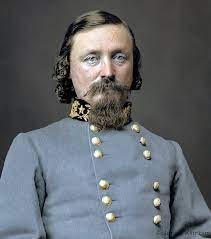
It was left to George Pickett to put his finger on the problem with all of these explanations.

When someone asked Pickett after the war who was responsible for Confederate defeat at Gettysburg, he scratched his head, and replied: I’ve always thought the Yankees had something to do with it.

Someday maybe I will be able to write a History of the United States.

When I get to the chapters on the 21st Century, I will try to answer the questions of What Happened to the United States.

I will scratch my head and reply, “I’ve always thought Donald Trump had something to do with it.”

10.10.2022 – its not my circus

its not my circus,
not my monkeys – hey waiter
ready for the check

Not my circus, not my monkeys is a calque Polish nie mój cyrk, nie moje małpy.

A calque is a borrowing by word-for-word translation or a loan translation.

For example, the English expression it goes without saying is a calque (a literal, word-for-word translation) of French ça va sans dire, and flea market is a calque of French marché aux puces (literally “market with fleas”).

Go down to beach and watch the waves.

As it is said in the Gullah, De wata bring we and de wata gwine tek we bak.

10.9.2022 – from Tajikistan

from Tajikistan
and over to Kyrgyzstan
to Azerbaijan

John Ronald Reuel Tolkien had a way with place names.

Coming up with the likes of Osgiliath, Gondolin and Cirith Ungol in his writings about the made up land of Middle Earth.

Still I am reminded that truth is stranger than fiction when I am reminded of those countries to the east of Russia.

The countries that when we had to live with the Union of Soviet Socialist Republics or the CCCP, made up that Union.

I got that reminder reading the article A Distracted Russia Is Losing Its Grip on Its Old Soviet Sphere in the New York Times.

The article states that these old members of the Soviet Union are taking advantage of Russia’s focus on Ukraine and are getting back to their old ways of not getting along that has gone along since before the birth of Christ.

That these countries don’t get along has to take a second seat for me as in the first seat is the realization that there really are countries named Tajikistan and Kyrgyzstan.

People live there.

They go to sleep and get up every morning and go to work and come home and go to bed at night.

Where they work, what they have for breakfast and whether or not they have parent-teacher conferences or even telephones, old style, telephone wire, landline telephones is all unknown to me.

They have to have some exposure to modern items as the article stated: And here along the mountainous border between Kyrgyzstan and Tajikistan, long-running quarrels between farmers over land, water and smuggled contraband escalated last month into a full-scale conflict involving tanks, helicopters and rockets, as the armies of the two countries fought each other to a standstill.

How about that?

Technology is available for fighting so why do I picture these places as looking just like Anatevka?

Well, forget what these places might look like.

From the point of view of syllables and haiku, you can’t beat the names.