December 2 – foreign policy

foreign policy
terminal decline; make way
foreign politics

Online in the Guardian, David Adler and Ben Judah wrote an article titled, “Traditional ‘foreign policy’ no longer exists. Democrats are the last to know – Progressives need a new doctrine, championing the interests of the global 99% against a transnational oligarchy

Sadly and yet, intriguingly, I feel this is true.

They state:

Trump’s election was a symptom of a foreign policy paradigm in terminal decline; his foreign politics a dark premonition of what might replace it. Not only were his supporters reacting to a general sense that they had lost control over their national borders in the process of rapid international integration; they were also reacting to a more acute sense that the US government and its army of diplomats merely channeled the interests of a transnational economic elite. Trump promised to attack that elite, and – through his diplomacy-by-Twitter – cut out the middlemen unworthy of trust.

Trump is, of course, not alone. From Benjamin Netanyahu to Vladimir Putin, rightwing leaders are practicing foreign politics to advance their personal interests, linking up in a network of like-minded authoritarians who have little respect for the cherished norms of the liberal international order.

I think of Theordore Roosevelt negotiating (and winning the Nobel Peace) the end of the Russo-Japanese war as he thought he was the man to do it.

History seems to show that FDR and Churchill pretty much ran World War 2 as like minded authoritarians.

The reason for foreign policy I was taught is that it was there to take responsibility for any mistakes. Presidents took credit for any successes.

The world is smaller.

Few decisions can be made that will or would impact just one nation state.

Just got to remember to get the right people in place.

Traditional ‘foreign policy’ no longer exists. Democrats are the last to know

November 28 – peel, chop, boil, roast, bake

peel, chop, boil, roast, bake
stir, strain, mix, cool, slice, serve, eat
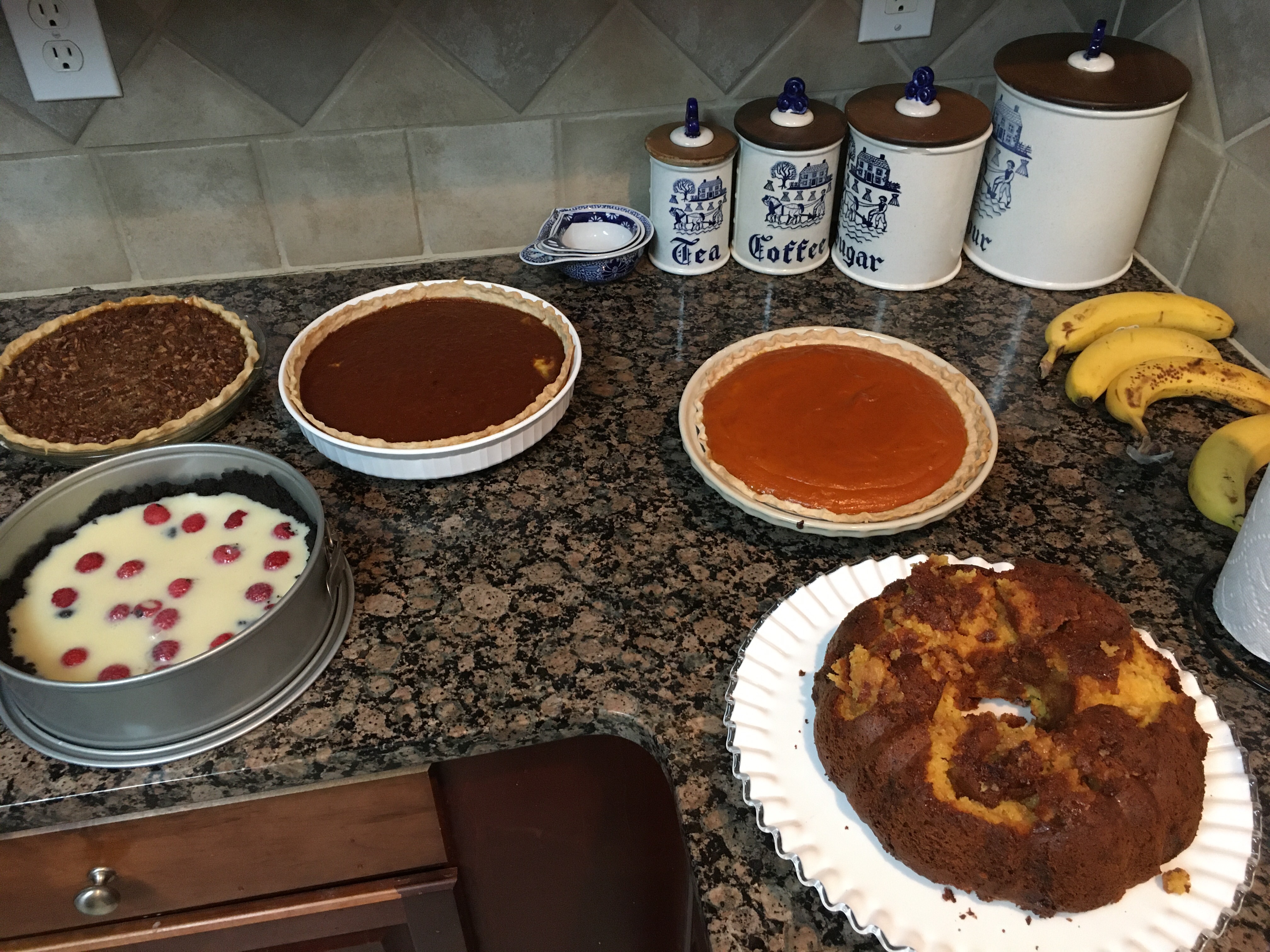
then time to have pie!

I have read that cooking appeals to some folks as it is a do-it-yourself project that you can do in less than one day.

Count me in.

Thanksgiving maybe my favorite holiday.

I think its great that we have a day put aside to recognize that we have much to be thankful for.

I like that it was Lincoln that issued the 1st Thanksgiving Day proclamation.

I love the food.

I love the anticipation of the food.

I love the smell of the food.

And I love the preparation of the food.

Starting with a vast selection of ingredients and turning them into different dishes that are all ready to eat at the same time.

I love the challenge.

And I am thankful that I don’t have to do it every day.

Washington, D.C.
October 3, 1863

By the President of the United States of America.

A Proclamation.

The year that is drawing towards its close, has been filled with the blessings of fruitful fields and healthful skies. To these bounties, which are so constantly enjoyed that we are prone to forget the source from which they come, others have been added, which are of so extraordinary a nature, that they cannot fail to penetrate and soften even the heart which is habitually insensible to the ever watchful providence of Almighty God. In the midst of a civil war of unequalled magnitude and severity, which has sometimes seemed to foreign States to invite and to provoke their aggression, peace has been preserved with all nations, order has been maintained, the laws have been respected and obeyed, and harmony has prevailed everywhere except in the theatre of military conflict; while that theatre has been greatly contracted by the advancing armies and navies of the Union. Needful diversions of wealth and of strength from the fields of peaceful industry to the national defence, have not arrested the plough, the shuttle or the ship; the axe has enlarged the borders of our settlements, and the mines, as well of iron and coal as of the precious metals, have yielded even more abundantly than heretofore. Population has steadily increased, notwithstanding the waste that has been made in the camp, the siege and the battle-field; and the country, rejoicing in the consciousness of augmented strength and vigor, is permitted to expect continuance of years with large increase of freedom. No human counsel hath devised nor hath any mortal hand worked out these great things. They are the gracious gifts of the Most High God, who, while dealing with us in anger for our sins, hath nevertheless remembered mercy. It has seemed to me fit and proper that they should be solemnly, reverently and gratefully acknowledged as with one heart and one voice by the whole American People. I do therefore invite my fellow citizens in every part of the United States, and also those who are at sea and those who are sojourning in foreign lands, to set apart and observe the last Thursday of November next, as a day of Thanksgiving and Praise to our beneficent Father who dwelleth in the Heavens. And I recommend to them that while offering up the ascriptions justly due to Him for such singular deliverances and blessings, they do also, with humble penitence for our national perverseness and disobedience, commend to His tender care all those who have become widows, orphans, mourners or sufferers in the lamentable civil strife in which we are unavoidably engaged, and fervently implore the interposition of the Almighty Hand to heal the wounds of the nation and to restore it as soon as may be consistent with the Divine purposes to the full enjoyment of peace, harmony, tranquillity and Union.

In testimony whereof, I have hereunto set my hand and caused the Seal of the United States to be affixed.

Done at the City of Washington, this Third day of October, in the year of our Lord one thousand eight hundred and sixty-three, and of the Independence of the United States the Eighty-eighth.

By the President: Abraham Lincoln

William H. Seward,
Secretary of State

Please note there is some historical discussion that the proclamation was written by Seward and not Lincoln.

Nevertheless, Lincoln was the President.

November 27 – turkey anxiety

turkey anxiety
big enough, thaw, roast, carve, eat
all these leftovers

Each year the same anxiety.

Turkey presents such interesting problems.

Often overlooked is, will it fit in the oven?

And don’t forget that bag of stuff in the backend.

Don’t throw out the neck but save it for soup. (Oh, right)

I got rid of much of my turkey anxiety but how I view the overall operation.

My wife’s favorite part of the meal is mashed potatoes and stuffing COVERED with TURKEY GRAVY.

For me the meal prep is all about the gravy, the gravy, the gravy.

For me, the entire meal comes down to the gravy, the gravy, the gravy.

As I view it, I am just making gravy.

Gallons of turkey gravy.

The fact that the turkey gets cooked in the process along with a bunch of other dishes is incidental to my goal.

It is amazing how much less anxiety there is for me overall since I am focused on the gravy.

All my eggs are in one basket and I am watching that basket!

Somehow, it all comes off.

The Butterball Turkey people maintain a HOT LINE for those whose turkey anxiety has put them out on a ledge.

They also handle any turkey related questions.

The Butterball people have published some of their favorite queries.

One that stands out for me was from a lady who discovered a frozen turkey that was 20 years old.

She called to ask if it was still good to eat.

The Butterball people told her that as long as it had not been thawed out, it was okay.

But, since it was 20 years old, the flavor might not be the best.

The Butterball people, to their credit, did recommend that it while it was okay, it might be best if she bought a new bird.

The lady paused and then said, “You are right. I’ll donate this one to my church food drive!”

Maybe the meal is designed so that we can give thanks that it happens once a year.

But I will have a repeat performance on Christmas.

Gosh darn those Pilgrims.

November 25 – I did it myself

I did it myself
it did not work, back to store
our motto, said Lowes

It was a moment of remarkable candor so I am remarking about it.

Fixing a dripping kitchen sink, I bought the wrong part at Lowes.

When I went back to get the right part, I announced to the clerk at the Customer Returns Desk that, “I did it myself and it did not work.”

He came right back, “That’s our motto!”

November 24 – confabulation?

confabulation?
imagined experience
replace memories

I ran across confabulate in a wonderful paragraph in my reading the other day.

In the Social Animal, David Brooks writes, “The unconscious mind merely confabulates stories that try to make sense of what the unconscious mind is doing of it own accord.”

I liked the word confabulate.

I was pretty sure I had heard it before.

I was pretty sure I knew what it meant.

I looked it up to make sure.

The first definition, engage in conversation; talk, seemed to apply to Brooks’ use of the word.

There was a 2nd definition listed.

  1. PSYCHIATRY
    fabricate imaginary experiences as compensation for loss of memory

That definition demanded more investigation.

My question, is the confabulator making things up on purpose?

Telling a lie in other words?

Or are these imaginary memories born out of frustration for lack of real memory?

Or are these imaginary memories there because that is how the confabultor really remembers them?

The online Merriam-Webster dictionary gives this use of the word, ” A major characteristic of brain-damaged patients is the tendency to confabulate—to hide and dissemble about their damage.”

To me that sounds like its all made up except that it refers to brain damaged people?

Merriam-Webster also states, ” Confabulate is a fabulous word for making fantastic fabrications. Given the similarities in spelling and sound, you might guess that “confabulate” and “fabulous” come from the same root, and they do – the Latin fabula, which means “conversation, story.” Another “fabula” descendant that continues to tell tales in English is “fable.” All three words have long histories in English: “fable” first appeared in writing in the 14th century, and “fabulous” followed in the 15th. “Confabulate” is a relative newcomer, appearing at the beginning of the 1600s. “

Fantastic fabrications?

Confabulate.

It’s a great word.

Presidential!