we have no reason to abandon belief in the ever-present better
Adapted from the book, The Architecture of Happiness (2009, Vintage Books) by Alain de Botton, and the passage:
We should recover a sense of the malleability behind what is built. There is no predetermined script guiding the direction of bulldozers or cranes. While mourning the number of missed opportunities, we have no reason to abandon a belief in the ever-present possibility of moulding circumstances for the better.
I felt this was kind of appropriate for the 1st anniversary of the Biden Administration.
Which isn’t so important for the start of the Biden efforts as much as it is important for the end of the previous administration.
According the The New York Review of Books, this is “A perceptive, thoughtful, original, and richly illustrated exercise in the dramatic personification of buildings of all sorts.”
What I find irrestible in reading Mr. de Botton is his use of language.
I get the feeling that if you made a spread sheet of all the words, adverbs and adjectives used by Mr. de Botton, you just might find that he used each word just once.
It is a story about how the Prime Minister of the United Kingdom is trying to get out from under the story that he went to party that no told him was actually a party.
There was a time in World History when the President of the United States wrote to the Prime Minister of England, “It is fun to be in the same decade with you.”
That was Franklin Roosevelt writing to Winston Churchill.
That those two came together at the same time and, well, that they didn’t come together now gets me to thinking about the Norns.
According to Norse Mythology, you know, the Vikings, at the center of the cosmos were three sisters called the Norns who spun or weave the destiny of the world.
There is little agreement on what they are doing, spinning a long string or weaving a cloth, but whatever they are doing, they are responsible for what happens to ever one every where.
Fate.
One writer I read writes that the Norns sit a big loom, weaving a tapestry.
If you have ever seen one of these looms, its a big frame with that separates every other north-south thread in a fabric and a shuttle is slid back and forth with east-west material and then with a motion the north-south threads are switched up and down to create a weave.
According to this writer, just when you have fate figured out, bazoom, the norns slide that shuttle back the other way or, bazoom, they switch the position of the threads or, bazoom, they use a batten to shove the weave tighter.
Whatever they do, it changes the direction anyone thinks there fate is going.
Along with this random action, the norns also select the type of thread, the colors and the patterns so to that extent their choices impact fate on earth.
I don’t believe any of this of course but it is fun to speculate and to wonder sometimes what those crazy Norns were thinking.
For the most part, according to Wikipedia, the Norns could be malevolent or benevolent: the former causing tragic events in the world while the latter were kind and protective.
Reading the newspaper today I realize that the Norns also have sense of humor.
I admit it is one of those mornings where the last thing I want to do is start working.
I know what waits at work today and I am not in any hurry to stand up, set the coffee cup in the sink and make that long trek upstairs.
When I get there and I get logged in, master of my password that I am, they will be waiting for me.
End of the year spread sheets.
In a world gone crazy and where ‘Statistics, more statistics and damn lies” still rule, when it comes to statistical reports I always ask, what do you want then to show?
I think back to the old show, Yes, Minister, where the last thing to do before leaving for a multi national summit was to write the final communique that would be sent out at the conclusion of the summit.
As Sir Humphrey Applebee would say, how would know what to meet, talk about and agree to if you didn’t have the agreement agreed to before the meeting?
I feel that way about stats.
Tell me what you to say or what you want to prove and I will provide the stats.
Do you want to say that 33% of all users embrace the technology or that 2/3 of all users reject the technology?
The history of dun, dun duuuun was just what I needed.
Wonderful and almost all embracing information that had absolutely no bearing, meaning or import to anyone, anywhere.
I have to love the writer and editor that got and gave the okay for this story.
Useless trivia reigns!
I can start my day.
And what is the history of dun, dun duuuun?
Amelia Tait, tech and internet phenomena writer for the Guardian traces the history of the sound to 74-year-old composer Dick Walter, who has arranged music for programmes such as The Two Ronnies and The Morecambe & Wise Show.
“It’s musical shorthand which says a lot very quickly,” Walter says of the first of five melodramatic exclamations that run all the way down to Shock Horror (E). But where did he find the inspiration? Walter’s mother, an amateur pianist, used to play Edwardian and Victorian melodrama in the house, while he was a lover of jazz as a teen. He explains that for centuries, composers have used a particular musical interval to denote tension. Its name? Diabolus in musica – or “the devil’s interval” to you and me.
The devil’s interval is a dissonant combination of tones that unsettles the listener because it is unresolved. You’ve likely heard the devil’s interval as the opening two notes to The Simpson’s theme tune, as well as the beginning of Maria from West Side Story (Walter helpfully sings both). Yet in both cases, the tension is immediately resolved with the next note, producing a pleasant effect. “But if you don’t resolve it, you’re left feeling unsatisfied,” Walter explains, “That’s what it boils down to.”
Diabolus in musica – or “the devil’s interval”?
This is so perfect.
This IS JUST the way to start the day.
And, as Mr. Walter says, “That’s what it boils down to!”
so you may master the intricacies of the English language
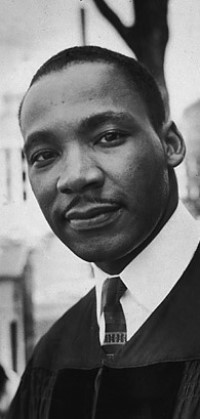
In his famous sermon, Paul’s Letter to American Christians Delivered at Dexter Avenue Baptist Church, Montgomery, Alabama, on 4 November 1956, Dr. Martin Luther King, Jr. said, “So American Christians, you may master the intricacies of the English language. You may possess all of the eloquence of articulate speech. But even if you “speak with the tongues of man and angels, and have not love, you are become as sounding brass, or a tinkling cymbal.”
In a famous documentary of Frank Lloyd Wright, Architect Philip Johnson says that he doesn’t know how Wright designed his buildings.
Mr. Johnson then says, “If I knew how it did it, I would do it.”
Listening and reading the speeches of Dr. Martin Luther King, Jr., I say to myself, how did he do that?
Listening and reading the sermons of Dr. Martin Luther King, Jr., I say to myself, how did he do that?
If I knew, I would do it.
I ask myself, what must it have been like to be a regular at the Ebenezer Baptist Church when Dr. King was in the pulpit.
I grew up Dutch in West Michigan.
I also grew up Baptist.
That meant church twice on Sunday, Wednesday Meeting, Tuesday Bible Club and Monday Awana.
I heard a lot of preaching growing up.
I often felt that Sheriff Andy Taylor’s assessment of the preaching in Mayberry when he says that he, ” … holds with Rev. Tucker. But he can be as dry as dust,” could apply to my years growing up Baptist.
The church I grew was strongly associated with both the Grand Rapids Baptist College and Grand Rapids Baptist Seminary.
Both places still exist but now that the word ‘Baptist’ is a determent to marketing, they are known as Cornerstone University and Grand Rapids Theological Seminary.
My Church did not so much have ‘Preaching’ as it had ‘Teaching’.
If ever in need of what was known as ‘Pulpit Supply’, the Church leaders would turn to the Seminary for someone to preach on Memorial Day Weekend, Labor Day Weekend or in the event that the Church was without a Preacher.
Once when searching for a new Pastor, Dr. Leon Wood of the Seminary spoke for two years using his course and latest book on the Prophet Daniel as the basis for his Sunday sermons.
Dr. Wood’s style was to teach, word by word, through each verse, and explain in detail, the meaning, history and use of the word.
My Dad used to remark on how many verses of the Book of Daniel that Dr. Wood might cover in a Sunday Sermon.
The average was about 2.
I was 10 and when I was told about the upcoming Sunday Sermons, I was excited because the Book of Daniel had those great stories of Daniel in the Lion’s Den and Shadrach, Meshach, and Abednego.
I was so excited, my Mom got me his book for my birthday.
I loved the gift.
I loved that I GOT a gift.
I loved that my Mom remembered.
But what was really cool about that gift was how it came about.
Every summer, my Dad would take a week off and we would take a State of Michigan vacation.
This meant Sleeping Bear Dunes, Mackinaw or Michigan’s Upper Peninsula.
This vacation also usually happened around my Birthday on July 17th.
That meant my birthday was celebrated on the road.
For me, this was (as Jim Harrison writes in his book “The Big Seven”) the kind of injustice that weighs heavily on children who collect injustices for later possible use.
That year we were in Eagle Harbor Michigan up in the Keweenaw Peninsula of Michigan’s Upper peninsula, on my birthday and we trooped into a restaurant for lunch and with about 10 or 12 of us, we took three tables of 4.
Understand that by car, Eagle Harbor Michigan was a far away from Grand Rapids as Washington, DC,
Check a map, it is a LONG way there to get there.
I sat with Mom and Dad and probably little Stevie who would have been about 6.
Not sure why, but it seems like I always got to sit with Mom and Dad.
And most likely I was moping about it being my birthday and no cake or celebration as I was not going to let such an opportunity to whine get by when my Mom reached into her purse and pulled out a wrapped present.
She had packed it away and kept it hidden from me the entire trip.
Few gifts through out my life have been more a surprise.
And it was Dr. Wood’s book on Daniel.
I did read it – or at least tried to read it but I was just 10 years old and I still have it my shelf all these years later.
But I digress.
Dr. Wood, as I remember it, spent three weeks of Sunday Services dissecting the word, word history and meanings of the word ‘pulse’.
(For those who weren’t there, pulse is the veggie diet that Daniel asked for in place of the royal food’s that had been offered up before the Babylonia gods)
Where was the lion’s den?
Where was Shadrach, Meshach, and Abednego?
Daniel’s 70 weeks?
And the missing week?
Minutes seemed like hours.
And hours seemed like days.
Years later, moving to the south, my wife and I (she grew up the same church) decided that anyone who attend our church when we did should be award a M.Div degree from the Seminary AND if anyone, and I mean ANYONE, had tried to preach any of those sermons in the south, biblical stoning would have made come back.
And I have to wonder why.
To be sure, Dr. King had a gift.
But was there anything else?
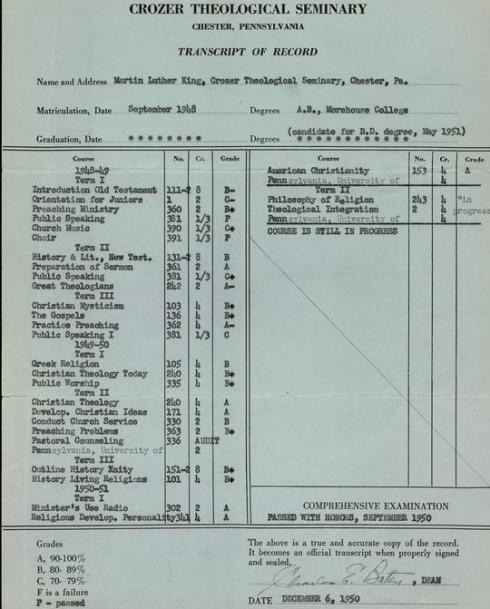
Dr. King after attending Morehouse in Atlanta, went off to post graduate work at Crozer Theological Seminary in Chester, Pennsylvania to work on a Bachelor’s of Divinity degree in 1948.
Dr. King took some 35 courses.
Of those 35 course, 11, almost 1/3 of the course of study, were classes on HOW TO PREACH or other pulpit skills.
Dr. King took the following courses.
Preaching Ministry of the Church Public Speaking (twice) Public Speaking I Preparation of the Sermon Practice Preaching Preaching Problems Conduct of Church Services The Minister’s Use of Radio Church Music Choir
Thinking about my experiences with sermons and preaching, I checked the current catalog list of required courses for a Master of Divinity or M.Div at the Grand Rapids Theological Seminary.
There are 32 required classes.
BBL-501 Biblical Hermeneutics BBL-510 Greek I THE-501 Program Introduction BBL-511 Greek II THE-540 Systematic Theology I MIN-500 Christian Spiritual MIN-543 Christian Formation in the Church MIN-545 Teaching & Learning THE-640 Systematic Theology II MIN-560 Global Impact BBL-516 Hebrew I BBL-672 NT I: Introduction to Exegesis. 3 THE-641 Systematic Theology III BBL-517 Hebrew II BBL-601 Experiencing the Ancient World of the Bible (Israel) BBL-677 NT II: The Gospels MIN-685 Ministry Residency I MIN-510 Organizational Leadership General Elective BBL-640 OT I: Intro to Hebrew Exegesis BBL-678 NT III: Hebrews to Revelation. 3 Ministry Specialization Course MIN-686 Ministry Residency II BBL-641 OT II: Exegesis in the Pentateuch Historical Theology Elective Ministry Specialization Course MIN-781 Ministry Residency III MIN-711 Program Completion MIN-782 Ministry Residency IV BBL-642 OT III: Exegesis in the Prophets and Writings THE-676 Apologetics and Moral Issues in Christian Ministry Historical Theology Elective Ministry Specialization Course
For specialization in Pulpit Ministry, Homelitics (the art of preaching or writing sermons) I & II are recommended Specialization courses.
Otherwise, nothing on how to speak or preach.
Boy Howdy!
That course list reads like a list of sermon titles I have sat through.
I held with the preaching, but it was dry as dust.
Now I am not saying that just the study of preaching and the classes that Dr. King took might have helped but I will say it wouldn’t hurt.
How much did it help Dr. King?
That is hard to say.
According to his transcript, Dr. King got a C’s in public speaking.
will you still need me give your answer, say the word mine for evermore?
To the love of my life on her Birthday – turning a certain unmentioned number.
Here are the lyrics of the song written just for her but not by me.
I adapted the Haiku from the words though.
So this is, I guess, a collaboration between me and a 14 year Paul McCartney.
At least that Sir Paul wrote this when he was 14 and that it was the 2nd song he ever wrote is what Wikipedia says.
Kind of appropriate when you think that I was 14 and my not-yet-then-wife was 16 when we happened to meet at the beach one summer.
We grew up together at church, but that summer was the first time I saw her in a swimsuit.
She looked very good.
It was a really nice swimsuit.
She made that swimsuit look really good.
I remembered it the rest of my life.
She forgot about it in the next minute.
She walked away.
I watched and walked into a wall.
Sauvé.
It took me about 9 years to get up the nerve to ask her out.
It took her all of another minute to say nope.
It took another 5 years after that to regroup and ask again.
This time she said yes and we went out together with my mother.
Well, see, we had tickets to the same event that my mom and some of her friends had tickets to so it wasn’t like she went out with us, but she was there.
The story goes that they could see us from where they were sitting and at one point, my Mom’s friend leaned over to her and said, ‘They seem to be speaking together quite animatedly.”
I think I should mention that this friend had a Ph.d in English and taught at GRCC so more than likely she did indeed use the word, “animatedly.”
I know that my wife doesn’t like birthday’s or at least she doesn’t like her birthday or at least she doesn’t like recognizing that it has been another year.
But I like birthday’s.
I like that it is her birthday.
I don’t like the fact that on the morning of her birthday, when I was letting her sleep in, one of our neighbors, who rides a harley, had to get up at 7AM to go for a ride and also had to make sure that his on board radio, the one that plays loud enough to be heard over a harley, was operating correctly by playing the Go-Go’s.
But I digress.
And I know that in the song, it is the singer is the one who is 64 so I guess that means I get to use this again.
ANYWAY …
Love You and Happy Birthday.
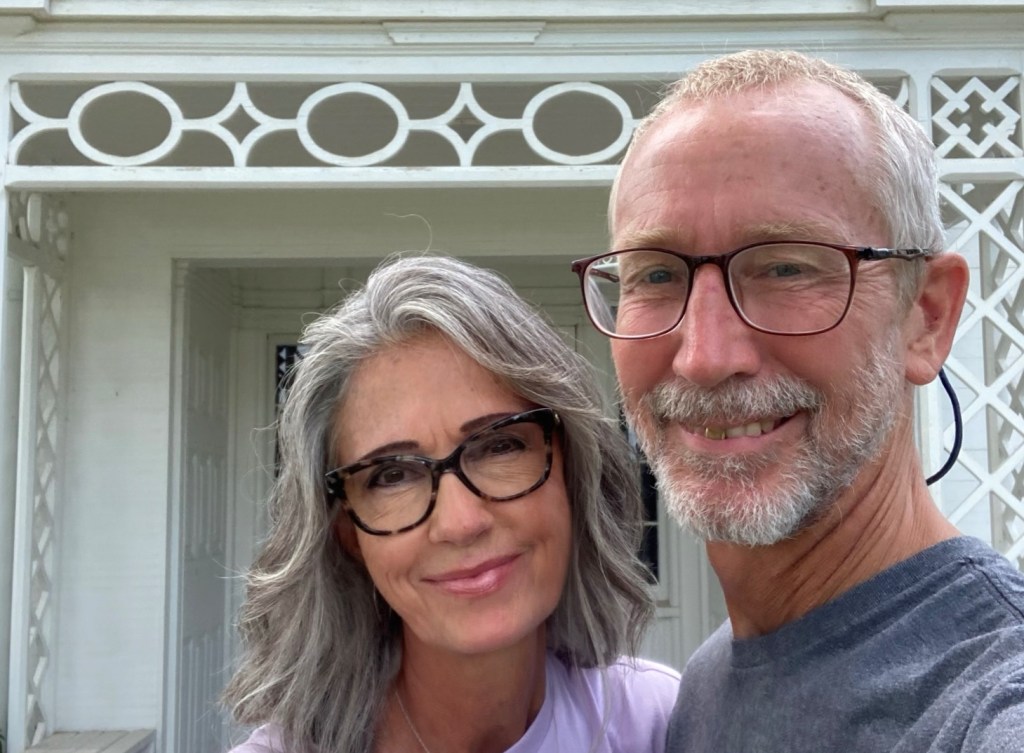
Me and the birthday girl on the steps of the house where Humphrey Bogart married Lauren Becall.
When I get older losing my hair Many years from now
Will you still be sending me a Valentine Birthday greetings bottle of wine
If I’d been out till quarter to three Would you lock the door
Will you still need me, will you still feed me When I’m sixty-four
You’ll be older too And if you say the word I could stay with you
I could be handy, mending a fuse When your lights have gone
You can knit a sweater by the fireside Sunday mornings go for a ride
Doing the garden, digging the weeds Who could ask for more
Will you still need me, will you still feed me When I’m sixty-four
Every summer we can rent a cottage In the Isle of Wight, if it’s not too dear We shall scrimp and save
Grandchildren on your knee Vera, Chuck and Dave
Send me a postcard, drop me a line Stating point of view
Indicate precisely what you mean to say Yours sincerely, wasting away
Give me your answer, fill in a form Mine for evermore
Will you still need me, will you still feed me When I’m sixty-four