1.14.2022 – that morning headache

that morning headache
flat thick heavy ache feeling
on top of my head

My mornings aren’t what they used to be.

Back in the day there was this commercial that showed people driving tanks and dropping out of helicopters and running across deserts, all first thing in the morning.

The tagline was something like, ‘The U S ARMY – we do more before 8AM …’

That was me for a big part of my life.

Not only did I have to get up and get started, no small task, I had to get the kids up and going and either off to school or to school.

It was a part of being a Dad I had not envisioned.

There is an episode of that old show, Frasier, where Dr. Frasier Crane tries to explain, in detail, the way HIS day has to start so that HE can function.

Boy Howdy!, but that was me.

Most of ‘my way to start the day’ went away for a long time.

Like I said, getting kids up and going.

Getting kids off to school.

Getting kids TO school.

Getting to work.

Believe there is ‘getting to work’ and there is ‘getting to work.’

At one point I was getting up and then getting up kids and then getting kids TO school to a school that was in a different direction from downtown Atlanta that I needed to go and then getting to work in downtown Atlanta.

When I used the term, ‘dawn broke …’, it had an entirely different meaning.

It seems to me that I went to bed filled with both anxiety and apprehension.

Anxiety and apprehension not over what the new day MIGHT bring.

Though there was a lot of concern over what MIGHT show up each day.

But my plate was quite full with what I KNEW was coming.

I didn’t suffer in silence.

Seems like there is a family story of one of the kids asking “Why is Dad so crabby in the morning?”

Of late, my morning roll call is down to just me again.

My morning commute is to walk upstairs.

I almost look forward to getting in to bed and not much more on my mind than maybe the weather.

Still, there is HOW I wake up.

Of late, there are three ways I wake up.

My favorite is to come back to consciousness from REM dream sleep and let the realization that it is time to get up slowly, dreamily, drowsily, sink in.

Then there is waking up for the day, most likely to the sound of the beeping of the coffee maker and it is time to get out of bed so I get out of bed.

Maybe in those cases I am already awake, lying in bed, waiting for those beeps.

Then there are those headache mornings.

They usually start sometime early in the morning when I roll over to look at the clock and its 3AM.

The time about which Francis S. Fitzgerald said, “In a real dark night of the soul it is always three o’clock in the morning.”

(Yes – F. Scott Fitzgerald was named after Francis Scott Key … if that didn’t contribute to the …)

And there is a flat, thick ache across the top of my head.

My first thoughts are of despair.

Oh great, the headache.

The 2nd thought is how to hold it off.

I try to arrange head on the pillow to either put some pressure on the ache in hopes that the ache might go away or relive the pressure on the ache in hopes that the ache might go away.

I have been doing this for years and for years I still try the same things.

I try but I know it is not going away.

Then I get to resolve.

Resolve that I know I will have a headache when I get up, that it will rob my morning, if not the whole day, of action, of the new day’s freshness.

Resolve that even though I know this, I can fight back with my morning shower, my morning coffee and my morning advil.

And with that in mind, I settle down to wait to get out of bed.

I don’t like the headache but, like my morning, they aren’t what they used to be.

My and a morning headache have reached the nuisance stage of a relationship and while I wish it would go away, I will push on.

There was I time that when the morning headache hit, I would find myself at work after getting the kids to school and getting myself to work and having no clear recollection of how I got there.

And that was a good day with a bad headache.

Like my new mornings, much of what caused the headaches is gone.

Much of the stress and anxiety and lifestyle that contributed to the headache is muted.

I might even venture that I know what is the main cause of today’s headache and it is physical rather than mental.

And it is something that I am doing to myself, every day all through the day.

It is these screens!

I stare at the these doggone screens all day long.

My computer screen.

My TV screen.

My iPhone screen.

My iPad screen.

My kindle screen.

Screens to the point of screaming!

I use all the tricks.

I dim the screens.

I set timers to have my tablets go darker at 8PM.

I have the ‘blue screen’ shades for my glasses.

But when I get an e book I can’t put down …

When I start reading something on a tablet and forget the rest of the world …

When I focus on my work and anyone had to poke me with a sharp stick to get my attention …

The last thing on my mind is a headache.

Is there anything new here?

Screens and eyestrain are just a latest in eyestrain.

The classic, ‘2 Years Before the Mast’ was written because a Doctor told the author, Richard Henry Dana Jr., that he might be able to hold off his apparent oncoming blindness by taking a long sea voyage.

Mr. Dana, Jr. signed on as a novice shipmate and sailed off to California in 1839 to find that after a couple of weeks away from law school and legal textbooks, his eyesight returned.

Not that he was able to get out his contract on the ship for the rest of those 2 years, but he did get a classic book out of the deal.

Another story in the back of my mind is one told by a now I-can’t-remember sports writer in Washington, DC whose Father worked at the Library of Congress.

The sports writer, it may have been Shirley Povich, recalled that when his Dad worked on a Saturday, he would tag along.

His Dad would lead him back in the stacks to the GV8 section where the baseball books were and click on a light and leave him there for the day.

‘Don’t go blind,’ his Dad would say as he went off to his job.

What can I say?

You would think that after all these years I would learn something.

And maybe I have.

Maybe my lesson is that, if the price of reading is the headache, well, where are the books?

I did though recently go off on a rant.

A rant about ebooks and epubs and mobis and kindles.

When I worked for the Grand Rapids Public Library, the old card catalog was still in place but not maintained.

Everything was on the computer terminal systems.

From time to time the system would be down.

Patrons would come to the desk and ask about a book.

I got up on my platform and would say that unfortunately the system was down.

Then I would point, majestically and slowly like Moses parting the Red Sea, at the old card catalog and say that in the 110 years of its existence, the GRPL Card Catalog never crashed.

Though that did present a really scary mental image.

What’s that saying?

The best way to hide something is misfile it in a library?

My rant to my ever faithful audience made up of my wife was that at one time I owned 1,000’s of books in my personal library and when we moved, I had to moved literally 1,000’s of books.

From that point of view, e-readers were a blessing.

Holding one small tablet in my hands and I had access to 1,000’s of books saved on my tablet and through the internet, I could access any book any where.

YET.

My rant continued with the anguish and righteousness of Orson Welles playing the Clarence Darrow character in the 1959 film, Compulsion. (worth the watch if you haven’t seen it – might change your life)

Without electricity.

Without power.

I would have nothing.

I would have nothing to read.

“Books don’t need batteries,” I said.

“Books don’t need to be plugged in,” I said.

“No power – nothing to read,” I said in a voice crying in the wilderness.

My wife listened to me as she has learned to listen to me when I get into a rant.

“At night, you would still need a light to read your books,” she said.

My wife is very good looking too.

1.13.2022 – No coach takes a job

No coach takes a job
assuming they’ll fail – think they’re
going to succeed

Little Jimmie ‘I Lost the Brown Jug” Harbaugh made it to the sports page of the Manchester Guardian.

The headline was Jim Harbaugh’s likely NFL return shows college isn’t what it used to be.

Boy you can say that again.

Back when I was in college with Jimmie and he would go practice football and I would go and try to get lost in the grad library, it sure seemed a lot more simple.

A lot more fun.

But someone had to come along and fix it.

Play to crown a real national champion and more fans from more schools will be involved in the process and the game.

Yep that worked out.

I remember how at the end of college football season, as many as 10 or 12 teams would be looking at how their team might be voted the champion depending on how all the bowl games were played.

Now we got a system and just two teams, two teams with extensive fan bases that included the entire state of Alabama and the north east corner of South Carolina, seem to have controlled that discussion.

Boy Howdy and oh boy.

So we can fix the fix this and put more teams into the mix.

Now 4 more games and this seems to be getting the game off the field and into the schools medical and injury support so maybe my old college might benefit.

Just label anything fun and take it out, just like my old job.

Somehow they were able to take college football and turn it into the only national sport were FEWER people are interested in the playoffs.

That’s a pretty neat trick but not one that you would think would want on your resume.

Anyway, reading that article I got to this line.

No coach goes into a job assuming they’re going to fail. They think they’re going to succeed.

How about that!

I am sure I knew this.

I am sure everyone knows this.

Still, it has to be said.

I remember years and years ago watch some game and the poor little reporter on the field has to interview the coach of the visiting team as the half came to an end.

I know that everyone is aware this is a RULE.

I don’t mean that it is a rule for ‘How to Cover College Sports – A TV Broadcaster Rule Book’ but then again maybe it is.

What I mean is that in the great board meetings that take place where major things are decided that impact all our live, it was agreed upon by all the powers that have the power to be at these meetings that any and all college football and basketball coaches MUST – HAVE TO – GONNA GET IN TROUBLE IN YOU DON’T – take part in these running off the field interviews.

It is in the contracts between the TV Networks and the conferences, the conferences and the schools and the schools and the coaches.

It is a RULE.

It is IN THE BOOK.

So when the young sideline reporter is told at the production meeting to GET THAT INTERVIEW, if the reporter asks ‘HOW?’ as in “HOW DO I GET JUWAN HOWARD TO talk to me?” the producer can yell back, “Don’t worry about that – THEY GOTTA DO IT.”

For the fan I guess.

Some where is the person who thought this up.

That at this moment, we needed someone to yell some questions at a coach.

Either at the half and at the end of game.

Some of the world’s best sports questions and answers have come out of this idea.

One of my favorites was when a reporter as a very fast walking Bobby Knight how his team was able to win the game.

Coach Knight, without breaking stride replied that while he was an not expert like most sports broadcaster he did recommend that if you looked at the scoreboard you would see that his team scored more points than the other team.

He was pretty much jerk in real life too.

Another time, a breathless young reporter (they always seem to get this assignment) run up to Bear Bryant and asked why he ran a certain play.

As I remember it, Coach Bryant stopped and stared at the reporter and said, ‘Everything I do is part of trying to WIN this game.’

The reporter didn’t like that or something so repeated the question.

Coach Bryant repeated the answer.

The reporter again started to repeat with a ‘But ….”

Coach Bryant stared for a second or 2 into the camera, shook his head and walked off.

They more I thought about it the more I thought he was right.

Would a Coach do something that he thought might NOT help win a game?

There is a plan here.

There is a plan when each coach is hired.

The plan is to win.

Even in the NFL were as the writer of today’s article stated:

Parity is legislated in the NFL; it’s equality by design. 

Some how this writer has not experienced the phenomena know as the Detroit Lions.

1.11.2022 – miss me a little

miss me a little
but not for long and not with
your head bowed low

Adapted from the poem, “Let Me Go” –

by Christina Rossetti (5 December 1830 – 29 December 1894).

Here is an excerpt.

When I come to the end of the road
And the sun has set for me
I want no rites in a gloom filled room
Why cry for a soul set free?

Miss me a little, but not for long
And not with your head bowed low
Remember the love that once we shared
Miss me, but let me go.

For this is a journey we all must take
And each must go alone.
It’s all part of the master plan
A step on the road to home.

When you are lonely and sick at heart
Go to the friends we know.
Laugh at all the things we used to do
Miss me, but let me go.

Lots of things, on this anniversary of my Dad’s death back in 1988, come to mind from this poem.

I think my Dad would have wanted to be missed, for little while, but not with a head bowed low.

There was too much fun in our lives to hang my head.

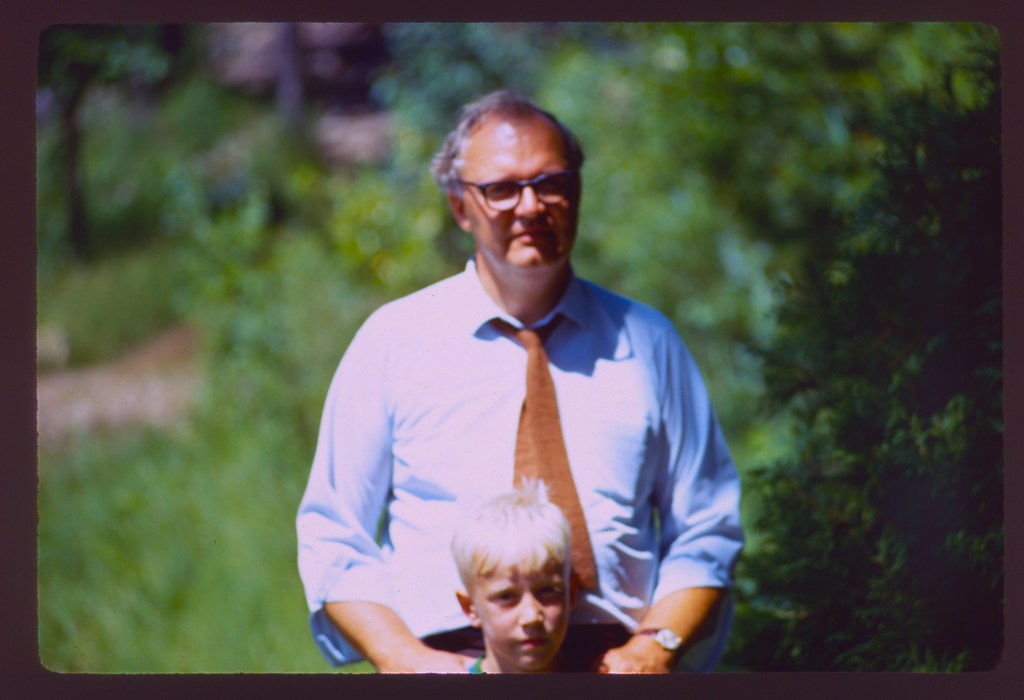
1967? Me and my Dad on VACATION – well, that is how he dressed on vacation

We had a place out on Lake Michigan and every spring we would go out to repair any winter storm caused damage.

Usually this involved the whole crew of my brothers and brothers-in-law and a lot of building and digging.

One spring when I was back from college, my Dad took me and drove off to the lake with a plan to pick up a load of lumber that we would need later when everyone else could get out there.

We got the lumber at Lappo’s in Spring Lake, Michigan and drove to our place where I unloaded it.

I had a little more muscle I guess in those days.

As I unloaded my Dad looked over the deck we had built on the edge of the sand dune overlooking the lake.

It leaned back in one corner and had a couple of loose boards but otherwise was in good shape.

With the lumber unloaded Dad told me to “go get a bucket.”

Which meant one of the buckets we used at the beach for a tool box.

I knew he wanted a bucket with hammers, nails and a level.

We always used a level when working on decks or steps more so we could always say, “We used a level” no matter how the project turned out.

We also always used Grip-Tite nails, that ones that made noise when you hammered them in, ping ping ping, rising in pitch with each hammer blow.

I set the bucket down and took my jacket off and laid it on the deck.

It was warm in the sun.

When I brought out the hammers and nails, Dad positioned himself against the low corner of the deck with the level on the deck and he lifted the corner of the deck until he could see that he had it level.

“Put a nail in here,” he said, indicating a place where the deck brace lined up with the deck post.

And I did.

Never did something I had learned in 7th grade shop class or any class feel so good.

Dad pointed about 4 inches away from the first spot and said, “And here.”

And I did.

It went right in, straight.

ping – Ping – PING.

“Put another one in,” he said.

After about 5 nails, he got up on the deck and bounced a few times.

“Good,” he said.

Then he pointed to the loose deck boards.

“Pound some nails in there.” he pointed.

And I did.

“Good!” he said.

He walked back and forth on the deck, testing it, trying to make it sway.

Satisfied, Dad sat down on the bench that was built into the back of the deck.

I picked up my jacket and pulled two cigars out the inner pocket along with a small cigar cutter and some matches.

Dad looked at me and before I could ask, he held out his hand for a cigar.

He stripped off the wrapper and held out his hand for my cigar cutter and when the cigar was ready, he turned towards me.

He leaned over and I held a match out cupped in my hands.

Once Dad had his cigar properly lit he sat back on the bench.

I sat next to him in the spring sunshine, warmed by the sun, but cooled by the breeze off the lake.

Two guys and two cigars with troubles, like the cigar smoke, drifting away.

Dad took a few puffs, then gestured at the repaired deck with his cigar.

“We do good work!” he said.

And we sat and smoked.

It was kind of solemn, sitting by the big still lake.

We did not feel like talking loud.

And it seemed like nothing happened to us at all.

Yes, I stole that from Huckleberry Finn.

So what?

I will miss my Dad a little.

I will miss my Dad a lot.

But with my head bowed?

Nope.

Never.

No way.

That wouldn’t be right.

We had too much fun.

We had too much.

1.10.2022 – lost along the way

lost along the way
had a talk with history
can help? Then do it
!

What do you do in January if you live in a beach community and the weather, wind and waves conspire together to take the beach out of your afternoon options?

If new to the Low Country, like we are, exploring the area is next on the list.

Was about to write, “The Low Country is famous for …” when it came to me that the while the Low Country is a lot of things, famous is not one of them.

Still, things happened here.

Things happened here that did not happen other places.

And some things happened here for the first time.

One of the things that happened here during the United States Civil War is that the armed forces of the United States had some of its earliest success stories here.

The Battle of Bull Run is fought in July of 1861 and as Stonewall Jackson got one of the great nicknames in military history the Union Army got chased out of Virginia.

In November of 1861, combined Union Army and Navy forces took over the Low Country when they attacked Port Royal Sound and the South Carolina Sea Islands of St. Helena and Hilton Head.

This led to what the South Carolina history books called the “Big Skedaddle” as all the white South Carolinians got out of the Low Country and went to Charleston or Savannah.

Leaving all their former slaves behind for the most part.

This early the war, Abraham Lincoln was not ready to declare and end to slavery and the Union Government really didn’t know what to do with former slaves until one Union General, a real off the wall political General but able lawyer, Ben Butler, said that the slaves were former property and as ‘abandoned property’ could now be considered ‘contraband of war’ that could be seized by the forces of the Federal Government and as such, free.

Okay, so then what?

Then what became known as the Port Royal Experiment.

According to Wikipedia, “The Port Royal Experiment was a program begun during the American Civil War in which former slaves successfully worked on the land abandoned by planters. In 1861 the Union captured the Sea Islands off the coast of South Carolina and their main harbor, Port Royal. The white residents fled, leaving behind 10,000 black slaves. Several private Northern charity organizations stepped in to help the former slaves become self-sufficient. The result was a model of what Reconstruction could have been.”

A special education commission was established which led to the establishment of the Penn Center on St. Helena island, just over a half hour drive away from where we live.

The Penn Center, Founded in 1862 by Quaker and Unitarian missionaries from Pennsylvania, it was the first school founded in the Southern United States specifically for the education of African-Americans.

It provided critical educational facilities to Gullah slaves freed after plantation owners fled the island, and continues to fulfill an educational mission.

The campus was designated a National Historic Landmark District in 1974 and you can tour the grounds and buildings to this day.

St. Helena Island is one of those places where you can say take THE ROAD, turn left at THE STOP LIGHT and go past THE GAS STATION because out on St. Helena there is pretty much one road (2 if you count the north-south road and the east-west road) one, stop light and one gas station.

Before the Civil War there were 50 Plantations out here.

The road is lined with flat (what else) fields being prepared for (in January!) strawberry planting.

Tunnels through the live oaks and Spanish moss with dust from the strawberry fields cloud the sun.

And we drove up to St. Helena to explore and one of our stops was the Penn Center.

Be we kinda, even with just two roads, got lost along the way and got there late.

We drove and parked by a building with a sign that said Welcome Center.

There was a small OPEN sign on the door.

But when we went in the room was dark.

Dark and empty of other people.

There were displays and such but no people.

Behind us the door opens and a voice calls out, “I am so sorry, but we are closed.”

We turned around and there was this lady with this smile who took the open sign down and turned it around to closed.

So they were closed but the lady with a smile took some time to talk with us for a minute about the Penn Center.

The minute turned into 10 minutes or more as we learned that the lady we were talking too had graduated from the Penn Center back in 1952.

She had moved away but when retirement came, she moved back to St. Helena and started to volunteer where she could.

She was amazing to listen.

It was like to TO history.

There was history in her voice and a graciousness to her style I could not describe with the words that I have.

We apologized for making her stay over long and told her we would be back and that we would bring out grand children.

As we left, I asked her name.

“Gardenia,” she said with her smile on her face.

And she locked the door behind us.

When I got a chance, I punched ‘Gardenia’ and ‘Penn Center Volunteer’ in the Google and found out who we had been talking to.

She was Ms. Gardenia Simmons-White.

Gardenia Simmons-White was born on St. Helena Island, SC in 1934.

She was one of the last living graduates of the Penn Center.

NO

Now 87 years old, this wonderful lady was a wonder to listen too.

She said that volunteering as a docent at the Penn Center, “[is her] way of giving back to Penn for helping to shape my life and never forgetting the education I received which enabled me to reach higher heights. 

I admit I have been a little off on everything with the covid and the economy and the news lately.

Kinda lost along the way.

To have talked with Ms. Simmons-White and heard her stories, heard just her voice, was a long drink of cool water.

Her story is one of those stories that makes you hope that maybe things can and will turn out okay.

You can click here to read an article written about her BACK in 2013. (She seems to be just as active today.)

I was struck by something she said in that article.

Ms. Simmons-White said, ““If anyone asks, if I can help, I will.”

I like that.

I like that a lot.

Maybe if I can get my rear in gear and make the effort my tombstone can say:

“If anyone asked, if I can help, I did.”

1.8.2021 – Governments for – from

Governments for – from
the consent of the governed
derive just powers

In 1776, Mr. Thomas Jefferson, in the Declaration of Independence, wrote, “We hold these truths to be self-evident, that all men are created equal, that they are endowed by their Creator with certain unalienable Rights, that among these are Life, Liberty and the pursuit of Happiness.

That to secure these rights, Governments are instituted among Men, deriving their just powers from the consent of the governed.”

IN 2020, Fiona Hill wrote in her autobiography/social commentary, There is Nothing for You Here wrote, “This lack of a direct relationship between ordinary people and prominent intellectual and political elites leaves the playing field open for others to step in and present themselves as advocates for the entire working or middle class or other distinct underrepresented groups.

Indeed, politics since 2000 has been marked by the rise of populists -politicians who spurn “out-of-touch experts” and who claim to speak on behalf of millions of people with whom they in fact have no authentic connection, and in whom they have no genuine interest beyond securing votes to support their own often very personal agendas.

I am trying to think back to the days when an elected Representative of the people felt in someway responsible to the ‘people back home”.

In the old book, Advise and Consent, a novel focusing on the story of the United States Senate working to consent to the President’s latest Secretary of State nominee, the ‘people back home’ have a role.

The President calls the Senate Majority Leader and complains that he had a hard time getting through.

“Michigan needed their Senator this morning,” said the Majority Leader.

Why do I feel that most folks now in Washington are not as advocates for the entire working or middle class or other distinct underrepresented groups but people with their own often very personal agendas.

Do these folks check their mail or phone calls from the ‘people back home’ or do they only read their twitter and facebook comments and watch and re-watch their sound bites on TV as they push their ‘brand’.

Trying to think through this, I bet the last candidate for any office I ever talked to was a feller running for Judge back in Gwinnett County Georgia.

I shook hands but didn’t dare ask him what I wanted to ask him.

The funny thing was we had a connection with the candidate.

And once we explained the connection, we didn’t have to ask our question.

The candidate knew the question and knew he didn’t want to answer the question and moved on from us quickly.

See we had purchased a house he had owned.

We needed to get a new roof and our insurance didn’t cover it.

Seems that the house had just HAD it’s roofed repaired.

Or at least the previous owner had filed a claim to fix the roof but it appeared that while the claim was paid, the roof repairs had not been made.

Ahhhhhhhhhhhhhhhhhhhhh well, I digress.

BTW, this feller did not get elected.

How do we make Congressional Representation truly representative.

On the other hand, maybe it is.

Mr. Jefferson also wrote that, ” … all experience hath shewn, that mankind are more disposed to suffer, while evils are sufferable, than to right themselves by abolishing the forms to which they are accustomed.”