1.26.2022 – I think … I am … does

I think … I am … does
not preclude us from morning
prayer of thank you

Last night was Robert Burns Night.

According to Wikipedia, Burn’s Night is when Scots eat a Burn’s Night Supper or the traditional meal of haggis, neeps (turnips) and tatties (potatoes).

Never had haggis.

Maybe never will.

Does anyone know if sheeps stomach tastes like bacon?

Haggis is just one of those things I doubt I will ever grasp.

I think the secret of eating haggis must lie in the what renowned Chef Paul Bocuse said in an interview you can watch on YouTube.

Chef Paul was asked when being a chef was the most fun.

“1946, 1947,” Chef Paul said, “People ate anything!”

The post World War 2 era in France and the over all lack of food and those French cooking dishes that were created helped me understand much about French post-war cooking.

That, I think, the amount of available food in Scotland, might explain Haggis.

As they used to say about Chicago, Hog Butcher for the World, “We use everything but the squeal.”

I, as I said, cannot grasp haggis and I also, truth be told, cannot grasp the poetry of Robert Burns.

Alistair Cooke, in his book/show, America, when writing about the word skills of Abraham Lincoln said, “We know that he steeped himself in the subtleties of Shakespeare, the cadences of the Bible, and the hard humanity of Robert Burns.”

Because of this line in the show which I watched when I was 12, I felt I needed to steep myself in the hard humanity of Robert Burns.

I just can’t get there.

Not sure why.

Wikipedia states, “Robert Burns (25 January 1759 – 21 July 1796), also known familiarly as Rabbie Burns, the National Bard, Bard of Ayrshire, the Ploughman Poet and various other names and epithets, was a Scottish poet and lyricist. He is widely regarded as the national poet of Scotland and is celebrated worldwide.

One of his poems starts out:

Wee, sleekit, cowrin, tim’rous beastie,
O, what a pannic’s in thy breastie!
Thou need na start awa sae hasty
,
Wi’ bickering brattle!
I wad be laith to rin an’ chase thee,
Wi’ murd’ring pattle!

I don’t see the roots of the Gettysburg Address here.

I remember reading about William Shirer (CBS Radio Commentator and author of “Rise and Fall of the 3rd Reich“) that he could never, ever understand the attraction of James Joyce until he was at a bookshop in Dublin and happened to catch a reading of James Joyce BY James Joyce.

I may have the reverse affect here as whenever I try to read Robert Burns, I imagine the Michael Palin/Monty Python sketch of a scots poet send up of Burns and it is all over for me and Mr. Burns.

But listening to London Radio, I am made aware of Burn’s Night.

Which brings to mind the famous Selkirk Grace.

Some hae meat an canna eat,
And some wad eat that want it;
But we hae meat, and we can eat,
And sae the Lord be thankit
.

Which, in english, says:

Some have meat but cannot eat,
some have none that want it;
But we have meat and we can eat,
So let the Lord be thanked.

And the last line, And sae the Lord be thankit, got me to thinking about giving thanks.

And thinking about giving thanks got me to thinking about this clip from the movie, St. Vincent.

Cannot watch this clip or even think of this clip, that I do not feel better.

I like the IT Crowd.

I like Moone Boy.

Chris O’Dowd, in this 90 second moment, does his best work from the movie St. Vincent.

The way he rolls with the classroom and maintains control reminds me so much of the way so many of my teachers rolled with me in class and still kept control.

I take my hat off to them and thank God for their presence in my life at that time.

God, Thank You.

For those teachers.

And for so much more.

Neither here nor there, but Katherine Parkinson’s (IT Crowd) jaw dropping performance in the movie, The Guernsey Literary and Potato Peel Pie Society made my jaw drop.

Yes I know, O’Dowd is Irish.
1.25.2022 – impermanent than

impermanent than
eternal and the simple
rather than ornate

Adapted from the book, The Architecture of Happiness (2009, Vintage Books) by Alain de Botton, and the passage:

. . . the Japanese sense of beauty has long sharply differed from its Western counterpart: it has been dominated by a love of irregularity rather than symmetry, the impermanent rather than the eternal and the simple rather than the ornate. The reason owes nothing to climate or genetics . . . but is the result of the actions of writers, painters and theorists, who have actively shaped the sense of beauty of their nation.

According the The New York Review of Books, this book, the The Architecture of Happiness is “A perceptive, thoughtful, original, and richly illustrated exercise in the dramatic personification of buildings of all sorts.”

What I find irrestible in reading Mr. de Botton is his use of language.

I get the feeling that if you made a spread sheet of all the words, adverbs and adjectives used by Mr. de Botton, you just might find that he used each word just once.

Neat trick in writing a book.

If I knew how to do that, I would.

1.24.2022 – pathological

pathological
narcissism when in office
petty in extreme

Adapted from the line “Once addicted, the pathologically narcissistic politician can become petty in the extreme, taking every slight as a deep personal insult.” in the article, “Where egos dare: Manchin and Sinema show how Senate spotlight corrupts” by Robert Reich, a former US secretary of labor, and professor of public policy at the University of California at Berkeley.

I liked the article as much for what it said as for the word play of the 1967 book, “Where Eagles Dare” by Alistair MacLean.

I have read that the book was supposed to be titled “Castle of Eagles” but that a Hollywood producer convinced MacLean to change the title to “Where Eagles Dare” from the line “The world is grown so bad, that wrens make prey where eagles dare not perch” from Act I, Scene III in William Shakespeare’s Richard III.

But I bet you a dollar that who ever came up with the title for Reich’s article, was thinking of the movie with the same title that starred Richard Burton and a very young Clint Eastwood.

But this is the trick to the question.

MacLean was contacted by this Hollywood Producer to write an original story directly for the screen.

In this case of chicken-egg, book-movie, it was the MOVIE that came first.

According to online sources [sic], the producer told MacLean that he wanted, “a team of five or six guys on a mission in the Second World War, facing enormous obstacles. I want a mystery. I want a sweaty, exciting adventure movie.’ That’s all I told him, just that.”

I am not sure if there is a specific word or genre’ for this type of book, but I have always regarded it with a bit of awe as it takes place in realtime.

What I mean by that is that the entire book takes place within the time of about 12 hours.

12 hours to land in Germany, get inside a heavily guarded German HQ that is located in a castle on top of mountain accessible only by cable car, free a captured allied spy, capture the top three German spies and get the spies to write out a list of all the German spies in Britain, un-mask the top traitor in the British high command and get away.

A grand case of the suspension of disbelief.

If you can watch the movie and accept that all the Germans speak English, its a small step to accept all the rest.

Also a grand example of my inability to stay on topic and to fall into a digression that has no bearing on the haiku.

Or does it?

The haiku is about narcissism in politics.

The article I link to writes in the voice of an insider who has seen many great efforts brought to unexpected ends because, “Again and again, I’ve watched worthy legislation sink because particular senators didn’t feel they were getting enough credit, or enough personal attention from a president, or insufficient press attention, or unwanted press attention, or that another senator (sometimes from the same party) was getting too much attention.”

I am reminded of a story told by then Speaker of the House, Tip O’Neil.

The Speaker was elected to the House seat vacated by JFK in 1952 and was re-elected 12 times.

In politics, or at least in what I used to know as politics, running for Congress in Boston in the District that at one time was represented by John F. Kennedy, like Gerald R. Ford’s district in Michigan, was known as a ‘safe seat.’

Most likely you will be reelected.

Re-elected with very little effort.

My Dad told me how Gerald Ford would come back to West Michigan every couple of months, rent an RV and drive around the district and park in a lot and put up a sign that said “MEET YOUR CONGRESSMAN – NO WAITNG,” and then go back to Washington and forget about Grand Rapids.

The Speaker loved to tell this story about seeing some polling data from his district.

Mr. O’Neil noticed that a neighbor of his in his district, an older lady, someone who had voted the democratic ticket forever, someone that he knew, had indicated that in the last election she had NOT voted for the Speaker.

The next time he was in Boston, the Speaker sought her out and asked what happened?

Why had she not voted for him?

The lady looked at the Speaker and said in a very tired voice, a voice the Speaker never forgot, “Tip,” she said, “Sometimes folks just want to be asked.”

I bring this to up to ponder what if politicians, the House, the Senate, all of them together, somehow asked, on a regular basis, not just every two years, what we wanted.

Mr. Reich writes, “The Senate is not the world’s greatest deliberative body but it is the world’s greatest stew of egos battling for attention.

Every senator believes he or she has what it takes to be president.

Most believe they’re far more competent than whoever occupies the Oval Office.

Out of a 100 Senators, only a handful are chosen for interviews on the Sunday talk shows and very few get a realistic shot at the presidency.

The result is intense competition for attention.

I would like to see an intense competition for our attention.

To get there, all it takes is a grand suspension of disbelief.

Then I thought again about the line, The world is grown so bad, that wrens make prey where eagles dare not perch.

Written by Big Bill back in 1592.

Written by Big Bill back in 1592 about a King that had died in 1485.

A time when, The world is grown so bad, that wrens make prey where eagles dare not perch.

And again I realize, I guess, that this world and all that is going has been done before.

Like is says in scripture, “there is no new thing under the sun.” (Ecclesiastes 1:9 KJV)

PS: Mr. Reich’s paragraph about Lindsey Graham made me laugh out loud. Especially now that Mr. Graham is ‘MY’ Senator.

Reich wrote:

Some senators get so whacky in the national spotlight that they can’t function without it. Trump had that effect on Republicans. Before Trump, Lindsey Graham was almost a normal human being. Then Trump directed a huge amp of national attention Graham’s way, transmogrifying the senator into a bizarro creature who’d say anything Trump wanted to keep the attention coming.

1.22.2022 – recover a sense

recover a sense
of the malleability
behind what is built

Adapted from the book, The Architecture of Happiness (2009, Vintage Books) by Alain de Botton, and the passage:

We should recover a sense of the malleability behind what is built. There is no predetermined script guiding the direction of bulldozers or cranes. While mourning the number of missed opportunities, we have no reason to abandon a belief in the ever-present possibility of moulding circumstances for the better.

According the The New York Review of Books, this is “A perceptive, thoughtful, original, and richly illustrated exercise in the dramatic personification of buildings of all sorts.”

What I find irrestible in reading Mr. de Botton is his use of language.

I get the feeling that if you made a spread sheet of all the words, adverbs and adjectives used by Mr. de Botton, you just might find that he used each word just once.

Neat trick in writing a book.

If I knew how to do that, I would.

1.21.2022 – paradoxically

paradoxically
succeeded in curtailing
concern for others

Adapted from the book, “The pleasures and sorrows of work” by Alain de Botton, (Random House – 2009) and the passage:

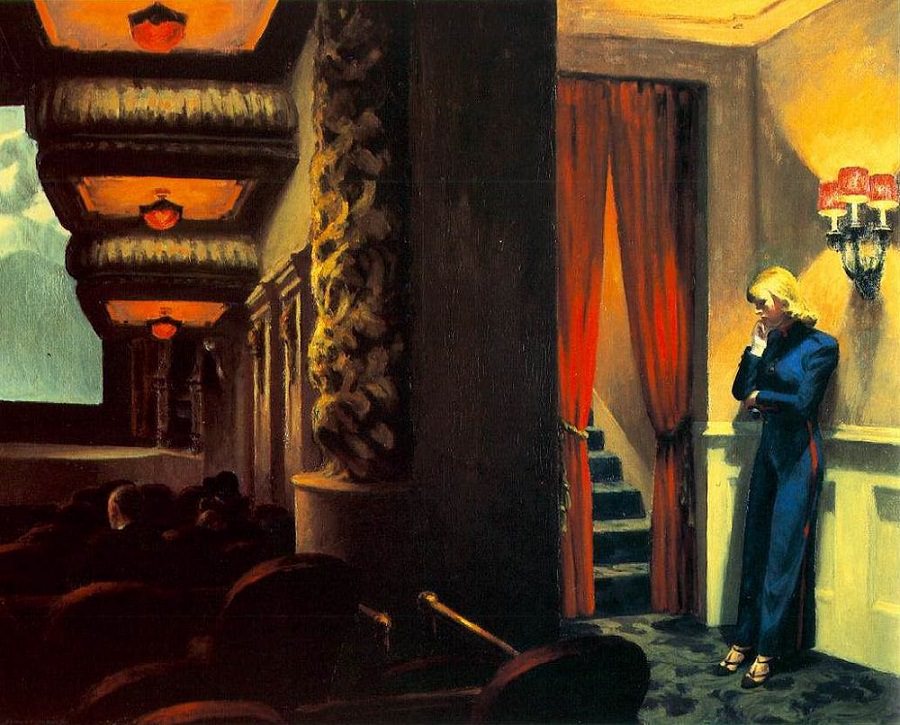
In New York Movie (1939), an usherette stands by the stairwell of an ornate pre-war theatre. Whereas the audience is sunk in semidarkness, she is bathed in a rich pool of yellow light. As often in Hopper’s work, her expression suggests that her thoughts have carried her elsewhere. She is beautiful and young, with carefully curled blond hair, and there are a touching fragility and an anxiety about her which elicit both care and desire. Despite her lowly job, she is the painting’s guardian of integrity and intelligence, the Cinderella of the cinema. Hopper seems to be delivering a subtle commentary on, and indictment of, the medium itself, implying that a technological invention associated with communal excitement has paradoxically succeeded in curtailing our concern for others. The painting’s power hangs on the juxtaposition of two ideas: first, that the woman is more interesting than the film, and second, that she is being ignored because of the film. In their haste to take their seats, the members of the audience have omitted to notice that they have in their midst a heroine more sympathetic and compelling than any character Hollywood could offer up. It is left to the painter, working in a quieter, more observant idiom, to rescue what the film has encouraged its viewers not to see.

And the painting, New York Movie by Ed Hopper.

Reading the history of the painting on Wikipedia I was struck by three things.

One was the note that “Hopper was fascinated by film, and it is said that, when experiencing creative block, he would stay at the theater all day.

So much community has been lost due to covid and high on that list is the movie theater experience of the big room and the screen, alone in the darkness, surrounded by many.

Though much of this was already lost due to the person next to you or behind you who could not handle the idea that any message they might receive required an immediate response and of course their phone would not be turned off.

Another was the note that fans of the painting and Mr. Hopper have long tried to identify the movie in the painting.

On the one hand easily this is just oh-come-on and just-enjoy-the-painting.

But on the other, for example, when I read an obscure novel and come across an address that lodges in my brain so that years, decades later, reading another novel and this author, for no reason at all that anyone might think, uses that same address and I suspect some form of ‘homage‘ yet one that I may among the few people that get it, I feel I am sitting at a table with both authors.

Picturing yourself at a table with Compton Mackenzie and Jim Harrison is a pleasant picture.

It is a silent picture because if ever I found myself at that table, I am sure that about all the conversation I could come up with would be, “Yes it is warm for this time of year.”

The last thing, I as I read the discussion, was that I noticed that what Mr. de Botton wrote about the painting, that “communal excitement has paradoxically succeeded in curtailing our concern for others” that shows up in the painting, shows up in the discussion as well.

There was one comment though.

Others claim that New York Movie and other paintings of city life are Hopper’s ode to the warmth and endurance of the human spirit in the midst of the dehumanizing existence that is mass living.

Somehow these two statements come can come together as:

While communal excitement has paradoxically succeeded in curtailing our concern for others, the warmth and endurance of the human spirit in the midst of the dehumanizing existence endures.

I like that.

Almost like being at the table with Alain de Botton and Ed Hopper.

And me talking about the cold rain outside my window.

PS – According to Wikipedia, “Josephine Hopper (Mrs. Ed Hopper) wrote in her notes on New York Movie that the image represents fragments of snow-covered mountains.” Which makes me think that the movie must be Lost Horizons which came out in 1937/.