4.16.2022 – after rooster crowed

after rooster crowed
he remembered, went outside
and wept bitterly

Scout Finch telling the story of her father says, “One time he said you never really know a man until you stand in his shoes and walk around in them.

Thinking about shoes and the time of year, the phrase, ‘Shoes of the Fisherman’ came to mind.

In memory, it always seemed to have something to do with the Pope and how the Pope wore the Shoes of the Fisherman, the Shoes of Peter the Fisherman, when a new guy took on job.

Surprised to learn that Shoes of the Fisherman is not a phrase with deep roots in history but a book and movie title from the the ’60s.

I remembered the movie but thought the title had those deep roots.

More surprised to learn from Wikipedia that the movie was not a bio-pic on the life of John XXIII staring Anthony Quinn (not sure how I got that idea but there it is in my memory) but a fictional-world-stage-political-drama.

But for today taking on the phrase, “Shoes of the Fisherman”, and the phrase, “stand in his shoes and walk around in them,” a moment in the Easter week was on my mind.

The moment is captured by the artist mononymously known as Rembrandt or Rembrandt Harmenszoon van Rijn.
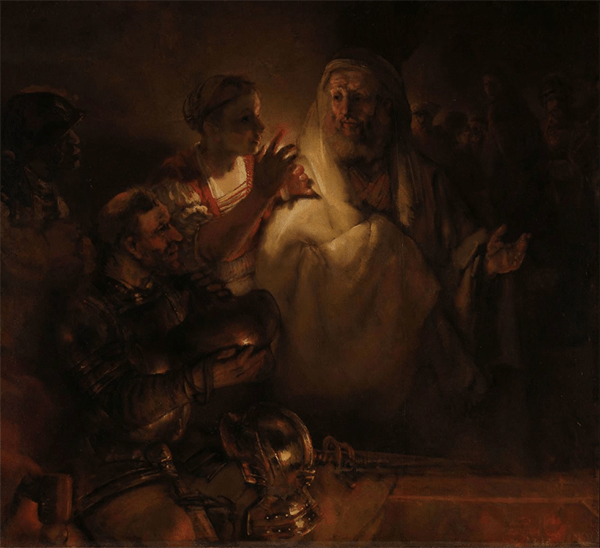
The painting is of the moment when Peter is waiting outside the house of the High Priest.

A ‘crowd’ made up of chief priests, the officers of the temple guard, and the elders had grabbed Jesus and took him before the High Priest.

Peter found a place to wait near a fire with other gawkers.

See, earlier that day, Jesus had told Peter that he, Peter was going to sell Jesus out.

Not in the manner of Mr. Judas but that Peter would deny never ever ever knowing who Jesus or what he done or what Peter had witnessed Jesus doing.

Not only would Peter do this, said Jesus, but he would do it THREE TIMES.

Solid as a rock Peter according one Gospel says that not on his life would this never ever ever happen.

And a couple of hours later, it did.

In the painting, Mr. Rembrandt depicts the point in the story where “servant girl saw him seated there in the firelight. She looked closely at him and said, ‘This man was with him.‘”

Rembrandt shows a man saying emphatically with his eyes, his face, his posture, his gestures, “Who, Me? Nope, Not me. Nope, y’all thinking of someone else.”

This painting was included in the Gods Saints and Heroes exhibition and I was lucky to see the original at the Detroit Institute of Art in the spring of 1981.

And I was blown away.

Like any painting you see in person, the definition, the light, everything is so much more.

There is a detail in this painting that sadly does not make it in any online or printed reproduction that I have seen.

Over Peter’s shoulder you can just make out Jesus.

Jesus is looking back at the scene.

Seeing this construction of the events it hit me that when Peter said, “Who, Me?”, Jesus heard.

The Gospel of Luke says that when Peter said this, he looked up and Jesus looked right at him.

I knew that part of the story, but for some reason the idea that Jesus also heard Peter was a new angle for me.

In the painting, the face of Jesus is clear, much clearer than anything you can see in anything online.
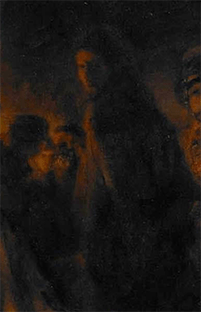
It is the face of resignation.

Not an ‘I told you so’ resigination.

But a sad, sorrow filled, ‘yep’ moment for Jesus.

A sad sorrow filled ‘yep’ moment for Peter when it sunk in a moment later.

Stand and walk around in his shoes, in Peter’s shoes for a while.

In the Shoes of the Fisherman.

I can’t imagine.
4.15.2022 – How everything shines in

How everything shines in
morning light full of moonlight
morning moonlight light

Based on the poem, Breakage, by Mary Oliver.

Thank you to my sister Lisa, to telling me about Ms. Oliver.

Here is the poem.

Breakage by Mary Oliver.

I go down to the edge of the sea.
How everything shines in the morning light!
The cusp of the whelk,
the broken cupboard of the clam,
the opened, blue mussels,
moon snails, pale pink and barnacle scarred—
and nothing at all whole or shut, but tattered, split,
dropped by the gulls onto the gray rocks and all the moisture gone.
It’s like a schoolhouse
of little words,
thousands of words.
First you figure out what each one means by itself,
the jingle, the periwinkle, the scallop
full of moonlight.

Then you begin, slowly, to read the whole story.

go down to the edge
of the sea – How everything shines
in the morning light

It’s like a schoolhouse
of little words, thousands of words
First you figure out what each one means by itsel

– – – – – – –

Readers of this blog may remember that from time to time I struggle with the weight of effort of producing a daily Haiku and any thoughts I may have about the words and time that went in the Haiku that day.

This daily schedule of missing a day can bring on a personal mental paralysis wherein writing these entries becomes impossible.

I learned to deal with this by not dealing with it and let it go.

Then when I look at my register of entries and see blank days with no post, I will grab a topic or book or poem for a source and produce a series of Haiku to fill in those blank dates.

This is one of the great benefits of this effort being my blog and my blog, my rules.

It IS cricket because I say it is.

It is ‘according to Hoyle’ because I say it is.

Thus I have this series of haiku based on the poem ‘Breakage’ by Mary Oliver.

4.14.2022 – malice toward none

malice toward none
with charity for all strive
to finish the work

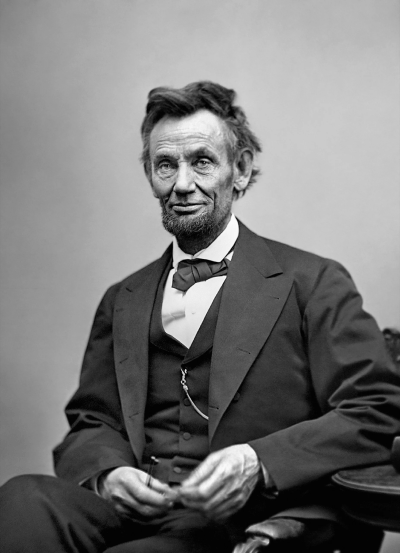
Adapted from Abraham Lincoln’s 2nd Inaugural Address.

A speech Mr. Lincoln made on March 4, 1865.

On April 14, 1865, he was shot.

On April 15, 1865, he died.

Here is the speech.

“Fellow countrymen: at this second appearing to take the oath of the presidential office there is less occasion for an extended address than there was at the first. Then a statement somewhat in detail of a course to be pursued seemed fitting and proper. Now, at the expiration of four years during which public declarations have been constantly called forth on every point and phase of the great contest which still absorbs the attention and engrosses the energies of the nation little that is new could be presented. The progress of our arms, upon which all else chiefly depends is as well known to the public as to myself and it is I trust reasonably satisfactory and encouraging to all. With high hope for the future no prediction in regard to it is ventured.

“On the occasion corresponding to this four years ago all thoughts were anxiously directed to an impending civil war. All dreaded it ~ all sought to avert it. While the inaugural address was being delivered from this place devoted altogether to saving the Union without war insurgent agents were in the city seeking to destroy it without war ~ seeking to dissolve the Union and divide effects by negotiation. Both parties deprecated war but one of them would make war rather than let the nation survive, and the other would accept war rather than let it perish. And the war came.

“One eighth of the whole population were colored slaves not distributed generally over the union but localized in the southern part of it. These slaves constituted a peculiar and powerful interest. All knew that this interest was somehow the cause of the war. To strengthen perpetuate and extend this interest was the object for which the insurgents would rend the Union even by war while the government claimed no right to do more than to restrict the territorial enlargement of it. Neither party expected for the war the magnitude or the duration which it has already attained. Neither anticipated that the cause of the conflict might cease with or even before the conflict itself should cease. Each looked for an easier triumph and a result less fundamental and astounding. Both read the same Bible and pray to the same God and each invokes His aid against the other. It may seem strange that any men should dare to ask a just God’s assistance in wringing their bread from the sweat of other men’s faces but let us judge not that we be not judged. The prayers of both could not be answered ~ that of neither has been answered fully. The Almighty has His own purposes. “Woe unto the world because of offenses for it must needs be that offenses come but woe to that man by whom the offense cometh.” If we shall suppose that American slavery is one of those offenses which in the providence of God must needs come but which having continued through His appointed time He now wills to remove and that He gives to both North and South this terrible war as the woe due to those by whom the offense came shall we discern therein any departure from those divine attributes which the believers in a living God always ascribe to Him. Fondly do we hope ~ fervently do we pray ~ that this mighty scourge of war may speedily pass away. Yet, if God wills that it continue until all the wealth piled by the bondsman’s two hundred and fifty years of unrequited toil shall be sunk and until every drop of blood drawn with the lash shall be paid by another drawn with the sword as was said three thousand years ago so still it must be said ‘the judgments of the Lord are true and righteous altogether.’

“With malice toward none with charity for all with firmness in the right as God gives us to see the right let us strive on to finish the work we are in to bind up the nation’s wounds, to care for him who shall have borne the battle and for his widow and his orphan ~ to do all which may achieve and cherish a just and lasting peace among ourselves and with all nations.”

4.13.2022 – facial expressions

facial expressions
are truly important how
we communicate

“Her lips said ‘No Way’, but her eyes said, ‘Read my lips.’

So went a line from the old TV show Frazier.

I don’t like and rarely accept any finding based on a ‘recent study’.

Yesterday my boss told me that with his boss in town, to be ready to make a presentation with numbers based on website traffic.

“No problem”, I said.

“What do you want the numbers to show?”

Still I came across a story about a study where I said “YES, THAT’S IT.”

The headline was, ‘Can you hear me now?’ Study reveals why voices are raised on video calls.

The key statement is that Scientists find that as video quality deteriorates, people speak louder.

Anytime I am on a video chat, zoom, teams or facebook face time and the video goes bad I find myself speaking both S L O W E R and LOUDER and now I know why.

How can speaking S L O W E R and LOUDER improve the video?

The article says:

Although speaking louder probably doesn’t help, the fact that people do it shows how integrated these systems are, particularly since people only speak louder when gestures are present, Trujillo added. “They know that the gestures being produced are vital to their communication, but their partner is going to have a harder time seeing them. So they increase the strength of the other signal – speech.”

While I question any study, this one was done at Radboud University Nijmegen, in the Netherlands.

You have to trust the Dutch and I think my family roots at back in Nijmegen so its all in the family.

I also think it has to do with the how you grew up.

When I was a kid everyone had a cutting edge transistor radio and you could control the audio quality by changing hands from left to right or standing the radio on its side or on its back or upside down or turning off a fluorescent light or turning on the toaster.

When you went to other peoples homes, TVs had an assortment of wire coat hangers, odd angled antennas and strange strips or wads of tin foil attached to the back to ‘improve reception.’

What I am saying is that you had things you could do on your own.

I worked for many years at a TV Station in Grand Rapids Michigan and there was one of those orange and white towers on the property that dominated the skyline of Grand Rapids.

Anyone who wanted improved TV reception of ABC would point their antenna’s at this tower.

The funny thing was it wasn’t a broadcast tower, it was a repeater tower that sent the station’s broadcast signal to the broadcast tower 40 miles to the north.

It was (and maybe is) that TV broadcast towers had to be 120 miles or something like from any other tower with the same channel.

To get to the required distance from WTVG 13 in Toledo, Ohio, WZZM TV13 in Grand Rapids, Michigan had to set up their tower 40 miles further north in the town of Grant.

I am not sure how I got into Grant, Michigan but there I am.

Next time you are on a video call and the video goes fuzzy remember to SPEAK UP, they can’t see you.

4.12.2022 – in my beginning

in my beginning
is my end, across the field
now the light falls

Adapted from Four Quartets Part II: East Coker by T.S. Eliot.

The passage seemed to fit my day.

I got up to start my day and I was thinking how much I hate having to wait for things to boot up.

Turn on a light and its on.

Turn on the TV and its on (well mostly)

Open a book and start to read.

But tablets?

Laptops?

Turn them on and … wait.

I used to have a routine when I worked in an office where I turned on all my machines then went and got water or coffee or something and when I came back, everything on.

Today I turned on my laptop and got my tablet and a cup of coffee and waited.

And waited.

And waited.

I started working the problem to arrive at wi-fi was out.

So stated that process.

Technical issue with our account caused it be turned off by accident.

No worries.

No problems.

They could turn it back on from there.

I would have to wait though.

And here I am.

Waiting.

You know what you call a web designer who works from home but has no connectivity?

Really frustrated is what you call that person.

Lifting heavy feet in clumsy shoes for sure.

The digital age my butt.

As Mr. Frank Lloyd Wright might say, “there you are.”

Here is the complete 1st part of East Croker, which is the 2nd part of Four Quartets.

In my beginning is my end. In succession
Houses rise and fall, crumble, are extended,
Are removed, destroyed, restored, or in their place
Is an open field, or a factory, or a by-pass.
Old stone to new building, old timber to new fires,
Old fires to ashes, and ashes to the earth
Which is already flesh, fur, and faeces,
Bone of man and beast, cornstalk and leaf.
Houses live and die: there is a time for building
And a time for living and for generation
And a time for the wind to break the loosened pane
And to shake the wainscot where the field mouse trots
And to shake the tattered arras woven with a silent motto.

In my beginning is my end. Now the light falls
Across the open field, leaving the deep lane
Shuttered with branches, dark in the afternoon,
Where you lean against a bank while a van passes,
And the deep lane insists on the direction
Into the village, in the electric heat
Hypnotized. In a warm haze the sultry light
Is absorbed, not reflected, by grey stone.
The dahlias sleep in the empty silence.
Wait for the early owl.
In that open field
If you do not come too close, if you do not come too close,
On a summer midnight, you can hear the music
Of the weak pipe and the little drum
And see them dancing around the bonfire
The association of man and woman
In daunsinge, signifying matrimonie—
A dignified and commodiois sacrament.
Two and two, necessarye coniunction,
Holding eche other by the hand or the arm
Whiche betokeneth concorde. Round and round the fire
Leaping through the flames, or joined in circles,
Rustically solemn or in rustic laughter
Lifting heavy feet in clumsy shoes,
Earth feet, loam feet, lifted in country mirth
Mirth of those long since under earth
Nourishing the corn. Keeping time,
Keeping the rhythm in their dancing
As in their living in the living seasons
The time of the seasons and the constellations
The time of milking and the time of harvest
The time of the coupling of man and woman
And that of beasts. Feet rising and falling.
Eating and drinking. Dung and death.
Dawn points, and another day
Prepares for heat and silence. Out at sea the dawn wind
Wrinkles and slides. I am here
Or there, or elsewhere. In my beginning.