you cannot even remember the questions that weigh so in your mind
From Terns by Mary Oliver.
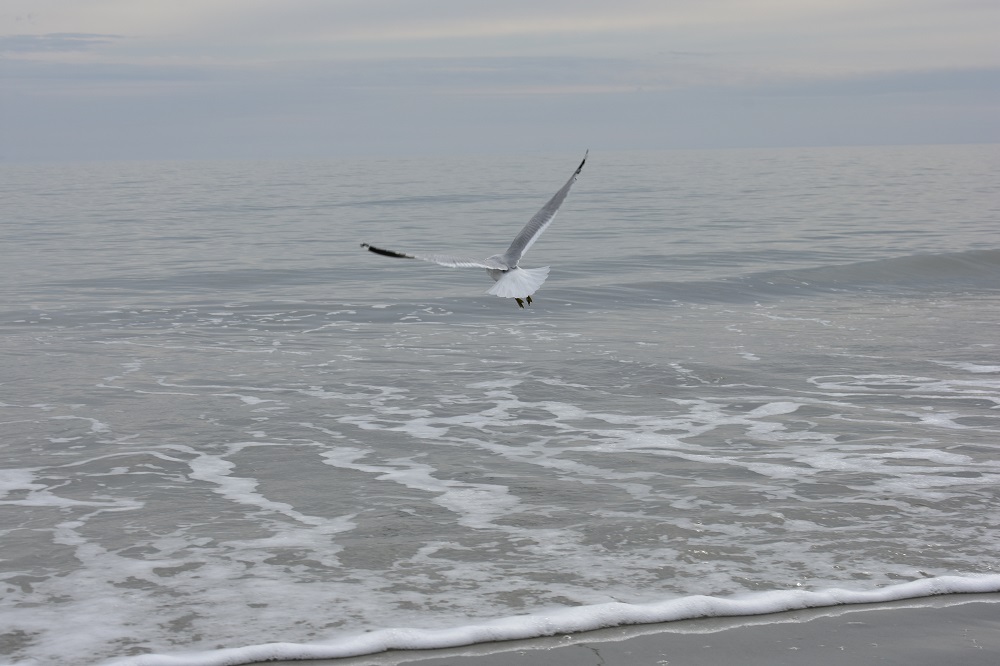
Sea Gull on Hilton Head Island
Don’t think just now of the trudging forward of thought, But of the wing-drive of unquestioning affirmation. It’s summer, you never saw such a blue sky, And here they are, those white birds with quick wings, Sweeping over the waves, chattering and plunging, Their thin beaks snapping, their hard eyes Happy as little nails The years to come – this is a promise- Will grant you ample time To try the difficult steps in the empire of thought Where you seek for the shining proofs you think you must have. But nothing you ever understand will be sweeter, or more binding, Than this deepest affinity between your eyes and the world. The flock thickens Over the rolling, salt brightness. Listen, Maybe such devotion, in which one holds the world In the clasp of attention, isn’t the perfect prayer, But it must be close, for the sorrow, whose name is doubt, Is thus subdued, and not through the weaponry of reason, But of pure submission. Tell me, what else Could beauty be for? And now the tide Is at its very crown, The white birds = sprinkle down, Gathering up the loose silver rising As if weightless. It isn’t instruction, or parable. It isn’t for any vanity or ambition Except for the one allowed, to stay alive. It’s only a nimble frolic Over the waves. And you find, for hours, You cannot even remember the questions That weigh so in your mind.
In a recent text message, my sister Lisa asked me to look up this poem.
It was my sister who first pointed out the work and writing of Mary Oliver to me.
She said this poem make her think of me and the beautiful ocean … in our neighborhood.
The beautiful ocean in our neighborhood.
I really like that.
I really like that a lot.
“My life,” wrote Mr. Thoreau, “is like a stroll upon the beach, as near to the ocean’s edge as I can go.“
Just a stroll upon the beach.
Just a walk along the neighborhood ocean.
As near to the ocean’s edge as I can go.
And It’s only a nimble frolic
Over the waves. And you find, for hours,
You cannot even remember the questions
That weigh so in your mind.
PostScript on Terns and Seagulls – The sight of a white bird near water leads most people to assume it’s a seagull, but in reality the term seagull is not one specific type of bird. Any of a number of different gull species are what we often refer to as seagulls, even when we are far from any sea. Seagull is a generic term for the many gulls in the Laridae family of shorebirds, according to the Michigan State University Extension. The Laridae family also includes terns, many of which are similar in appearance to gulls. Telling a gull from a tern can be difficult, although it’s easier to tell them apart when seen in flight. That’s because the terns common in this area have sharply angular tails and wings, while gulls have more rounded wings. (from the The Forest Preserve District of Will County website)
The article was about Twitter and social media in general.
It brought to mind an article in Time Magazine about the Information Super Highway that was being built in the 1990’s.
The article touched base on all the hoped for hopefuls listed in this essay, especially the amount of knowledge that could be gained with this new cyber access to information, but it ended with a warning.
Do not, the articled cautioned, confuse knowledge with wisdom.
It really didn’t make us smarter and with the sky-has-fallen anxiety that is eating many of us alive, can anyone doubt that the cost of all this connection and information, the deterioration of our capacity for attention reflection, is both a real cost and too high a cost.
I have to agree it is the quality of our attention and reflection that matters most.
Seems someone would have seen this coming but who would have stopped it.
Their scale is truly civilizational.
And what have they wrought?
Well, more money for them I guess.
I like to think of these new tech billionaires and all their money earned through their genius and trickery and being so smart.
I like to think about them and then I like to remind myself that the feller who signed a pretty much toss-off contract back in the late 1950’s to supply McDonald’s with paper napkins is also a billionaire.
know this and dimly aware that it may be worse instead of better
For we lived then in a time of great expectations.
We believed in ourselves and in the future, and we welcomed all of the omens that were good.
We were not, to be sure, altogether half-witted.
It is good to know that the world is not exactly what it seems to be, but to know this is to be dimly aware that it may be worse instead of better.
These voices that spoke to us out of spring sunlight and the dawn of life could be lying, and a well-read person had to keep an ear open for confused echoes from the darkling plain.
However, bookish knowledge did not necessarily mean much.
We lived by our emotions rather than by our brains, and although we did not know where we were going we trusted the future.
We lived for it, confident that when it came it would rub out all of the mistakes of the past.
It was the one thing we really believed in.
From Waiting for the morning train : an American boyhood by Catton, Bruce, 1899-1978
quirky cartoons and upbeat music rote learning euphonious fun
George R. Newall, an advertising executive who was the last surviving creator of “Schoolhouse Rock,” the animated musical snippets that taught young Generation X television viewers grammar, math, civics and science for a few moments during otherwise vacuous Saturday-morning commercial programming, died on Nov. 30 at a hospital near his home in Hastings-on-Hudson, N.Y. He was 88.
The cause was cardiopulmonary arrest, his wife, Lisa Maxwell, said.
“Schoolhouse Rock,” series, which ran from 1973 to 1984 and was revived in the 1990s, used quirky cartoons and upbeat music to furtively transform rote learning into euphonious fun during regular programming and before the government, in the 1990s, mandated that stations broadcast a modicum of educational and informative fare.
From the obit, George Newall, a Creator of ‘Schoolhouse Rock,’ Dies at 88, written by Sam Roberts, in the New York Times, Dec. 7, 2022.
Who among us who grew up in this era in front of our TVs, cannot sing “Conjunction Junction” (What’s your function? I got And But and Or … they can take you pretty far.)
Who can’t sing this song?
Well, besides my wife who grew up without a TV in the house so she did not experience Saturday morning cartoons.
My Saturday morning, growing up in the late 1960’s (which I realize are farther away from me today then the world of Little House in the Big Woods was from Laura Ingalls Wilder when she wrote, or her daughter wrote, her remembrances of time past) began with getting out of bed, coming downstairs and pouring my breakfast.
I had my choice of Kellogg’s products that included Sugar Smacks, Frosted Flakes and Cocoa Krispies along with the single General Foods representative, Cheerios.
We were a Kellogg’s family.
There were no Post Cereal’s in our house.
During the week, when we watched Captain Kangaroo and they ran the commercial of the Captain with his electric train set that had a flat car with a cereal bowl on it that stopped at the water tower and the spout unfolded and poured milk on the cereal and the Captain announced that this segment was brought to you by Kellogg’s of Battle Creek, Michigan, I thought that the Captain and Mr. Greenjeans WERE IN Battle Creek.
That kind of made both the Captain and Kellogg’s the home town team.
I know that Post was also located in Battle Creek but there was something about Post Cereal and the connection with Marjorie Merriweather Post and Cary Grant or something that kept Post cereals out of our kitchen.
It also may have had something to do with my Dad as one of his death sentences on any food was to say, ‘It reminds me of Postum!’
Whether it was a beverage or something to eat, if it reminded my Dad of Postum, it never showed up again.
I am not sure what Postum was but my Dad’s word was good enough for me.
As might be noticed from the brand names of the cereal, the cereal was focused without shame, on SUGAR.
Cheerios were not sweetened with sugar or honey coated back then, and when I chose Cheerios, I poured milk on them and coated them with several spoonful’s of white sugar to that point that there was a thick sludge at the bottom of the bowl to be slurped up after the Cheerios had been eaten.
There was a long running battle whenever my Grandma Hendrickson happened to around as she would make us put the sugar on BEFORE the milk though we would argue it wouldn’t stick to the Cheerios.
Whenever my Mom had a baby, Grandma would stay with us and run the kitchen.
She also limited us to something like one spoonful of sugar and barely enough milk to float the Cheerios.
Grandma was also UP on a Saturday morning when most other adults wanted no part of us early on weekends.
Once the sugar was in our systems and our brain were pushed into near cationic activity of overdrive, we headed for the TV and Saturday Morning kids shows.
The earlier you were up, the odder these Saturday morning shows were.
There might be some old black and white TV shows.
I remember something called Sky King where a cowboy flew around the modern (1960 era) American west and solved peoples problems with his plane.
Also the Japanese cartoons were on early.
Those were cartoons where only the mouths were animated.
I feel like there were several cartoons like Speed Racer that really had about 3 episodes but the story could be changed by changing the recorded voices so there were 100’s of versions of these cartoons but they all looked the same.
Then the kids shows would start and there would be a mix of shows and cartoons produced for kids.
Some of the great shows include Lancelot Link Secret Chimp, really chimps dressed up in clothes with human voices and George of the Jungle.
On a sugar high that would not have been able to be recorded with any medical device available at the time, we watched them all.
Glued to the TV set was not an exaggeration.
This continued until near noon when the Bugs Bunny cartoons would start.
By this time, my older brothers and sister would be up and they might join the circle to watch a few minutes of Looney Tunes.
My memory tells me that my brother Jack had a standing request to be notified whenever the Bugs Bunny / Yosemite Sam Fearless Freep cartoon was on.
To this day, Jack’s endorsement has kept this cartoon in my Top 10 Canon of Bugs Bunny cartoons.
Noon also meant it was close to lunch time and lunch time on Saturday meant Swanson’s Frozen Chicken pies and it was a job that my brother Bobby took on.
He would get out this round, bent baking sheet that we had forever, set the oven to 425 degrees and then walk around and ask everybody, ‘who wants a chicken pie?’
Then back to to the kitchen, he would open up to 9 or 10, depending on who was up or home from college, small boxed chicken pies out of the freezer and arrange them on that round baking sheet and put the pies in the oven with the timer set so the pies would be ready about the same time as when the Bugs Bunny show was over.
I admired my brother’s role in all this and was awed by his mastery of this important job and I would daydream about the day that I might take over this job.
Grandma Hendrickson comes in this part of the story as well.
On those Saturdays when she was with us, once the breakfast was over, Grandma would make us all a nice lunch, unaware of our set Saturday schedule.
There was this one famous time when she created a spread of sandwiches and fruit and chips and glasses of milk all set for us and Bobby came into the kitchen without seeing anything Grandma had set out and turned on the oven and opened up a stack of chicken pies before Grandma caught him and asked him just what was he doing?
Through out all these TV shows and cartoons, there was a reoccurring theme, like the bass note in a Bach Fugue.
Saturday morning commercials.
Commercials that extolled the life long benefits of heavily sugar coated cereals and other such things that most American’s kids of that time begged to be provided with because of these commercials.
The Federal Government and its TV arm, the FCC had long been aware of the power of TV and in an effort to do something, anything positive with TV, mandated, in the words of writer, Sam Roberts, that stations broadcast a modicum of educational and informative fare.
This mandate led to Schoolhouse Rock.
Again the words of Mr. Roberts, Schoolhouse Rock was animated musical snippets that taught young television viewers grammar, math, civics and science for a few moments during otherwise vacuous Saturday-morning commercial programming.
These were shorts that ran on Saturday mornings between the shows.
And they ran for years.
I never thought about the people who made these.
And last week I saw that George R. Newall had died and he was the last surviving creator of “Schoolhouse Rock.”
I read about Mr. Newall and learned that “Schoolhouse Rock,” series, which ran from 1973 to 1984 and was revived in the 1990s, used quirky cartoons and upbeat music to furtively transform rote learning into euphonious fun during regular programming and before the government, in the 1990s, mandated that stations broadcast a modicum of educational and informative fare.
The show won four Emmy Awards.
The series spawned books, recordings, live singalong shows and a nostalgia cult that will mark the show’s 50th anniversary next year when the Walt Disney Company presents a prime-time television special; rereleases “The Official Schoolhouse Rock Guide,” written by Mr. Newall and Tom Yohe; and publishes an adult coloring book featuring all of the program’s characters.”
I love that line, furtively transform rote learning into euphonious fun.
Rote learning when I must have seen each of these clips about a million times.
Mr. Roberts wrote that: Schoolhouse Rock” originated in the early 1970s when David McCall, president of the McCaffrey & McCall advertising agency, complained to Mr. Newall, a creative director there, that his young sons couldn’t multiply, “but they can sing along with Jimi Hendrix and the Rolling Stones.”
Could Mr. Newall put the multiplication tables to music? he asked. Mr. Newall’s search for a quirky musician who might help led him to Ben Tucker, who played bass at the Hickory House in New York, which Mr. Newall frequented regularly.
“I asked Ben, and he said, ‘Oh yeah, my partner, Bob Dorough — he can put anything to music!’”
And they did.
And I watched.
And today, ask me how a bill becomes a law or the function of a conjunction and I can tell you.