3.9.2023 – fundamentally

fundamentally
flawed conception of our selves
language, knowledge

Adapted from:

Today our supposedly revolutionary advancements in artificial intelligence are indeed cause for both concern and optimism. Optimism because intelligence is the means by which we solve problems. Concern because we fear that the most popular and fashionable strain of A.I. — machine learning — will degrade our science and debase our ethics by incorporating into our technology a fundamentally flawed conception of language and knowledge.

It is at once comic and tragic, that so much money and attention should be concentrated on so little a thing — something so trivial when contrasted with the human mind, which by dint of language, in the words of Wilhelm von Humboldt, can make “infinite use of finite means,” creating ideas and theories with universal reach.

In the guest opinion essay, “The False Promise of ChatGPT” by Noam Chomsky (March 8, 2023, NYT).

Mr. Chomsky’s global standing as THE expert on language leaves me little room to argue, not that I would, as I was happy to read his opinions on the latest computer generated textual content craze that has a place in the current news cycle.

For me, the concept is as old as the Infinite Monkey Theory which states that if an infinite number of monkeys were left to bang on an infinite number of typewriters, sooner or later they would accidentally reproduce the complete works of William Shakespeare.

It goes back to 1913 and Félix Édouard Justin Émile Borel a French mathematician, who wrote:

.. Concevons qu’on ait dressé un million de singes à frapper au hasard sur les touches d’une machine à écrire et que, sous la surveillance de contremaîtres illettrés, ces singes dactylographes travaillent avec ardeur dix heures par jour avec un million de machines à écrire de types variés. Les contremaîtres illettrés rassembleraient les feuilles noircies et les relieraient en volumes. Et au bout d’un an, ces volumes se trouveraient renfermer la copie exacte des livres de toute nature et de toutes langues conservés dans les plus riches bibliothèques du monde. Telle est la probabilité pour qu’il se produise pendant un instant très court, dans un espace de quelque étendue, un écart notable de ce que la mécanique statistique considère comme la phénomène le plus probable…*

I remembered it more from Bob Newhart who told the joke about the typing monkey’s, “Hey, Harry! This one looks a little famous: ‘To be or not to be – that is the gggzornonplatt.”

To be sure of the date, I did the google and read the article on Wikipedia.

BOY HOWDY!

So much on so little that for some reason caught the attention of so many people including a ‘famous’ study by some fellers named, Hoffmann and Hofmann!

It seems that the image of an infinite number of typing monkeys is just the thing to get stuck in a lot of people’s brain.

And, for the record, my family name is Hofman, but my Grandpa thought it looked unbalanced and changed it to Hoffman.

I think to get four spellings of the same last name into 2 sentences is pretty good for a non monkey!

To return to Mr. Chomsky and his something so trivial when contrasted with the human mind.

I used to try to observe objectively my mind in action as it worked to process all the information coming into my brain as I drove into Atlanta.

I was pretty much left in awe everytime.

In his books, C.S. Forester has several scenes where the hero is in a situation surrounded by activity and is called on to make decision after decision.

In these scenes, one of the sources of activity is either a beeping clock or someone else calling off the time in 5 second intervals or some such thing that marks the time in the background and the hero begins to contemplate how in the world the brain can process all the data let alone arrive at a conclusion, let alone a successful conclusion, in the time allowed for the situation.

Infinite use of finite means, creating ideas and theories with universal reach.

It is, the mind, an incredible thing.
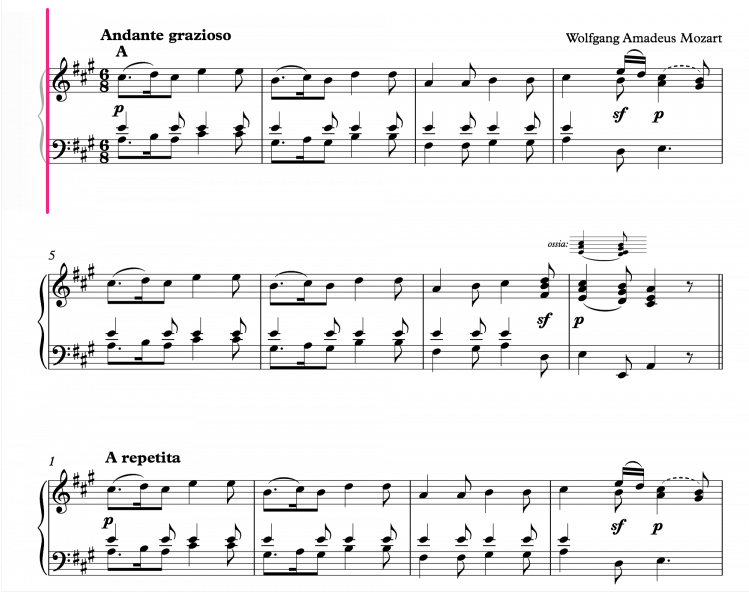
click on image to watch music and listen

To shift from text to music, I have long said that I had been allowed to compose the first 8 bars or so of Mozart’s Piano Concerto #11, I could die a happy person.

When Artificial Intelligence can compose this music, then email me a note.

When Artificial Intelligence can compose this music and KNOW what it did, then text me.

When Artificial Intelligence can LISTEN to this and feel it and know it is special and also know that if the computer was unplugged today, that computer would be happy that it has composed such a piece, then call me.

*.. Let us imagine that a million monkeys have been trained to type at random on the keys of a typewriter and that, under the supervision of illiterate foremen, these typing monkeys work with ardor ten hours a day with a million machines to write of various types. Illiterate foremen would collect the blackened sheets and bind them into volumes. And at the end of a year, these volumes would be found to contain the exact copy of the books of all kinds and all languages ​​preserved in the richest libraries of the world. Such is the probability that there will occur for a very short instant, in a space of some extent, a notable deviation from what statistical mechanics considers to be the most probable phenomenon… (Yes I used a computer generated translation)

3.8.2023 – independence and

independence and
irresponsibility
cannot co-exist

Adapted from a scene in the book, Commodore Hornblower, by C.S. Forester who writes that Hornblower:

Recalling himself to reality, he forced himself to remember with what a bubble of excitement he had received his orders back to active service, the light heart with which he had left his child, the feeling of – there was no blinking the matter – emancipation with which he had parted from his wife.

The prospect of once more being entirely his own master, of not having to defer to Barbara’s wishes, of not being discommoded by Richard’s teeth, had seemed most attractive then.

And here he was complaining to himself about the burden of responsibility, when responsibility was the inevitable price one had to pay for independence; irresponsibility was something which, in the very nature of things, could not co-exist with independence.

It is part of the Hornblower lore that when Gene Roddenberry created the Star Trek character of Captain James T. Kirk, he used Hornblower and the Hornblower books as a model.

3.7.2023 – sometimes a crumb falls

sometimes a crumb falls
from the tables of joy some
times a bone is flung

Pretty cheeky of me but this is adapted from the poem, Luck, by Langston Hughes, word for word.

Sometimes a crumb falls

From the tables of joy

Sometimes a bone

Is flung

To some people

Love is given

To others

Only heaven.

Angst?

Despair?

Some times for some people things fall, are flung, are given or found.

How can so much be packed into so few words?

I wonder what others might have made of this.

I also wanted a further attribution so I put the phrase, Sometimes a crumb falls in the google and was rewarded with a story that appeared in the New York Times on March 2, 1994.

In the article by Joe Sexton, Mr. Sexton reports on the New York City Transit authority was using ad space in the New York Subway system to display poetry in a program called Poetry in Motion.

On that day, March 2nd, in 1994, this poem was on display and Mr. Sexton rode along on the subway to ask commuters if they had noticed the poem, if they would read it, and want they thought it meant.

It is a fascinating read and a fabulous snapshot of a moment in the lives of several people who I am sure never once thought they might be talking to a reporter about Langston Hughes on the New York Subway.

For me, the poem might have its roots in the Bible story in Matthew 15:

The woman came and knelt before him. “Lord, help me!” she said.

He [Jesus] replied, “It is not right to take the children’s bread and toss it to the dogs.”

“Yes it is, Lord,” she said. “Even the dogs eat the crumbs that fall from their master’s table.”

Then Jesus said to her, “Woman, you have great faith! Your request is granted.”

I could go one with this thought of crumbs that fall, a bone that is flung, love found on earth or in Heaven but I won’t.

That thought of Biblical roots does not show up in the thoughts listed by the reporter as he interviewed commuters.

“I can’t express it, but I get it,” Ms. McNeil says of the poem.

“A crumb? A bone?” she [another commuter] asked. “What’s it got to do with heaven?”

“… To me, the poem means that you are lucky if you even find just some happiness.”

The story was headlined, Langston Hughes On the IRT; A Poem Arouses Many Feelings.

Whatever the feelings, I have to feel that Mr. Hughes would have been happy to learn that his poem, posted in the subway, where people might have a few seconds to ponder its message, had many feelings.

One more thing.

Those tables of joy.

Simple phrase you can consider in your mind and find it is 20 minutes later in your day.

3.6.2023 – dystopian farce

dystopian farce
it is laughable if you
don’t have to live it

Adapted from the line, “It’s pretty much a dystopian farce,” said Kathleen Miller Green, an assistant professor of child development who attended the nearly six-hour, capacity-crowd meeting at the school’s student union building on Feb. 22. “It’s laughable if you don’t have to live it.”, in the New York Times article, The Politicization of North Idaho College, by Daniel Berehulak.

It was too good a line with too much application to today’s United States to let it go past.

“It’s pretty much a dystopian farce,” it’s laughable if you don’t have to live it.”

So quoted is Kathleen Miller Green, an assistant professor of child development at North Idaho College in Coeur d’Alene, a town of 56,000 in the Idaho Panhandle.

See, according to the article, the county Republican Party holds a majority on the North Idaho College board. They have denounced liberal “indoctrination” by the college faculty and vowed to bring the school administration’s “deep state” to heel and “Make N.I.C. Great Again.”

I apologize to the people of the great state of Idaho but saying, Make North Idaho College Great Again out loud makes me laugh.

It’s IS laughable.

Until.

Until it isn’t.

And it isn’t as we all have to live it.

And is isn’t as it isn’t just the North Idaho College, it is small colleges, schools, churches, libraries, township boards and zoning commissions everywhere.

It gets very scary quickly.

Here in the low country of South Carolina, a feller was convicted of murder pretty much evidence from his own cell phone that showed where he was, or at least where his phone was (and he was NEVER with his phone), how his phone moved around, whether in a car or walking and what he used his phone for.

While I have little problem with this specific case, think of how, in general, we are all being tracked.

All that data is there.

All that data is real.

All that data can and will be used against you.

Live a good life and you got little to worry about.

Still, there is a concern over WHO has control or even access to this data.

Imagine a local police force, or for example, the Michigan State Police (an awful awe inspiring title when you think about it, so says Jim Harrison) with access to the data.

Or worse, imagine the North Idaho College Board of Regents with access to this data.

Tracking faculty.

Tracking students.

On the one hand, It’s pretty much a dystopian farce,”

On the one hand, it’s laughable

On the other hand, it’s laughable if you don’t have to live it.

And we all have live it.

We all have to live with it.

What part of this is making us great again?

For decades, Eleanor Roosevelt wrote a daily column called simply, My Day.

If you wonder why any one would care about Mrs. Roosevelt’s day, just look at the subheadings in the online archive.

They include, White House Years (1935-1941), White House Years (1942-1945 WW2), United Nations, (1946-1951- Post UN years (1953-1962).

In her December 12, 1953 Column, she wrote about attending a meeting to celebrate Brandeis University and she commented about the ‘Red Scare’ that dominated US politics at the time.

She wrote: The attacks on our schools today and on our clergy are of course only incidents but they reflect a little the attitude toward educated people.

We are all of us opposed to the evils of fascism and communism but in fighting these evils we must beware lest we adopt the very methods used by fascists and communists and find ourselves destroying things of value in our own country when what we really are trying to destroy is a foreign concept with which we disagree and yet which we are being led to copy.

3.5.2023 – my community

my community
pathologically lazy
rejoice with brisk walk

From the paragraph:

There’s (sedentary) rejoicing in my community, the pathologically lazy, at the news that only 11 minutes of brisk walking a day may save us from early death.

Of course, multiple caveats must accompany this statement, distilled from a Cambridge University-led meta-analysis of data on physical activity and heart disease.

We would have to be in the lucky 10%: only one in 10 early deaths could be avoided with a brief constitutional.

Exercise levels were also self-reported, meaning researchers had to make some assumptions about duration and intensity.

And 11 minutes is a neatly digestible take-home from analysing 196 studies with more than 30 million participants, not a magic bullet.

We like a magic-bullet figure though, don’t we?

In the article, An 11-minute walk can save you from an early death? That’s my kind of fitness regime by Emma Beddington in the Guardian, 3.6.2023.

I may have told the story how as an exercise with a big group of people, I was given a pack of 50 cards with a word on each card.

We had to divide the cards in half, choosing the words that best described ourselves.

Then we did it again.

Then we did again.

Then we did it until we were down to the last card, the last word, that was OUR word.

We had to go around the room and read our word out loud.

Electric!

Details!

Work!

My turn.

Lazy!

Kinda blew up the effect of the exercise.