Christmas in the air, yet the air seemed too soft to sustain the treasure
In his January, 1966 essay, What Do Our Hearts Treasure?, EB White laments a Christmas in Florida away from New England, snow and family.
Mr. White writes: The scene was idyllic. Christmas was in the air, yet the air seemed too soft to sustain it.
Mr. White and his wife, Katherine Angell White, receive a box from home with evergreens, gifts and photos and with these items, the White’s restore the feeling’s of the holiday as they remember the question, What do our hearts treasure?
Mr. White does not go one to include the answer to this question that comes from the Bible.
For where your treasure is, there your heart will be also. (Matthew 6:21)
We took a day to drive up to Atlanta to see our kids and our grand kids.
We had presents but seeing those people, I tell you, it wasn’t that the air seemed too soft to sustain it, it was that the air was strong enough to contain it.
getting back to where the Christmas Story began … back to … Ephesus
Most of folks know that Jesus was born in Bethlehem over in the old country.
Most folks know the connection between Jesus and Christmas.
The reason for the season and all that.
We read this year that due to the conflict in Gaza, Bethlehem was closed this Christmas.
No one could get to where the Christmas story took place.
But could they get to where the Christmas story started?
I mean the start, the origin, of the story of the Christmas.
When, where was it first told?
If we go to the book of Luke, Luke records the story of Christmas and the angels and the shepherds and then he writes, Mary treasured up all these things and pondered them in her heart.
I think it was Mary who told Luke the story.
Who else had all those facts and names and places in their head?
Mary treasured up all these things and pondered them in her heart.
To get the story from Mary I think that Luke traveled to the city of Ephesus where tradition has it that Mary lived with her nephew, the disciple, John.
I am going to keep that in mind next year.
I am going to recommend that folks travel to the birthplace of the Christmas story.
no message of love, goodwill, friendship, that can’t be conveyed in a book
This ad ran in the New York Times, 100 years ago today, December, 20, 1923.
There is no Message of Love, Affection, Good-Will or Friendship that cannot be conveyed in a book.
In 1928, the New York Herald Tribune would report, ” … Brentano’s on West Forty-seventh street probably [is] the foremost bookshop in the world. Over a million books are kept in stock, and there are branch shops in Washington, Chicago, Paris, London.“
realized that the man who spoke to them was sincere could feel in his tones
Only a few weeks ago we were listening to the King’s Christmas broadcast. I am sure that as the years went by people liked more and more to listen to these talks addressed by a King to his own people. They realized that the man who spoke to them was sincere. They could feel in his tones that firm religious faith which was one of the sources of his strength.
So wrote Clement Attlee, the man who replaced Winston Churchill as Prime Minister in an election in the summer of 1945, in his autobiography, As It Happened.
He is writing about George the Sixth, by the Grace of God, of Great Britain, Ireland and the British Dominions beyond the Seas King, Defender of the Faith, Emperor of India.
This was the same King whose stuttering problem was profiled in the movie, The King’s Speech.
The same King who stayed in London during the bombing in WW2.
As his wife, Queen Elizabeth, the Queen Mother said when asked about leaving London for someplace safer or maybe sending their daughters, Elizabeth and Margaret away, “The girls will not leave without me. I will not leave without the King. And the King will not leave.”
Some might look for me here to point out that even today we have people making speeches and we might feel in that person’s tones their level of sincerity and the extent of that person’s firm religious faith.
But no, I am not going to point any fingers or make any comparisons.
If anyone came to your mind, well, squeaky wheel and tight shoe pinching the foot and all that.
Can’t stop you from making any comparisons now can I.
This is the speech Mr. Attlee heard on Christmas Day, 1951.
George VI died the next month on January 31, 1952, of lung cancer/
“As I speak to you to-day, I would like to wish you, wherever you may be, a happy Christmas. Though we live in hard and critical times, Christmas is, and always will be, a time when we can, and should, count our blessings – the blessings of home, the blessing of happy family gatherings, and the blessing of the hopeful message of Christmas.
“I myself have every cause for deep thankfulness, for not only – by the grace of God and through the faithful skill of my doctors, surgeons and nurses – have I come through my illness, but I have learned once again that it is in bad times that we value most highly the support and sympathy of our friends. From my peoples in these islands and in the British Commonwealth and Empire as well as from many other countries – this support and sympathy has reached me, and I thank you now from my heart.
“I trust that you yourselves realise how greatly your prayers and good wishes have helped, and are helping me, in my recovery. It has been a great disappointment to the Queen and to myself that we have been compelled to give up, for the second time, the tour which we had planned for next year. We were looking forward to meeting mv peoples in their own homes, and we realise that they will share our regret that this cannot be. I am very glad that our daughter, Princess Elizabeth, with her husband, will be able to visit these countries, and I know that their welcome there will be as warm as that which awaited us.”
I think I can repeat that last of the 1st paragraph.
Christmas is, and always will be, a time when we can, and should, count our blessings –
the blessings of home,
the blessing of happy family gatherings,
and the blessing of the hopeful message of Christmas.
into the winter night as if we heard the sound of far-off trumpets
Every year, on the night before Christmas, or sometimes on the last Sunday night before Christmas, the tallest balsam that could be got into the church was erected on the raised platform where the choir ordinarily sat, and it was covered with homemade decorations: looped chains made of colored paper, white popcorn threaded on long strings, tinsel stars, metal clips holding lighted candles, and so on.
We had no electric lights for Christmas trees in those days; we simply used candles with open flames, burning within inches of drying evergreen needles, and the fire hazard must have been considerable.
I should think a few houses would have burned down every year, but it never seemed to happen. Anyway, the church was filled with people.
It was imperfectly lighted, and its interior seemed immense, larger than life, dominated by the great tree that reached up to the shadows just beneath the rafters, its tiny flames all twinkling. Just to be in the place was to partake of a mystery.
The services were extremely simple.
There were carols, prayers, readings of the gospel story of the first Christmas, a few quiet remarks bv the minister, distribution of candy canes and molasses-and-popcorn balls to the small children, and a final hymn: and when the wheezy organ (pumped vigorously by a sweating young man behind a screen) sounded off with “Joy to the World,” and the doors opened to let us out into the winter night, it was as if we heard the sound of far-off trumpets.
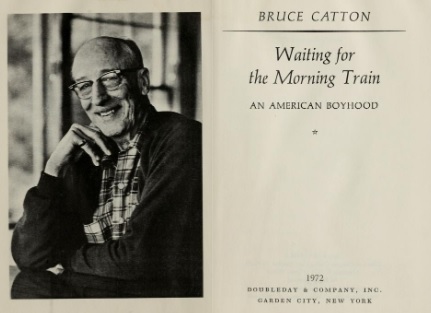
From Waiting for the Morning Train by Bruce Catton.
Not sure how old I was, 9 or 10, but one day my grandfather came in the back door of our house asking for me.
It had to be a Friday as it was on Friday night that my Grandpa and Grandma Hendrickson, my Mom’s parents, came to ‘pay a call’ on our family.
Every once in awhile my Dad might try to arrange a date night with my Mom since he knew they were coming, but most often we would just sit and visit and watch TV.
But this night, Grandpa Hendrickson came in asking for me.
He had a book for me.
He said that their church library was throwing out a bunch of books and he rescued one volume that was a book on the Civil War.
He said that he had a grandson who would want that book so they gave it to him.
I was, as I said, about 9 or 10.
Grandpa called for me when they walked in and with some satisfaction handed me a battered copy of Mr. Lincoln’s Army by Bruce Catton.
It was the first Catton book I ever read.
It was the first ‘adult book with chapters’ I ever owned.
I still have it.
The book was most likely over my head at the time and as it started out medias-res it screwed up my timing of the Civil War for years.
But the stories told and the way Catton told them have stayed with me forever.
I have a very solid memory of one summer when late at night, my older brother, Jack, read me the chapter on Crackers and Bullets.
Catton’s words were magic and magically arranged.
I know that my Grandpa’s gift made a big impression on me and maybe shaped my future.
I never ever doubted there was a book I couldn’t read after that.
It also made a big impression on my Mom and she remembered it.
See Bruce Catton grew up in Michigan, up in Benzonia (in Upper Lower Michigan) before he was a world famous Pulitzer prize winning author and Editor the American Heritage magazine of history.
My Mom remembered that Mr. Catton had written that book the her Dad had given to me.