1.16.2023 – my soul is sick with

my soul is sick with
every report, wrong, outrage
with which earth is filled

Oh for a lodge in some vast wilderness,
Some boundless contiguity of shade,
Where rumour of oppression and deceit,
Of unsuccessful or successful war,
Might never reach me more! My ear is pained,
My soul is sick with every day’s report
Of wrong and outrage with which earth is filled.

Adapted from The Task and Other Poems: The Timepiece Book II, by William Cowper (CASSELL & COMPANY, LONDON, PARIS, NEW YORK & MELBOURNE – 1899).

I guess it is the same old question of wars and rumors of wars.

If I ignore the rumors, do the wars go away?

If I ignore the news, does the news go away?

The news and news reporting and the endless commentating is like the work of traffic engineers.

Traffic engineers can’t fix traffic, but they can spread it out over a greater area.

I stole that line from Bill Bryson.

Back in the day, the World and National News was a 15 minute show.

Now it’s a never ending endless story.

If you remember that terrible kids song, the song that never ends, the news cycle never ends and leaves me brain dumb and stupefied.

Does that make the news any less important?

What is the definition of important news?

When I wake up, all I want to know about is my morning drive.

And that want has stayed they same whether I am in a small city in Michigan, a major metropolis like Atlanta or the low country of South Carolina.

And I know that any news about traffic that I get on the news is news too old to be of any use to me.

I am reminded of a story from history back when young Theodore Roosevelt (when do you mention Theodore Roosevelt without the preface ‘young’ … but then he was 41 when he became President and as John Hay, the Secretary of State said, “Theodore, you have made a fine start in life and we have high hopes for you … when you grow up), when he was 36, he was President of the New York City Police Commission.

In charge of the Police and responsible for crime management, Commissioner Roosevelt found himself in the middle of a crime wave with the 12 or so New City Daily Newspapers suddenly being filled with the reports of crimes, big and small, all over the city.

Commissioner Roosevelt checked and found there was no increase in Police activity, but there was an increase in crime … reporting.

He called in the newspaper reporters.

They admitted that under pressure from their editors to step up crime reporting, the reporters had figured out that the shift reports by the Police were left out in the open at the Sergeant’s Desk in Police Precincts all over the city.

The reporters could read these reports and have access to the facts of any and all crimes throughout the city and the reporters reported them.

Commissioner Roosevelt ordered the shift reports be locked up and the crime wave came to a stop.

If I stop watching the news will it all go away?

Oh for a lodge in some vast wilderness,
Some boundless contiguity of shade,
Where rumour of oppression and deceit,
Of unsuccessful or successful war,
Might never reach me more! My ear is pained,
My soul is sick with every day’s report
Of wrong and outrage with which earth is filled.

1.10.2023 – How is the world ruled?

How is the world ruled?
lie to journalists and then …
believe what is read

How is the world ruled and how do wars start?

Diplomats tell lies to journalists and then believe what
they read.

So wrote Karl Kraus in his book, Aphorisms and More Aphorisms back in1909.

An aphorism, not to be confused with aphorismus (from the Greek: ἀφορισμός, aphorismós, “a marking off”, also “rejection, banishment”) is a figure of speech that calls into question if a word is properly used (“How can you call yourself a man?”). It often appears in the form of a rhetorical question which is meant to imply a difference between the present thing being discussed and the general notion of the subject, but an aphorism (from Greek ἀφορισμός: aphorismos, denoting ‘delimitation’, ‘distinction’, and ‘definition’) is a concise, terse, laconic, or memorable expression of a general truth or principle. Aphorisms are often handed down by tradition from generation to generation.

Don’t ask me, I copied that right from Wikipedia.

I copy a lot from Wikipedia but then I site my source, not that that means I am qualified to be the President of an Ivy League School, not that I would want the job if I was and if I was I most likely be remembered by having a building like Haven Hall named after me.

Haven Hall is the ugly brick late Ramada Inn style building BEHIND Angell Hall and its 8 marble columned entrance that is a University of Michigan Landmark.

But I digress.

The subject was aphorisms.

Again, Wikipedia says, aphorisms are distinguished from other short sayings by the need for interpretation to make sense of them.

That is the beauty of “Diplomats tell lies to journalists and then believe what
they read.”

Who needs that interpreted?

Mr. Kraus also said, “The devil is an optimist if he thinks he can make people worse than they are.”

I got no problem understanding that one either.

Mr. Kraus was a social critic for his times and was confined to publishing his own works.

He would, it is said, agonize over the placement of a comma and the use of the correct, best words.

I can only imagine what Mr. Kraus would have made of the world today and the access to the world made possible by social media.

On the other hand maybe it wouldn’t be too hard to imagine what Mr. Kraus would have said today because he said it back then.

Mr. Kraus once wrote, “The secret of the demagogue is to make himself as stupid as his audience so they believe they are clever as he.”

All that is missing today is the twitter, I mean X account.

1.5.2023 – reasonable but

reasonable but
nevertheless too often
we slow down for fog

Adapted from, You Came with Shells by June Jordan.

You came with shells. And left them:
shells.
They lay beautiful on the table.
Now they lie on my desk
peculiar
extraordinary under 60 watts.

This morning I disturb I destroy the window
(and its light) by moving my feet
in the water. There.
It’s gone.
Last night the moon ranged from the left
to the right side
of the windshield. Only white lines
on a road strike me as
reasonable but
nevertheless and too often
we slow down for the fog.

I was going to say a natural environment
means this or
I was going to say we remain out of our
element or
sometimes you can get away completely
but the shells
will tell about the howling
and the loss

In a borough that has landmarks for the writers Thomas Wolfe, W. H. Auden, and Henry Miller, to name just three, there ought to be a street in Bed-Stuy called June Jordan Place, and maybe a plaque reading, ‘A Poet and Soldier for Humanity Was Born Here,” said American playwright, journalist, librettist, novelist, poet, and screenwriter, Thulani Davis.

Nevertheless.

We slow down for the fog.

Too often.

We slow down for the fog.

What might be in the fog?

Giants maybe?

Windmills?

Tie Sherlock Holmes with Don Quixote and you get the line from the movie, “They Might Be Giants where Mr. Holmes comments:

Well he had a point.

Of course, he carried it a bit too far.

He thought that every windmill was a giant.

That’s insane.

But, thinking that they might be…well…all the best minds used to think the world was flat.

Sometimes you can get away completely …

But the shells …

They might be …

Reason?

Reasonable?

But the shells.

Will tell about the howling.

And the loss.

1.4.2023 – The Elfstedentocht

The Elfstedentocht
nonmaterial losses
commemorated

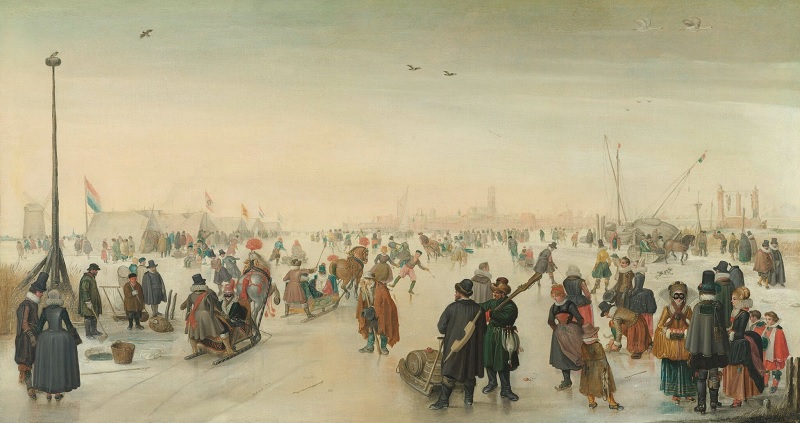
These scenes were so iconic, so Dutch, that I felt a bit bereaved, when I moved to the Netherlands more than 20 years ago, to realize that the world they showed was gone — and that thanks to climate change, it wouldn’t be coming back. Even the Elfstedentocht, the skating race through the 11 historic cities of Friesland that is one of the country’s most beloved national traditions and has been held 15 times since 1909, was passing from memory. The ice has to reach a certain thickness for it to be safely held, and the ice no longer reaches that thickness. What I found, in place of the sparkling white winters of the old paintings, was month after month of tepid drizzle.

How can such nonmaterial losses be commemorated? As long as we are unable to see them as losses, we can keep refusing to see what has caused them and keep hoping that they still, someday, might be reversed. The Elfstedentocht is like a relative whose small plane went missing a few years ago and whose loved ones still hope that he could, one day, stumble into town. They all know he’s dead, of course. But it feels too cruel to be the first to say it — too painful to erect a gravestone without so much as a corpse.

From the Guest Opinion piece, Waiting for Snow in the Netherlands, by Benjamin Moser, the author of “The Upside-Down World: Meetings With the Dutch Masters.”

Sure.

I just wanted to use the word, Elfstedentocht.

Aside from that I am forming a theory that every generation feels like they just missed out on something because of when they born and also because of how old they are getting, they are starting to lose out on something as well.

That I even typed this statement out reminds of the story that Secretary of State John Hay (a man who made a career out of having been Abraham Lincoln’s 2nd personal secretary) once said to Theodore Roosevelt, “There is one thing I admire about you, Theodore, it‘s your original discovery of the Ten Commandments.”

Anyway, so I regret that I missed out on what I never had and I regret what I perceive is being lost.

Welcome to the old age club I guess.

The old ways are changing.

And Mr. Churchill did say, “To improve is to change, so to be perfect is to have changed often.”*

2024 will be a year of changes.

People will disagree on what should be changed.

People will disagree on why things should be changed.

People will disagree on whether or not the changes are good or bad.

People all agree 2024 will be a year of changes.

I am prepared to regret what I missed out on that I never had and to regret what I perceive is being lost.

Because I will remember the line before Mr. Churchill said, “To improve is to change, so to be perfect is to have changed often.

Before Mr. Churchill said, “To improve is to change, so to be perfect is to have changed often,” he said this.

“There is nothing wrong in change, if it is in the right direction.”

*The quote was traced by Jonah Triebwasser to The Wit and Wisdom of Winston Churchill, by James C. Humes, but no further. It appears to be part of an exchange in the House of Commons with Philip Snowden when Churchill defended his first budget in 1924, cf. “Ephesian” [Bechover Roberts], Winston Churchill, second edition, p. 288.

1.3.2023 – so always have hope

so always have hope
it can be hard to find hope
but always have it …

Kate Kellaway, a feature writer and deputy theatre critic for the Observer, interviewed the author, Michael Rosen and published it under the headline, Michael Rosen: ‘My daughter once called me an “optimistic nihilist.”

That headline caught my eye so I read the interview even though I had never heard of Mr. Rosem.

Ms. Kellaway asks, “In The Big Dreaming, you have three catchphrases – “happiness right now”, “safe path home” and “have hope”. Why this trio?”

Mr. Rosen responded with: Happiness is worth striving for but the problem is, the more you strive for it, the less you get it. You have, somehow, to happen upon it in a light way. And about the safe path back home… one thing I learned in rehab is that, at the end of the day, you have to help yourself.

Ms. Kellaway asks, “And hope?”

Mr. Rosen responded with: “You can’t go to the next minute if you don’t have hope. My daughter once said: “Dad, you’re an optimistic nihilist.” I said: “What’s that?” And she said: “Well, you don’t believe in anything divine but you’re optimistic about life.” And I said: “Yes, it’s not much fun to be pessimistic about it.” So always have hope. It can be hard to find. But always have it.”

Happiness right now.

Safe path home.

Have hope.

It’s not much fun to be pessimistic about it.

So always have hope.

It can be hard to find.

But always have it.

Not bad to start the New Year.

Though ….

Yet …

I am reminded of how the movie, PATTON, ends with a voiceover of George C. Scott reading something General George S. Patton wrote.

For over a thousand years Roman conquerors returning from the wars enjoyed the honor of triumph, a tumultuous parade. In the procession came trumpeters, musicians and strange animals from conquered territories, together with carts laden with treasure and captured armaments. The conqueror rode in a triumphal chariot, the dazed prisoners walking in chains before him. Sometimes his children robed in white stood with him in the chariot or rode the trace horses. A slave stood behind the conqueror holding a golden crown, and whispering in his ear a warning: that all glory is fleeting.”

I can say always have hope.

But whispering in my ear a warning is the voice of Morgan Freeman saying, “Hope is a dangerous thing. Drive a man insane. It’s got no place here.”

You buys your ticket and you takes your chance I guess.

Take a walk on the wild side.

Always have hope.