11.19.2023 – nation conceived

nation conceived
in liberty … under God
all created equal
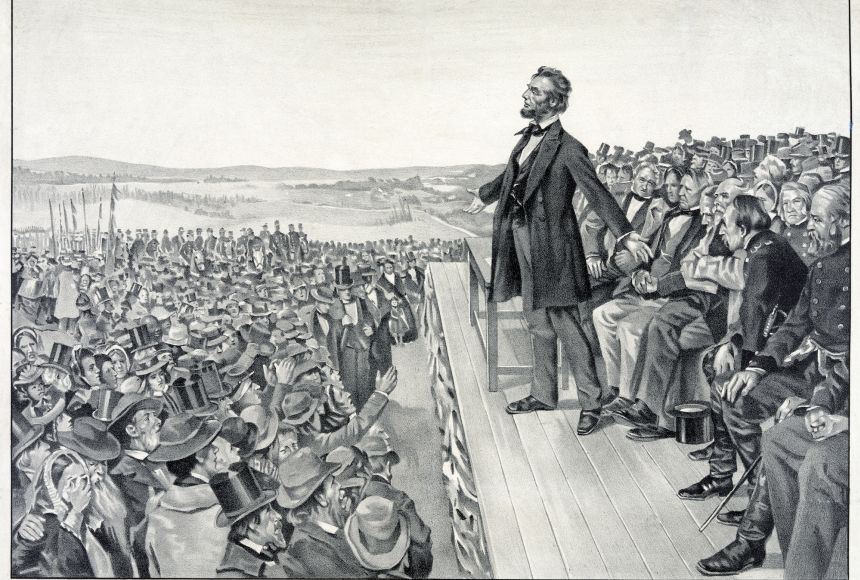
Four score and seven years ago our fathers brought forth, upon this continent, a new nation, conceived in liberty, and dedicated to the proposition that all men are created equal.

Now we are engaged in a great civil war, testing whether that nation, or any nation so conceived, and so dedicated, can long endure. We are met on a great battle field of that war. We come to dedicate a portion of it, as a final resting place for those who died here, that the nation might live. This we may, in all propriety do.

But, in a larger sense, we can not dedicate we can not consecrate we can not hallow, this ground The brave men, living and dead, who struggled here, have hallowed it, far above our poor power to add or detract. The world will little note, nor long remember what we say here; while it can never forget what they did here.

It is rather for us, the living, we here be dedicated to the great task remaining before us that, from these honored dead we take increased devotion to that cause for which they here, gave the last full measure of devotion that we here highly resolve these dead shall not have died in vain; that the nation, shall have a new birth of freedom, and that government of the people, by the people, for the people, shall not perish from the earth.

Abraham Lincoln’s remarks were made at the dedication of the National Cemetery on the Battlefield at Gettysburg, Pennsylvania on November 19, 1863, 160 years ago today.

This text, known as the Nicolay Copy is named for John G. Nicolay, President Lincoln’s personal secretary, this is considered the “first draft” of the speech, begun in Washington on White house stationery. The second page is writen on different paper stock, indicating it was finished in Gettysburg before the cemetery dedication began. Lincoln gave this draft to Nicolay, who went to Gettysburg with Lincoln and witnessed the speech. The Library of Congress owns this manuscript.

There are five handwritten copies of the text of the speech.

Two are noted as drafts and are named after Mr. Lincoln’s secretaries, the Nicolay Draft Copy and John Hay Draft Copy.

There is a great scene in history when then Secretary of State John Hay handed his copy to President Theodore Roosevelt who took the paper and forgot what he was holding and went to make several strong points, punctuating the air with the paper in his fist as he made his points, all the while his Secretary of State was trying to retrieve it.

Also interesting to note that when Mr. Roosevelt was sworn in as President, having had three years filling out the term of murdered William McKinley, he wore a ring that was lent by Mr. Hay.

The ring was fashioned to hold a lock of Mr. Lincoln’s hair.

But I digress.

Neither draft has the words ‘under God‘ after the words, that the Nation … in the last line.

Tradition has it that the night before the speech, Secretary of State William Seward talked Mr. Lincoln into adding the words at that spot.

The night before the big day, it was Secretary Seward who said,  “… We shall therefore be united, only one country, having one hope, one ambition, and one destiny … this government of ours – the freest, the best, the wisest and the happiest in the world – must be, and so far as we are concerned practically will be, immortal.”

There are three more copies of the text, all in Lincoln’s handwriting, all written later in response for a copy of his remarks and all three have the sentence as, that the nation, under God, shall have a new birth of freedom.

Hmmmmmmmmmmmm.

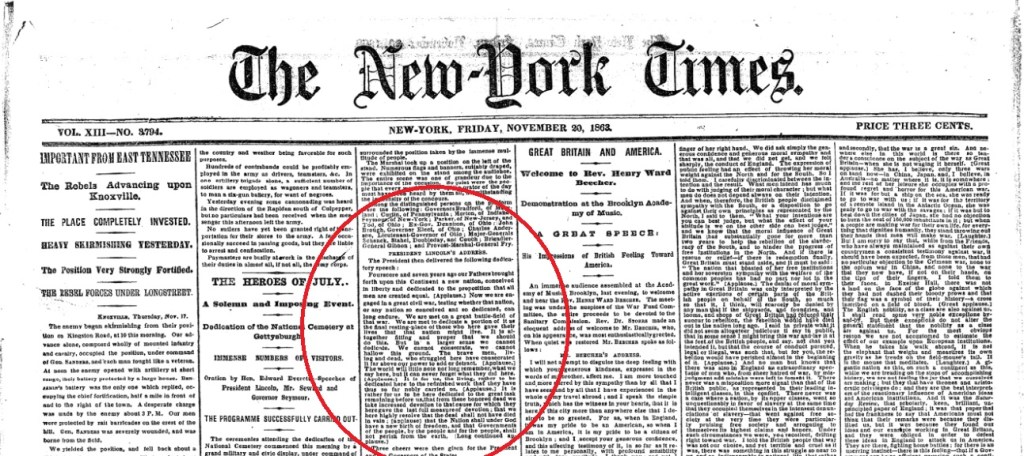
Interesting to be able to say that in the newspaper coverage of the day, the New York Times gave front page coverage to the events in Gettysburg that November afternoon and gave the full text of Mr. Lincoln’s short short remarks.

And in that text, are the words, Under God.
11.17.2023 – nothing but the truth

nothing but the truth
the whole truth, truer, more true
can’t handle the truth
?

I was writing up a report for work that discussed the google’s analytics and web site performance data.

I had just written the statement that recent changes by the Google to their tracking codes and tags, called GA4, that reports on web traffic would be truer than before.

I stopped and rewrote the line to say ‘more true’.

And that didn’t sound right either.

But it got me thinking.

You start with true.

You start with truth.

That’s kind of ground zero.

Down to the nub.

The basic.

Truth.

As defined, the quality or state of being true, that which is true or in accordance with fact or reality, or a fact or belief that is accepted as true.

Can there really be degrees of being true?

More true?

Truer?

Truest?

Mr. Aristotle is credited with saying, “To say of what is that it is, or of what is not that it is not, is true.”

Boy Howdy but that helps a whole lot don’t it?

I guess it comes down to, what do you choose to believe?

Back to my web stats report.

BTW I usually start to work on these web stats reports by asking my boss, “What do you want the web stats to be?|

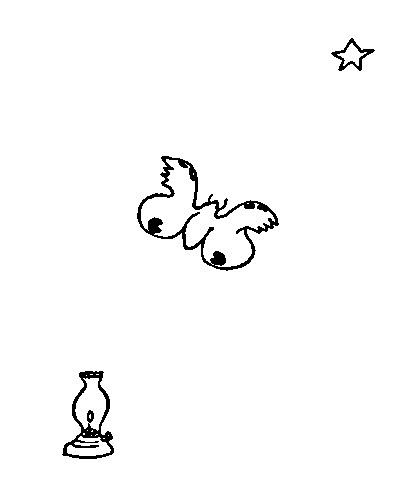
The Moth and the Star

A young and impressionable moth once set his heart on a certain star. He told his mother about this and she counseled him to set his heart on a bridge lamp instead. “Stars aren’t the thing to hang around,” she said; “lamps are the thing to hang around.” “You get somewhere that way,” said the moth’s father. “You don’t get anywhere chasing stars.” But the moth would not heed the words of either parent. Every evening at dusk when the star came out he would start flying toward it and every morning at dawn he would crawl back home worn out with his vain endeavor. One day his father said to him, “You haven’t burned a wing in months, boy, and it looks to me as if you were never going to. All your brothers have been badly burned flying around street lamps and all your sisters have been terribly singed flying around house lamps. Come on, now, get out of here and get yourself scorched! A big strapping moth like you without a mark on him!”

The moth left his father’s house, but he would not fly around street lamps and he would not fly around house lamps. He went right on trying to reach the star, which was four and one-third light years, or twenty-five trillion miles, away. The moth thought it was just caught in the top branches of an elm. He never did reach the star, but he went right on trying, night after night, and when he was a very, very old moth he began to think that he really had reached the star and he went around saying so. This gave him a deep and lasting pleasure, and he lived to a great old age. His parents and his brothers and his sisters had all been burned to death when they were quite young.

Moral: Who flies afar from the sphere of our sorrow is here today and here tomorrow.

11.16.2023 – nuances spoken

nuances spoken
delicate change – cloud and blue
and flimmering sun

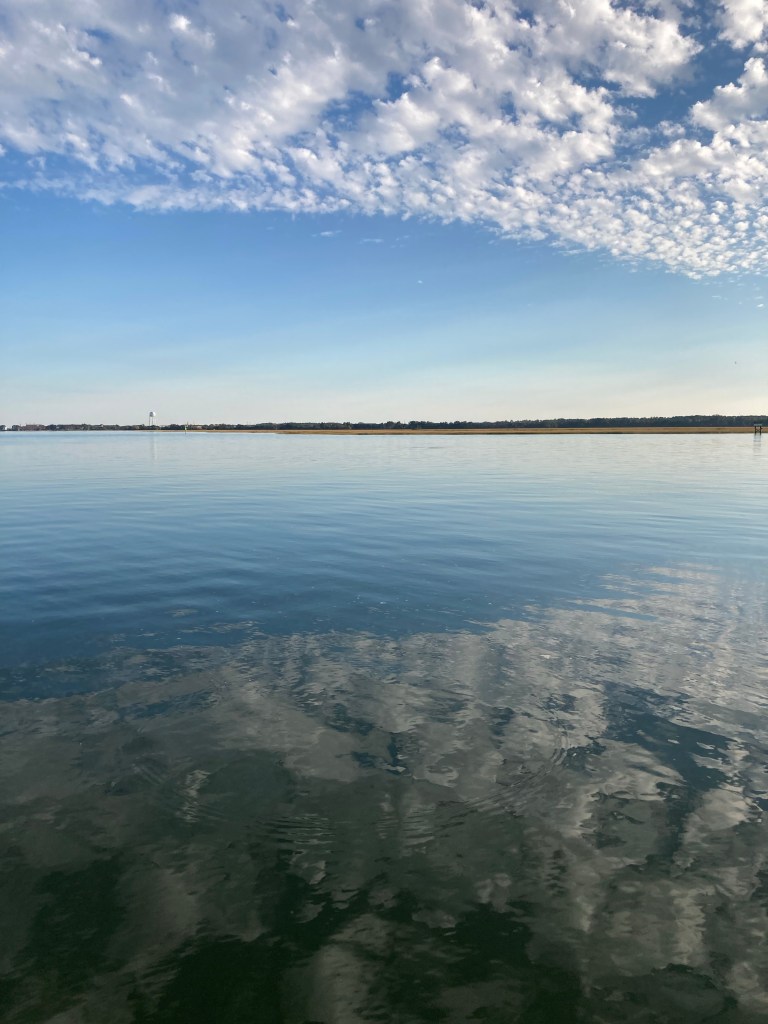
On a tip, the wife and I visited Sands Beach at Port Royal, South Carolina.

As the crow flies, its 13 miles from where we live.

To drive there, around the swamps and marches of the low country of South Carolina, its a 40 minute, 27 mile drive.

It is located at the southern tip of Port Royal Island where Battery Creek breaks off from the Beaufort River a few miles above Port Royal Sound.

The beach has a walkway along Battery Creek and a 4 story observation tower.

The view from the top of this tower helps you understand the meaning of ‘the low country.’

The day we were there, the water was still and blue and the surface reflected the sky and clouds in a way that defeated use of any words in the my dictionary.

I was reminded of the writing of Jenny Lawson who in her book, Furiously Happy, used the word, Concoctulary, which she footnoted, saying ” … a word that I just made up for words that you have to invent because they didn’t yet exist.”

Ms. Lawson doesn’t just invent words that you have to invent because they didn’t yet exist, she made a word for the words that you have to invent because they didn’t yet exist.

Concoctulary.

As Ms. Lawson writes, “… It’s a portmanteau of “concocted” and “vocabulary.” I was going to call it an “imaginary” (as a portmanteau of “imagined” and “dictionary”) but turns out that the word “imaginary” was already concoctularied, which is actually fine because “concoctulary” sounds sort of unintentionally dirty and is also great fun to say. Try it for yourself. Con-COC-chew-lary. It sings.”

So I needed a word for the way the clouds reflected in the blue still water of Batter Creek off of Sands Beach in Port Royal and I found flimmering.

Try it for yourself.

It sings.

No surprise to say that I didn’t invent it though.

Carl Sandburg did.

In his poem, Dream Girl, in the section Other Days of the book, Chicago Poems as reprinted in the Complete Poems of Carl Sandburg, Mr. Sandburg wrote:

You will come one day in a waver of love,
Tender as dew, impetuous as rain,
The tan of the sun will be on your skin,
The purr of the breeze in your murmuring speech,
You will pose with a hill-flower grace.

You will come, with your slim, expressive arms,
A poise of the head no sculptor has caught
And nuances spoken with shoulder and neck,
Your face in pass-and-repass of moods
As many as skies in delicate change
Of cloud and blue and flimmering sun.

Yet,
You may not come, O girl of a dream,
We may but pass as the world goes by
And take from a look of eyes into eyes,
A film of hope and a memoried day.

Flimmering.

As many as skies in delicate change
Of cloud and blue and flimmering sun.

It sings.

So does the view.

11.13.2023 – demand I make of

demand I make of
readers devote entire life
to reading my works

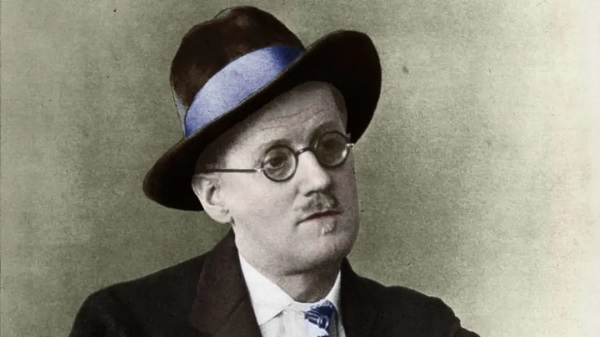
Joyce himself would probably be pleased to hear of these endeavors: he once described the perfect reader of Finnegans Wake as “suffering from an ideal insomnia”, and said: “The demand I make of my reader is that he should devote his entire life to reading my works.”

From the article, It never ends’: the book club that spent 28 years reading Finnegans Wake‘ by Lois  Beckett, a senior reporter for the Guardian who covers Los Angeles, with a focus on life, culture and communities. 

I take my hat off to anyone who takes James Joyce seriously.

Jazz great Roy Eldridge once said about the jazz great, Ornette Coleman that, “I listened to him high and I listened to him cold sober. I even played with him. I think he’s jiving baby.

I guess that’s me on Mr. Joyce.

But who am I?

Mr. Joyce has made a name for himself and somehow survives.

So I applaud the efforts of the the California reading group that spent longer reading Finnegans Wake than Joyce spent writing it.

And I resolved to give it another try.

I had a good friend who confided in me that every summer for years he resolved to read Joyce’s Ulysses and who get set up with a comfy seat outside with a bottle of whisky and never managed to get through the book before the whisky took him out of the game.

I opened up Finnegan’s Wake on my ereader and it took me all of 10 seconds to say OH GOOD GRIEF.

What am I missing?

Then I decided to have some fun with our modern tools.

First I copied this paragraph.

Bygmester Finnegan, of the Stuttering Hand, freemen’s maurer, lived in the broadest way immarginable in his rushlit toofarback for messuages before joshuan judges had given us numbers or Helviticus committed deuteronomy (one yeastyday he sternely struxk his tete in a tub for to watsch the future of his fates but ere he swiftly stook it out again, by the might of moses, the very water was eviparated and all the guenneses had met their exodus so that ought to show you what a pentschanjeuchy chap he was!) and during mighty odd years this man of hod, cement and edifices in Toper’s Thorp piled buildung supra buildung pon the banks for the livers by the Soangso. He addle liddle phifie Annie ugged the little craythur. Wither hayre in honds tuck up your part inher. Oftwhile balbulous, mithre ahead, with goodly trowel in grasp and ivoroiled overalls which he habitacularly fondseed, like Haroun Childeric Eggeberth he would caligulate by multiplicables the alltitude and malltitude until he seesaw by neatlight of the liquor wheretwin ’twas born, his roundhead staple of other days to rise in undress maisonry upstanded (joygrantit!), a waalworth of a skyerscape of most eyeful hoyth entowerly, erigenating from

Then I pasted it into Microsoft Word and graded it.

Let me report that Word DID NOT throw up or crash.

It found that the passage has 198 words and according to word, 47 are misspelled.

It got a reading scale of 32 with 100 being the easiest to understand.

All things considered, I felt 32 was a pretty high score.

It graded out at 19.7 or that you should be in the 19th grade to have this text as assigned reading.

Again, I thought that was pretty good.

Then I got really mean.

I pasted the text into an AI generator and asked it to REPHRASE the text and I got:

Bygmester Finnegan, a maurer from the Stuttering Hand, lived in a very broad way in his rushlit toofarback before the Joshua judges gave us numbers or Helviticus wrote Deuteronomy. One day, he stuck his head in a tub to observe his fate, but before he could take it out again, the water had evaporated and all the guenneses had left. This illustrates just how extraordinary a chap he was! Over many odd years, he piled buildung supra buildung on the banks of the Soangso in Toper’s Thorp for the local people. He also had a little craythur named Annie. With a trowel in hand, and overalls which he liked to wear, he would calculate the altitude and magnitude until he could see the liquor where it was born, and his roundhead staple of other days rose in undress maisonry upstanded, an awe-inspiring view of the skyline.

Then I asked AI to expand the text:

Bygmester Finnegan, of the Stuttering Hand, freemen’s maurer, lived in the broadest way immarginable in his rushlit toofarback for messuages before joshuan judges had given us numbers or Helviticus committed deuteronomy (one yeastyday he sternely struxk his tete in a tub for to watsch the future of his fates but ere he swiftly stook it out again, by the might of moses, the very water was eviparated and all the guenneses had met their exodus so that ought to show you what a pentschanjeuchy chap he was!) and during mighty odd years this man of hod, cement and edifices in Toper’s Thorp piled buildung supra buildung pon the banks for the livers by the Soangso. He addle liddle phifie Annie ugged the little craythur. Wither hayre in honds tuck up your part inher. Oftwhile balbulous, mithre ahead, with goodly trowel in grasp and ivoroiled overalls which he habitacularly fondseed, like Haroun Childeric Eggeberth he would caligulate by multiplicables the alltitude and malltitude until he seesaw by neatlight of the liquor wheretwin ’twas born, his roundhead staple of other days to rise in undress maisonry upstanded (joygrantit!), a waalworth of a skyerscape of most eyeful hoyth entowerly, erigenating from

Then I asked AI to summerize the text and I got:

Bygmester Finnegan was a freemen’s maurer who built many buildings in Toper’s Thorp. He was an intelligent man who could calculate the altitude and magnitude. He was also fond of his overalls, and was able to build a magnificent skyerscape of buildings.

Then I decided that for the feller who said, The demand I make of my reader is that he should devote his entire life to reading my works, I had given enough time of my morning.

More or less Mr. Duchamp’s R Mutt for literature.

But I have to think of the utter arrogance of the man.

Someone once worked out the math and said to me that if you read a book a week from age 10 to age 70 … you will read 3,120 books.

Those folks took 28 years of their reading on this one book.

Not saying of course that that was all that these folks read during this time.

I just think, well, that is just nutz.

Boy Howdy! buts that just wrong.

Wikipedia points (Oh the irony .. .quoting Wikipedia on James Joyce) out, “Due to its linguistic experiments, stream of consciousness writing style, literary allusions, free dream associations, and abandonment of narrative conventions, Finnegans Wake has been agreed to be a work largely unread by the general public”

But in the back of my head there is a little voice and I seem to remember that it is the voice of William Shirer, the CBS radio man and World War 2 witness, who said that he could never understand or bother with Finnegans Wake BUT he once attended a reading in Dublin and heard Joyce read it … and with his diction, phrasing and accents, it all became clear and wonderful.

Wish I could track down that thought and cite it.

I also wish I could have experienced it.

Listen to a recording of Charlotte’s Web read by EB White and you will understand.

As for Mr. Joyce, more power to him but I read him high and I read him cold sober.

I even collaborated with with him using AI.

I think he’s jiving baby.

111.11.2023 – life is nothing much

life is nothing much
to lose – young men think it is …
and we, we were young

Here dead we lie
Because we did not choose
To live and shame the land
From which we sprung.

Life, to be sure,
Is nothing much to lose,
But young men think it is,
And we were young.

Here dead we lie by AE Housman

French Cemetery at la Targette – World War One Battlefields

According to Wikipedia, “British poetry especially was transformed by the trauma of trench warfare and indiscriminate massacre.

The ‘War Poets’ constitute an imperative presence in modern British literature with significant writers such as Wilfred Owen, Robert Graves, Siegfried Sassoon, David Jones, Ivor Gurney, Rupert Brooke, Edward Thomas, and Isaac Rosenberg.

Their work, which combined stark realism and bitter irony with a sense of tragic futility, altered the history of English literature.

These scarred survivors reshaped the sensibility of modern verse.”