5.8.2024 – everything is jake

everything is jake
what is life but a bubble
I ask anyway

I was looking for a specific James Thurber quote about being content to sit in the backseat of a car, not drive and read the burma-shave signs and found this blog that reviews the back issues of the New Yorker Magazine.

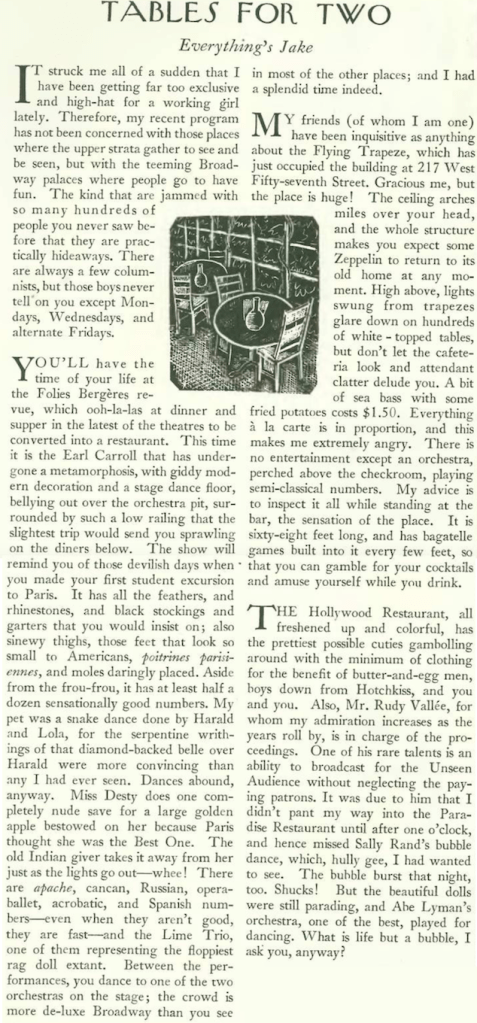
Scrolling through the posts, the column titled Table for Two and subtitled for this edition of the New Yorker, Everything’s Jake.

In the movie, The Sting, you might remember Robert Redford tells the waitress (the unknown hit lady assigned to kill Redford) to go open the window a back restroom saying, “Just do what I tell ya and everything’ll be jake.”

Everything’s Jake, according to Wikipedia  is “a slang expression from the Roaring Twenties in the United States, meaning “everything is in good order”.

The column was written by Lois Long, who at 23 years old, again according to Wikipedia, was hired to review the speakeasies of New York for the New Yorker. Her witty, satirical column was called “When Nights are Bold,” the title of which changed to “Tables for Two” with the issue for September 12, 1925 and ran until June 6, 1931.

In this column she closed with the line, “What is life but a bubble, I ask you, anyway?”

23 years old, living in New York during the Roaring 20’s and tasked with reviewing illegal speakeasies.

What is life but a bubble?

I ask you, anyway!

Everything is jake!


5.3.2024 – that something very

that something very
peculiar happening …
need to acknowledge

New York Times Opinion Columnist Paul Krugman was thinking about the question Ronald Reagan asked during a debate with Jimmy Carter back in 1980.

Mr. Reagan asked, “Are you better off now than you were 4 years ago?”

Mr. Krugman, in an Opinion Piece titled, The Peculiar Persistence of Trump-stalgia, pondered which of the two current Presidential Candidates comes off better asking that question.

Mr. Krugman writes, “So how can anyone think that the Reagan question favors Trump? Spoiler alert: I don’t have a full explanation. But at the very least, we need to acknowledge that something very peculiar is happening.

Mr. Krugman has been an Opinion columnist since 2000 and is also a distinguished professor at the City University of New York Graduate Center. He won the 2008 Nobel Memorial Prize in Economic Sciences for his work on international trade and economic geography.

And his opinion piece is a wonderful collections of ponderings on the economic patterns of the last 4 years.

But know what?

Who needs to confine his salient point to economics?

Mr. Krugman’s salient point being, as I see it, is at the very least, we need to acknowledge that something very peculiar is happening.

Boy Howdy, but at the very least, we need to acknowledge that something very peculiar is happening.

I am reminded of a baseball game I went to with my kids back in Grand Rapids, Michigan.

The home town team was the West Michigan Whitecaps, named after the white capped waves on Lake Michigan.

Of course the team wore Navy Blue caps with a wavy logo.

This night I am thinking of we were sitting in the Family Zone.

A section that was supposed to be family friendly with no drinking.

The whole stadium was no smoking of course.

The section was bench seating, bleachers with a back and me and my kids sat in a row

Another Dad sat with his kids in the same row.

Between me and the other Dad was a guy who looked like he played lead guitar for ZZ Top.

He had a heavy nylon biker jacker of some short and a baseball cap pulled down low and dark sunglasses.

He had long hair, a long beard down to his belt buckle and a long mustache flaring out over his cheeks and covering his mouth.

Peeking out from under his moustache was a cigarette that was replaced as soon as he finished smoking it.

In one hand was a beer.

The wind was such that the smoke went right into the face of this other Dad.

He looked like a nice enough guy with khaki slacks and a polo shirt and windbreaker topped off by a really nice haircut.

You know the type, a nice, well behaved, golf Buddy, at home in a world of people who followed rules.

Every time Mr. ZZ Top exhaled, Buddy would make a big show of waving at the smoke in front of his face.

Finally, he leaned over and said, “Sir, there is no smoking.”

Mr. ZZ Top reached up and with two fingers slowly removed the cigarette from his mouth, turned, ever so slowly, to Buddy and blew out a lungful of smoke and looked Buddy in the eye.

“No shit?” he said.

Mr. ZZ Top turned back to the game and returned the cigarette to his mouth.

Buddy caught my eye and I shrugged.

I wanted to say, at the very least, we need to acknowledge that something very peculiar is happening.

Thinking of Mr. Krugman’s article and its salient point, about all I can say is … well Mr. ZZ Top said it better than I ever could.

4.28.2024 – scarcely anyone …

scarcely anyone …
any time … can locate self
in meaningful sense

Adapted from the lines:

We achieve our dimensions for very specific reasons we ourselves ordain.

In other words, we already are, at any given moment, what we, in totality, wish to be.

Scarcely anyone at any given time can locate himself in a meaningful sense.

From the book, Sundog by Jim Harrison, Bantam Books, New York, 1985

4.27.2024 – my glaswegian

my glaswegian
friends would appreciate her nous
liverpudlian

Reading the column, ‘Blind Date’ in The Guardian with the header, “‘I warned him if he was less than complimentary, my girls would hunt him down“, where Trisha, 61, a yoga teacher, meets Neil, 65, a meditation teacher, I came to the question, Would you introduce Trisha to your friends?

Neil’s response was: Absolutely: my Glaswegian friends in particular would appreciate her Liverpudlian nous.

As Neil prefaced his statement with Absolutely that he would introduce Trisha to his friends, I decided that my Glaswegian friends in particular would appreciate her Liverpudlian nous was an accolade.

But what did it mean?

Blind Date is a short weekly feature in The Guardian made up of questions and answers from two people who are matched up at a restaurant for a ‘Blind Date’

In the responses this week, Glaswegian was used several times.

I had a feeling, more of a suspicion that the word might have something to do with Glasgow in Scotland, mostly from other allusions to Neil in the story but how do you get from Glasgow to Glaswegian?

I grew up in Michigan and we were either Michiganders or Michiganites while I preferred Michiganiac.

But Glaswegian?

Maybe he was a druid or a shepherd, like The Basques’ or something.

A little time with the Google and it turns out that it means someone who speaks the Glasgow dialect, also called Glaswegian.

I would make a comparison to the Low Country language known as Gullah but Gullah has been recognized as a ‘Language’ and Glaswegian is a dialect or a version of a language

From Wikipedia, “As with other dialects, it is subject to dialect levelling where particularly Scots vocabulary is replaced by Standard English words and, in particular, words largely from colloquial English. However, Glaswegians continue to create new euphemisms and nicknames for well-known local figures and buildings.”

Then it hit me that I had heard the word, Glaswegian, before.

In his travel book, Notes from a Small Country (London, Black Swan, 1991), about traveling around Great Britain, Bill Bryson tells the story of taking a cab to the Burrell Collection Museum in the Glasgow.

Mr. Bryson writes (and I am using his spelling):

Among the city’s many treasures, none shines brighter, in my view, than the Burrell Collection. After checking into my hotel, I hastened there now by taxi, for it is a long way out.
‘D’ye nae a lang roon?’ said the driver as we sped along a motorway towards Pollok Park by way of Clydebank and Oban.
‘I’m sorry,’ I said for I don’t speak Glaswegian.
D’ye dack ma fanny?’
I hate it when this happens – when a person from Glasgow speaks to me. ‘I’m so sorry,’ I said and floundered for an excuse. ‘My ears are very bad.’
Aye, ye nae hae doon a lang roon,’ he said, which I gathered meant ‘I’m going to take you a very long way around and look at you a lot with these menacing eyes of mine so that you’ll begin to wonder if perhaps I’m taking you to a disused warehouse where friends of mine are waiting to beat you up and take your money,’ but he said nothing further and delivered me at the Burrell without incident.

So much for Glaswegian.

That left Liverpudlian nous, which I reversed to nous Liverpudlian so I could hammer it into my Haiku but not sure it makes an difference.

I am guessing that nous, French for we (not oui which is French for yes, which may have been a big reason I left French to people like my niece Joann who teaches French to kids in Kansas City which by itself can boggle the mind but I digress) means something like nuance or that je ne sais quoi that one has by being from Liverpool.

When my Dad disembarked from the Queen Mary to the City of Liverpool in World War 2 he wrote my Mother that the city reminded him of Detroit … the bad parts.

Start with that and roll in the Beatles and I think you have the essence that is Liverpudlian nous.

So Neil feels that, absolutely, his friends, in particular the ones who spoke Glaswegian (‘D’ye nae a lang roon?) would appreciate Trish for that certain air that being from Liverpool brings to someone.

Indeed, a match that could only be made in heaven.

4.24.2024 – the mind uses all

the mind uses all
its senses to obtain, apply
some new idea

The inquiring mind uses all its senses to obtain some new idea, and to apply it to some useful purpose;

it is this spirit of research that has led to all the great results in Art and in the mechanical and chemical sciences, which we now enjoy and admire;

but it is only by very slow degrees, and by great perseverance, that such results are obtained, although the accumulation of a few years makes an enormous aggregate.

Look back a generation or two — where was then the steam-engine, where the tall stalks which indicate the sites of complicated and ingenious manufactures?

From the Introduction to The Boy’s Book of Industrial Information by Elisha Noyce, Illustrated by The Brothers Dalziel, Ward & Lock, London, 1858.

I can embrace that The inquiring mind uses all its senses to obtain some new idea.

It is the to apply it to some useful purpose that I worry about.

Isn’t it more that all the senses are used to obtain some new idea and then come up with the reason that this new idea, this new thing, is all the rage necessary not for fun, better life or anything good, but just so one isn’t left behind.

I sit in a room filled with computers that indicate the sites of complicated and ingenious manufactures.