swinging on a star take moon beams home in a jar moonlit morning hopes
The Google says that the Moon today is in a Waxing Gibbous phase. This phase is when the moon is more than 50% illuminated but not yet a Full Moon. The phase lasts round 7 days with the moon becoming more illuminated each day until the Full Moon.
It was cold and clear last night when my wife and I went for walk.
Cold for Georgia anyway.
Clear and lit by the Waxing Gibbous Moon.
Moonlight was strong enough that we cast shadows and the old song about catching moonbeams in a jar stuck in my brain.
Innocent and sweet thoughts to end the day.
When I left for work this morning that Waxing Gibbous Moon was still shining.
(When the Moon shows up the next night, the King worries that his daughter will notice. The Court Jester suggests asking the Princess how that happened when she has the Moon on a chain around her neck. The Princess replies “That is easy, silly,” she said. “When I lose a tooth, a new one grows in its place, doesn’t it?”)
Mr. Debussy’s prélude, La fille aux cheveux de lin (otherwise known as The Girl With The Flaxen Hair) was playing on the radio.
Where does this music come from?
A bad mood and crummy attitude that has been percolating inside me this week didn’t have a chance.
Like the Court Jester, I winked at the moon, “for it seemed to the Court Jester that the moon had winked at him.”
I am not sure what the difference in those things mean exactly but I am sure my good friends Chesley McNeil at WXIA or George Lessens at WZZM could explain it.
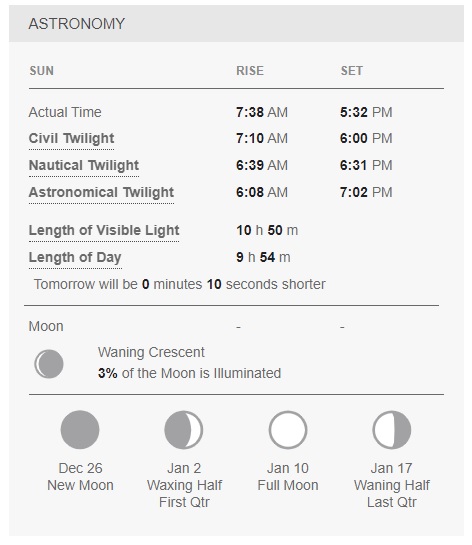
Here in Atlanta for December 17, there is 10 hours and 50 minutes of visible light.
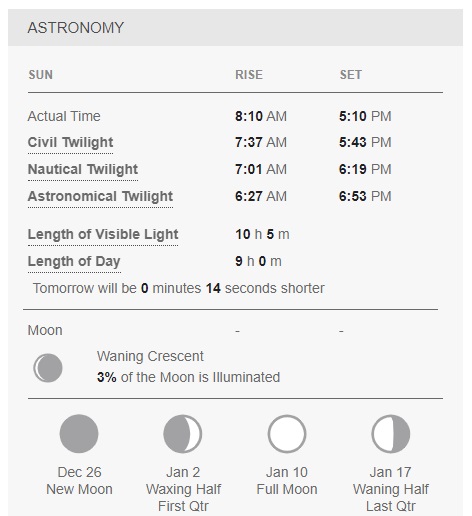
Further up the globe in Grand Rapids, there is 10 hours and 5 minutes of visible light.
There is more light down here in the south.
But if you compare the time from sunset to astronomical twilight, Grand Rapids comes out on top with a total of 103 minutes of total twilight compared to Atlanta’s 90 minutes.
We noticed this right away after we moved down here.
The sun comes up fast.
The sun goes down fast.
I look out the window in the evening and think we have time for a walk while it is still light.
By the time we get outside, it is full dark.
Not much color to dark.
Most likely if you were looking for a color based adjective for night time, the word you come up with is inky.
But daylight.
I have as much ability in art as I do in music.
I can look and listen.
I look at the colors of the day.
Pastels done in sidewalk chalk to capture the powdery pinks and blues of morning.
The strict separation of colors in oils for the full sun of noon.
Spreading wet watercolors on a damp piece of paper for the evening.
Alice Walker writes, “I think it pisses God off if you walk by the color purple in a field somewhere and don’t notice it.”
I am not going to stop my car and get out and look at the colors in the sky.
I am not going to get out my phone and take a picture of the sky (I know it wouldn’t work anyway).
But I think God would be pissed off if I, at the very least, didn’t notice the show in the sky.
weak upper impulse lingering secondary fairly pleasant start
Ernie Hemingway could not have been a meteorologist.
Mr. Hemingway’s prose can be described in the one word, terse.
A meteorologist’s prose can be describe in the one word, verbose.
Weather forecasts may be the best example of the use of descriptive adjectives in modern english writing.
Consider today’s forecast from the National Weather Service.
SHORT TERM /Today through Sunday/…
A lingering secondary weak upper impulse is allowing for some isolated light rain/drizzle potential mainly in portions of central GA early this morning, otherwise should transition to NW flow aloft and dry Saturday on tap. Some continued mid level moisture especially in central GA could keep some cloud coverage hanging around today. Should be a fairly pleasant start to the weekend with afternoon highs mostly in the low to mid 60s.
Surface high center sliding into New England this evening will result in a CAD wedge building in for Sunday across the area. We can expect a shift to cooler temps (about 10 degrees lower than Saturday across north GA), increased easterly gradient winds, and some low level moisture overrunning/isentropic upglide causing increased cloud coverage and some return of afternoon shower potential in parts of the south and west. Ascent and late shower potential could also be aided by a weak upper shortwave.
Baker
LONG TERM /Sunday Night through Friday/…
The long term period begins on Sunday night with a wedge still in place across northeast Georgia. As southwest flow advects moisture over the wedge, chances for showers will continue into the early hours on Monday. Have included slight chance pops for Sunday afternoon with increasing chances Sunday night into Monday afternoon, as the wedge breaks down. A large longwave trough will push a strong cold front towards the area on Tuesday into Wednesday with the arrival of the front during the day on Wednesday. Have included chance pops across much of the area with likely pops across portions of northern Georgia in addition to the mountains. The highest QPF amounts for Monday through Wednesday look to be across far northern Georgia, around 1 to 2 inches with around a half inch or less further south. In addition, models are showing some slight differences on the backside of this system with the GFS showing another shortwave trough developing and crossing the local forecast area late Wednesday into Thursday and the ECMWF, while still showing the shortwave trough, clears precip from the local forecast area by Thursday and takes the trough much further south of the area. Overall, decided to trend on the drier side for pops in this time period, with slight chance to chance pops Wednesday afternoon and clearing across the area on Thursday.
Post frontal passage, high pressure will build into the area at the surface, providing dry weather for Thursday. By Friday, chances for precipitation will increase again as models show a developing surface low in the Gulf moving towards the local forecast area on Friday and Saturday. Although models are showing some differences in timing, have included chance pops for Friday through the early weekend.
High temperatures on Monday and Tuesday will be about 5 to 15 degrees above average in the 60s and 70s, returning to the 40s and 50s through the rest of the extended. Overnight lows Tuesday morning will be very warm in the 50s and 60s, around 20 to 25 degrees above average. Otherwise, lows through the rest of the extended are expected to be in the 30s and 40s.
Reaves
Notice in the 2nd paragraph the abbreviation CAD.
CAD stands for ” Cold Air Damming. The phenomenon in which a low-level cold air mass is trapped topographically. Often, this cold air is entrenched on the east side of mountainous terrain. Cold Air Damming often implies that the trapped cold air mass is influencing the dynamics of the overlying air mass, e.g. in an overrunning scenario. Effects on the weather may include cold temperatures, freezing precipitation, and extensive cloud cover.”
Good Grief.
I can see why they used the abbreviation.
These are some of the words used in just the short term forecast.
lingering secondary weak upper isolated light mainly early mid especially fairly pleasant mostly low mid high cooler lower increased easterly gradient overrunning isentropic upglide
Impressive list.
Notice also the names Baker and Reeves and the end of the forecasts.
Are these the meteorologist who wrote these forecasts?
Did they learn this style in meteorology class?
Is there a special thesaurus for weather modifiers?
At the end, what do want to know?
I take my hat off to these people.
I salute these people.
I also recall once seeing my good friend George Lessens come into the newsroom after a particularity wordy forecast and I yelled, “oh come on. You guys make all the stuff up!”
Even George joined in as everyone in the newsroom laughed.
warm days never cease? mists and mellow fruitfulness? what happened to fall?
Temperatures across the continent plunge in a cruel mockery of autumnal thoughts of a “Close bosom-friend of the maturing sun.”
What happened to fall in this, the year of our Lord, 2019?
I have been informed that Keats was thinking about England when he penned this.
To Autumn BY JOHN KEATS
Season of mists and mellow fruitfulness, Close bosom-friend of the maturing sun; Conspiring with him how to load and bless With fruit the vines that round the thatch-eves run; To bend with apples the moss’d cottage-trees, And fill all fruit with ripeness to the core; To swell the gourd, and plump the hazel shells With a sweet kernel; to set budding more, And still more, later flowers for the bees, Until they think warm days will never cease, For summer has o’er-brimm’d their clammy cells.
Who hath not seen thee oft amid thy store?
Sometimes whoever seeks abroad may find
Thee sitting careless on a granary floor,
Thy hair soft-lifted by the winnowing wind;
Or on a half-reap’d furrow sound asleep,
Drows’d with the fume of poppies, while thy hook
Spares the next swath and all its twined flowers:
And sometimes like a gleaner thou dost keep
Steady thy laden head across a brook;
Or by a cyder-press, with patient look,
Thou watchest the last oozings hours by hours.
Where are the songs of spring? Ay, Where are they?
Think not of them, thou hast thy music too,—
While barred clouds bloom the soft-dying day,
And touch the stubble-plains with rosy hue;
Then in a wailful choir the small gnats mourn
Among the river sallows, borne aloft
Or sinking as the light wind lives or dies;
And full-grown lambs loud bleat from hilly bourn;
Hedge-crickets sing; and now with treble soft
The red-breast whistles from a garden-croft;
And gathering swallows twitter in the skies.
rainy Wednesday Piano Sonata 8 the perfect sound track
After a slow, gray and rainy commute, Beethoven’s Piano Sonata No. 8 in C minor, Op. 13, or the Pathétique, was playing on the radio.
Wikipedia reports that Beethoven’s Piano Sonata No. 8 in C minor, Op. 13, commonly known as Sonata Pathétique, was written in 1798 when the composer was 27 years old, and was published in 1799. It has remained one of his most celebrated compositions.
Although commonly thought to be one of the few works to be named by the composer himself, it was actually named Grande sonate pathétique by the publisher, who was impressed by the sonata’s tragic sonorities.
Wiktionary defines pathétique as (post-classical) full of pathos, affecting, pathetic.