6.12.2022 – festina lente

festina lente
make haste slowly in long run
but eat everyday

Festina Lente, in the latin, or ‘make haste slowly’ or ‘more haste, less speed.’

It has been adopted as a motto numerous times, particularly by the emperors Augustus and Titus, the Medicis and appears over and over in literature.

To combine the two concepts a logo of an anchor and a dolphin together was been devised.

According to Wikipedia, “The meaning of the phrase is that activities should be performed with a proper balance of urgency and diligence. If tasks are rushed too quickly then mistakes are made and good long-term results are not achieved. Work is best done in a state of flow in which one is fully engaged by the task and there is no sense of time passing.”

I am reminded of this phrase, ‘festina lente’, as I watch this country and this government deal with the problems of high inflation, high cost of food, high cost of housing, high cost of fuel, high human cost of guns, lack of baby formula, and any number of the current crisis’s that are today’s news.

Festina lente is the watchword from history for today.

Responses to these problems should be performed with a proper balance of urgency and diligence.

If tasks are rushed too quickly then mistakes are made and good long-term results are not achieved.

We can all agree on that, right?

I am reminded of a time in the history of the United States called the Great Depression.

The people of America finally got so fed up with the festina lente attitude of the Government in Washington that in one if the great electoral upheavals of all time, they voted in Franklin Roosevelt and the New Deal.

President Roosevelt appointed social worker, Harry Hopkins as the Secretary of Commerce and in that role, the day after the inauguration in March of 1933, Mr. Hopkins started spending money to provide relief in the form of food and housing.

He was told he couldn’t do that.

He was told that such a program could not work.

He was told that giving out money that way would not succeed in the long run.

Mr. Hopkins replied, “People don’t eat in the long run, they eat every day.”
6.10.2022 – day age we live in

day age we live in
you’re entitled to hate them
you know what I mean?

“And I think that the day and age that we live in now, it’s just so negative that you see it in everything. Sport, politics, whatever it is, it’s like if you disagree with someone you just feel that you’re entitled to like hate them and talk bad about them and just bash their decision, when everybody’s entitled to their own opinion, you know what I mean?”

PGA Golfer Justin Thomas commenting on the pro golfers who opted to play in the new Saudi backed golf league … and about life in the United States in general.

Back in the day, I think there were just as many opinions and just as many thoughts but if you wanted to express them to the world at large you wrote a letter to the editor of the local paper or called AM talk radio.

Since few people read editorials and fewer people listened to AM talk radio, the opinions were muffled.

Today, all anyone has to do is voice their opinion on social media and their opinions are amplified beyond the wildest imaginations.

Of all the emotions available, it seems that giving into rage, giving into hate, are the most embraced by social media.

I don’t watch the Simpson’s often but I saw the one where Homer went on a work’s outing to the local minor league baseball team and was warned by his wife to not make a drunken fool of himself.

Homer replied that he ‘ … had a ticket! A ticket which gives me the right … no … the OBLIGATION to make a drunken fool of myself.’

As Mr. Thomas said, today we feel ‘entitled to hate.’

The only thing that is left is for when we are obligated to hate.

Sounds stupid until it is remembered that this was not beyond anyone’s wildest imagination and in the book, 1984, by George Orwell, every day all the employee’s gather in the lunch room for the required ’10 minute hate.’

It’s the day and age that we live in now.

You know what I mean?

6.8.2022 – has nearly worried

has nearly worried
the life out of me at times
I should be sorry

Sometime history can come alive for me and I have to talk about it.

I have been fighting my way through the Civil War campaigns of Ulysses S. Grant this summer.

I started Chattanooga and have worked backwards in time through Vicksburg and am now in the middle of the Shiloh campaign.

In my reading, I came across a minor character by the name of Col. Thomas Worthington, of the 46th Ohio Volunteer Infantry.

By all accounts the Colonel, a graduate of West Point in 1827, was a perfect pest of a person.

General Sherman especially found the man to be beyond belief and took pains to describe him in ways so that others would understand how unbelievably bad the feller was.

The accounts in the books I was reading were so overwhelming in both their statements on the man’s inability and the total agreement of all the authors that the man was useless and his own worst enemy that I had to stop for a minute.

Could this Colonel Worthington have been such a jerk?

Or, after the passage of time, when history revealed that General’s Grant and Sherman were great officers, that it became open season on anyone who didn’t recognize their virtue at the time and everyone is just jam piling on poor Colonel Worthington.

I had never heard of the guy to be honest and I thought could he really have been so bad?

So I searched him out.

With the wonder that can be the World Wide Web, I found copies of two letters about the Colonel that were written back in 1864.

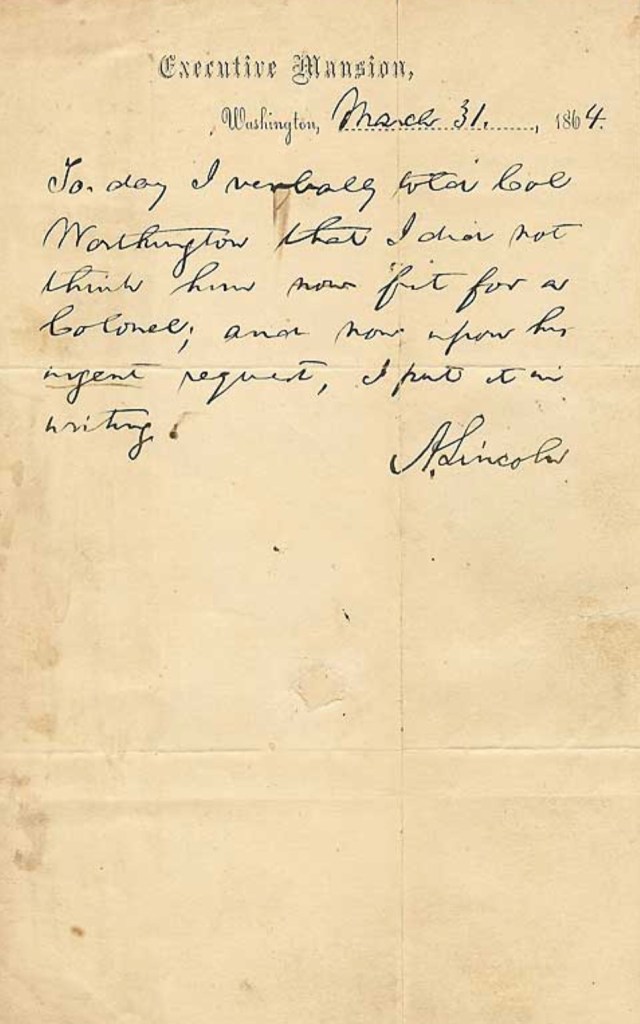
The first one is hand written and states simply:

“Today I verbally told Col Worthington that I did not think him now fit for a Colonel; and now upon his urgent request, I put it in writing.”

The note is on letter paper printed with the heading, EXECUTIVE MANSION, Washington.

It is dated, March 31, 1864.

It is signed, A. Lincoln.

Okay.

So maybe the Colonel was unwell and was requesting permission for sick leave and that is what Mr. Lincoln meant when he told him he was ‘not fit for a Colonel.”

Yeah, maybe.

The Colonel came back later to see Mr. Lincoln a few months later and this time, the President tried send him off to someone else.

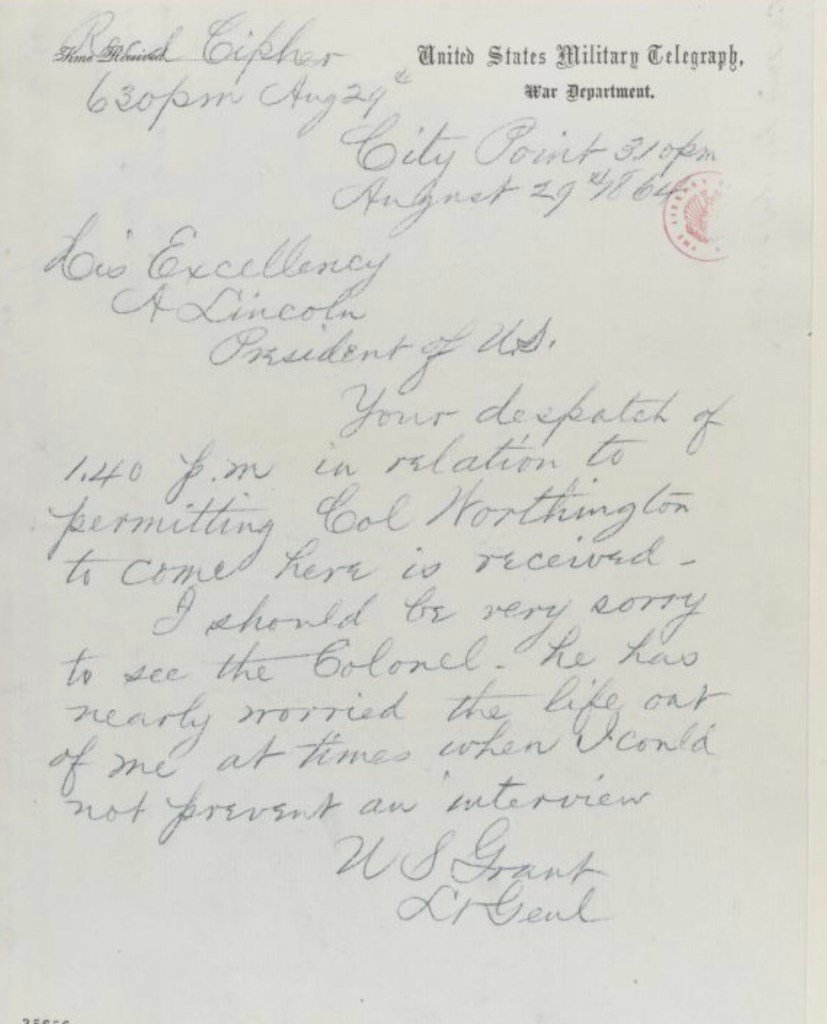
The other letter is actually a transcription of a telegram:

It is dated: (Recd Cipher – 6:30pm) City Point, 3:10pm August 29, 1864.

It is addressed to:

His Excellency., A Lincoln, President of the US.

It states:

Your dispatch of 1.40 p.m. in relation to permitting Col. Worthington to come here is received.

I should be very sorry to see the Colonel. He has nearly worried the life out of me at times when I could not prevent an interview.

It is signed, US Grant, LT General.

Ahhhhhhhhhhhhhhhhhhh.

I can imagine Mr. Lincoln laughing as he sent off his message to the General.

I can hear him say, “Grant will love this.”

It took the General less than 2 hours to get the telegram from the President, think about it and dictate his reply and get the reply encoded and say, nope, not me, don’t send him here.

That those two guys took time out from the Civil War to play guess who’s coming to dinner made me laugh.

It made them a little more real.

All respect to Colonel Thomas Worthington, but if Abraham Lincoln and US Grant felt this way I have to feel that the verdict of history has been just.

Colonel, you must have been one world record of a pest.

6.1.2021 – insecurity

insecurity
flatlining pay are every
day reality

From the paragraph:

In fact, for millions of people in Britain, 2022’s growing sense of disaster is another chapter in a story that goes back at least 10 years – to rules and regulations that turned the welfare state into a mess of trapdoors and tripwires, to the hacking back of benefits, to the dire treatment of disabled people and to a new world of work where chronic insecurity and flatlining pay are an everyday reality.

In the article, The decade that broke Britain: the disastrous decisions that left millions in a cost of living crisis by John Harris.

What struck me is the thought that I have been focused on the Covid years of late and all the issues it has caused.

This article (based in Britain but a lot of applies here) made me realize how long, going back to the the Housing Market crash of 2009 and the first time I got fired by the same company.

Talk about insecurity.

Back in 2009 the company I was working for called me into the office on a Tuesday and I was told my job had been eliminated and that my last day would be Friday.

In the next sentence, I was told that the company was creating a new corporate department and that I was wanted to be on that team and I was offered the same job I was doing but if I wanted it, I would be doing that same job in Atlanta.

So off to Atlanta we dragged all the kids and that chapter of our life started.

Then in 2020, I got call to be in a meeting on a Tuesday and once again I was told that my job had been eliminated and my last day would again be Friday.

The first time it happened, I felt it was the current economic climate.

The 2nd time it was pure spite and meanness and people who I worked with turning out to pretty small people.

If you read this blog, you will know this turned out okay for me but do I have trust in my job, any job?

Do I jump any time I get a note to be in a meeting?

Is my insecurity part of my every day reality?

BOY HOWDY!

5.30.2022 – piece of cloth, a sound

piece of cloth, a sound
make something not cloth nor sound
totems of love, hate

Adapted from the passage:

A flag is a piece of cloth and a word is a sound,
But we make them something neither cloth nor a sound,
Totems of love and hate

From the poem, John Brown’s Body by Stephen Vincent Benét.

According to Wikipedia

, John Brown’s Body (1928) is an epic American poem written by Stephen Vincent Benét. Its title references the radical abolitionist John Brown, who raided the federal armory at Harpers Ferry in Virginia in October 1859. He was captured and hanged later that year. Benét’s poem covers the history of the American Civil War. It won the Pulitzer Prize for Poetry in 1929.

The photo is of my Great Great Grand Fathers grave.

When he was 18, he joined the 16th Michigan Volunteer Infantry and later fought in Virginia and wounded in action at the Battle of Gaines Mill on June 27, 1862.

Here is a larger extract from the poem.

One cannot balance tragedy in the scales
Unless one weighs it with the tragic heart.
The other man’s tragedy was the greater one
Since the blind fury tore the huger heart,
But this man’s tragedy is the more pitiful.
Thus the Eastern board and the two defended kings.
But why is the game so ordered, what crowns the kings?
They are cities of streets and houses like other cities.
Baltimore might be taken, and war go on,
Atlanta will be taken and war go on,
Why should these two near cities be otherwise?
We do not fight for the real but for shadows we make.
A flag is a piece of cloth and a word is a sound,
But we make them something neither cloth nor a sound,
Totems of love and hate, black sorcery-stones,
So with these cities.

Even today, We do not fight for the real but for shadows we make.

A flag is a piece of cloth and a word is a sound.

But we make them something neither cloth nor a sound, Totems of love and hate.