pick and choose numbers that tell you what you want and glue them together
Adapted from the last paragraph of the article, The Humbug Economy, by Paul Krugman in the New York Times.
Writing about the current economic climate, Mr. Krugamn stated:
Overall, the picture appears consistent with a “soft landing” — a slowdown that falls short of a full-on recession, or involves a mild recession at worst, together with stabilizing inflation.
But, of course, we don’t know that. In fact, given the wide discrepancies in economic data, economic pundits (including me) have unusual freedom to believe whatever they want to believe. Just pick and choose the numbers that tell you what you want to hear and glue them together.
He also stated:
Are you confused? You should be. I’ve been in this business a long time, and I can’t remember any period when economic numbers were telling such different stories. On the other hand, we’ve never before faced the kind of shocks we’ve gone through in the past few years: Both the pandemic-induced recession and the recovery from that recession were, to use the technical term, weird, and maybe we shouldn’t be surprised the measures we normally use to track the economy aren’t working too well.
Hmmmmmmmmmmmmmmmm.
Both the pandemic-induced recession and the recovery from that recession were, to use the technical term, weird, and maybe we shouldn’t be surprised the measures we normally use to track the economy aren’t working too well.
Got to love the use of the technical term, weird!
And the warning that we shouldn’t be surprised the measures we normally use to track the economy aren’t working too well?
The people of America responded to the news of Kennedy’s assassination and the continuing televised reports of every subsequent happening with a state of shock that went beyond mourning to something approaching melancholia, a serious collapse of self-esteem. With the assassination, something more than a man had been lost, something more abstract and more compelling – a part of America’s faith in itself as a good society.
The line, something more than a man had been lost, something more abstract and more compelling – a part of America’s faith in itself as a good society, hit me.
America’s faith in itself as a good society.
I admit much of that faith was a hypocrisy.
But it was a useful hypocrisy.
Recent political turmoil over, well, politics and Covid and any number of other issues of late have ripped the scab off the hypocrisy and left folks, not wondering if we have lost a part of America’s faith in itself as a good society but now QUESTIONING even if America was, is or can be, a good society.
I like to think that Mr. Lincoln was right when he said the United States was, “… the last best hope of earth.”
Maybe Mr. Lincoln is right, its just that the bar to being recognized as the last best hope of earth was a lot lower than I ever thought.
Again, the passage quoted from Ms. Godwin is about the United States after the assassination of President John F. Kennedy.
The time has come for Americans of all races and creeds and political beliefs to understand and to respect one another.
So let us put an end to the teaching and the preaching of hate and evil and violence.
Let us turn away from the fanatics of the far left and the far right, from the apostles of bitterness and bigotry, from those defiant of law, and those who pour venom into our Nation’s bloodstream.
As Mr. Lincoln put it in his December, 1862 Annual Address to Congress, “We must disenthrall ourselves, and then we shall save our country.”
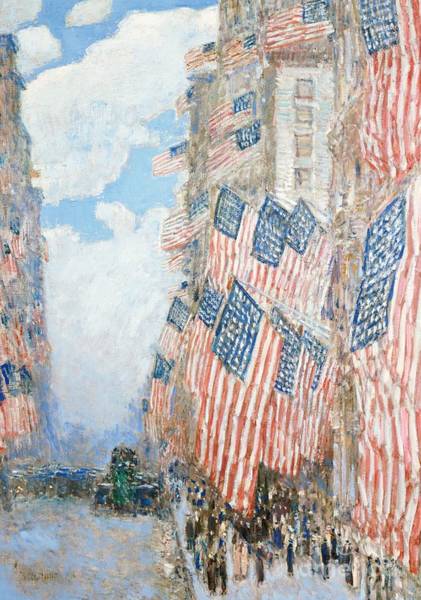
The Fourth of July, 1916 (The Greatest Display of the American Flag Ever Seen in New York, Climax of the Preparedness Parade in May) by Childe Hassam (1859-1935)
laughter, singing rang again, all the sounds of the earth were like music
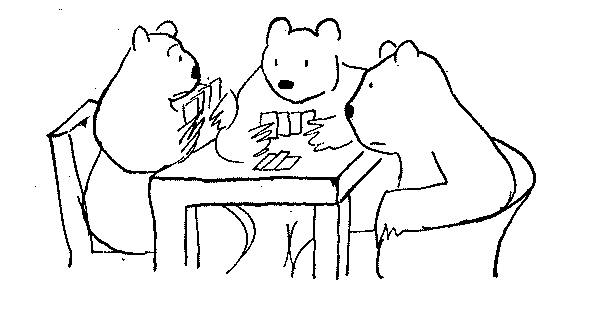
Adapted from James Thurber’s Further Fable, “The Bears and the Monkeys.”
I have used this fable of Mr. Thurber’s before.
I will most likely use again and if I don’t use it again, I will read it again and most likely often.
The fable is an analogy on the red scare of the McCarthy era when folks were afraid to think for themselves and wake up to find out they were accused of being a communist.
It was better to let someone else do the thinking for you than risk being labeled being part of the red threat or a pinko commie sympathiser.
So they thinking went according to the monkeys.
When I first read this probably 50 years ago when I was a kid, I think I was able to grasp the meaning that folks do not want anyone telling them what to.
Maybe I was thinking along the lines of Mr. Lincoln’s “as I would not be a slave, so I would not be a master.”
I thought the story noble in its’ irony.
I read it today not in with humor but with horror.
I read it today and feel that the irony now goes over most folks heads.
I read the line, “By sparing you the burden of electing your leaders, we save you from the dangers of choice. No more secret ballots, everything open and aboveboard.” and I hear folks yelling, “YESSIR, THAT’S IT!”.
As Mr. Twain wrote in Huckleberry Finn, “Hain’t we got all the fools in town on our side? And hain’t that a big enough majority in any town?”
BOY Howdy 😦
I still somehow have hope.
Maybe its more I want to refuse to be hope-less.
But I do hope that one day folks will break the chains of their new freedom and found their way back to the deep forest and begin playing leap-bear again and stealing honey and buns from the nearby cottages. And folk’s laughter and gaiety will ring through the forest, and birds that had ceased singing begin singing again, and all the sounds of the earth will be like music.
The Bears and the Monkeys.
In a deep forest there lived many bears. They spent the winter sleeping, and the summer playing leap-bear and stealing honey and buns from nearby cottages. One day a fast-talking monkey named Glib showed up and told them that their way of life was bad for bears. “You are prisoners of pastime,” he said, “addicted to leap-bear, and slaves of honey and buns.”
The bears were impressed and frightened as Glib went on talking. “Your forebears have done this to you,” he said. Glib was so glib, glibber than the glibbest monkey they had ever seen before, that the bears believed he must know more than they knew, or than anybody else. But when he left, to tell other species what was the matter with them, the bears reverted to their fun and games and their theft of buns and honey.
Their decadence made them bright of eye, light of heart, and quick of paw, and they had a wonderful time, living as bears had always lived, until one day two of Glib’s successors appeared, named Monkey Say and Monkey Do. They were even glibber than Glib, and they brought many presents and smiled all the time. “We have come to liberate you from freedom,” they said. “This is the New Liberation, twice as good as the old, since there are two of us.”
So each bear was made to wear a collar, and the collars were linked together with chains, and Monkey Do put a ring in the lead bear’s nose, and a chain on the lead bear’s ring. “Now you are free to do what I tell you to do,” said Monkey Do.
“Now you are free to say what I want you to say,” said Monkey Say. “By sparing you the burden of electing your leaders, we save you from the dangers of choice. No more secret ballots, everything open and aboveboard.” For a long time the bears submitted to the New Liberation, and chanted the slogan the monkeys had taught them: “Why stand on your own two feet when you can stand on ours?”
Then one day they broke the chains of their new freedom and found their way back to the deep forest and began playing leap-bear again and stealing honey and buns from the nearby cottages. And their laughter and gaiety rang through the forest, and birds that had ceased singing began singing again, and all the sounds of the earth were like music.
MORAL: It is better to have the ring of freedom in your ears than in your nose.
this stormy present occasion is piled high with difficulty
Again and again I keep coming back to Abraham Lincoln’s 1862 Annual Address to Congress when he wrote ( and I saw wrote as the speech, now known as the State of the Union, was not delivered by the President in person until Woodrow Wilson first did it in 1913) so this speech was read to Congress by a clerk.
Mr. Lincoln closed this address with these words.
The dogmas of the quiet past are inadequate to the stormy present.
The occasion is piled high with difficulty, and we must rise with the occasion.
As our case is new, so we must think anew, and act anew.
We must disenthrall ourselves, and then we shall save our country.
Fellow-citizens, we cannot escape history.
We of this Congress and this administration, will be remembered in spite of ourselves.
No personal significance, or insignificance, can spare one or another of us.
The fiery trial through which we pass, will light us down, in honor or dishonor, to the latest generation.
We say we are for the Union.
The world will not forget that we say this.
We know how to save the Union.
The world knows we do know how to save it.
We, even we here, hold the power, and bear the responsibility.
In giving freedom to the slave, we assure freedom to the free — honorable alike in what we give, and what we preserve.
We shall nobly save or meanly lose the last best hope of earth.
Other means may succeed; this could not fail.
The way is plain, peaceful, generous, just — a way which if followed, the world will forever applaud, and God must forever bless.
they did not value resources, communities historic nature
Today’s haiku is adapted from a quote from US Representative Teresa Leger Fernández of New Mexico when she made a statement about the US Forest Service and that they made multiple miscalculations, used inaccurate models and underestimated how dry conditions were in the south-west, causing a planned burn to reduce the threat of wildfires to explode into the largest blaze in New Mexico’s recorded history.
Representative Fernández said, “These are complex issues. Starting a prescribed burn in an area where there are homes and watersheds and communities should be something that you take incredibly seriously because those are high value assets. They did not value the resources, the communities, the historic nature of these communities and so they went forward allowing more risk than they should have.”
She was speaking about forest management.
You could easily think she was talking about any number of things in the news right now.
When talking about right now I must be talking about rights.
Right to vote.
Right to have your vote counted.
Curious how right and right are the some word.
The online Merriam-Webster defines the words like this:
>Something to which one has a just claim.
>Conforming to facts or truth.
>Being in accordance with what is just, good, or proper.
>Qualities (such as adherence to duty or obedience to lawful authority) that together constitute the ideal of moral propriety or merit moral approval.
My thought this morning was to write about how difficult it has been of late to construct a daily haiku and write some commentary in a light hearted way when I am feeling anything but lighthearted.
I saw this quote of Representative Fernández’s and thought how easy it would be to use the words in a commentary on how so many decisions and actions are being taken today without any consideration to the value the resources, the communities, the historic nature of these communities and so they went forward allowing more risk than they should have.
Then by chance I hit that word right.
Seems there has been a major disconnect on the importance of this word.
Right.
Rights.
Right rights.
I am reminded of Proverbs 21:3 (NIV) –
To do what is right and just is more acceptable to the LORD than sacrifice.
It was a long time ago but I had to take a class in school to learn how to drive a car.
It was a free class offered by the Grand Rapids Public Schools, all you had to do was sign up.
The only restriction was that you had to turn 16 years old, legal driving age, either before the class started or by the time it finished to sign up.
In the winter of 1976, for reasons I have never understood, my Dad was interested in my getting a drivers license.
At the same time he also took a life insurance policy out of me.
Maybe he thought it was a good investment.
It was January and my birthday was in July and I knew that I couldn’t sign up until then but he kept after me to sign up for drivers ed.
Maybe he just wanted to avoid another summer of having a kid in drivers ed instead of during the school year.
To make him happy I went into the office and asked for a registration card and filled it out and dropped it in the office inbox and forgot about it.
I can’t say I have had many you-could-knock-me-over-with-a-feather shocks in my life but a week later, this would have been January still, I was walking home from school in the snow with my buddies when my Dad pulled up next to us in his car, rolled down the window and said, “get in.”
This NEVER HAPPENED.
The first thing that went through my mind was to examine my conscience to figure out what I done wrong.
Truthfully, the list was so long I most likely didn’t know where to start.
My buddies all looked at me with that oh-are-you-in-trouble look and they all moved away from me to get away from any possible shrapnel.
Very slowly and tentatively I opened the car door and got in my Dad’s car.
My Dad’s car was one of the pleasures’ he allowed himself to indulge in.
My Dad had driven a Thunderbird convertible in the early 1960’s when there might not have been a more coveted car in America.
He updated that to the Buick Riviera, which in the late ’60s had POWER EVERYTHING.
From the Riviera, he got a 1976 two door navy blue Mercury Cougar.
It was this car I was now sitting in.
15 years old and I learned how to drive in this car
Sitting in the front seat and waiting to find out what I had done.
My stomach was doing all kinds of calisthenics and I kept my mouth shut.
My Dad drove pulled away from the curb and said, “We are going to the park so I can show you have to drive. School called and you have Driver’s Ed at 4 o’clock!”
HUhhhhhhhhhhhhhh whaaaaaaaaaaaaaaaaaaaaaa?
Talk about you-could-knock-me-over-with-a-feather!
We got to the nearby Riverside Park and I was put in the drivers seat of my Dad’s Cougar and on a snow covered park road, I got a quick lesson in how to start a car, put it in gear and drive.
While I drove, my Dad explained that School had called and said that due to a cancellation there was an opening in the Drivers Ed class that started that day.
As it happened, my card was sitting out on the desk and the school was calling to see if I was eligible for the class.
See, when I filled out the card, I put my birthday as being in July, 1976!
The current year.
The school was calling to check if was old enough.
In other words, had I been born in 1959 (when I had been born in 1960).
My Dad said that my Mom had taken the call and she looked at Dad and asked what to say.
“TELL THEM YES!,” my Dad said.
About an hour later, I was dropped off back at school and found the Drivers Ed class where the teacher had my card in his hand.
“You Hoffman?” he asked.
I said yes and the class started.
The teacher started talking to the class about driving and getting a drivers license.