
couldn’t get married
because there’s crazy people
in his ancestors
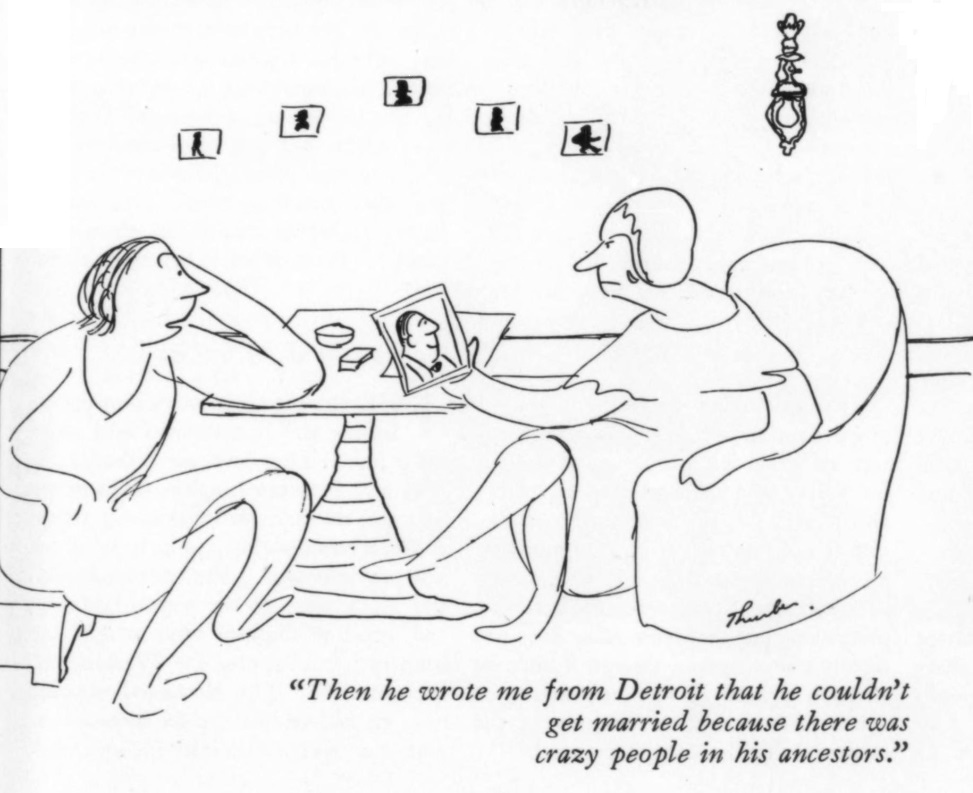
I am not sure, but I am pretty sure, this James Thurber drawing was never released beyond it’s original publication the New Yorker Magazine on April 9, 1932.
couldn’t get married
because there’s crazy people
in his ancestors
I am not sure, but I am pretty sure, this James Thurber drawing was never released beyond it’s original publication the New Yorker Magazine on April 9, 1932.
better look fast … there
go the most intelligent …
of all animals
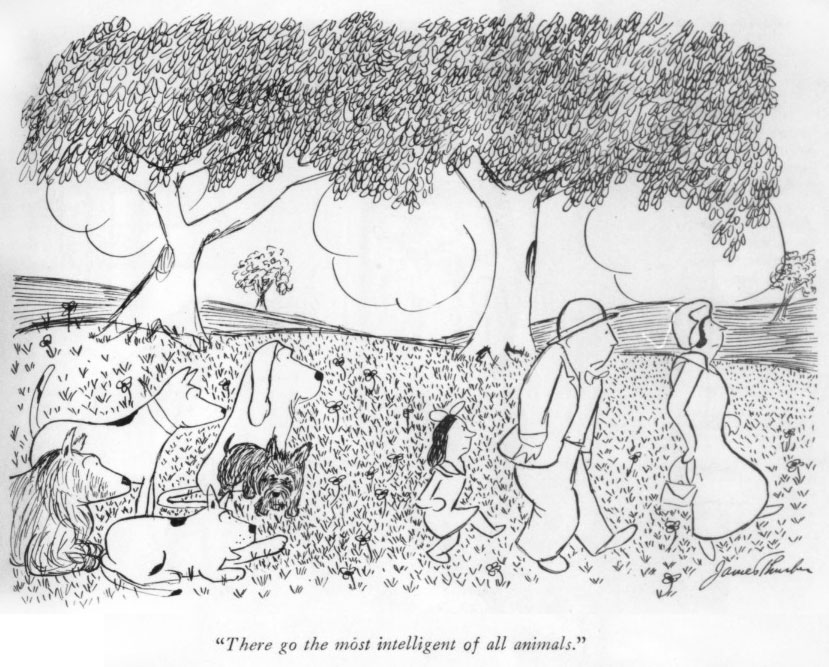
Some how, some where, I feel some one or some body is looking down at us and is saying … some thing … went wrong here.
James Thurber Drawing – New Yorker Magazine, July 24, 1937
strive to learn before
they die what they are running
from, and to, and why …

The Shore and the Sea
A single excited lemming started the exodus, crying, “Fire!” and running toward the sea. He may have seen the sunrise through the trees, or waked from a fiery nightmare, or struck his head against a stone, producing stars. Whatever it was, he ran and ran, and as he ran he was joined by others, a mother lemming and her young, a night watch lemming on his way home to bed, and assorted revelers and early risers.
“The world is coming to an end!” they shouted, and as the hurrying hundreds turned into thousands, the reasons for their headlong flight increased by leaps and bounds and hops and skips and jumps.
“The devil has come in a red chariot!” cried an elderly male. “The sun is his torch! The world is on fire!”
“It’s a pleasure jaunt,” squeaked an elderly female.
“A what?” she was asked.
“A treasure hunt!” cried a wild-eyed male who had been up all night. “Full many a gem of purest ray serene the dark unfathomed caves of ocean bear.”
“It’s a bear!” shouted his daughter. “Go it!” And there were those among the fleeing thousands who shouted “Goats!” and “Ghosts!” until there were almost as many different alarms as there were fugitives.
One male lemming who had lived alone for many years refused to be drawn into the stampede that swept past his cave like a flood. He saw no flames in the forest, and no devil, or bear, or goat, or ghost. He had long ago decided, since he was a serious scholar, that the caves of ocean bear no gems, but only soggy glub and great gobs of mucky gump. And so he watched the other lemmings leap into the sea and disappear beneath the waves, some crying “We are saved!” and some crying “We are lost!” The scholarly lemming shook his head sorrowfully, tore up what he had written through the years about his species, and started his studies all over again.
MORAL: All men should strive to learn before they die what they are running from, and to, and why.
From Further Fables for Our Time by James Thurber, published in Great Britain 1956 by Hamish Hamilton Ltd.
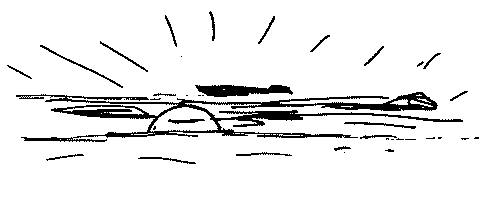
trying to escape,
and as you know, this is no
world for escapists
The Rabbits Who Caused All the Trouble
Within the memory of the youngest child there was a family of rabbits who lived near a pack of wolves. The wolves announced that they did not like the way the rabbits were living. (The wolves were crazy about the way they themselves were living, because it was the only way to live.) One night several wolves were killed in an earthquake and this was blamed on the rabbits, for it is well known that rabbits pound on the ground with their hind legs and cause earthquakes. On another night one of the wolves was killed by a bolt of lightning and this was also blamed on the rabbits, for it is well known that lettuce-eaters cause lightning. The wolves threatened to civilize the rabbits if they didn’t behave, and the rabbits decided to run away to a desert island. But the other animals, who lived at a great distance, shamed them, saying, “You must stay where you are and be brave. This is no world for escapists. If the wolves attack you, we will come to your aid, in all probability.” So the rabbits continued to live near the wolves and one day there was a terrible flood which drowned a great many wolves. This was blamed on the rabbits, for it is well known that carrot-nibblers with long ears cause floods. The wolves descended on the rabbits, for their own good, and imprisoned them in a dark cave, for their own protection.
When nothing was heard about the rabbits for some weeks, the other animals demanded to know what had happened to them. The wolves replied that the rabbits had been eaten and since they had been eaten the affair was a purely internal matter. But the other animals warned that they might possibly unite against the wolves unless some reason was given for the destruction of the rabbits. So the wolves gave them one. “They were trying to escape,” said the wolves, “and, as you know, this is no world for escapists.”
Moral: Run, don’t walk, to the nearest desert island
By James Thurber as published in The Thurber Carnival, Random House, New York, NY, 1957
no delete buttons,
no cut-and-paste, just the click
clack of history
Fun but unsatisfying is what I thought after reading, You Can Buy Hemingway’s Typewriter. But Would You Use It? by David Waldstein in the New York Times.
Unsatisfying because Mr. Waldstein did not tell the story on how this feller, Steve Soboroff, tracked down all the typewriters of famous people that he now plans to offer at auction.
Fun because it was fun to think about owning such a machine.
This past summer I was able to sit at a desk with one of James Thurber’s typewriters.
Maybe a musician sitting at a piano used by Stevie Wonder would feel something.
Mr. Leonard Bernstein is on film describing what it was like to direct an orchestra and standing what had to be standing somewhere near the spot Ludwig Beethoven stood when his 9th Symphony was debuted.
Something about a typewriter.
I haven’t owned one in years but I have a bunch.
The last one I got was a gift that had a small computer screen and could store up to three lines of text.
You could set it to type each letter or to wait and type out each line.
I never caught the rhythm of the line by line.
A funny thing, but the last typewriter I ever bought was vintage manual Royal typewriter I got at the Salvation Army.
The machine worked fine, but finding typewriter ribbon was a problem.
The place where I worked had just thrown out all there old adding machines, along with boxes of adding machine ribbon and with a little winding, these ribbons could be retro-fitted onto my typewriter.
Friends and neighbors let me tell you that when the time comes to move cross country, a 20lb manual typewriter quickly makes it on the list of things you don’t need to bring.
Mr. Waldstein writes, The machine has no delete buttons, no cut-and-paste. Just the click-clack of history.
Sitting at the Thurber machine, I imagined his fingers on the keys and a story coming out, letter by letter, return by return.
I could hear the click-clack and the bell and the grrrrrrrr of the carriage and the thump when the the next line came into place.
John Steinbeck said, “Sometimes just the pure luxury of long beautiful pencils charges me with energy and invention.”
There is much to be said for those pencils.
I cannot remember the source of line, but someone pointed out that the American Space Programs spent millions developing a pen that could insure the flow of ink and write in zero gravity while the Soviet Union sent their astronauts into space … with pencils.
I use a comuter.
I hear the rattle of my keyboard.
That qwerty keyboard that connects my typing with the old machines.
But I back space.
I delete.
I highlight and copy and paste.
I print multiple copies.
And …
I miss that old Royal typewriter.
no delete buttons,
no cut-and-paste, just the click
clack of history

