in a hat, drinking sherry, reading poems, dream long long dreams of youth
Daise Terry North Brookline, Maine 14 December, 1938
Dear Miss Terry
Would you have your office order me a copy of “Last Poems” by A. E. Housman?
I want to give it to Roger for Christmas.
He asked for Housman poems, a bottle of Amontillado, and a top hat.
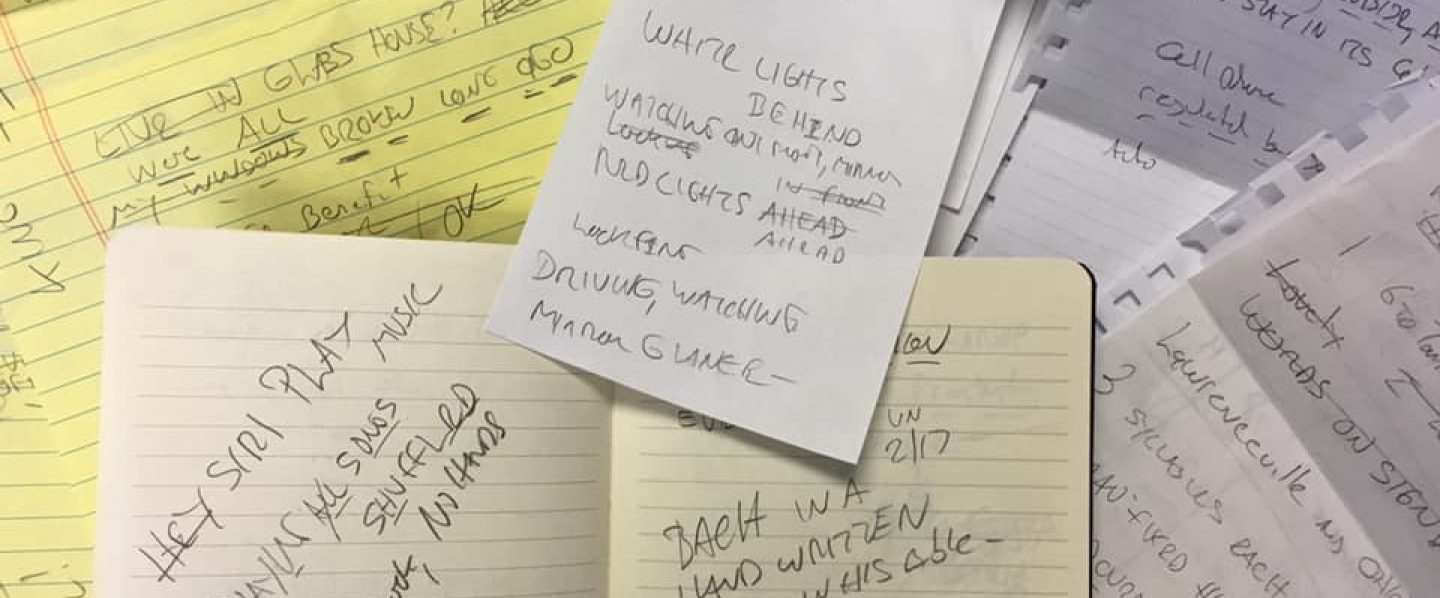
I can only assume that he is going to sit around in the hat, drinking the sherry, reading the poems, and dreaming the long long dreams of youth.
Yr distant friend E. B. White
From the Letters of E.B. White by E. B. White, collected and edited by Dorothy Lobrano Guth, 1976, New York : Harper & Row.
I am still dreaming the long long dreams.
Maybe I am younger than I think.
Age loses some objectivity when you move to resort town.
Here where I live in Bluffton, SC, the median age is around 32 and I am far above that.
If I drive out on the Island where I work, the median age goes up to 60 and I am once again, middle aged.
It is a miracle of youth to rival anything found by Ponce de León and not controlled by Prestor John and I can get right back into the dreaming those long long dreams.
these are tawny days bashful mornings hurl gray mist on stripes of sunrise
These are the tawny days your face comes back The grapes take on purple the sunsets redden early on the trellis. The bashful mornings hurl gray mist on the stripes of sunrise. Creep, silver on the field, the frost is welcome Run on, yellow halls on the hills, and you tawny pumpkin flowers, chasing your lines of orange Tawny days and your face again
Tawny by Carl Sandburg in his book, Smoke and Steel, New York: Harcourt, Brace and Co., (1920).
The website, https://www.vocabulary.com/, defines tawny as an adjective meaning of a light brown to brownish orange color; the color of tanned leather.
The online Merriam-Webster says that tawny is from the Middle English, from Anglo-French tané, tauné, literally, tanned, from past participle of tanner to tan and that the first recorded use of the word is from the 14th century.
The book of Genesis, Chapter 1, verses 2-5 state:
And God said, “Let there be light,” and there was light. God saw that the light was good, and he separated the light from the darkness. God called the light “day,” and the darkness he called “night.” And there was evening, and there was morning—the first day.
For myself, when the Bible reports he separated the light from the darkness, I think that God set up what we know as the planet earth and when he separated the light from the darkness, God gave the planet a push that started it in motion so that on the planet, day was separated from night by the rotation of the planet.
From that moment all laws of what we now know as physics came into play.
Neither here nor there, that means, for me anyway, that God had a timer running as the earth revolved on its axis and when the Bible reports “… the first day”, God knew just what he meant, but I digress.
Anyway, at the end of that first day, the light sank below the horizon and on the morning of the 2nd day the light came up.
I am betting that when that light came, it was a tawny day and anyone who might be there to see it would see thatthe bashful mornings hurl gray mist on the stripes of sunrise.
My wife is not fond of these sunrise pictures I take with my iPhone because she knows that to take them, I am driving one handed, with my other hand holding my iPhone as I cross the Cross Island Bridge on Hilton Head Island.
I know it’s goofy but what can one do?
We live in the low country and it is flat.
There are few views to be had anywhere.
The Cross Island Bridge is one of few places you can see anything of the area.
And, as Augustus McCrae said the book Lonesome Dove, “, and “…if he missed sunrise, he would have to wait out a long stretch of heat and dust before he got to see anything so pretty.”
there is the place now, where I look back, look ahead and dream and wonder
This is the view right now from the Bridge Street bridge that crosses a small tributary of the May River, between the Colhoun Street Dock and the Oyster Factory Dock in Bluffton, South Carolina.
We walked over the bridge the other day and we had to stop and stare.
We walked on to the Oyster dock and stood there as long as we could stand those nasty gnats that can be so tiresome that we have known people to decide living in the low country wasn’t worth dealing with the gnats.
On the walk back I stopped to take some pictures with my phone, one of which I sent to my grand daughter and said that we were visiting the Land of Oz.
She did not dispute it.
I look at this image, which I offer here … and I am not sure, what, which world I AM in.
I was reminded of the poem, Between Worlds, by Carl Sandburg …
And he said to himself in a sunken morning moon between two pines, between lost gold and lingering green
I believe I will count up my worlds There seem to me to be three There is a world I came from which is Number One. There is a world I am in now, which is Number Two There is a world I go to next, which is Number Three
There was the seed pouch, the place I lay dark in, nursed and shaped in a warm, red, wet cuddlmg place, if I tugged at a latchstring or doubled a dimpled fist or twitched a leg or a foot, only the Mother knew
There is the place I am now, where I look back and look ahead, and dream and wonder There is the next place –
It was if all three worlds, the one I came from, the one am in now and the one I go to next, are all in the same place.
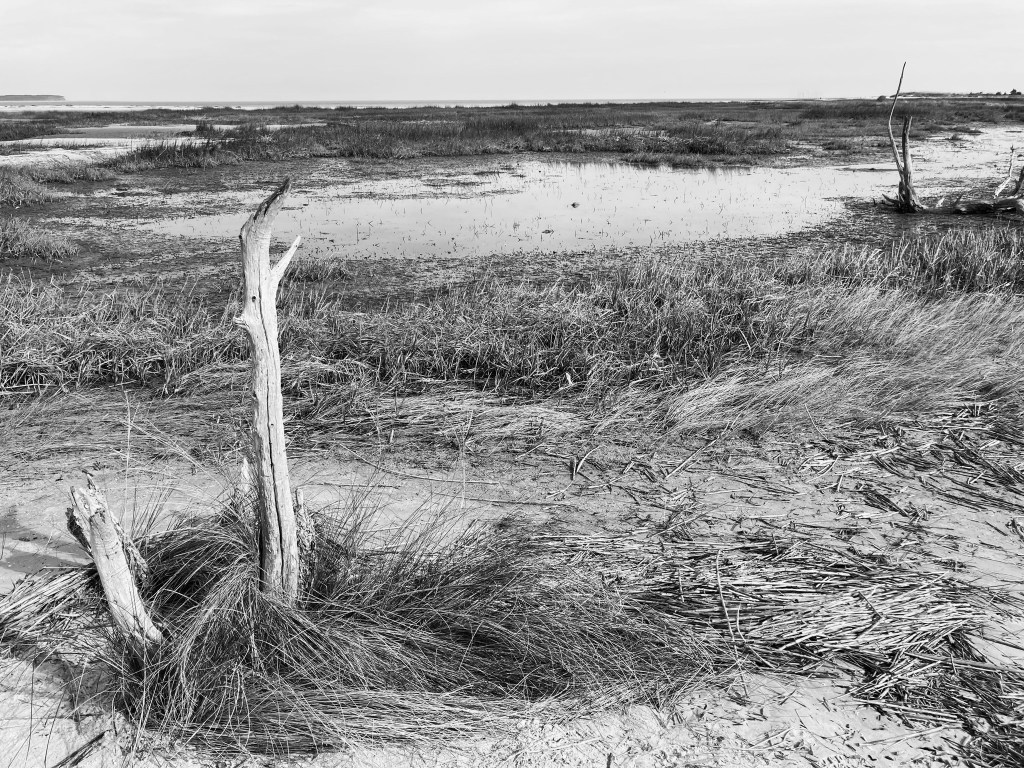
For an other other world, I offer the view in black and white.
passing footfalls beat in my ear like restless surf of a wind-blown sea
While the hum and the hurry Of passing footfalls Beat in my ear like the restless surf Of a wind-blown sea, A soul came to me Out of the look on a face.
Eyes like a lake Where a storm-wind roams Caught me from under The rim of a hat. I thought of a midsea wreck and bruised fingers clinging to a broken state-room door.
Under a Hat Rim by Carl Sandburg published in Chicago Poems, Henry Holt and Co., New York, 1916.
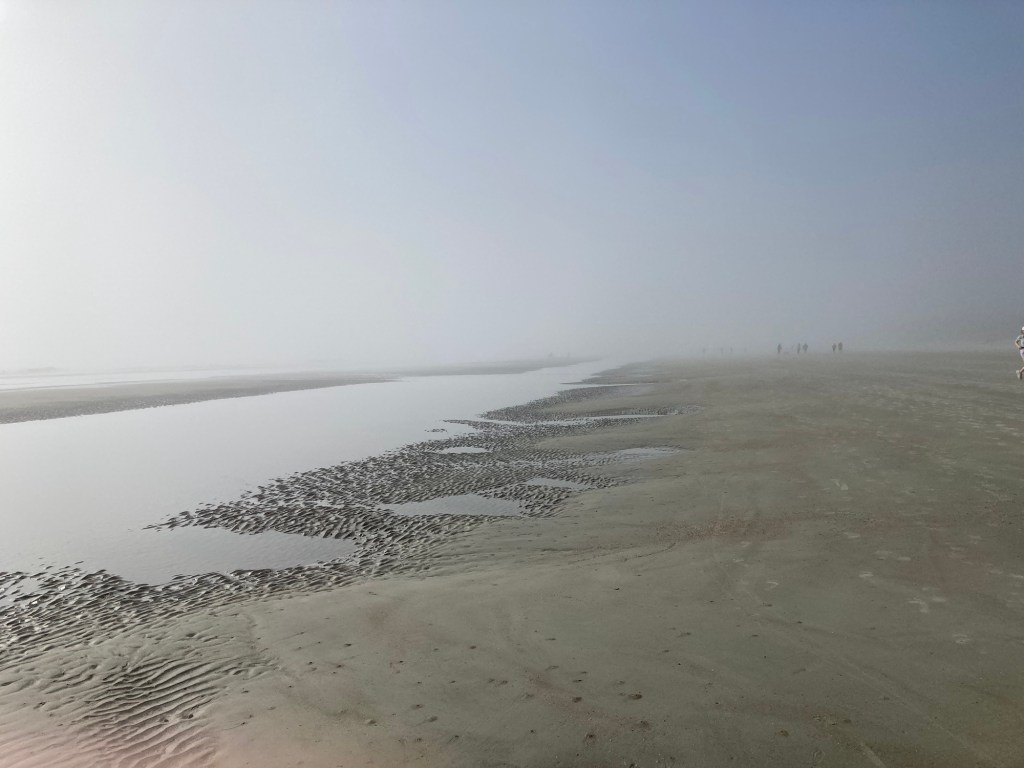
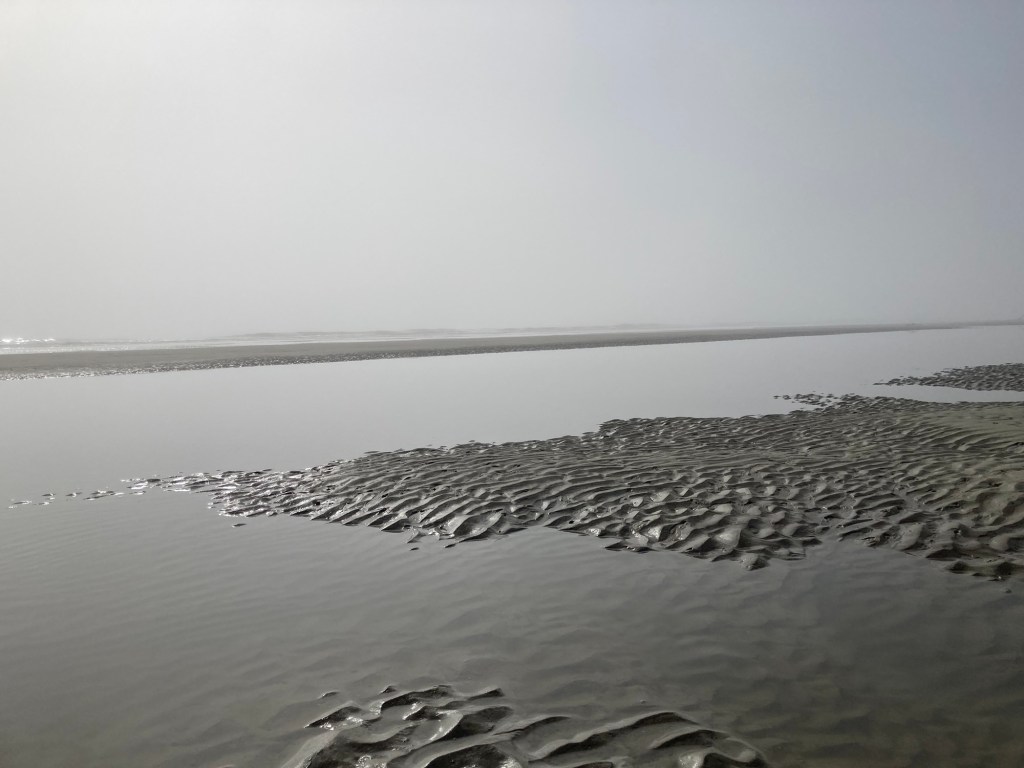
nuances spoken delicate change – cloud and blue and flimmering sun
On a tip, the wife and I visited Sands Beach at Port Royal, South Carolina.
As the crow flies, its 13 miles from where we live.
To drive there, around the swamps and marches of the low country of South Carolina, its a 40 minute, 27 mile drive.
It is located at the southern tip of Port Royal Island where Battery Creek breaks off from the Beaufort River a few miles above Port Royal Sound.
The beach has a walkway along Battery Creek and a 4 story observation tower.
The view from the top of this tower helps you understand the meaning of ‘the low country.’
The day we were there, the water was still and blue and the surface reflected the sky and clouds in a way that defeated use of any words in the my dictionary.
I was reminded of the writing of Jenny Lawson who in her book, Furiously Happy, used the word, Concoctulary, which she footnoted, saying ” … a word that I just made up for words that you have to invent because they didn’t yet exist.”
Ms. Lawson doesn’t just invent words that you have to invent because they didn’t yet exist, she made a word for the words that you have to invent because they didn’t yet exist.
Concoctulary.
As Ms. Lawson writes, “… It’s a portmanteau of “concocted” and “vocabulary.” I was going to call it an “imaginary” (as a portmanteau of “imagined” and “dictionary”) but turns out that the word “imaginary” was already concoctularied, which is actually fine because “concoctulary” sounds sort of unintentionally dirty and is also great fun to say. Try it for yourself. Con-COC-chew-lary. It sings.”
So I needed a word for the way the clouds reflected in the blue still water of Batter Creek off of Sands Beach in Port Royal and I found flimmering.
Try it for yourself.
It sings.
No surprise to say that I didn’t invent it though.
Carl Sandburg did.
In his poem, Dream Girl, in the section Other Days of the book, Chicago Poems as reprinted in the Complete Poems of Carl Sandburg, Mr. Sandburg wrote:
You will come one day in a waver of love, Tender as dew, impetuous as rain, The tan of the sun will be on your skin, The purr of the breeze in your murmuring speech, You will pose with a hill-flower grace.
You will come, with your slim, expressive arms, A poise of the head no sculptor has caught And nuances spoken with shoulder and neck, Your face in pass-and-repass of moods As many as skies in delicate change Of cloud and blue and flimmering sun.
Yet, You may not come, O girl of a dream, We may but pass as the world goes by And take from a look of eyes into eyes, A film of hope and a memoried day.
Flimmering.
As many as skies in delicate change Of cloud and blue and flimmering sun.