1.17.2023 – those who watch rainbows

those who watch rainbows
gather a reputation
as rainbow chasers

Adapted from Moments of Dawn Riders by Carl Sandburg in “The People, Yes: Sky Talk” (Harcourt, Brace & Company, 1936).

Those who straddle foaming sea-horses and ride into the sunrise
do so with no instrument board, no timetables
Those who watch one rainbow after another dissolve in seven prisms
they seem to gather reputations for being rainbow chasers —
they also choose bright mornings of clear weather and fading daystars
to study the organization of the sprockets of the bursting dawn …

Life is filled with talk of the path not taken and the road less traveled and the sounds of different drummers and the grass being greener over there on the other side of the fence.

Sometimes you get to look down those other paths, hear the different drums, look over that fence.

The past weekend, the Wife and I watched the movie, “The Holdovers.

Charming film, though a bit disconcerting when the era of your childhood is the subject of what is called a “Period Piece”, where the look and feel of a by gone era is ‘historically accurate’ as recreated on screen.

Not wanting to become a movie review, the focus of the story is a teacher who is teaching at same small private school that he attended.

The teacher left the school for college and came back and never left.

As far as we know he moved into his ‘rooms’ and stayed there the rest of his life.

In those rooms he accumulated books, school papers to be graded and dust.

Here is my point.

The life of that teacher as portrayed in the movie, was a life I could easily imagine to have been mine and consider, more or less, one my paths not taken.

As the credits rolled over the screen at the end of the movie, I said to my wife, “That could have been my life.

My Wife said, “Yes, it could have.

I said, and full transparency here – spoiler alert, “I would have been fired.

My Wife said, “Yes, you would have.”

I was thinking about that this morning as I drove to work.

I thought of a singular, solitary life, surrounded by books and a school schedule and dust.

And I thought of my life and jobs and kids and meetings and car problems and taxes and bills and grand kids and kids.

And I thought of the path not taken.

And I looked at the path I was on.

I was driving over the bridge to the island and I thought of George Bailey.

And I said, “Thank you, God.

I would write more but I have to go chase some rainbows and study the sprockets of the bursting dawn.

1.12.2024 – the meals in your life

the meals in your life
are numbered and the number
is diminishing

Food.

Jim Harrison.

Guilt.

Great way to start the day.

I live in a country that is somewhat obsessed with cooking, eating, weight and weight loss while at the same time unthinkable numbers of people, children, unthinkably go to bed hungry.

I read and enjoy the author, Jim Harrison but of late I have been listening to his work while I drive to work.

Audio versions of a book make sure you hear every word.

I think I have developed a mental screen that allows me to read Jim Harrison and filter out the worst of Mr. Harrison’s … earthy soliloquies* … while focusing on his word play, sentence structure and word painting observations on life that make him one of my favorite authors.

When I LISTEN to his work, read out loud and mispronounced (If I hear MACK-i-NACK one more time …) you cannot ignore those earthy soliloquies and gee whiz but he can get to the edge of social ridiculousness and go over.

And starting my day thinking about food and Mr. Harrison leaves me with a feeling of guilt.

So what to do?

Should I feed the hungry?

Should I make an apology for Mr. Harrison?

And I have only been up and about for 30 minutes.

So I heave a sigh and I say out loud a line from the Savannah based movie, Midnight in the Garden of Good and Evil.

The line that goes … “Two tears in bucket … mother f*ck it.

(Okay so I faded on spelling it out … but it’s a word we have all heard)

And I am going to comment on the dinner my wife made last night.

And I going to quote Jim Harrison without apology.

Last night my wife slow cooked a pork tenderloin in barbecue sauce and made pan fried sweet potatoes with Parmesan cheese and served it with rice.

There are meals where I can lose myself in the food, the flavors.

I look up, mists clear from my eyes and time has passed and my plate is empty.

I think of that Ben Franklin quote, “Behold the rain which descends from heaven upon our vineyards, and which incorporates itself with the grapes to be changed into wine; a constant proof that God loves us, and loves to see us happy.

There are times when I feel that way about food.

I remember the place in the Bible where the picnic cloth filled with food comes down in front of Peter and God says, “don’t say anything I made is bad.

There were no man made food additives or improvements included in that spread.

Nothing ‘fat free.’

Nothing ‘reduced calorie.’

Take and eat, said God.

I enjoyed my dinner.

I was reminded of other good, great meals, both simple and extravagant in my life.

I wondered how many have I had?

How many good, great meals does one get to eat in life?

I thought of a line from Clarence Day’s Life with Father where Mr. Day writes, “I adjusted my cap and walked on, thinking over this future. The more I thought about it, the less I wanted to be a civilized man. After all, I had had a very light lunch, and I was tired and hungry. What with fingernails and improving books and dancing school, and sermons on Sundays, the few chocolate éclairs that a civilized man got to eat were not worth it.

Then I thought … How many good, great meals do I have left to eat?

And I thought of this passage from the 2011 essay, Chef English Major, by Jim Harrison that is reprinted in A really big lunch(New York, Grove, 2017)

Cooking becomes an inextricable part of life and the morale it takes to thrive in our sodden times.

A good start, and I have given away dozens of copies, is Bob Sloan’s Dad’s Own Cookbook. There is no condescension in the primer.

Glue yourself to any fine cooks you meet.

They’ll generally put up with you if you bring good wine. Don’t be a tightwad.

Owning an expensive car or home and buying cheap groceries and wine is utterly stupid.

As a matter of simple fact you can live indefinitely on peanut butter and jelly or fruit, nuts, and yogurt, but then food is one of our few primary aesthetic expenses, and what you choose to eat directly reflects the quality of your days.

Your meals in life are numbered and the number is diminishing.

Get at it.

Have to admit food is not the part of my life that it once was.

Sorry and sad to say that since moving to the south and its pollens and mud flats, my nose is not what it was and flavors are not what they were.

Oddly I get the subtle flavors of seafoods like shrimp and scallops over the blunt heavy flavors of a good steak.

Lucky for me I live near the sea.

Nevertheless, I appreciate food and the good foods and flavors that God has packed into that picnic cloth.

Again, I thought of a Jim Harrison passage.

It is a from one of the first essay’s of Mr. Harrison that I read and one that got me into the Harrison’s camp.

This is from the 1989 essay, Hunger, Real and Unreal that was reprinted in Just before dark : collected nonfiction, (Boston, Houghton Mifflin, 1991)

.. one day at lunch I told some plumpish but kindly ladies what I thought was a charming story of simple food. One August, years ago, I was wandering around the spacious property of a chateau up in Normandy, trying to work up a proper appetite for lunch.

Two old men I hadn’t seen laughed beneath a tree. I walked over and sat with them around a small fire. They were gardeners and it was their lunch hour, and on a flat stone they had made a small circle of hot coals. They had cored a half-dozen big red tomatoes, stuffed them with softened cloves of garlic, and added a sprig of thyme, a basil leaf, and a couple of tablespoons of soft cheese. They roasted the tomatoes until they softened and the cheese melted. I ate one with a chunk of bread and healthy-sized swigs from a jug of red wine. When we finished eating, and since this was Normandy, we had a sip or two of calvados from a flask.

A simple snack but indescribably delicious.

I waited only a moment for the ladies’ reaction. Cheese, two of them hissed, cheese, as if I had puked on their sprouts, and wine! The upshot was that cheese is loaded with cholesterol and wine has an adverse effect on blood sugar. I allowed myself to fog over as one does while reading bad reviews of one’s own work.

I read this bit to my Mother and she laughed and laughed and laughed, shaking her head the way she could.

Let me circle back and sum it all up.

Food is a constant proof that God loves us, and loves to see us happy, but the few chocolate éclairs that a civilized man gets to eat may not be worth it.

So?

Quoting Mr. Harrison again, “Eat the delicious fat and take a ten-mile walk. Reach into your memory and look for what has restored you, what helps you recover from the sheer hellishness of life, what food actually regenerates your system, not so you can leap tall buildings but so you can turn off the alarm clock with vigor.”

Hoffman Family Picnic – 1964

*scenes of a sexual nature that may or may not have anything to do with the plot …

12.30.2023 – Christmas in the air

Christmas in the air,
yet the air seemed too soft to
sustain the treasure

In his January, 1966 essay, What Do Our Hearts Treasure?, EB White laments a Christmas in Florida away from New England, snow and family.

Mr. White writes: The scene was idyllic. Christmas was in the air, yet the air seemed too soft to sustain it.

Mr. White and his wife, Katherine Angell White, receive a box from home with evergreens, gifts and photos and with these items, the White’s restore the feeling’s of the holiday as they remember the question, What do our hearts treasure?

Mr. White does not go one to include the answer to this question that comes from the Bible.

For where your treasure is, there your heart will be also. (Matthew 6:21)

We took a day to drive up to Atlanta to see our kids and our grand kids.

We had presents but seeing those people, I tell you, it wasn’t that the air seemed too soft to sustain it, it was that the air was strong enough to contain it.

Where is my treasure?

It is with my heart … up in Atlanta.

12.10.2023 – no delete buttons,

no delete buttons,
no cut-and-paste, just the click
clack of history

Fun but unsatisfying is what I thought after reading, You Can Buy Hemingway’s Typewriter. But Would You Use It? by David Waldstein in the New York Times.

Unsatisfying because Mr. Waldstein did not tell the story on how this feller, Steve Soboroff, tracked down all the typewriters of famous people that he now plans to offer at auction.

Fun because it was fun to think about owning such a machine.

This past summer I was able to sit at a desk with one of James Thurber’s typewriters.

Maybe a musician sitting at a piano used by Stevie Wonder would feel something.

Mr. Leonard Bernstein is on film describing what it was like to direct an orchestra and standing what had to be standing somewhere near the spot Ludwig Beethoven stood when his 9th Symphony was debuted.

Something about a typewriter.

I haven’t owned one in years but I have a bunch.

The last one I got was a gift that had a small computer screen and could store up to three lines of text.

You could set it to type each letter or to wait and type out each line.

I never caught the rhythm of the line by line.

A funny thing, but the last typewriter I ever bought was vintage manual Royal typewriter I got at the Salvation Army.

The machine worked fine, but finding typewriter ribbon was a problem.

The place where I worked had just thrown out all there old adding machines, along with boxes of adding machine ribbon and with a little winding, these ribbons could be retro-fitted onto my typewriter.

Friends and neighbors let me tell you that when the time comes to move cross country, a 20lb manual typewriter quickly makes it on the list of things you don’t need to bring.

Mr. Waldstein writes, The machine has no delete buttons, no cut-and-paste. Just the click-clack of history.

Sitting at the Thurber machine, I imagined his fingers on the keys and a story coming out, letter by letter, return by return.

I could hear the click-clack and the bell and the grrrrrrrr of the carriage and the thump when the the next line came into place.

John Steinbeck said, “Sometimes just the pure luxury of long beautiful pencils charges me with energy and invention.”

There is much to be said for those pencils.

I cannot remember the source of line, but someone pointed out that the American Space Programs spent millions developing a pen that could insure the flow of ink and write in zero gravity while the Soviet Union sent their astronauts into space … with pencils.

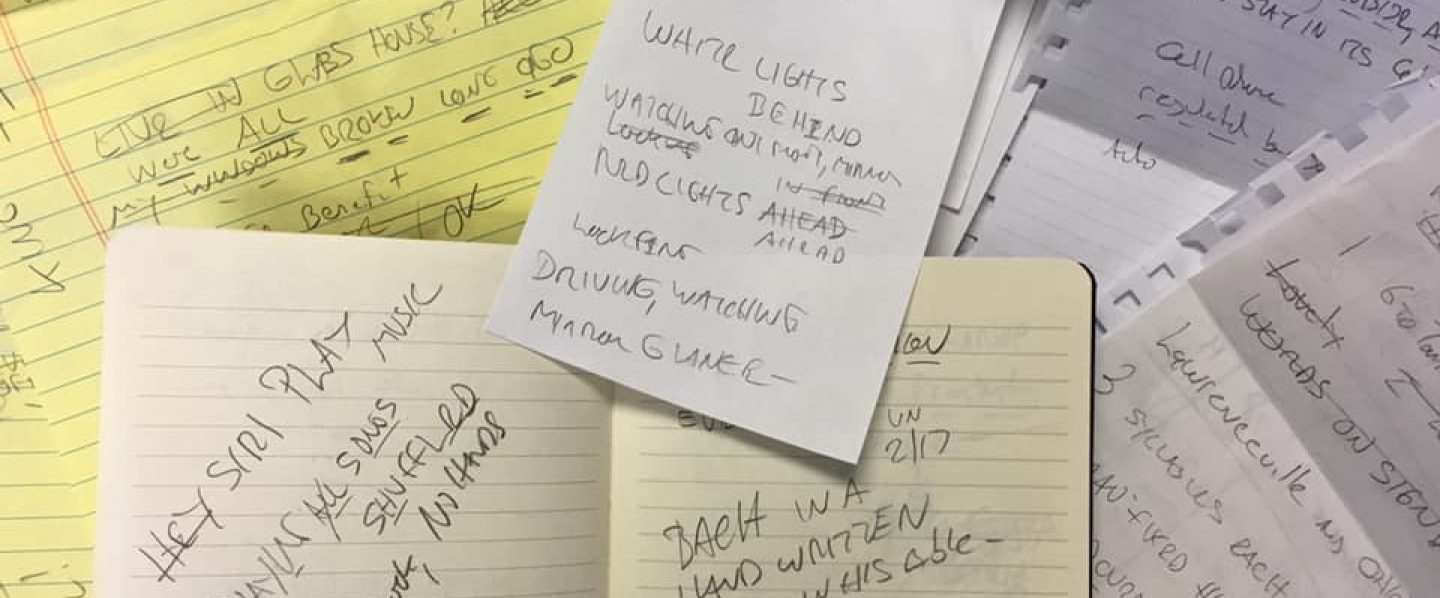
I use a comuter.

I hear the rattle of my keyboard.

That qwerty keyboard that connects my typing with the old machines.

But I back space.

I delete.

I highlight and copy and paste.

I print multiple copies.

And …

I miss that old Royal typewriter.

no delete buttons,
no cut-and-paste, just the click
clack of history

James Thuber’s Typewriter … As I said before, the first person who would have ignored the signed and banged on the computer would have been James Thurber.

12.7.2023 – piled ice, snow, every

piled ice, snow, every
thing looked raw except when
you knew what it meant

There wasn’t even a trace of green in the landscape but then it smelled like spring in the fifty-degree temperature and the sight of the mounds of snow on the north sides of houses, shacks, and log cabins, and the drifts along fence rows, and the glistening drift ice far out on Lake Michigan and the ice piled on shore on the westerly sides of the forested peninsulas out into the lake.

It was more the contrasts in the present that attracted me to this paragraph.

Its a line from the fifth Brown Dog Novella, He Dog, by Jim Harrison.

I grew up in Michigan.

I grew up in West Michigan when the Lake Michigan was a 45 minute drive away and more times than I can remember, I made the drive out to see Lake Michigan covered in ice.

Trips to the ice do stand out though.

Once when my wife, then girl friend, said to me that I was going to get her out on the ice.

Then I pointed out to her that we had been walking out on the ice for a couple hundred yards.

There was also the time I went through the ice when I was about 12.

I yelled HELP, I’M THROUGH THE ICE and my brother Jack, who had driven us out to the lake so was nominally in charge yelled IS HE KIDDING.

My brother Pete got to a place where he could see me and his eyes bugged out and he yelled NO!

My point being that when I read, “the glistening drift ice far out on Lake Michigan and the ice piled on shore on the westerly sides.”

But that isn’t exactly accurate.

I mean I wasn’t reading.

I was listening.

I was listening to the audio book as I took a lunch time walk at work.

In my head, I was along the frozen shoreline of Lake Michigan.

My feet were making their way towards the Atlantic Ocean.

Both places were about 55 degrees.

I heard “… the sight of the mounds of snow on the north sides of houses, shacks, and log cabins, and the drifts along fence rows, and the glistening drift ice far out on Lake Michigan.”
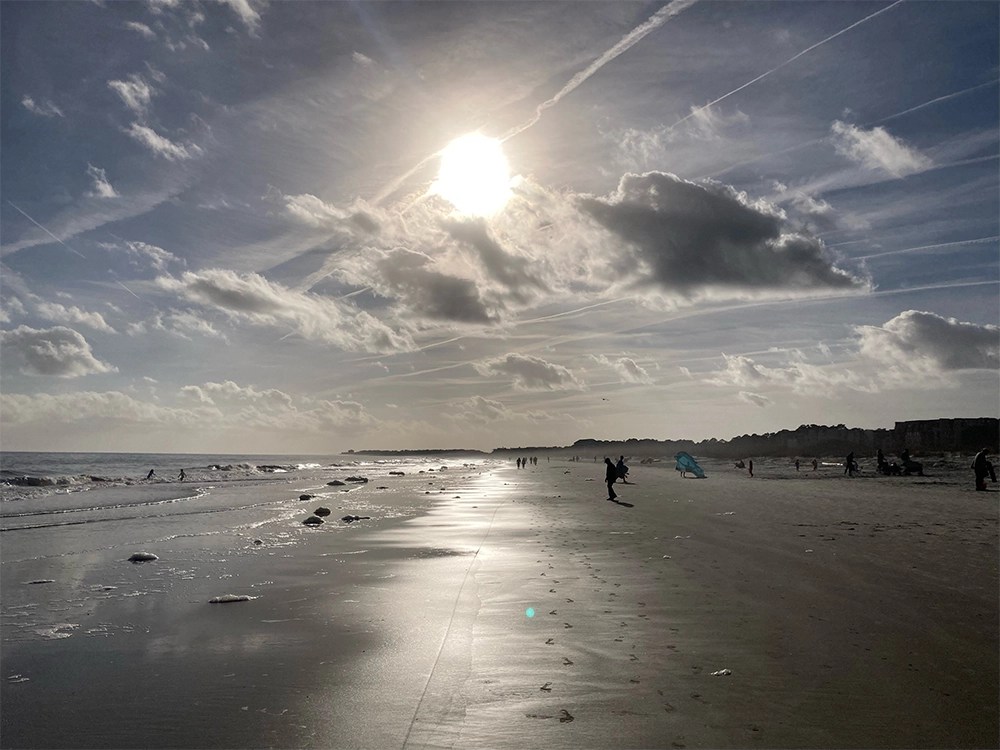
I saw the December empty streets of a summer Resort and then the glint of the sun off the waters of the Atlantic Ocean.

The beach was almost empty.

I don’t know what Kings and Presidents get paid or how much money those billionaires have, but I don’t think they get to walk along an empty beach at lunch time too often.

It was quiet.

I could see forever out past Tybee Island.

I could hear the waves.

I could hear the putt putt of a shrimper going past not too far off shore.

I could hear the gulls.

It all sounded a but raw except when you knew what it meant.