12.2.2021 – tireless pointillist

tireless pointillist
people often say show me
picture with the dots

I opened up my computer this morning and my mind went back in time.

This was weird because I went back to a time before everyone had a computer.

I had opened the Google and the google logo was all in dots.

Small points of color.

I knew it had to have something to do with Georges Seurat and when I hovered over the logo the embedded alt information for the graphic displayed the text, “Georges Seurat’s 162nd Birthday.”

If you grew up in the midwest at some time in your life you visited Chicago.

If you visited Chicago at some time in your life you had a good chance of going to the Art Institue.

If you went to the Art Institute of Chicago, you most likely saw La Grande Jatte or A Sunday Afternoon on the Island of La Grande Jatte by Georges Seurat.
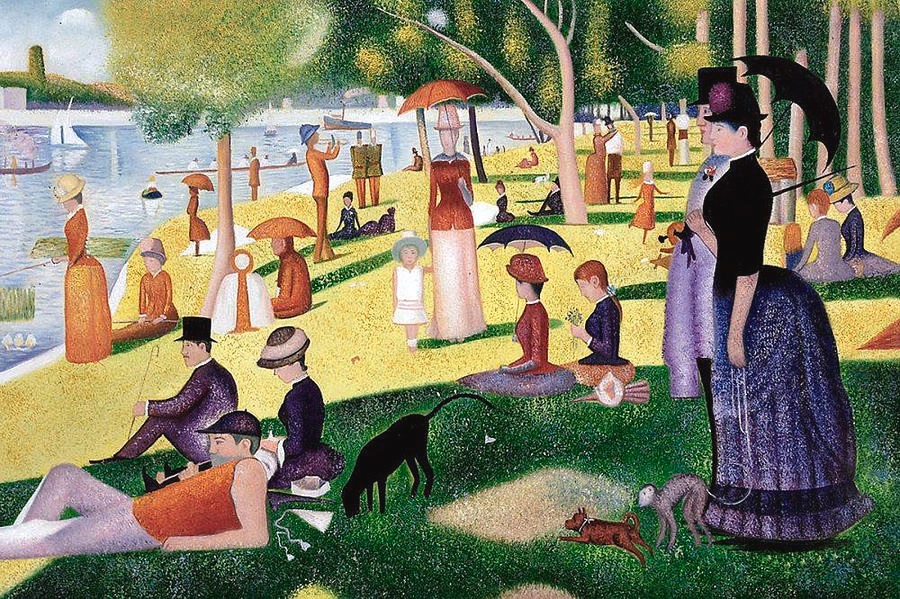
Sometimes known as Sunday Afternoon in the Park and maybe the inspiration for the song, “Saturday in the Park” by the band, Chicago.

Sometime known as the painting with the dots.

I hear two general reactions from folks who see this painting.

One is HOW BRIGHT IT IS.

Colors just cannot be captured in any form of reproduction.

I remember walking down the main hall of the National Gallery of Art in Washington and through an open entry way, I was faced, unexpectedly, with A Girl with a Watering Can by Renoir.

The color flared out from the painting so bright that I tripped.

No, I am not kidding, fell flat out on the marble floor.

Guard looked at me and shrugged like this happened a lot.

The second thing I hear from folks is HOW BIG IT IS.

Neither, here nor there, but look at this photgraph.

I feel it could have been painted by any one the great impressionists and entitled, ‘A visit to Chicago’.

This is what took me back in time when I thought of Seurat.

For me, I cannot think of this painting without thinking of a documentary on the City of Chicago by Studs Terkel.

Mr. Terkel was the American version of Alistair Cooke.

Where Mr. Cooke wrote and later, read, a weekly column, ‘Letter from America’ for the Manchester Guardian and later the BBC, tried to explain America to Brits, Studs Terkel tried to explain America to Americans.

In my mind was a quote of Mr. Terkel from that documentary on La Grande Jatte and I plugged Studs Terkel Suerat into the Google to try and find it.

To my surprise and pleasure not only did I find the quote, I found the entire documentary and you can watch it all right here.

It is in this documentary that Mr. Terkel talks about La Grande Jatte and says, “people often say, show me the picture with the dots.

The bit about La Grande Jatte is at 30:00 into the but go to about 28:00 into the video to catch Mr. Terkel’s comments about Night Hawks as well.

Or, if you have the time, watch the whole show.

Overwhelming in nostalgia for a city and a place that no longer exists.

This is the Chicago I grew up with.

Still a city close to the city of Carl Sandburg.

Still the city of Daley.

You remember the old story.

Richard Daley and two guys are in boat that is sinking and there are only two life jackets.

Daley says they should vote on who got a life jacket and Daley won 9 to 2.

This is the Chicago I loved to visit.

One memorable visit, I had talked my Friend Doug into an overnight trip to the city.

The plan was to drive to Comiskey Park and see the Thursday night baseball game between the Chicago White Sox and the Detroit Tigers.

Then drive to my sister’s apartment on the northside and stay overnight.

Spend the next day in the Chicago museums, back to the ball park for another baseball game and drive home after the game finished out the plan.

I was going through a period of being a Chicago White Sox fan when I was really following their owner, Bill Veeck.

How many people today will say they were fans of an owner?

The deal got a little sweeter when it was announced that the first game was going to be a double header due to an earlier rained out game.

Doug and I knew something was up when we drove up to Comiskey Park on 34th St., and everyone in the crowd seemed to be carrying 45rpm records or singles as they called.

We didn’t know.

Maybe that’s what you did in Chicago.

What it was was a promotion by the White Sox.

You got into the game for 99 cents if you brought a record to the game.

A DISCO record.

All the records where then going to be put into a big box and blown up between games.

This was the famous DISCO DEMOLITON PROMOTION and we had box seats.

The first game was played okay more or less.

Records starting be thrown out of the upper deck late in the game.

Both the left and right fielders were wearing batting helmets IN THE FIELD.

Between games the big box was trucked in and as planned, blown up.

Then, as wasn’t planned, all the fans ran out and took over the field.

In fairness, what else was going to happen when you get 57,000 people in a stadium designed to hold 47,000.

I mean they had to go somewhere.

So Doug and I had box seats for a riot.

In a goofy way, it was kinda cool.

Disco Demolition has gone down in baseball history as the worst thought out promotional stunt in history since the dedication fireworks of the New York City Hall set the new city hall on fire and burned it down back in 1852.

But, as the organizers say, how can it be a promotional failure if we are still talking about it?

But I digress.

In the video, Studs Terkel quotes french filmaker, René Clair as saying, “Everytime I go to America I must stop off at your city to see La Grande Jatte. It refreshes me. I need it.”

Mr. Terkel ends the little bit on with the words, “Hurrah Seurat.”

And, Happy Birthday.

Will you help him change the world?
Can you dig it? (Yes, I can)
And I’ve been waiting such a long time
For today

*The first American Letter was broadcast on 24 March 1946 (Cooke said this was at the request of Lindsey Wellington, the BBC’s New York Controller); the series was initially commissioned for only 13 instalments. The series came to an end 58 years later in March 2004, after 2,869 instalments and less than a month before Cooke’s death. (wikipedia)

**His well-known radio program, titled The Studs Terkel Program, aired on 98.7 WFMT Chicago between 1952 and 1997. The one-hour program was broadcast each weekday during those forty-five years. (wikipedia)

1.30.2021 – shovel them under

shovel them under
let me work, two years, ten years
ask where are we now?

Adapted from Carl Sandburg’s poem, Grass.

Pile the bodies high at Austerlitz and Waterloo.
Shovel them under and let me work—
I am the grass; I cover all.

And pile them high at Gettysburg
And pile them high at Ypres and Verdun.
Shovel them under and let me work.
Two years, ten years, and passengers ask the conductor:

What place is this?
Where are we now?

I am the grass.
Let me work.

Frustrated at the lack of change when I thought everything had changed.

Then I realize it has only been a couple of weeks.

This is going to take time.

But I do believe that after two years or ten years, passengers ask what place WAS this.

As Mr. Willy Wonka said, “Oh, you can’t get out backwards. You’ve got to go forwards to go back, better press on.”

9.3.2020 – things I want to know

things I want to know
are in books – friends will get me
a book I ain’t read

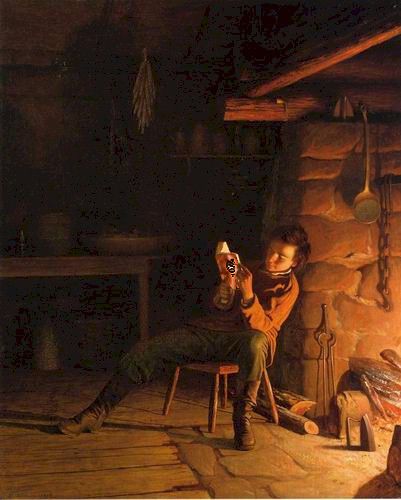
This is attributed to Mr. Abraham Lincoln.

Looking for a citation, the best I that can do is that Carl Sandburg has old Dennis Hanks recalling that his young cousin Abe Lincoln saying, “The things I want to know are in books; my best friend is the man who’ll git me a book I ain’t read.”

Mr Sandburg recorded this in his book, Abraham Lincoln Volume 1 The Prairie Years (Dell, New York, NY – 1927).

So did Mr. Lincoln say it?

Or did Mr. Sandburg imagine that Mr. Lincoln said it?

Would Mr. Lincoln had said it had it thought of it?

Well, maybe and yes and why not all at the same time.

Lincoln or Sandburg or Lincoln and Sandburg.

Someone said it and I like it.

It works for me.

Its good enough for me.

It is late in the day.

I got my new Kindle Fire that my wife got me on my last birthday.

She is my best friend.

I got lots of books on it I ain’t read.

Me for the back porch and the rocker.

Ps – the above painting is owned and displayed by the University of Michigan – I liked to go look at it as student …

7.29.2020 – night of summer stars

night of summer stars
low, near, lazy in the sky
sky of summer stars

Walking at night in the warm dark of summer in Georgia is something you to cannot explain to people up north.

I remember our first 4th of July fireworks down here and realizing it was near midnight and I was still in a T shirt and shorts.

No sweatshirt.

No hoodie.

No long pants.

Up north in Michigan, I was lucky to go out at night and not end up wanting a coat.

Jim Harrison in the Brown Dog novellas writes about a summer in the Upper Peninsula of Michigan without tourists.

It was so cold that people went to the 4th of July fireworks in snowmobile suits and watched the rockets red glare through snow flurries.

Walking in the warm dark of the Georgia night.

Stars so fat and close.

No big names but the North Star and the Big Dipper, maybe Booters, but so many stars without names.

Warm and lazy stars of summer time.

Maybe global warming will bring this Michigan.

Maybe that might bring me back.

Summer Stars
by
Carl Sandburg in Smoke and Steel (Harcourt, 1920).

Bend low again, night of summer stars.
So near you are, sky of summer stars,
So near, a long arm man can pick off stars,
Pick off what he wants in the sky bowl,
So near you are, summer stars,
So near, strumming, strumming,
So lazy and hum-strumming.

7.21.202 – ten, twelve hours a day

ten, twelve hours a day
8 cents a box, drops to 6
pictures for today

Today’s haiku comes from the poem, Onion Days, by Carl Sandburg, that I recently ran across.

It is a poem about a woman who picks onions 10 to 12 hours a day for 8 cents a box.

The owner of the farm worries about how to make his farm produce more efficiently so he hires more workers so he only has to pay 6 cents a box.

The poem was written in 1916.

I also recently watched the movie ‘The Irishman”.

I wonder if its time for DeNiro and Pesci to close the door on mob movies but I digress.

The movie was about Jimmy Hoffa, a man today more famous for not being here than for what he did when he was here.

And that’s too bad.

Right or wrong in his methods, Hoffa cared about the people who did the working.

Not sure there is anyone in that role today.

His first strike was on the loading dock of a grocery company in 1931.

The crew on the loading dock was expected to work 12 hours shifts.

They were paid 32 cents an hour.

12 cents in cash and 20 cents in credits at the grocery store.

BUT they were only paid for the time they spent actually unloading trucks.

Hoffa organized the crew and on a hot summer day when truckloads of strawberries rolled in, they went on strike.

They demanded a full 32 cents an hour in cash and a minimum of 4 hours pay for a 12 hour day.

The grocery store, a place called KROGER, gave in a signed a one year contract.

Congress will meet this week to ‘discuss’ a further stimulus package.

How many of them are really thinking of the people who work.

Don’t the men and women of Congress enjoy chanting the Nicene creed with their daughters on each side of them joining their voices with theirs?

I am lucky.

I have a well paying job and am allowed to work from home.

No one would ever write a play about me.

But as Mr. Sandburg says in his poem about Mrs. Gabrielle Giovannitti …

or the crew on the loading dock …

or the people who need to work and can’t work because there is not enough work …

or can’t work enough because stores are closing …

because restaurants are closing …

because businesses everywhere are closing …

No dramatist living COULD put them into a play.

No one could capture that.

In 1916, in 1931, or today.

But I hope the men and women in Congress at least think about them this week

– – – – – – – – – – –

Onion Days in Chicago Poems by Carl Sandburg, (1916)

Mrs. Gabrielle Giovannitti comes along Peoria Street every morning at nine o’clock

With kindling wood piled on top of her head, her eyes looking straight ahead to find the way for her old feet.

Her daughter-in-law, Mrs. Pietro Giovannitti, whose husband was killed in a tunnel explosion through the negligence of a fellow-servant,

Works ten hours a day, sometimes twelve, picking onions for Jasper on the Bowmanville road.

She takes a street car at half-past five in the morning, Mrs. Pietro Giovannitti does,

And gets back from Jasper’s with cash for her day’s work, between nine and ten o’clock at night.

Last week she got eight cents a box, Mrs. Pietro Giovannitti, picking onions for Jasper,

But this week Jasper dropped the pay to six cents a box because so many women and girls were answering the ads in the Daily News.

Jasper belongs to an Episcopal church in Ravenswood and on certain Sundays

He enjoys chanting the Nicene creed with his daughters on each side of him joining their voices with his.

If the preacher repeats old sermons of a Sunday, Jasper’s mind wanders to his 700-acre farm and how he can make it produce more efficiently

And sometimes he speculates on whether he could word an ad in the Daily News so it would bring more women and girls out to his farm and reduce operating costs.

Mrs. Pietro Giovannitti is far from desperate about life; her joy is in a child she knows will arrive to her in three months.

And now while these are the pictures for today there are other pictures of the Giovannitti people I could give you for to-morrow,

And how some of them go to the county agent on winter mornings with their baskets for beans and cornmeal and molasses.

I listen to fellows saying here’s good stuff for a novel or it might be worked up into a good play.

I say there’s no dramatist living can put old Mrs. Gabrielle Giovannitti into a play with that kindling wood piled on top of her head coming along Peoria Street nine o’clock in the morning.