saudade, long lost irretrievable but the dream of it
” … there is a word in Portuguese called saudade that appeared to represent the farm and our lives, a homesickness or longing for something vital that had been irretrievably lost and only the dream of it could be recovered.”
From “The Road Home” by Jim Harrison.
The online dictionary defines saudade (saa·daydz) as a feeling of longing, melancholy, or nostalgia that is supposedly characteristic of the Portuguese or Brazilian temperament.
Wikipedia says, “Saudade is a deep emotional state of nostalgic or profound melancholic longing for something or someone that one cares for and/or loves. Moreover, it often carries a repressed knowledge that the object of longing might never be had again.”
Then Wikipedia adds this.
Saudade is a word in Portuguese and Galician that claims no direct translation in English.
However, a close translation in English would be “desiderium.”
Desiderium is defined as an ardent desire or longing, especially a feeling of loss or grief for something lost.
Desiderium.
Not a bad word.
Desiderium.
But it smacks of things other than the heart some how.
Desiderium.
No, I will take saudade.
I keep saudade in my head for those moments when there are no words.
Somewhere along the line of my life I came across the singing of Cesaria Evora.
Her song Sodade is a saudade put to music.
I am not sure what it is called when a feeling, an outlook, a word and a song all combine the same way.
Jenny Lawson writes in ‘Furiously Happy” that when there are no words, she has license to make one up.
For me then, when a feeling, an outlook, a word and a song all combine the same way I call in omniaonomatopoeia.
have each of us the advantage of using the books of all others
In the 1985 movie, Silverado, a western written, produced and directed by Lawrence Kasdan (just after he made The Big Chill, which I saw in special preview in Ann Arbor and which was my first glimpse of the Low Country – I just didn’t appreciate it at the time) there is a scene where Kevin Kline walks through the swinging doors into a saloon and stops, looks around and breathes deep with the satisfaction of someone who has arrived in their one perfect place.
Yesterday, after two years of Covid restrictions and 1 year of reduced operations for renovations, I went back to the Bluffton branch of the Beaufort County Library.
I walked through the double doors and into the lobby and I stopped and looked around and I breathed in deep with the satisfaction of someone who has arrived in their one perfect spot.
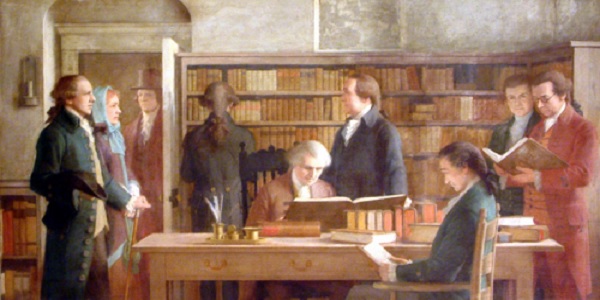
According to legend, and in this case by legend, I mean the classic Autobiography of Ben Franklin, which I was taught may have been the single most successful manufactured self-serving long-lasting piece of propaganda ever published but that is for another day (lets just say that Ben was in it for the long game with the possible goal of walking off with the state of Pennsylvania for himself), it was in 1731 that Dr. Franklin and his friends worked out how to share books.
Dr. Franklin writes, “, a proposition was made by me that, since our books were often referr’d to in our disquisitions upon the queries, it might be convenient to us to have them altogether where we met, that upon occasion they might be consulted; and by thus clubbing our books to a common library, we should, while we lik’d to keep them together, have each of us the advantage of using the books of all the other members, which would be nearly as beneficial as if each owned the whole. “
It didn’t work out as “yet some inconveniences occurring for want of due care of them” and this first effort was stopped but it led to the what we would call a subscription library and eventually that cornerstone of liberty and freedom, the public library.
Now closing in on 300 years after Ben’s Book Club, in an edge of electronic books and reading, the role of a public library has to be questioned as really necessary?
(Ever see the TV show, The Librarians? I don’t mean the American docu-drama, I mean the one from Australia?)
I will say the the tools have changed but the need, the job, the role of the public library is as important and necessary as at any time in history.
Big surprise there right?
What would anyone expect me to say?
I love the library.
I was happy that when we moved to the low country I saw that the county library system was investing in their buildings and that the local branch, the Bluffton Public Library would be getting almost a million dollar renovation.
And when I walked into the re-opened library building yesterday I just felt good.
Much like a walk on the beach, it was refreshing, good-for-the-soul just to be in there.
I thought of the Hemingway line of, “This is a clean and pleasant café. It is well lighted. The light is very good” and I thought of how in the Hemingway short story, the older waiter thinks, “Each night I am reluctant to close up because there may be some one who needs the café.”
The people I know and the people I worked with in the libraries were like that and were often reluctant to close up because there may be some one who needs the library.
I walked around and just enjoyed the books and the clean, well lit space.
I looked for new books, challenging myself to grab any fiction book at random off the 14 day loan shelf to searching out old favorites and to see how many Jim Harrison books were in the stacks (7!).
I went through the library sale books.
I sat in the new chairs.
I chatted with librarians and volunteers.
I checked my books out and left thinking that maybe, just maybe, the hordes would be held at bay for another 20 or 30 years.
In my life time anyway.
I thought about the other Ben Franklin library story.
When Benjamin Franklin passed away on April 17, 1790, he left Boston and Philadelphia $2,000 for libraries. He’d saved this money while he was Governor of Pennsylvania (1785 to 1788). The money was not to be distributed until 200 years after his death.
In 1990, the bequest was worth $6.5 million and Philadelphia’s portion of the trust was $2 million.
By all scientific examination of Ben’s kite flying in the thunderstorm stunt, Dr. Franklin should have been fried to a crisp.
a long, gentle curve hardly realize we’re talking love, family, life
Based on the short passage:
I think of all the things I’ll want to talk to the catcher about. I’ll guide the conversations, like taking a car around a long, gentle curve in the road, and we’ll hardly realize that we’re talking of love, and family, and life, and beauty, and friendship, and sharing …
From the book, Shoeless Joe by W.P. Kinsella.
Most folks are more familiar with the movie made from the book, Field of Dreams, than they are of the book.
Field of Dreams is a good movie (made possible by Jim Harrison, but that is another story) but a lot of, shall we say, nuance is missing from the movie that is in the book.
For one, the author in the story is J.D. Salinger and not a fictitious Terrence Mann and then there is the twin brother, but that is for another time as well.
The 15th of February is my Father’s birthday.
The anniversary always brings the book and the movie and my Dad to mind
If I say I wish he was here I certainly don’t mean I wish he was here in realtime.
I don’t wish that he was here and 102 years old.
The best part of wishing is that you get to set the rules.
Not being able to set the rules is maybe the best part of wishes not coming true.
Never the less, I do like to say that I would build a ball park in my back yard if my Dad could come back for a day or two.
Not because I have anything I need to say or that I could have said to my Dad when I had the chance, but because I would like to introduce him to my kids and grand kids.
I would like to take him out to any of the seafood restaurants down here where I live in South Carolina.
I have a feeling that when he was stationed at Fort Andrew Jackson near Columbia, South Carolina, he spent time in Savannah.
The idea of sitting with him in Forsyth Park sounds just right.
We would sit there and talk and he would describe how he remembered the city back in 1943.
It would be a long gentle curve in the road.
We would hardly realize we were talking.
And that we would be talking about love and family and life.
Happy Birthday Dad!
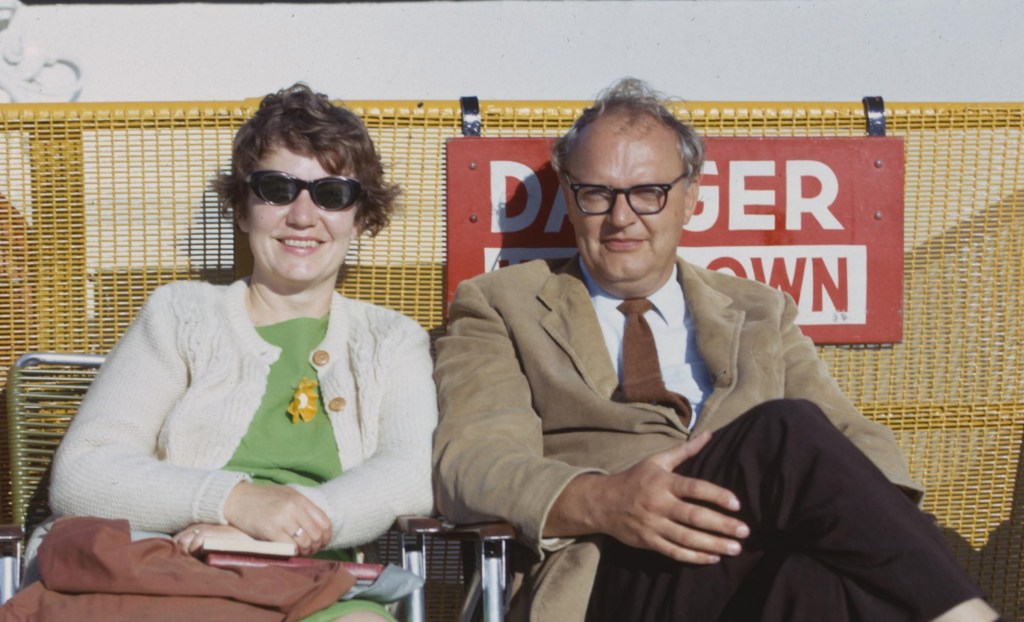
PS: The above photograph, was taken by me on a family trip to Wisconsin to visit my Uncle Jim and Aunt Millie.
It was summertime probably 1968 or 1969.
This was taken aboard the SS City of Midland, the car ferry that went between Ludington, Michigan and Manitowoc, Wisconsin across Lake Michigan.
This was how my Dad dressed for vacation.
Almost always he had on a jacket and often enough, a tie as well.
These were his fun clothes.
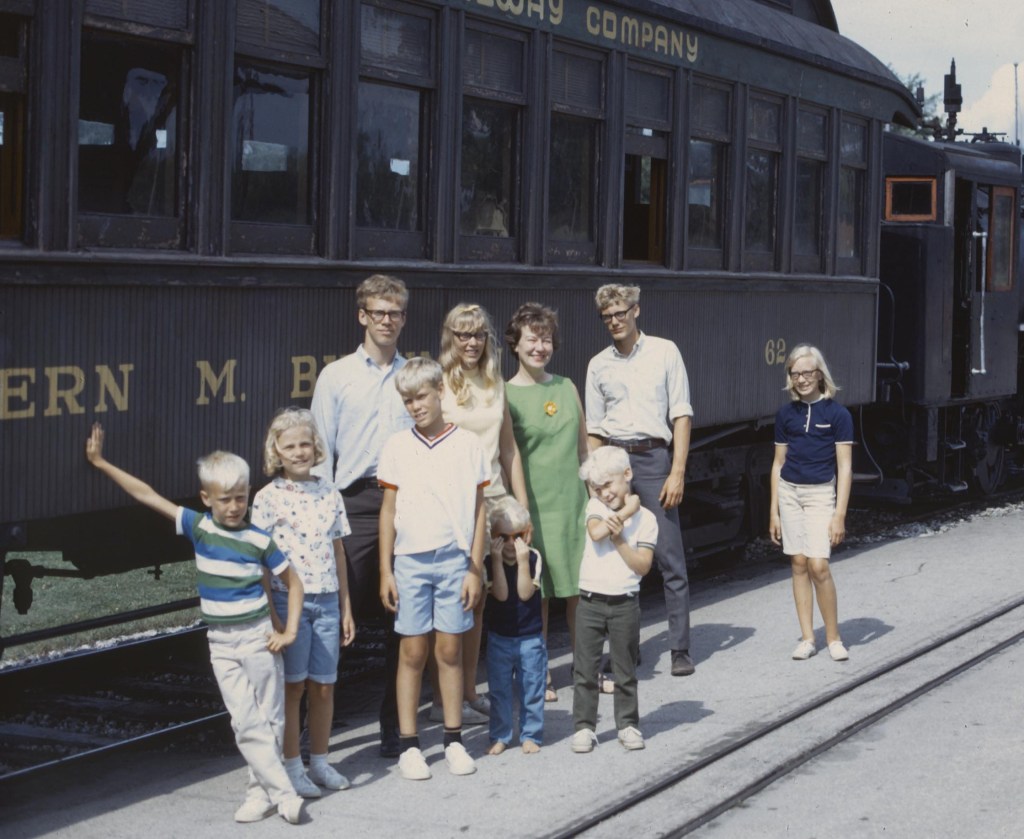
That is if your idea of fun was to pack 11 people into a car and drive off into the wilds of Wisconsin.
If this was 1969, my brother Paul was now married and my youngest brother, Al, hadn’t made his appearance yet so the 11 of us, my parents and 9 kids were probably the biggest bunch of us altogether on trip we ever took.
Taken at the National Railroad Museum in Ashwaubenon, Wisconsin
We were running all over the ship and my Mom and Dad found a place in the sun out of the wind.
I wanted to take a picture.
I guess I had an interest in photography back then or at least I wanted to be the one taking the pictures.
I whined and whined until my Dad gave me his camera and let me take this picture of Mom and Dad in sunshine.
Then I wanted to take another photograph.
I wanted to take a picture of the bow of the ship cutting through the water.
I explained this to my Dad and he said okay and went with me as far forward on the ship as we could get.
The very peak of the bow was blocked off by a yellow rail so there would be no “I’m flying – Titanic” scenes on this ship.
As I remember the railing of the ship was just above my head level when I was nine so my Dad got a deck chair for me to stand on.
I hopped up and now the rail was about waist high and I leaned over.
My Mom called out but my Dad waved that it would be okay.
I leaned back and my Dad handed me his camera, his new nikon and back over the edge I went.
“Hey, hey hey!” my Dad yelled.
I stood up straight and turned and looked at him.
He reached over and put the camera strap over my head.
“Don’t want you to drop the camera!” he said.
PSS many people have asked and yes this is the photo I took looking down at the bow of the ship … mjh
The article was in a British Newspaper so I guess I should not be surprised that I wasn’t familiar with any of the books.
The description of the last book listed caught me eye.
The writer writes about the book, Cooking With Fernet Branca by James Hamilton-Paterson, that “The plot is fast-paced but daft, the characters ludicrous but hilarious, and the recipes imaginative but ridiculous.”
For me, any book that can be described with all those wonderful words in one sentence is worth a look-see.
I got my copy this morning out of archive.org so I will add an update soon.
I offer the first paragraph as a window.
If you will insist on arriving at Pisa airport in the summer you will probably have to fight your way out of the terminal building past incoming sun-reddened Brits, snappish with clinking luggage. They are twenty minutes late for their Ryanair cheapo return to Stansted (“I said carry your sister’s bloody bag, Crispin, not drag it. If we miss this flight your life won’t be worth living… “). Ignoring them and once safely outside, you can retrieve your car in leisurely fashion from the long-term park and hit the northbound motorway following the “Genova” signs. Within a mere twenty minutes you are off again at the Viareggio exit. Don’t panic: you are not destined for the beach which stretches its tottering crop of sun umbrel¬ las like poison-hued mushrooms for miles of unexciting coast¬ line. No. You are heading safely inland through the little town of Camaiore.
incomprehension sun wasn’t, but who could have imagined water
Adapted from the passage “Sitting there on the stump he was visited by a wave of incomprehension. The sun in the sky wasn’t problematical but who could have imagined water?” from the novella, The Summer He Didn’t Die, by Jim Harrison, Grove Press, 2005.