
any good to talk
about voting, you sit, too
lazy to turn out
The 1st stop in the famous Truman Whistle stop Campaign in 1948 in Grand Rapids, Michigan – what is now Rosa Parks Circle.
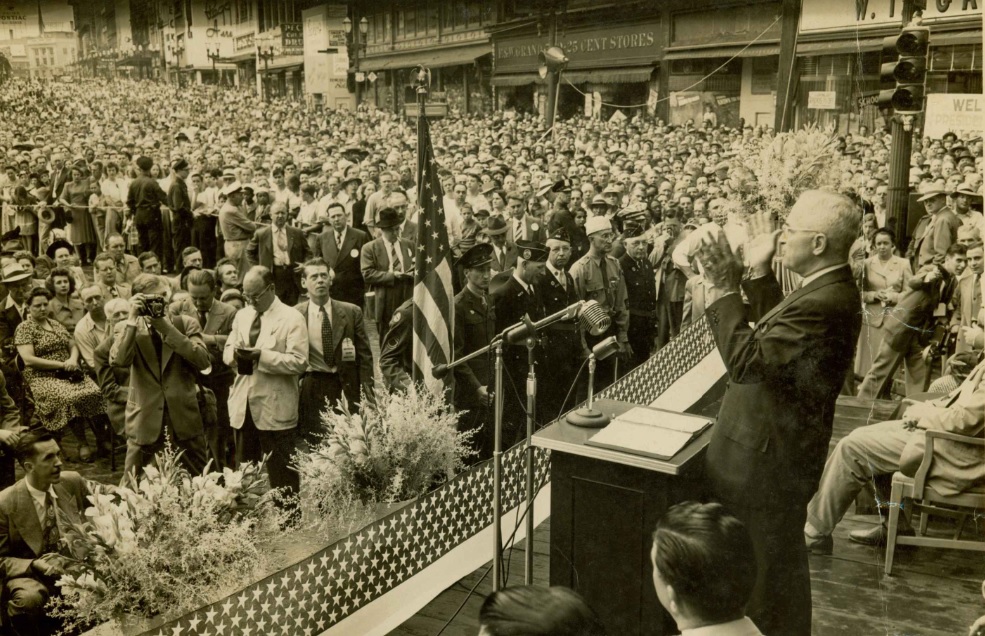
Today’s Haiku is adapted from the line “Doesn’t do any good to talk about voting, if you sit around on election day, too lazy to turn out.” from a speech made by President Harry S Truman when he started his famous whistle stop campaign across the country with a 9AM stop in Downtown Grand Rapids, Michigan.
Most folks will remember DIME STORE row and the WT Grant store behind the President in what is now called Rosa Parks Circle.
Here is the text of the speech.
September 6, 1948
GRAND RAPIDS, MICHIGAN (Rally, 9:10 a.m., E.D.T..)
My, what a wonderful crowd at 8:15 in the morning. I wonder what it would have been at 8:15 in the evening! I don’t see how it could have been any greater. I am looking at three solid blocks of people spread out in three different directions from this square. It is remarkable. I never thought you could do it. It just goes to show that you are interested in the welfare of this great Nation, and that you want to hear some of the facts in connection with the coming campaign.
It is a great day for me. It is a great day for you. I am just starting on a campaign tour that is going to be a record for the President of the United States, and when I get through you are going to know the facts.
I can’t tell you how very much I appreciate this welcome. It is a wonderful thing. It warms your heart–makes you feel like going out and making a fight for the people, when they turn out to see you like this.
I appreciate very much that key to the city which Acting Mayor Davis has given me, and I shall treasure it along with several more that I have. I appreciate it just as highly as I do the others. In fact, I have two keys to the city of Grand Rapids and that is a wonderful thing. That is the only city I have ever been in where I got two keys.
Your Mayor Welsh wrote to me that he was sorry he couldn’t be present as he had to go abroad. He has been in to see me on several occasions with the mayors organization in the country and I have had some very pleasant talks with him.
This also is the hometown of my good friend and former colleague when I was in the Senate, Senator Arthur Vandenberg. The Senator and I have spent 10 years in the Senate. While we didn’t always agree on domestic problems, I will say this to you, that Senator Arthur Vandenberg is intellectually honest and I like him.
I understand that there are three Congressional Medal of Honor men on this platform with me this morning. You know, that is a wonderful thing. That is a real record for one city, to have three Congressional Medal of Honor men. It was my privilege to hand the medals to these young men. They made wonderful records. If you haven’t read those citations, I hope everyone of you will make it a point to read the citations which accompany these medals for these young men.
You know, that is the greatest honor that can come to any man. I have said it time and again, and I don’t mind repeating it, that I would rather have that Congressional Medal of Honor than to be President of the United States. And I mean every word of it, and I know what I am talking about.
When the war ended there were some 12,500,000 young men and young women in the Armed Forces of the United States, and they were a cross section of the country, just as these three young men are a cross section of the country. I am not alarmed about the future of the United States as long as we have young men and young women like that.
Now these young men, and all those who were under arms when the war ended, were fighting for a principle. They were fighting for peace in the world, and they were fighting for the freedom of the individual.
We are still making that fight, and we are still making a fight for an honorable peace, and a just peace in the world. And I am here to tell you we are going to get it before we get through.
The working people of this country have demonstrated time and again that they are devoted to freedom and to world peace. They had an essential part in winning this war. Organized labor has been a leading force in international cooperation. Working people are also interested in building a better United States of America.
For the most part, workers have the same kind of problems that everybody else has-high prices, housing, schools for their children. In recent years, labor has become strong enough to have real influence. This is a development that I am very happy to see. Some people are not.
In November you will have a chance to use your influence in a manner that will be the determination of your destiny for years to come.
Now the necessity that faces us is one of voting on November 2d. You must register, you must vote, if you expect to get a square deal in this great Nation. Doesn’t do any good to talk about voting, if you are not on the books. Doesn’t do any good to talk about voting, if you sit around on election day, too lazy to turn out. The interests of this great Nation are such that every man and woman of voting age in this country ought to turn out and vote on November 2d.
If you will do that, I am perfectly willing to abide by these results, because I know it will be right.
You just have two parties to choose from in this election: the Democratic Party which stands for the peace and the welfare of the people and the little man, and the Republican Party which stands for special interests.
The record proves conclusively that the Republican Party is controlled by special privilege; and that the Democratic Party is responsive to the needs of the people.
Let us look at some of the instances of how that works and what it means to you. One of the things that worries you is high prices. During the war we were able to control prices, keep them at a fairly reasonable level. We could help rising prices now. It would be just as easy as it was to do it during the war. But the Republican Both Congress would not pass a price control law, although I recommended that they do that time and time again. As a result many of you and millions of other Americans are not able to buy the things you need, because prices are far higher than you can afford.
Another thing that troubles you in Grand Rapids is the housing shortage, and the shortage of school facilities. School facilities are short all over the Nation. Not only are we short in facilities, we are short in teachers and people to guide the young people through the lower grades in the schools. I tried every way within my power to get the Congress to do something about that. The Senate passed the bill. Most of the Democrats in the Senate voted for that bill, and some of the Republicans did. In the House that bill died along with the housing bill. I am told that within sound of my voice there are 62 veterans and their families with small children living in what was formerly a furniture factory, here in the heart of this city, subject to all the noise and confusion that goes on in a busy city.
There are other veterans in this community who are housed in temporary buildings with no early prospects of anything better. I have been doing everything within my power to get that Republican Both Congress to pass a housing bill to help meet the housing shortage. But the real estate lobby did not want low-rent housing, and did not want slums replaced by decent housing. That real estate lobby is one of the most powerful lobbies that ever came to Washington, and along later in this campaign I am going to tell you about a lot of other lobbies that came to Washington and got just what they wanted out of that 80th Congress–and the people didn’t get a thing!
The housing bill passed the Senate in the 80th Congress and was voted out of the House committee by 11 Democrats and 3 Republicans against 13 Republicans on the other side. But the Republican leadership wouldn’t even let the full membership of the House vote on that bill.
Finally the special session of Congress in July–after I had made things so hot for them; it looked for a while like we might get some action on that bill–still managed to kill it in the Rules Committee of the House. In fact, Senator Taft ran out on his own bill. You know, the bill in the first instance was called the Wagner-Ellender-Taft bill. That is the bill that passed the Senate and died in the House. Along came the 80th Congress in 1947 and it passed the bill again. This time it was called the Taft-Ellender-Wagner bill–a slight change. But when it was time for that bill to be pushed through the House, the Republicans voted against it, and Senator Taft ran out on his own bill. I am sorry to say that.
The veteran who needs a home is not greatly interested in the quarrel between the Congress and the President. What he wants to know is if he is going to have a place to live. The record shows that the Democrats want to use the full power of Congress to help provide homes. The Republicans do not want to do that.
Now you make your choice. You are going to have a chance in November.
There are many other ways in which the Republicans have proved that they serve special privilege and the privileged few at the expense of the people. I am going to talk about them a lot in this campaign, and I hope you will learn all about them. The fact that we have had a Republican Congress for 2 years has at least given you a chance to see what they are like and what they will do.
I call it the worst Congress, except one, this country has ever had. Because I was in the White House, however, they didn’t get to walk backwards quite as fast as they wanted to. They have interrupted the progress which we have made, though, since 1932. If you want to resume the progress to go on as we have been going on, under this administration that believes in the welfare of the whole people and not just in the welfare of the real estate lobbies and a few other great lobbies, you will send the Democrats back to power on November 2, 1948.
Thank you very much.
 No Haiku For You