Some of these beach haiku were written by random trips to beach.
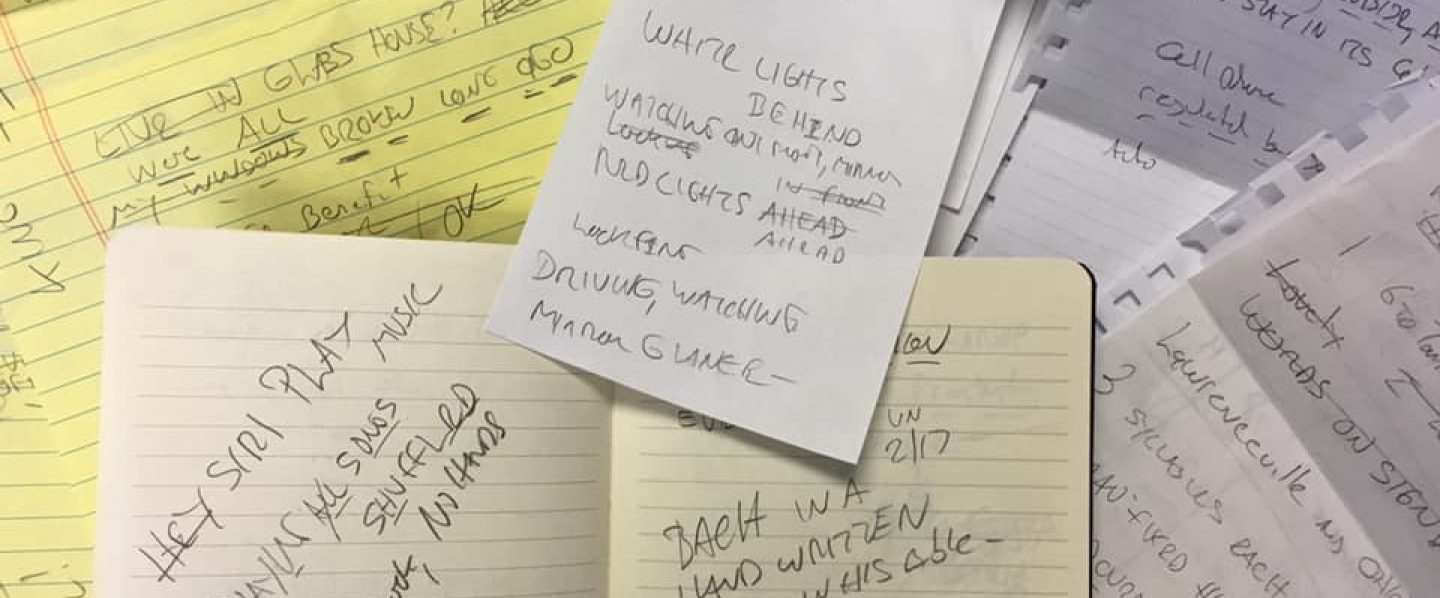
Most of these are part of a series based on afternoons spent at the beach on Hilton Head Island with my pad out ( a real paper note pad), hoping for words with my iPhone camera handy to add illustration to my thoughts.
I wanted to see if I would be ‘inspired’ by what I saw, by what I heard, by what I smelled, by what I tasted, what I felt emotionally and what I felt tactilely.
Some turned out okay.
Some were too forced.
Some were just bad.
Some did involve some or all of those feelings.
As far as it goes, I guess I was inspired by by what I saw, by what I heard, by what I smelled, by what I tasted, what I felt emotionally and what I felt tactilely.
Please aware that most of these haiku were NOT WRITTEN on the date in the title – for an explanation of this please see The Series link in the navigation table.
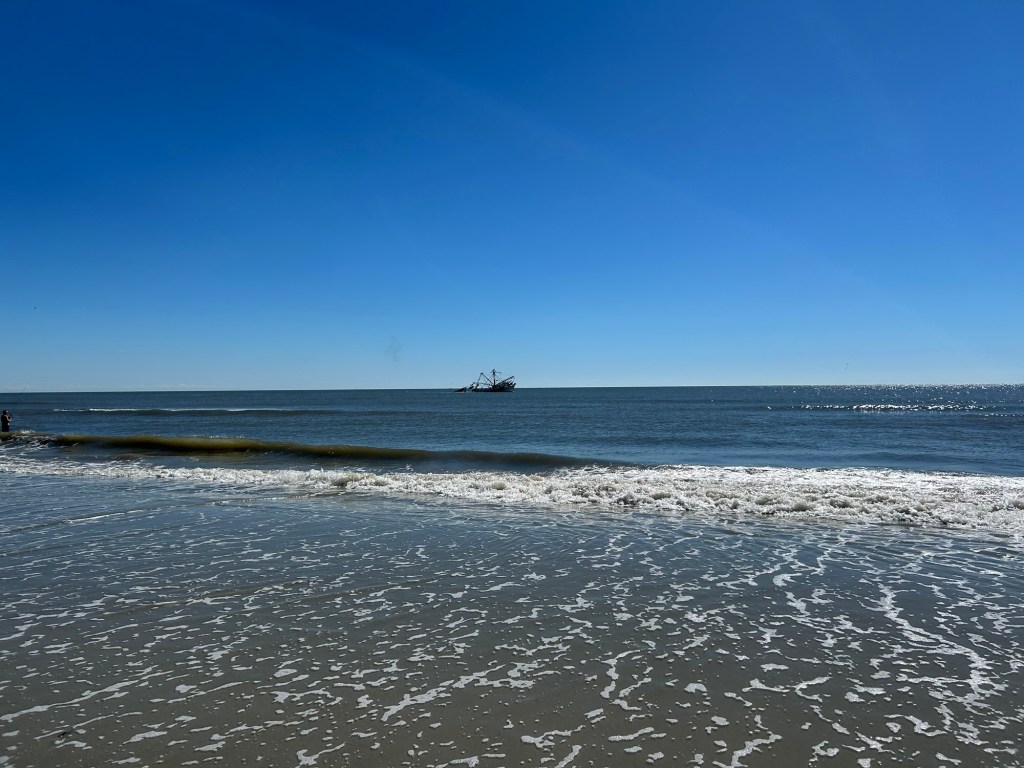
shrimping boats are late today swift mischief or stubborn sea lost beneath the tide
The shrimping boats are late today; The dusk has caught them cold. Swift darkness gathers up the sun, And all the beckoning gold That guides them safely into port Is lost beneath the tide. Now the lean moon swings overhead, And Venus, salty-eyed.
They will be late an hour or more, The fishermen, blaming dark’s Swift mischief or the stubborn sea, But as their lanterns’ sparks Ride shoreward at the foam’s white rim, Until they reach the pier I cannot say if their catch is shrimp, Or fireflies burning clear.
Nocturne: Georgia Coast by Daniel Whitehead Hicky as published in Poems of Daniel Whitehead Hicky by Daniel Whitehead Hicky (Atlanta : Cherokee Pub. Co.: Atlanta, 1975).
sea-born Venus, when rose from out her cradle shell wind out-blows, ’tis blue
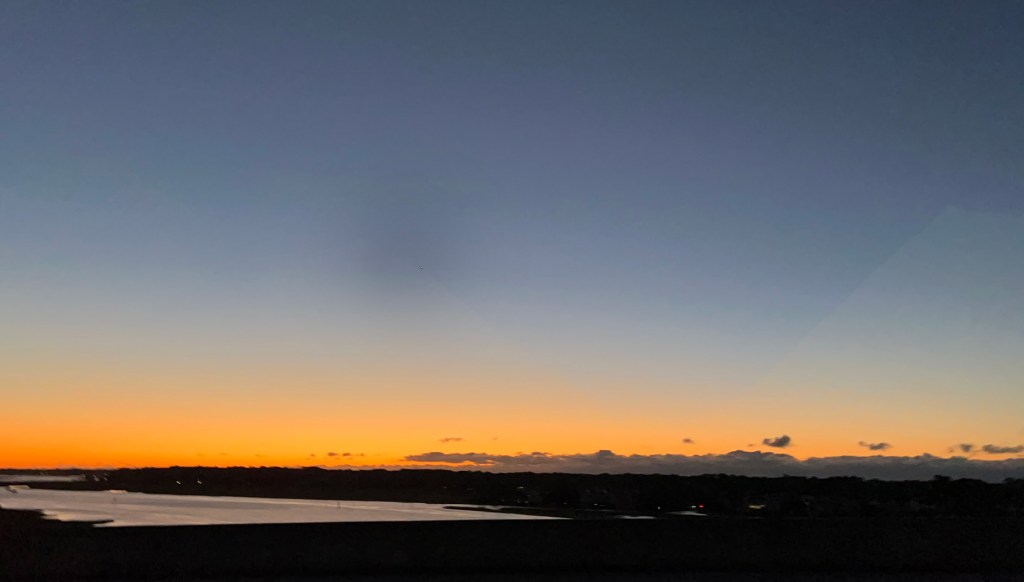
Venus in the Morning Sky over the Atlantic Coast – You will have to take it on faith that its there, but it is
That, when I think thereon, my spirit clings And plays about its fancy, till the stings Of human neighbourhood envenom all. Unto what awful power shall I call? To what high fane? — Ah! see her hovering feet, More bluely vein’d, more soft, more whitely sweet Than those of sea-born Venus, when she rose From out her cradle shell. The wind out-blows Her scarf into a fluttering pavilion; ’Tis blue, and over-spangled with a million Of little eyes, as though thou wert to shed, Over the darkest, lushest blue-bell bed,
Except from Endymion: a poetic romance by John Keats, John, 1795-1821 (Taylor and Hessey, 93, Fleet Street: London, 1918).
I cannot drive to work without looking to my left and see Venus bright in the pre dawn sky and not relax.
Since the moment of Creation, Venus has been there as the morning or evening Star.
No one in history, whether they made the history books or not, has not, at some point in their lives, seen Venus in the sky.
Maybe they didn’t know it was Venus but there it was.
My Dad had a way of pointing out Venus whenever he saw it.
Or if we pointed out that bright star, he would correct us and say, “That’s Venus … It’s a planet”.
I do the same thing with my kids and now, my many grand kids.
And when I do, I think of my Dad and I think of the how long people Dads and Grandfathers have been doing this.
A quick look at history shows that not only has Venus been around a long time, the name Venus for Venus goes back a ways in recorded history.
The Greeks had two names for Venus:
Phosphoros (Φωσφόρος, “Light-Bringer”) when seen as the Morning Star.
Hesperos (Ἓσπερος, “Evening”) when seen as the Evening Star.
Eventually, Greek astronomers (like Pythagoras) realized they were the same object.
Later Greek writers used the name Aphrodite for the planet in line with mythology.
The Babylonians called Venus Ishtar, their goddess of love and war—very similar to Aphrodite/Venus.
Venus was extremely important in Babylonian astronomy and astrology.
For Egyptians, Venus was associated with goddess Isis and also sometimes Hathor.
Egyptians noted its dual role in the sky and had separate names for its morning/evening appearances.
In Chinese cosmology, Venus is called “Taibai” (太白), meaning the “Great White” star, it is associated with metal in the Five Elements (Wuxing).
Hard to see in the photo I snapped as I drove over the Cross Island Bridge this morning, but there was Venus.
As C. S. Forester writes in Hornblower and the Hotspur, ” Over there was Venus, shining out in the evening sky. This sea air was stimulating, refreshing, delightful. Surely this was a better world than his drained nervous condition allowed him to believe.”
I see Venus.
I think of my Dad.
I think of my kids and grandkids.
And I think, surely this is a better world than my drained nervous condition allows me to believe.
it begins to rain first harsh, sparse, swift drops across ground in a long sigh
“It begins to rain. The first harsh, sparse, swift drops rush through the leaves and across the ground in a long sigh, as though of relief from intolerable suspense. They are big as buckshot, warm as though fired from a gun; they sweep across the lantern in a vicious hissing.”
As I Lay Dying by William Faulkner (New York: Jonathan Cape and Harrison Smith, 1930).
In the original screen for the movie, Talladega Nights: The Ballad of Ricky Bobby, Ricky Bobby’s two boys are named Hank and Williams, Jr. which gets changed to Walker and Texas Ranger in the movie.
There is a scene that is only on the DVD in the extended cuts where Grandma Lucy is reading to Hank and Williams Jr. They are asking her questions. We see she is reading them Faulkner’s The Bear.
Williams, Jr. asks, “But doesn’t the bear symbolize the old south and the new dog, the encroaching North?”
Hank responds, “Duh! But the question is, should the reader feel relief or sadness at the passing of the old south?”
Grandma asks, “How about both?“
To which Hank gets it and says, “Ahh!… I get it, moral ambiguity! The hallmark of all early twentieth century American fiction!”
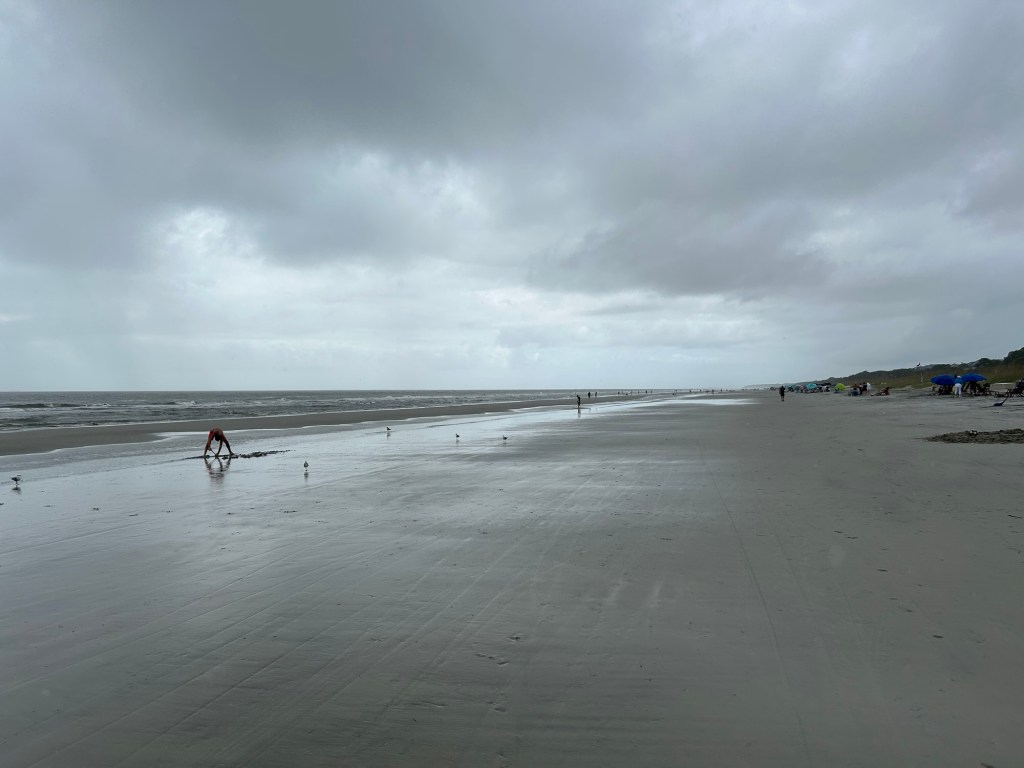
I went for a walk on the beach today and it started to rain and I got soaked.
I was there for a short time on my lunch break.
There were lots of families there who had spent a lot of time and effort and money to be on that same beach for just a few days.
Did I feel relief or sadness at being caught in the rain with all those poor folks, struggling to say, “I don’t think the hard stuff is going to come down for some time yet.”
Or …
Did I feel both.
Moral ambiguity! The hallmark of all early twentieth century American fiction!
a corner of the deserted beach solitary sea loudly claps its hands
Midday. A corner of the deserted beach. The huge, deep, open sun on high Has chased all the gods from the sky. The harsh light falls like a punishment. There are no ghosts and no souls, And the vast, ancient, solitary sea Loudly claps its hands.
Midday by Sophia de Mello Breyner Andresen as published in Obra Poética (translated by Richard Zenith) I. Lisbon: Caminho, 1990.