12.5.2025 – does the grain of sand

does the grain of sand
know it is a grain of sand
in any order

Does the grain of sand
know it is a grain of sand?
Will secrets fly out of me
when I break open?
Are the stars standing
in any order?
Is supplication
useful?
Exactly.

Riprap #8 as published in The Leaf and Cloud by Mary Oliver (Da Capo: New York, 2000)

In the fly leaf to the copy of The Leaf and Cloud that I have is written:

AN ASTONISHING book-length poem in seven parts from the winner of the Pulitzer Prize and the National Book Award With piercing clarity and craftsmanship, Mary Oliver has fashioned this unforgettable poem of questioning and discovery, about what is observable and what is not, about what passes and what persists.

Questioning and discovery.

About what is observable and what is not.

About what passes and what persists.

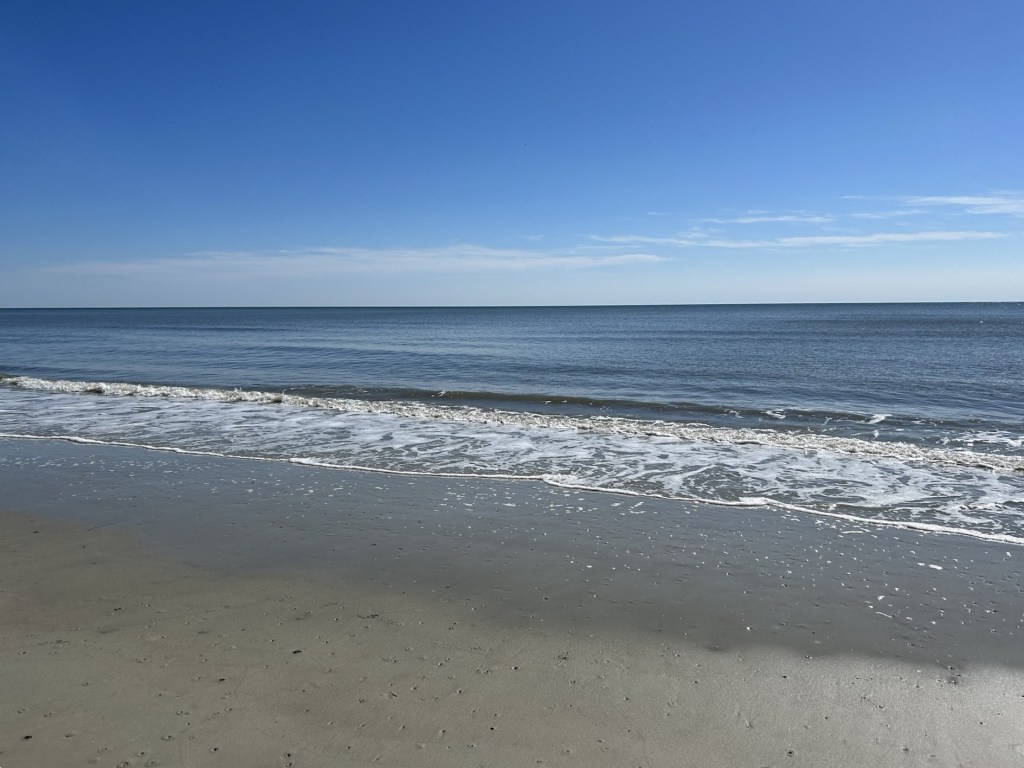
My regular readers know how I love to brag that when I am in the office, I get to spend my lunch hour walking the beach on the Atlantic Coast of South Carolina.

I take a sandy path through a salt marsh and then beach grass to the waters edge.

Its the same every day.

It is different every day.

It passes.

It persists.

It is observable.

It is unseen.

Does the grain of sand know it is a grain of sand?

Are the stars standing in any order?

Is supplication useful?

Observable or unseen?

There is a story told that back in World War 2, at one of the summit meetings of President Franklin Roosevelt, Prime Minister Winston Churchill and Marshall Josef Staling, Mr. Churchill mention that the point of view of the Pope should be considered on some point.

Mr. Stalin famously rebuked Mr. Churchill, saying something like, “The Pope, how many divisions does he have?”

Most historical accounts stop there.

But some do include Mr. Churchill’s response.

He said, “Just because you can’t see them doesn’t mean they aren’t there.”

Are the stars standing in any order?

Is supplication useful?

Observable or unseen?

EXACTLY!

11.22.2025 – that time of year when

that time of year when
yellow leaves, none, or few, hang
shake against the cold

That time of year thou mayst in me behold
When yellow leaves, or none, or few, do hang
Upon those boughs which shake against the cold,
Bare ruin’d choirs where late the sweet birds sang.
In me thou see’st the twilight of such day
As after sunset fadeth in the west;
Which by and by black night doth take away,
Death’s second self, that seals up all in rest.
In me thou see’st the glowing of such fire
That on the ashes of his youth doth lie,
As the death-bed whereon it must expire
Consum’d with that which it was nourish’d by.
This thou perceiv’st, which makes thy love more strong,
To love that well which thou must leave ere long.

Sonnet 73 by William Shakespeare.

If you traveled the length and width of Beaufort County, South Carolina you might be hard pressed to find more fall color then is this little patch of trees near where I live.

Beaufort County is 40 miles long and 10 miles deep and covers the coast of South Carolina from Savannah to Charleston.

At high tide, 50% of Beaufort County is underwater.

The salt is in everything and there is not a lot of color you can get out of salt.

Growing up in Michigan, the local forests are a poor player for fall color.

Having lived in Atlanta for years, the local forests are just as lacking for spring color.

The simple pond in the picture has the very real chance to be home to both alligators and water mocassians but it sits in the middle of housing development surrounded by an lawn that invites you to bring a picnic lunch and sit and enjoy your surroundings.

If you do that and aren’t bother by the alligators or snakes, either the fire ants or the sand gnats will eat you alive.

So why do I live in this salt marsh swamp?

That one line there captured by Big Bill.

Upon those boughs which shake against the cold.

Its the end of November.

It is forecast to be in the low 80’s and we are off to the beach.

Now my favorite fall colors are the numberless shades of blue in the sky and in the water of the Atlantic Ocean.

In me thou see’st the twilight of such day

This thou perceiv’st, which makes thy love more strong,

11.13.2025 – without wondering

without wondering
think about the sunrise and
what sunrise would bring

Adapted from the line, “He thought that he would lie down and think about nothing. Sometimes he could do this. Sometimes he could think about the stars without wondering about them and the ocean without problems and the sunrise without what it would bring.”

From the book, Islands in the Stream by Ernest Hemingway, (Charles Scribner Sons: New York, 1970 – published posthumously).

11.2.2025 – shake out every sail

shake out every sail
round the world and home again
that’s the sailor’s way

Head the ship for England!
Shake out every sail!
Blithe leap the billows,
Merry sings the gale.
Captain, work the reck’ning;
How many knots a day? —
Round the world and home again,
That’s the sailor’s way!

From Homeward Bound by William Allingham as published in The vista of English verse by Henry Spackman Pancoast, (H. Holt and company: New York, 1911).

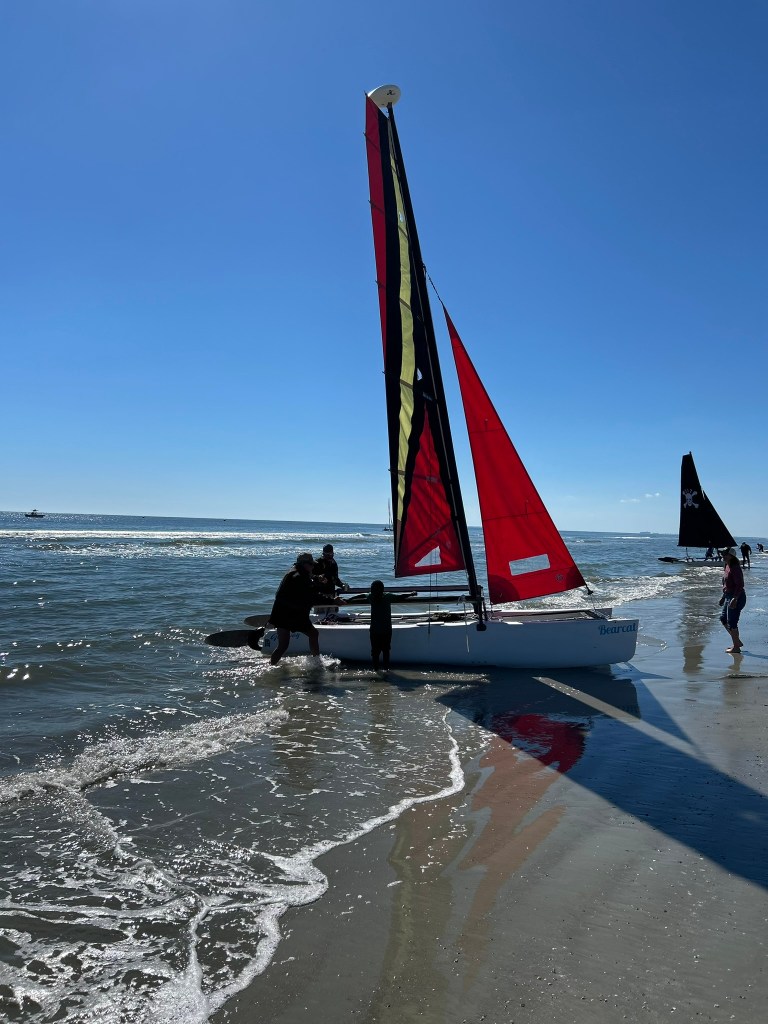
We happened to be on the beach on Hilton Head during the Hilton Head Multi Hull 50th Anniversary Beach Regatta.

My grandson Jaxon, who knows no fear, ran into the waves and asked for a ride.

One of the sailors boomed and I mean BOOMED out, ‘You Bet!’

Picked him up and plopped on the boat.

Today’s haiku is adapted from the poem, Homeward Bound, and the movie, Charlie and the Chocolate Factory.

According to the book, I want it Now, by Julie Dawn Cole, who played Veruca Salt in the movie, it was screen writer, David Seltzer, who came up with the “… clever and charming quotations, often borrowed from Classic Literature, that he wove into Gene’s dialogue. His fluency in this works translated into the final elegance of the final script. S[potting the origins of these quotes has fascinated many Wonka fans.

According to Wikipedia, He [David Seltzer] was uncredited for his contributions to the screenplay of the 1971 musical film Willy Wonka & the Chocolate Factory. The author of the original book, Roald Dahl, is credited as the sole screenwriter; however, it has been revealed that Seltzer rewrote 30 percent of Dahl’s script, adding such elements as the “Slugworth subplot”, music other than the original Oompa Loompa compositions (including Pure Imagination and The Candy Man), and the ending dialogue for the film.”

As a shout out to the movie, Mr. Seltzer and those guys on the boat, so shines a good deed in a weary world.

And lest we forget, Mr. Shakespeare and The Merchant of Venice. Where the original line, spoken by Portia, is:

How far that little candle throws his beams! So shines a good deed in a naughty world.

If you could have seen the smile on Jaxon’s face … you would know just what Big Bill and Mr. Seltzer were going for.

10.22.2025 -La mer est tout, son

La mer est tout, son
souffle est pur et sain que
mouvement et amour 

Based on the passage: La mer est tout ! Elle couvre les sept dixièmes du globe terrestre. Son souffle est pur et sain. C’est l’immense désert où l’homme n’est jamais seul, car il sent frémir la vie à ses côtés. La mer n’est que le véhicule d’une surnaturelle et prodigieuse existence ; elle n’est que mouvement et amour ; c’est l’infini vivant, comme l’a dit un de vos poètes. Et en effet, monsieur le professeur, la nature s’y manifeste par ses trois règnes, minéral, végétal, animal.”

From Vingt mille lieues sous les mers : Tour du monde sous‑marin by Jules Verne( Paris : Éditions J. Hetzel & Cie, 1870).

Or … The sea is everything!

It covers seven-tenths of the earth’s surface. Its breath is pure and healthy.

It is the vast desert where man is never alone, for he feels life stirring on all sides.

The sea is only the vehicle for a supernatural and prodigious existence;

it is nothing but movement and love;

it is living infinity, as one of your poets said.

And indeed, Professor, nature manifests itself there in all three of its kingdoms: mineral, vegetable, and animal.”

From Twenty Thousand Leagues Under the Seas: A Tour of the Underwater World by Jules Verne (Paris: J. Hetzel & Co., 1870).

What?

Another excuse to show off that this is where I take my lunch time?

La mer est tout!

The sea is everything!

Elle n’est que mouvement et amour!

It is nothing but movement and love!

And … another excuse to show off that this is where I take my lunch time.