2.11.2024 – quizzical sense earth

quizzical sense earth
far more fascinating place than
allowed it to be

In my reading I often come across a short collection of words by an author and I say to myself. that might work as a haiku if I could connect it with something.

In my adventures, I often come across a scene and take a photo and I say to myself that might work with a haiku if I connect it with something.

We had taken a walk today along what is called Fish Haul beach on the north end of of Hilton Head Island.

This is the location of the one of the first successes the Union Army and Navy had back in 1861 in the Civil War.

You can look out over the waters where Port Royal Sound and the Atlantic Ocean come together and I said to my wife that take away the few cottages you could see, and this is what it looked like back then except there were 40 warships under sail, moving a circle as they fired some 4000 shells at Confederate forts on the Phillips Island to the north and Hilton Head island to the south.

The shelling lasted about 4 hours and all the Confederates ran away.

“And nothing has changed,” I said again.

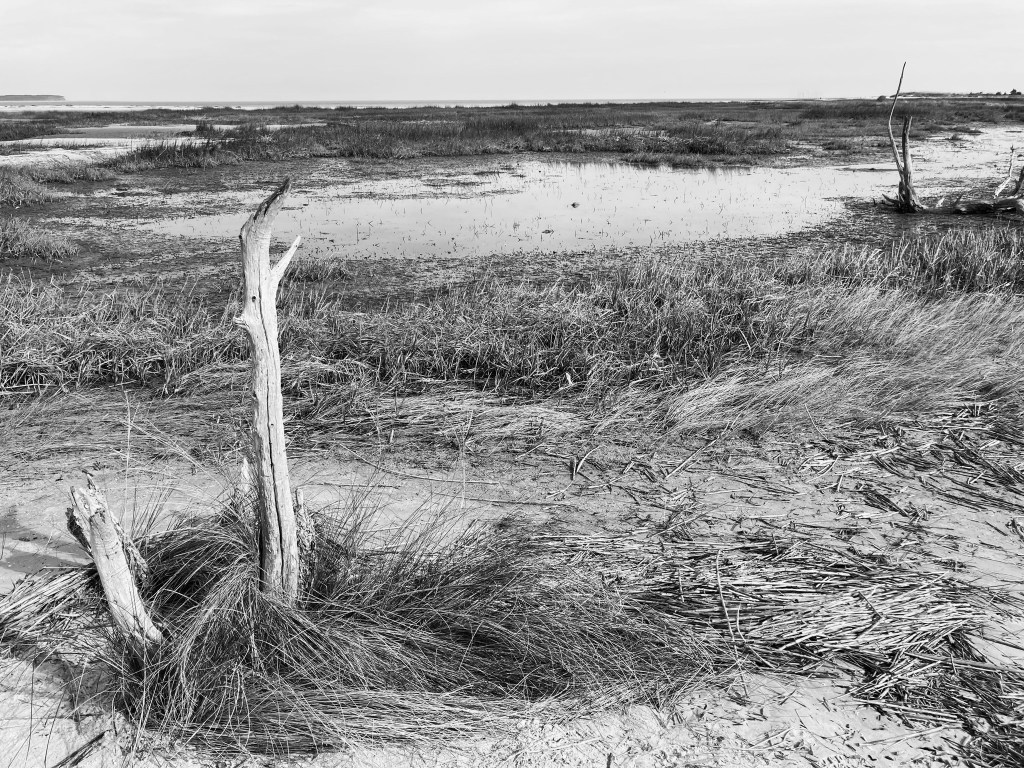
It was an extremely low tide and we were able to walk further back along the salt marshes behind the beach front.

We came to a pond that we have looked at for years but never from this side before.

There were dead trees and reeds and marsh grass and sea shells.

It was place and a view new to us.

And I thought …

In a few hours, the tide will come and rearrange all this.

Nothing in front of us will stay the same.

This view, what we are seeing, will never been seen in this way again.

And I thought of this passage from True North by Jim Harrison.

… [the] quizzical sense that the earth was a far more fascinating place than I had allowed it to be.

I was not inclined at the moment to blame anyone else for the number of ways I had been single minded in the wrong direction.”

I told my wife I wanted to stay at the point until the tide turned and wait as long as possible amd leave just before the tide cut us off.

I wanted to see it.

My wife stared at my and shook her head and walked back the path out of the marsh.

I have this quizzical sense that the earth is a far more fascinating place than I had allow it to be.

I am not inclined at the moment to blame anyone else for the number of ways I had been single minded in the wrong direction.

But I am trying to enjoy the path I am on.
2.8.2024 – God, it is something

God, it is something
face the sun know you are free
hear the undersong

IT is something to face the sun and know you are free.
To hold your head in the shafts of daylight slanting the earth
And know your heart has kept a promise and the blood runs clean:
It is something.
To go one day of your life among all men with clean hands,
Clean for the day book today and the record of the after days,
Held at your side proud, satisfied to the last, and ready,
So to have clean hands:
God, it is something,
One day of life so
And a memory fastened till the stars sputter out
And a love washed as white linen in the noon drying.
Yes, go find the men of clean hands one day and see the life, the memory, the love they have, to stay longer than the plunging sea wets the shores or the fires heave under the crust of the earth.
O yes, clean hands is the chant and only one man knows its sob and its undersong and he dies clenching the secret more to him than any woman or chum.
And O the great brave men, the silent little brave men, proud of their hands—clutching the knuckles of their fingers into fists ready for death and the dark, ready for life and the fight, the pay and the memories — O the men proud of their hands.

Clean Hands by Carl Sandburg as printed in Smoke and steel, (New York, Harcourt, Brace and Howe, 1920)

Yes, go find the men of clean hands one day and see the life, the memory, the love they have, to stay longer than the plunging sea wets the shores or the fires heave under the crust of the earth

On June 17, 1785, Thomas Jefferson wrote to James Monroe, “I sincerely wish you may find it convenient to come here. The pleasure of the trip will be less than you expect but the utility greater. It will make you adore your own country, it’s soil, it’s climate, it’s equality, liberty, laws, people and manners. My god! How little do my countrymen know what precious blessings they are in possession of, and which no other people on earth enjoy.”

Two years before the Constitution, they were both future Presidents but that was a job that didn’t even exist yet.

As I drive to work and face the sun with clean hands I feel the sun on my face but cannot help but hear the sob and its undersong.

I read the news and I think, My God! How little do my countrymen know what precious blessings they are in possession of.

2.1.2024 – everything changes

everything changes
everything changed yet almost
nothing changed at all

I’ve come to think of our current condition as a kind of long Covid, a social disease that intensified a range of chronic problems and instilled the belief that the institutions we’d been taught to rely on are unworthy of our trust.

The result is a durable crisis in American civic life.

Just look at the election cycle we are about to fall into: It seems like the world turned upside down several times, and yet here we are facing the prospect of another contest between Joe Biden and Donald Trump, as though the country hasn’t moved forward an inch.

Everything changed, and yet almost nothing changed at all.

From the Guest Opinion essay, “Why America Can’t Recover From That First Awful Covid Year” by Eric Klinenberg in the New York Times (Jan. 31 2024).

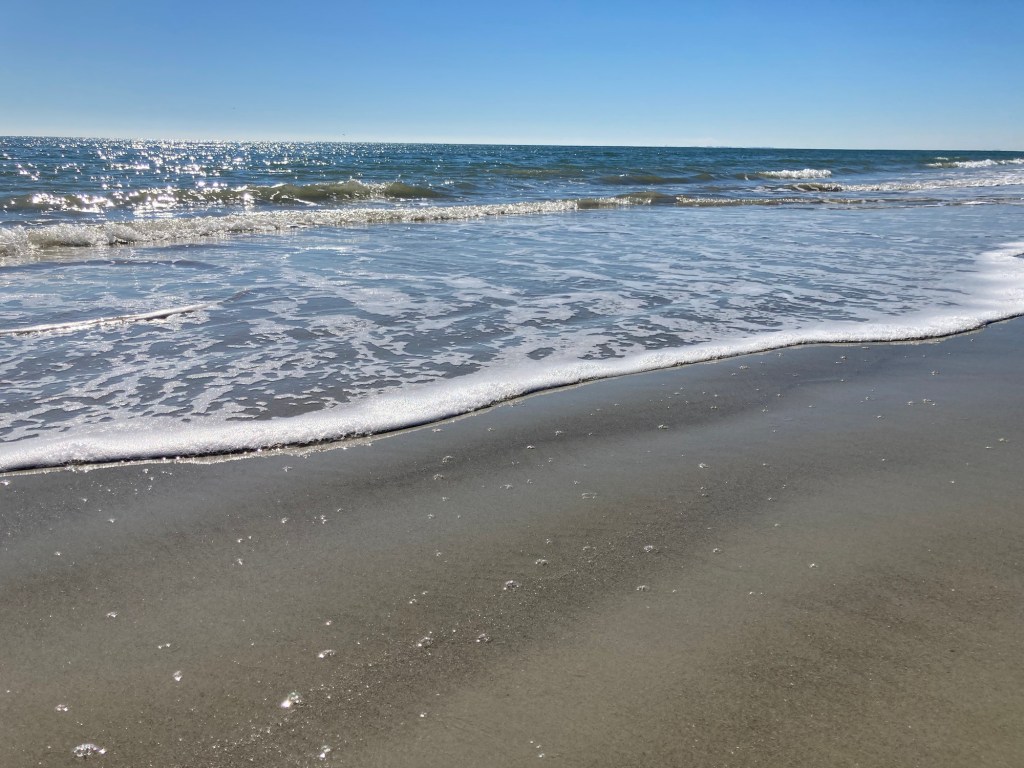
I live near the seashore and I walk the beach whenever I can.

One of the redeeming aspects of my job is that the office where I work is about 5 blocks from the beach and I can walk down to the east coast of the United States of America on my lunch break.

Over 330 million people in America and a fairly small percentage can be found actually standing on either the east or west coast at any one moment.

I understand and embrace the privilege.

Being this close to the ocean, it is odd that the tide becomes such a part of your life.

You are aware of its highs and lows.

Here in the low country of South Carolina, known as the low country as it usually less than 10 feet about sea level, when the tide is out the pluff mud, the top layer of land in the salt marshes is exposed.

You don’t need to see low tide to know its low tide, you just have to smell it and it smells like pluff mud.

One of my grand daughters got a good whiff and said ‘someone farted.’

I told her nope, that down here that just means its low tide.

Twice a day, the tide comes in and goes back out.

The beach is made and remade as the tide power washes the beach and scours everything in its path.

Tons of seawater plow across the sand and wipes away everything and then retreats, leaving a brand new beach.

Everything is changed.

At the same time, though.

It is the same beach.

Nothing changed at all.

More and more, history I realize, is just as subject to the tide as is the beach.

1.26.2024 – fog, little cat feet

fog, little cat feet
sits looking over harbor
on silent haunches

From Fog in Chicago Poems by Carl Sandburg (Henry Holt and Company, 1916).

I will bet you one dollar you knew this poem.

I will double that bet and guess you knew it was Mr. Sandburg.

I will double that bet and guess that its the only poem by Mr. Sandburg you know.

Maybe a safe bet, but if there are two things I hope from all this is that most folks know this poem and that it is by this poet and for today, and you know what, that is enough!

So let us go on out to the kitchen and grab ourselves a beer to celebrate if I won or do the same thing if I lost.

Fog as published in Chicago Poems by Carl Sandburg (Henry Holt and Company, 1916).

The fog comes
on little cat feet.

It sits looking
over harbor and city
on silent haunches
and then moves on.

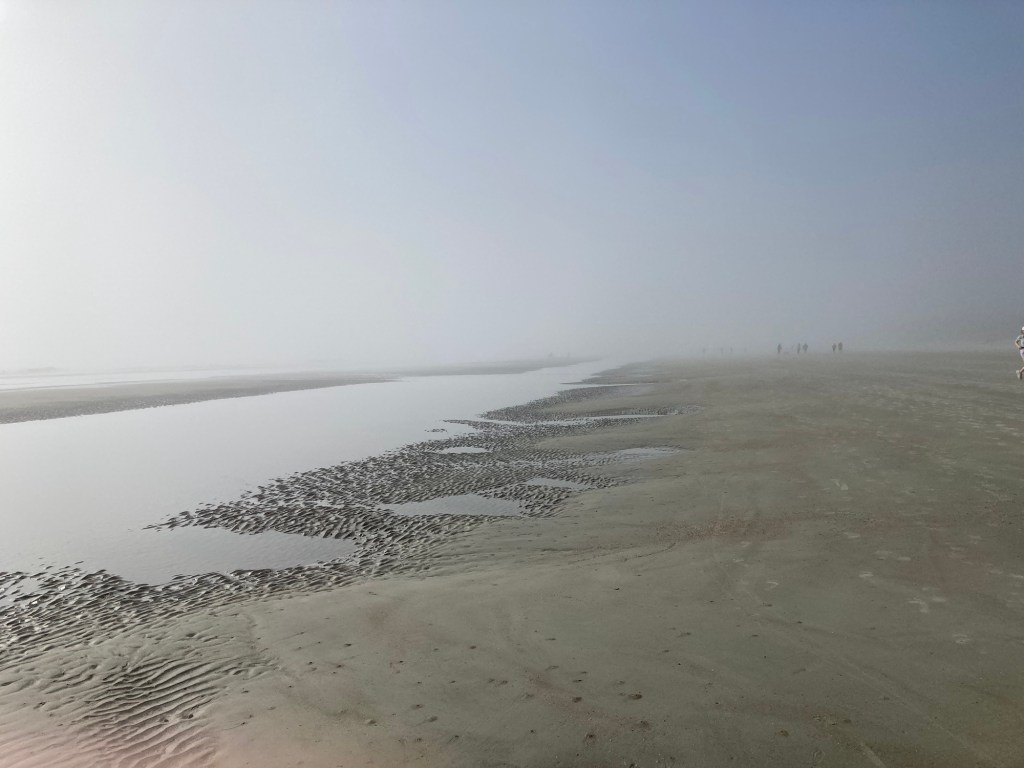
By the way with a 60 degree swing in the temperature since last weekend and with the ocean still at about 55 degrees, we gots ourselves a FOG warning here in the Low Country / Coastal Empire.

That’s what they call it down here.

1.14.2024 – whorls, curves, and shiny

whorls, curves, and shiny
iridescent insides are
the remains, the shell

One of the most striking features of our beaches is seashells. Their whorls, curves, and shiny iridescent insides are the remains of animals. Most shells come from soft-bodied mollusks. Snails, clams, oysters, and others need the hard protection of their shells. This tough outer covering protects the tasty body hiding inside. Other animals, such as crabs and lobsters, also make a tough outer covering, but here we focus on mollusk shells.

Where do shells come from? The animals make them. Mollusks have an outermost layer of tissue on their bodies. Called the mantle, this layer connects the animal to its shell. The mantle also creates that shell.

Specialized cells in the mantle build the shell using proteins and minerals. These are secreted—released into the space outside the cells. There, the proteins create a framework that provides support for the growing shell. The proteins in the framework also determine which minerals are used in specific parts of the shell.

Calcium carbonate, the main mineral found in shells (including eggshells), binds to the protein. If you have ever seen construction workers build with concrete, this is similar. The protein is like the steel rebar that gives shape and support. Calcium carbonate is like the cement that fills in all the gaps.

Calcium carbonate can form two different types of crystals. One is called calcite. This incredibly common crystal can be found all over the world. Calcite makes up chalk, marble, coral, limestone—and seashells. The other form is aragonite. This crystal has a different arrangement of calcium carbonate. Both calcite and aragonite are found in seashells.

A mollusk’s shell has three layers. Each is made up of similar materials. But how those materials are arranged gives them each a different look and feel. The outermost layer is mostly protein. It’s often rough and may have bumps or spikes. Proteins in the middle layer cause calcium carbonate to form calcite crystals. These fill in the spaces, making the shell tough to break.

The innermost layer is the one in contact with the mantle. It’s a smooth, iridescent layer called nacre or mother-of-pearl. Nacre is made up of protein and calcium carbonate. But it looks and feels completely different from other parts of the shell. That’s because the mantle secretes different proteins for different layers. Different proteins cause calcium carbonate to crystallize in different ways. Those used in the middle layer create calcite. Those used in the innermost layer create aragonite.

As the animal grows, its shell must grow along with it. This happens along the outer edges. A snail adds to its shell around the opening, where it pokes its head out. For a clam or mussel, it’s the outer edges where the two shells separate. The result is growth rings, like those in a tree, that allow us to measure a mollusk’s age.

When the animal inside dies, its shell is gradually pounded against the rocks and sand. Over time, shells break down. They become part of the sand. White beaches have sand made almost entirely of tiny bits of shells.

From How are seashells made? by the staff at the Woods Hole Oceanographic Institution.

I did not grow up near an ocean beach.

I grew up on a great lakes beach in Michigan.

On the great lakes you don’t have tides.

On the great lakes you don’t have sea water.

One of the favorite sayings of the folks up North is, “Lake Michigan – No Salt Added.”

But you also don’t have sea shells.

And I have fallen in love with them.

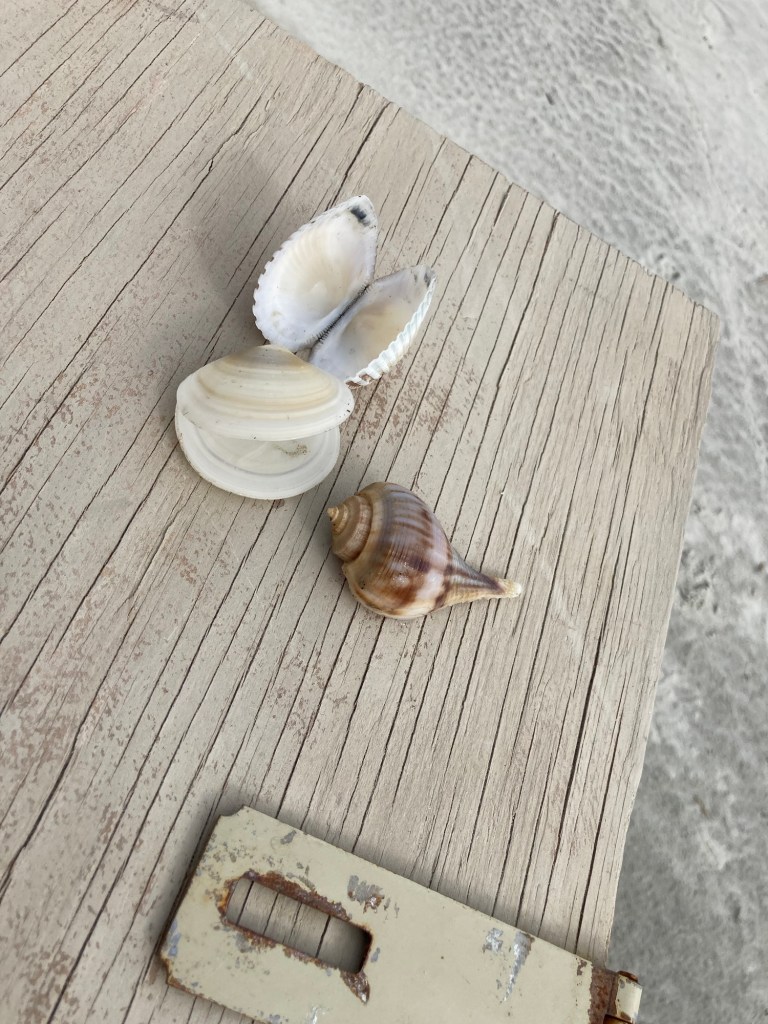
The shells in the picture I found on my lunch time break beach walk last week.

Being January, the number of the people on the beach is close to like … none (though there are always crazies from Wisconsin running around in swimsuits yelling its so warm) and the chances on finding sea shells on the beaches on the southern part of Hilton Head Island are pretty good.

I am learning about sea shells.

Any one should be able to tell you that you can cut down a tree and count the rings to get an age for the tree.

One new ring for each growth cycle in one year of freezing and thawing.

But what about shells.

Clam shells will add a new ring as it grows and these are not always one year apart.

According to the folks at Cornell:

• As they grow, clams add to the edge of their shell to protect
their squishy body inside.
• Each time the clam grows, you see a ring. Clams grow in
seasons when the water is warm (April-October).
• You can count the growth rings like you would age a tree.
• Count the darkest rings, each ring represents 1 year.
• The wider the band, the more the clam grew that year! More
growth suggests warm water and a lot of food that year!

I will never look at sea shells the same.