

purple – marine pests
jellyfish, stingrays … others …
are in the water
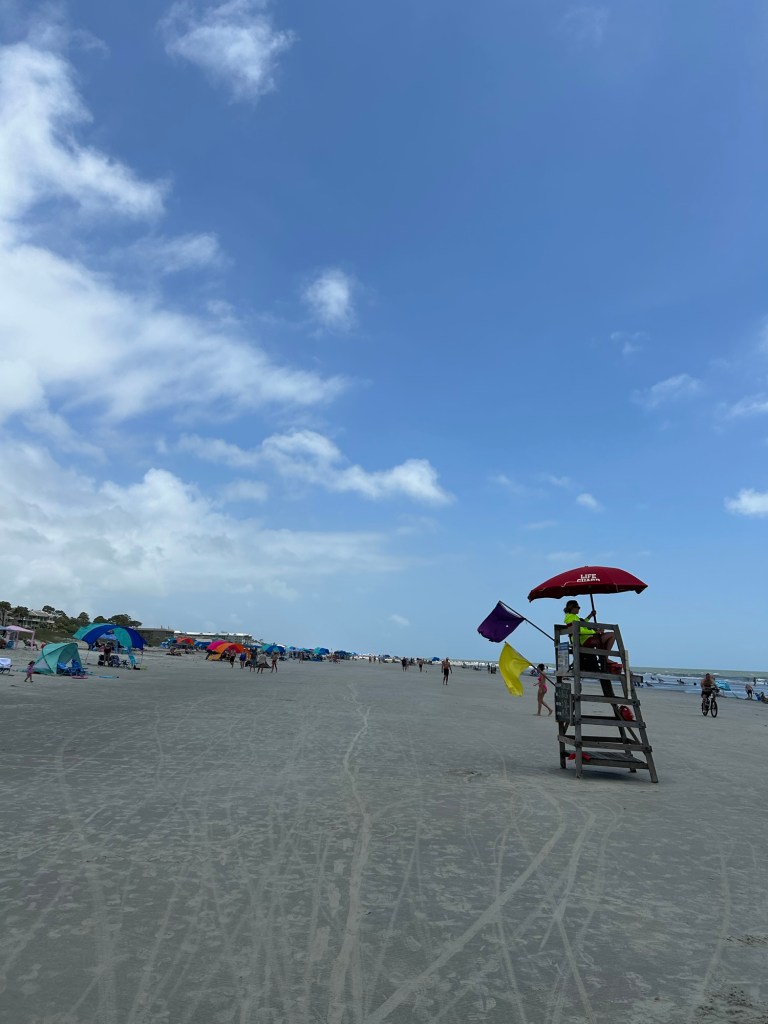
According to the United States Lifesaving Association website, for decades, lifeguard agencies in the U.S. and around the world have employed flags to notify swimmers of conditions, to warn of hazards, to identify safer areas for swimming, and to notify beach users about regulated areas. To help ensure global consistency, in 2004 the International Life Saving Federation developed international guidelines for warning flags.
Red – High hazard. Rough conditions such as strong surf and/or currents are present. All swimmers are discouraged from entering the water. Those entering the water should take great care.
Yellow – Medium hazard. Moderate surf and/or currents are present. Weak swimmers are discouraged from entering the water. For others, enhanced care and caution should be exercised.
Purple – Marine pests, such as jellyfish, stingrays, or other marine life which can cause minor injuries are present in the water. This flag is not intended to indicate the presence of sharks.
These guidelines have been adopted, in part, by the International Standards Organization and are endorsed by the United States Lifesaving Association. By consistently following these warning flag guidelines, lifeguard agencies can help ensure a universal understanding of their meaning and thus improve their effectiveness.
These flags are only approved for use on beaches where lifeguards trained to USLA standards are on duty. Flags are not an acceptable substitute for properly trained and equipped rescuers, but rather a tool for their use.
To be fully effective, the use of warning flags to notify the public of current hazard levels should be consistent, based on objective, measurable criteria that can be logged and tracked, and then changed as conditions change. They should be accompanied by good public education efforts to explain the meaning of the flags flown.
In the photo above, you see BOTH the yellow flag for moderate surf as well as the purple flag for marine pests.
The last line under the Purple Flag is the best.
This flag is not intended to indicate the presence of sharks.
I learned that there is a test down here for the prence of sharks.
Put your finger in the water and then put your finger in your mouth.
If it tastes salty, there are sharks nearby.
Growing up on Lake Michigan we had neither sharks nor marine pests.
I did experience the Alewife Explosion on the Great Lakes in the late 1960’s which took place because, according to the US Geological Survey, these invasive, saltwater fish are poorly adapted to the lake’s fresh water and struggle to handle sudden water temperature changes. When they undergo the stress of spring spawning or face dropping temperatures, their weakened bodies succumb to “osmotic shock” and they die by the millions.
I can attest to the dying by the millions as every morning the beach was cover with dead fish and our morning chore was to rake the beach and bury the fish.
There are no tides on the Great Lakes and the fact that twice each day the beaches here in South Carolina are stripped and power washed and resurfaced appeals seems to be worth the purple flags, stinging marine life and risk of sharks.
Discover more from No Haiku For You
Subscribe to get the latest posts sent to your email.
