5.5.2022 – tiresome for children

tiresome for children
always, forever, have to
explain to grown ups

Les grandes personnes ne comprennent jamais rien toutes seules, et c’est fatigant, pour les enfants, de toujours et toujours leur donner des explications.

Antoine de Saint-Exupèry in the ‘Le Petit Prince’ (1943).

In English:

Grown-ups never understand anything for themselves, and it is tiresome for children to be always and forever explaining things to them.

Jaxon was not happy that I could not understand that if he, Jaxon, could handle the waves of the Atlantic Ocean, he could easily handle the May River.

Geeeeeeeeeeeeeeeeeeeeeeeeee whiz.

5.4.2022 – enhanced use of force

enhanced use of force
deescalation training
so who but the Lord

Deadly force “is always the last resort” and that philosophy, as well as de-escalation training, needs to be ingrained into the department’s policies, Grand Rapids Police Chief Eric Winstrom told The Detroit News Tuesday.

So starts an article in the Detroit News with the headline, “Grand Rapids police need enhanced use of force, de-escalation training, chief says” by Leonard N. Fleming.

The words, enhanced use of force, de-escalation training, strung together in a line, the syllables clicking in a row like the sound of the wheels of a train over gaps in the tracks, grabbed and held my attention.

The article details the efforts of the Police Chief of Grand Rapids, Michigan (where I grew up) to address publicly the death of Patrick Lyoya, 26, who was shot in the back of the head by officer Christopher Schurr on April 4 following a tussle on the ground … after a traffic stop.

Mr. Fleming quotes the Chief as saying, “From what I’m hearing from the community, a real vocal part of the community is there’s no rebuilding trust. You’ve got to build it because it was never there.

Chief Winstrom said that on April 26th, 2022.

In 1947, in the magazine, Poetry, Langston Hughes published this poem.

I looked and I saw
That man they call the Law.
He was coming
Down the street at me!
I had visions in my head
Of being laid out cold and dead,
Or else murdered
By the third degree.

I said, O, Lord, if you can,
Save me from that man!
Don’t let him make a pulp out of me!
But the Lord he was not quick.
The Law raised up his stick
And beat the living hell
Out of me!

Now, I do not understand
Why God don’t protect a man
From police brutality.
Being poor and black,
I’ve no weapon to strike back
So who but the Lord
Can protect me?

We’ll see.

The title of the poem is ‘Who but the Lord?

A footnote in the “The collected poems of Langston Hughes” (Knopf, 1994) says that the last line was added when the poem was reprinted in the book, The Panther and the Lash.

That was in 1967.

That last line again?

We’ll see.

I gots no real standing as a social critic so I will take refuge (hide) under the cover of saying I am only a social commentator.

I just hold up the mirror and you can see what you want to see.

The Rev. Al once said something along the lines of, “You can use a mirror to reflect yourself or you can use a mirror to correct yourself.”

You’ve got to build trust because it was never there.

We’ll see.

5.3.2022 – sustaining the change

sustaining the change
not tax on the many poor
but the wealthy few

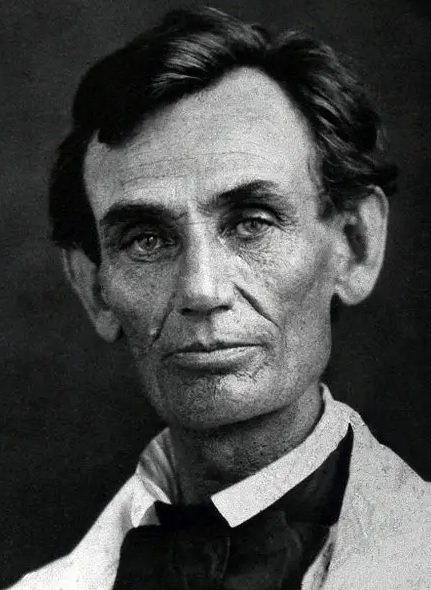
In a letter written from Vandalia (Illinois) dated, March 2, 1839 to a Mr. William S. Wait, Abraham Lincoln, then 30 years old, wrote about proposed legislation in the State that:

That proposition is little less than self-evident. The only question is as to sustaining the change before the people. I believe it can be sustained, because it does not increase the tax upon the “ many poor ” but upon the “wealthy few” by taxing the land that is worth $50 or $100 per acre, in proportion to its value, instead of, as heretofore, no more than that which was worth but $5 per acre. This valuable land, as is well known, belongs, not to the poor, but to the wealthy citizen.

I am not surprised and I AM pleased that Mr. Lincoln saw taxes that way.

I am not surprised either that in a speech two years earlier on the same subject of state finances, Mr. Lincoln said:

. . . this movement is exclusively the work of politicians; a set of men who have interests aside from the interests of the people, and who, to say the most of them, are, taken as a mass, at least one long step removed from honest men. I say this with the greater freedom because, being a politician myself, none can regard it as personal.

Self interested politicians looking to get rich off the poor.

The great American tradition I guess.

5.2.2022 – seen all of the sights

seen all of the sights
it is a little too dark
to see any more

Adapted from a passage from a book I read a long time ago.

It is the final paragraph to the autobiography of one of my favorite authors, Bruce Catton, of Benzonia, Michigan.

After a career of being a Civil War historian and 20 or more books and countless articles on the war picking up a Pulitzer Prize for the writing along the way, Mr. Catton wrote Waiting for the Morning Train – A Michigan Boyhood (1972 – Doubleday).

Writing about the war, Mr. Catton experienced all that this country had to offered at it lowest point and he was also able to maintain an optimistic outlook.

With the poetry of the written paragraph, Mr. Catton closed his auto-biography with this passage.

But you know how it can be, waiting at the junction for the night train. You have seen all of the sights, and it is a little too dark to see any more even if you did miss some, and the waiting room is uncomfortable and the time of waiting is dreary, long-drawn, with a wind from the cold north whipping curls of fog past the green lamps on the switch stands. Finally, far away yet not so far really, the train can be heard; the doctor (or station agent) hears it first, but finally you hear it yourself and you go to the platform to get on. And there is the headlight, shining far down the track, glinting off the steel rails that, like all parallel lines, will meet in infinity, which is after all where this train is going. And there by the steps of the sleeping car is the Pullman conductor, checking off his list. He has your reservation, and he tells you that your berth is all ready for you. And then, he adds the final assurance as you go down the aisle to the curtained bed: “I’ll call you in plenty of time in the morning.”

The final assurance as you go down the aisle to the curtained bed: “I’ll call you in plenty of time in the morning.”

5.1.2022 – go down to the edge

go down to the edge
of the sea – how everything shines
in the morning light

Based on the poem, Breakage, by Mary Oliver.

Thank you to my sister Lisa, to telling me about Ms. Oliver.

Here is the poem.

Breakage by Mary Oliver.

I go down to the edge of the sea.
How everything shines in the morning light!
The cusp of the whelk,
the broken cupboard of the clam,
the opened, blue mussels,
moon snails, pale pink and barnacle scarred—
and nothing at all whole or shut, but tattered, split,
dropped by the gulls onto the gray rocks and all the moisture gone.
It’s like a schoolhouse
of little words,
thousands of words.
First you figure out what each one means by itself,
the jingle, the periwinkle, the scallop
full of moonlight.

Then you begin, slowly, to read the whole story.

go down to the edge
of the sea – How everything shines
in the morning light

It’s like a schoolhouse
of little words, thousands of words
First you figure out what each one means by itsel

– – – – – – –

Readers of this blog may remember that from time to time I struggle with the weight of effort of producing a daily Haiku and any thoughts I may have about the words and time that went in the Haiku that day.

This daily schedule of missing a day can bring on a personal mental paralysis wherein writing these entries becomes impossible.

I learned to deal with this by not dealing with it and let it go.

Then when I look at my register of entries and see blank days with no post, I will grab a topic or book or poem for a source and produce a series of Haiku to fill in those blank dates.

This is one of the great benefits of this effort being my blog and my blog, my rules.

It IS cricket because I say it is.

It is ‘according to Hoyle’ because I say it is.

Thus I have this series of haiku based on the poem ‘Breakage’ by Mary Oliver.