3.24.2023 – nearest humans are

nearest humans are
in a space station when it
passes overhead

Intrigued to read in the article, The science of sailing: inside the race across the world’s most remote ocean, by Yvonne Gordon, that:

The Southern Ocean is not somewhere most people choose to spend an hour, let alone a month.

Circling the icy continent of Antarctica, it is the planet’s wildest and most remote ocean.

Point Nemo – just to the north in the South Pacific – is the farthest location from land on Earth, 1,670 miles (2,688km) away from the closest shore.

The nearest humans are generally those in the International Space Station when it passes overhead.

I looked it up.

The international Space Station is about 250 miles away.

So you need a circle with a radius of 250 miles or a diameter of 500 miles or an area of around 196,350 square miles which is bigger than California but smaller than Texas and in the circle, there can be no other people.

If you are at the center of that space and the International Space Station flies over you head, those people on the Space Station are closer to you than anyone else on earth.

3.23.2023 – there are pleasures in

there are pleasures in
madness, in being mad, known
only to madmen

I have a source that attributes the saying, There are pleasures in madness known only to madmen, to Dr, Johnson (also known as Dr. Samuel Johnson (1709- 1784), who was, according to Wikipedia, an English writer who made lasting contributions as a poet, playwright, essayist, moralist, critic, biographer, editor, and lexicographer. The Oxford Dictionary of National Biography calls him “arguably the most distinguished man of letters in English history”.)

As I was working on words to bring together walking on the beach in March and March Madness, the quote popped out of my brain and I hammered out a haiku.

Then I put back into the google to see if I could find some context for the quote and what I found was, There is a pleasure sure, In being mad which none but madmen know.” from John Dryden in Act II, scene 1 of The Spanish Friar (1681).

Dr. Johnson.

John Dryden.

Madness.

March.

March Madness and the Beach.

On the Beach in March.

I grew up in a place where March was mean.

I grew up where, as Garrison Keillor wrote of the Great Lakes/Upper Midwest, God invented March so that none drinkers would know what a hangover was like.

Now I don’t.

Now I live where March is kind of nice.

March is still a month of for Madness but for me, that doesn’t include the weather.

And this led into my search for a haiku.

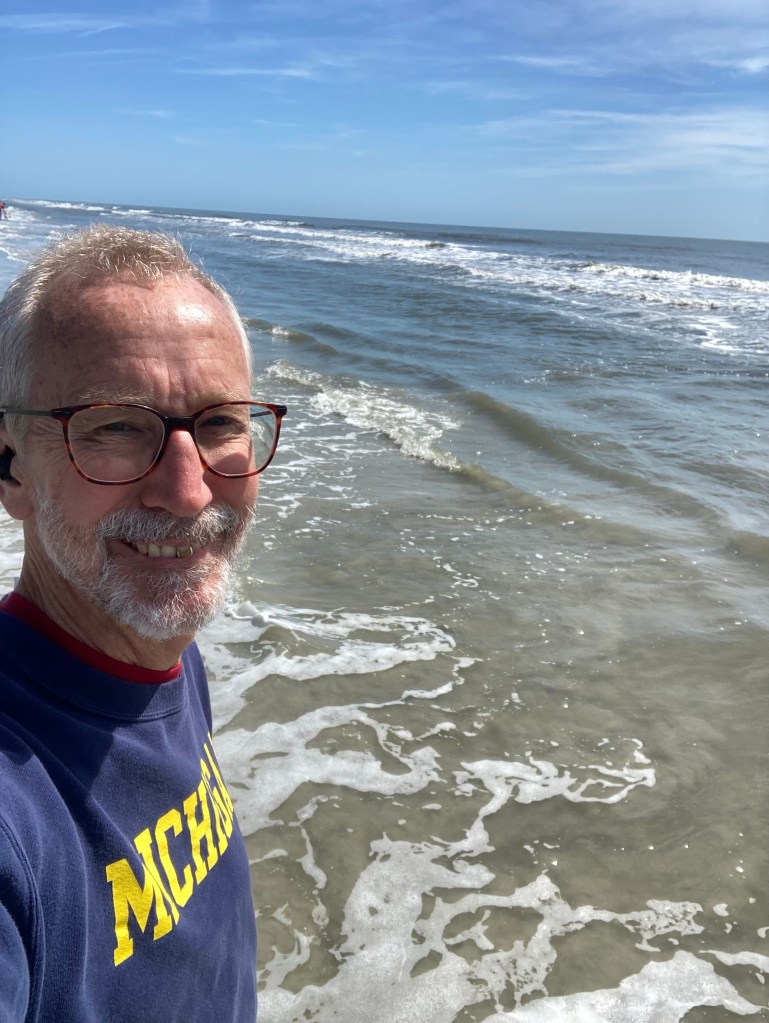
I was trying to find the words to express that while my team was no longer playing this March, I was able to compensate as I was able to walk on the beach in March on my lunch break.

Such madness.

Such in madness.

Suffice it to say, there are pleasures in walking in the waves on the beach at lunchtime, but you have to work near the beach to know that.

Which asks the question, am I only trying to rub it in on folks who don’t work near the beach?

Am I only trying to rub it on folks, friends and family who live up North where it is 44 degrees and overcast?

Surely, it would be a sign, sure, of some sort of madness to be so mean.

There are pleasures in madness, known only to madmen.

Which begs, the question, would I enjoy my lunch time walk on the beach as much if I couldn’t brag about in social media.

Hmmmmmmmmmmm.

Honestly?

YES I WOULD!

After all, there are pleasures in walking in the waves on the beach at lunchtime, but you have to work near the beach to know that.

3.22.2023 – imagine having a

imagine having a
city full of things that no
other city had

That’s the way of the world, of course.

Possessions get discarded.

Life moves on.

But I often think what a shame it is that we didn’t keep the things that made us different and special and attractive in the fifties.

Imagine those palatial downtown movie theaters with their vast screens and Egyptian decor, but thrillingly enlivened with Dolby sound and slick computer graphics.

Now that would be magic.

Imagine having all of public life — offices, stores, restaurants, entertainments — conveniently clustered in the heart of the city and experiencing fresh air and daylight each time you moved from one to another.

Imagine having a cafeteria with atomic toilets, a celebrated tea room that gave away gifts to young customers, a clothing store with a grand staircase and a mezzanine, a Kiddie Corral where you could read comics to your heart’s content.

Imagine having a city full of things that no other city had.

From The life and times of the thunderbolt kid : a Memoir by Bill Bryson, New York, Broadway Books (2006).

To punch away once more at Mr. Bryson’s words, that’s the way of the world, of course.

Possessions get discarded.

Life moves on.

But I often think what a shame it is that we didn’t keep the things that made us different and special and attractive.

3.21.2023 – step by step by step

step by step by step
bach by bach by note by note
each placed, nothing missed

Last Sunday found us at the the Grace Coastal Church of Okatie, South Carolina.

There was one of those Church moments when the pianist stopped during an intro to a hymn and announced that her piano was out of tune.

It’s one of those digital piano’s,” she said, “I know I just have to press a button to reset it … but I don’t know where that button is.”

And she got up and walked across the platform to the old grand piano and the picked up where she had left off.

One of those moments of natural comic relief that make church chuch.

The service was old fashioned to the point that all the lights were on and everyone, and I mean everyone sang.

And in this time of post covid, they even took up an offering by passing things hand to hand.

For an old church veteran like me, an offering meant an offertory.

The musical interlude before the sermon.

For a small Presbyterian low county church, I did not expect much.

For a small Presbyterian low county church, I wasn’t ready for what happened next.

That pianist, who already admitted she couldn’t tune a digital piano, sat down at the keyboard and pulled off a minor miracle by effortlessly pulling notes out of that old grand piano in a charming rendition of Orchestral Suite No.3 in D major (BWV.1068).

She played it slow, so slowly but on the beat.

Each note sounding alone but part of the chain.

The magic of Bach, the progression of the notes, each one, like one step following the next and never a misstep.

Each step following the next in a way that, to me, I have to say HOW and at the same time, HOW COULD IT BE ANYTHING ELSE.

I was sitting in a small, small Presbyterian low county church.

But the music took me far away.

I don’t know.

It’s been so long that I have had opportunity to hear live music.

This was so unexpected.

This was so charming.

I am sure I am making way more of this than anyone else there, or that anyone should, but it was, for a me, the truest moment of prayer and of grace with the gift of these notes, in this arrangement played in this way, that I have had in a long time.

Folks, let me tell you, if God lets the odd moment like this happen, and believe, not really by chance, what can happen when he really puts his mind too it?

Odd.

So much is given.

Boy, Howdy, but much is going to be expected!

They say Mr. Bach could set back and let these musical progressions pour out of his fingers without a thought.

All I can think of is how?

So I don’t think.

I just let the moment be that moment.

And I thanked God for it.

BTW, with the magic that is the internet, I was able to find a video of the church service and rip the audio of this simple musical moment and you can click here to hear it.

It isn’t a quality recording, but it is great at the same time and you close your eyes and imagine a small sunlight church with morning coming in the windows and nothing else to do for a minute but listen and as they say, know that God is God.

Yes, there is baby crying at the start … live music, what can you say.

3.20.2023 – for the modern world

for the modern world
stakes raised to infinity
win or lose it all

For the modern world is one in which all stakes are raised to infinity; win it all or lose it all, in this or the next generation.

Man’s problem is that he has at last become master of his own fate, and he may not have had the proper training; which is to say that he has arranged things so that he has no one but himself to rely upon.

Instead of looking beyond the skies, he is obliged to look into his own heart.

If he looks earnestly enough, he may find there the thing he needs most of all — the secret of the art of associating together.

From Michigan : a History by Bruce Catton, (1899-1978) New York : Norton, 1984