when everyone is gone, who is left, at what point future merge with Death?
Who is left when everyone is gone?
He watched Diana’s yellow Volvo disappear toward Traverse City, the faulty muffler putting along after the car disappeared, somehow as lonely as a dog barking far away in the night.
Who is left but me standing on the porch on a June morning, and able to see a green leaf fall, for the first and last time, fifty yards away.
Am I here if I abolish the input of my five senses?
Sure.
There’s still two hundred pounds of standing meat ignorant of the leaf.
The sense of compactness alternated with the banality of worrying about one leaf out of trillions.
He had felt a similar sorrow when an area of forest had been flooded long enough to kill the trees — as a child he had talked to trees until a neighbor kid had caught him and told everyone.
Water had always been a question of too little, enough, too much.
His thought processes lamely trailed off, then returned to the porch.
At what point did changing his future merge with eternity itself?
Death?
From Warlock by Jim Harrison, (1937-2016) New York, Dell (1981).
becomes clear none can conquer unpredictable impossible game
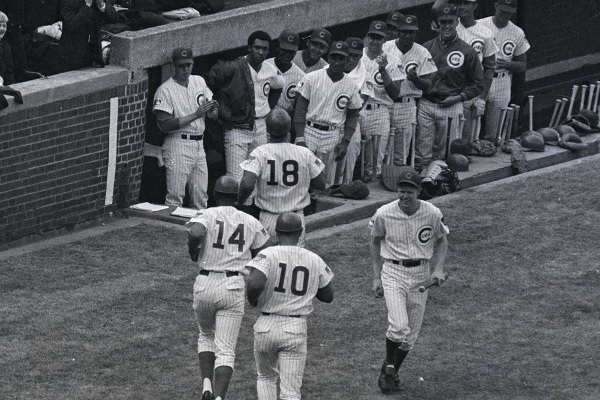
Hard to believe but I think the last major league baseball game I went to was more than 30 years ago.
We had tickets to a Cubs-Cardinals game in Chicago at Wrigley Field as a wedding present.
As I remember it, with a little help from the WWW, it was on September 8, 1989.
The Cubs had a 7-2 lead going into the 7th inning and lost 8-11.
Pedro Guerrero went 4 for 4 with 5 rbi’s.
I tried to concentrate on the game even though I had been married less than a month and my drop dead gorgeous wife was there with me.
But something else was going on in the stands that was new and distracting.
I didn’t realize it but I was experiencing the faint beginnings of the end of my civilationsation.
Because all around us were people using their new ‘mobile’ phones calling anyone and everyone they could think of to tell them that they were at Wrigley Field watching the Cubs and because of their new mobile phone, they just wanted to share the moment.
This was 15 years even before the invention of the iPhone.
This was when you paid dearly for every minute you were connected.
What else would you do with this new device but call people to run it in that one, you were at a Cubs game and they weren’t and two, you had a mobile phone and they didn’t.
A device that allowed you to capture the moment.
The moment that led to an INSTA GRAM.
The moment.
The moment you stopped time to prove to the world you were somewhere or with someone … for that moment.
Those moments that are about you are now more important than the game.
Somehow the game has become a backdrop for your moment.
So the game is being changed to get your attention back from the device six inches in front your nose.
Bigger bases.
And clocks.
Lots and lots of clocks.
Limit time to bat.
Limit time to pitch.
Limit time for commercials?
Now DON’T BE SILLY.
Time was one my mind after I happened to pick up a copy of Roger Angell’s The Summer Game that came out in 1972.
Roger Angell covered baseball for the New Yorker Magazine.
How does one get to cover baseball for the New Yorker you ask?
You have to be a good writer but having Katherine Angell White for your Mother and EB White for your Mom’s Husband sure doesn’t hurt.
The forward to the book states, “THESE PIECES COVER A span of ten years, but this book is certainly not offered as a comprehensive baseball history of the period. Most of the great winning teams and a good many of the horrendous losers of the decade are here, while the middle ground is often sketchy. I have written about some celebrated players.“
And inside the book are stories about a game that I remember but no longer can recognize.
I long held to Harry Caray’s comment about changes in the game when he said, “You still have to put the ball across the plate.”
Still, it has changed and I am not so sure for the better.
Mr. White wrote, “This is a difficult game. It is so demanding that the best teams and the weakest teams can meet on almost even terms, with no assurance about the result of any one game.
No one, it becomes clear, can conquer this impossible and unpredictable game. Yet every player tries, and now and again — very rarely — we see a man who seems to have met all the demands, challenged all the implacable averages, spurned the mere luck.
The last dimension is time. Within the ballpark, time moves differently, marked by no clock except the events of the game. This is the unique, unchangeable feature of baseball, and perhaps explains why this sport, for all the enormous changes it has undergone in the past decade or two, remains somehow rustic, unviolent, and introspective. Baseball’s time is seamless and invisible, a bubble within which players move at exactly the same pace and rhythms as all their predecessors. This is the way the game was played in our youth and in our fathers’ youth, and even back then—back in the country days — there must have been the same feeling that time could be stopped. Since baseball time is measured only in outs, all you have to do is succeed utterly; keep hitting, keep the rally alive, and you have defeated time. You remain forever young. Sitting in the stands, we sense this, if only dimly. The players below us — Mays, DiMaggio, Ruth, Snodgrass — swim and blur in memory, the ball floats over to Terry Turner, and the end of this game may never come.
You know what?
Somehow I think, Roger Angell would have ended up as the baseball writer for New York regardless of who his parents were.
Pablo León de la Barra Geaninne Gutiérrez- Guimarães
To tell the truth I have no idea how many syllables are being used.
I liked the juxtaposition of the two names.
There are real people.
Pablo León de la Barra and Geaninne Gutiérrez-Guimarães.
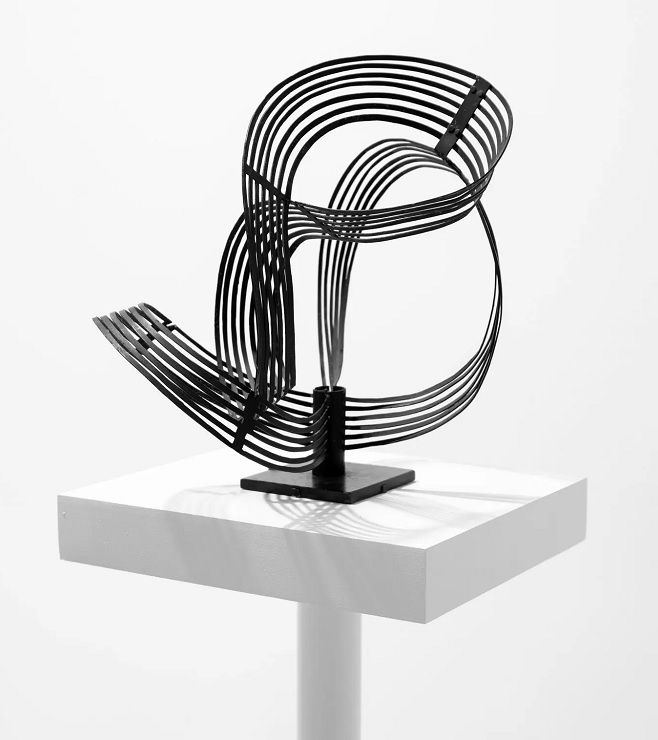
They are both of the Guggenheim Museum in New York City and are exhibition curators for the “Measuring Infinity” show the features the kinetic constructions of the Venezuelan sculptor Gertrud Goldschmidt as reviewed by Holland Cotter.
I have never heard of Pablo León de la Barra, Geaninne Gutiérrez-Guimarães or Gertrud Goldschmidt.
that it could be worse … does this knowledge hurt or help get you through your day
I have long held that listening to an online digital radio station from London helps me get through my workday.
See, as London is 4 or 5 hours ahead of us (depending on the season) by listening to this station, I know that, somewhere in this world, someone has already made it through the next 4 or 5 hours.
Lately I really can’t complain as I have a pretty cool job that has me working in a place where I can stroll on the beach along the Atlantic Ocean on my lunch break.
But there was time when besides having to be available 24×7, I also felt that anytime I picked up the phone I could be fired for no other reason than that I COULD be fired (and one day, that call came … come to think of it, the same place called me twice … its a long story).
It made for a great work environment.
I did know, even then, there were worse jobs but that never really made me feel better.
Maybe that was because I never knew how much worse a job could get.
Yesterday I happened to researching the horse drawn carriage tours that are available in Beaufort (or Beaufort by the Sea as they like to call it) South Carolina and I came across this bit of descriptive text.
First it says, “Re-live the past through the narration of our professional guides and the clippity-clop of our horses …“
Then to reassure any and all of those concerned about those horses that clippity-clop, the descriptive text goes on to describe the care of those horses.
It says, “When the horses are working, each horse is individually monitored no matter the weather conditions.
During a hot summer day their temperature is taken rectally at the beginning of the day, the start of the tour, and after each tour.
Their respiration is taken at the same time as their temperature.
If an individual horse goes up by 3 degrees then we do not allow them to go out on tour until their temperature drops to their normal rate.
If their respiration goes up, they are not allowed to go out until they have dropped to within a safe range.”
While I was happy to learn the care and comfort of these poor animals was high on the list of the people who conduct these tours, this text revealed an aspect of horse care and clippity-clop buggy rides that I had not thought of.
That maybe I wish I had NOT thought of.
Good to know.
But something, maybe I didn’t need to know.
And as for the process …
Well, let’s just say, it’s not my circus.
And I am glad for the job I have.
And they next time I got the go-to-work blues, I will say to myself, “Well, I don’t have to …”
suspicious neatness spongelike ramshackle craftless continuously vile
Adapted from the complete first sentence of Jim Harrison’s Wolf: A False Memoir.
The sentence describes upper lower Michigan as well as upper Michigan.
The sentence, one long sentence, the opening sentence of the Wolf, is two pages long.
Mr. Harrison admitted he did it that way because he could.
The sentence reads:
You could travel west out of Reed City, a small county seat in an unfertile valley with a small yellow brick courthouse and a plugged cannon on its lawn next to a marble slab with the names of the World War One and Two dead inscribed in gold and the not dead plainly inscribed with the suspicious neatness of cemetery script, those who served, farther west through fifty miles of pine barrens dotted with small farm settlements often of less than thirty people, or merely a grocery store and gas station adjoined by a shabby aluminum trailer or a basement house with the first and perhaps second stories awaiting more prosperous times, the stores themselves with little and aged stock — lunch meat, bologna pickled in a jar, Polish sausage, tinned foods covered with dust, plaquettes of fish lures, mosquito repellent in aerosol cans, live bait and a pop cooler outside the door — but not many of these — a narrow road through mixed conifers, cedar and jack pine, some stunted scrub oak, birch, and the short-lived poplar, a pulp tree usually living less than twenty years and clotting the woods floor with its rotting trunks and branches, and west through the low pelvic mysteries of swamps divided invisibly from the air by interlocking creeks and small rivers, made unbearable in spring and summer by mosquitoes and black flies, swamps dank with brackish water and pools of green slime, small knolls of fern, bog marshes of sphagnum, spongelike and tortuous to the human foot and bordered by impenetrable tamarack thickets: in short a land with no appreciable history and a continuously vile climate, lumbered off for a hundred years with few traces of the grand white pine which once covered it, an occasional charred almost petrified stump four feet in diameter, evidence of trees which rose nearly two hundred feet and covered the northern half of the state and the Upper Peninsula, razed with truly insolent completeness by the lumber barons after the Civil War with all the money going to the cities of the south — Saginaw, Lansing, Detroit — and east to Boston and New York; and the houses, even the large farmhouses on reasonably good land, sloppily built, ramshackle and craftless compared to Massachusetts or Vermont; west to Lake Michigan then to turn north along its coast to the Straits of Mackinac, cross the mammoth bridge, travel west another three hundred miles through the sparsely populated Upper Peninsula and then north again into the comparatively vast, the peopleless Huron Mountains.
From Wolf : a False Memoir by Jim Harrison, (1937-2016) New York : Dell, 1981