6.16.2023 – exciting drama

exciting drama
contribution lies in fabling
that it inspired

The significance of the Pony Express is not as apparent as its execution is memorable. The value of what happened during those eighteen months has transgressed the tangible effects carried in the padlocked saddle bags. The Pony Express as a cultural symbol has enjoyed a lot of traction over the years, and among the many artists, authors, journalists, and historians to depict and describe it, few have been able to resist romanticizing it. The apocryphal horseman has galloped off into the sunset so many times that exaggeration has adulterated fact. One exception is the 1930 book Six Horses, written by Captain William Banning and George Hugh Banning. William’s father was a transportation tycoon in California in the late 1800s. The book covers communication, freighting, and passenger conveyance in the West in the nineteenth century. Its title refers to a team of horses drawing a stagecoach. Banning dedicates two chapters to the Pony Express, and his observations are telling:

It did not involve more than 150 round trips. It did not cover a full nineteen months. Like a belated fragment of a storm, it came and was gone. Yet the fact remains: a more glamorous contribution to our historic West than that of this ephemeral Pony would be difficult to name.37

Banning refers to the Pony Express as an “immortal Pegasus” that was “able to identify himself with the new empire as permanently as though he had come racing up from the gold rush to the last spike driven for the Pacific Railroad.” History has lauded the Pony Express as a bold stroke of transcontinental progress, but Banning argues that the Pony Express “neither caused nor hastened the developments that followed his trail” and that “had he never existed, all must have been the same.” It was an exciting drama while it lasted, but it was little more than a drama. Its contribution to our historic West, therefore, lies in the fabling that it inspired:

From The Last Ride of the Pony Express: My 2,000-mile Horseback Journey into the Old West by Will Grant, Little, Brown and Company (June 6, 2023).

Seeming as American as any American enterprise could ever get.

According to legend, the help wanted notice read:

Wanted:

Young, skinny, wiry fellows, not over 18.

Must be expert riders, willing to risk death daily.

Orphans preferred.

It should be pointed out that the Pony Express ran from April 3, 1860, to October 26, 1861.

October 26, 1861 was the day the transcontinental telegraph went into service.

It cost more money than it made.

It didn’t last longer than technology.

But it has a permaemnt place in the history of this country.

A place based on fable than fact.

But who cares.
6.15.2023 – anybody who’s

anybody who’s
educated can write but
reading’s like breathing

“There are editors who will always feel guilty that they aren’t writers,” he explained. “I can write perfectly well — anybody who’s educated can write perfectly well. It’s very, very hard, and I just don’t like the activity. Whereas reading is like breathing.”

From the obit, Robert Gottlieb, Eminent Editor From le Carré to Clinton, Dies at 92 by Robert D. McFadden in the New York Times

6.14.2023 – they do not observe

they do not observe
walk blindly without trying
to see for themselves

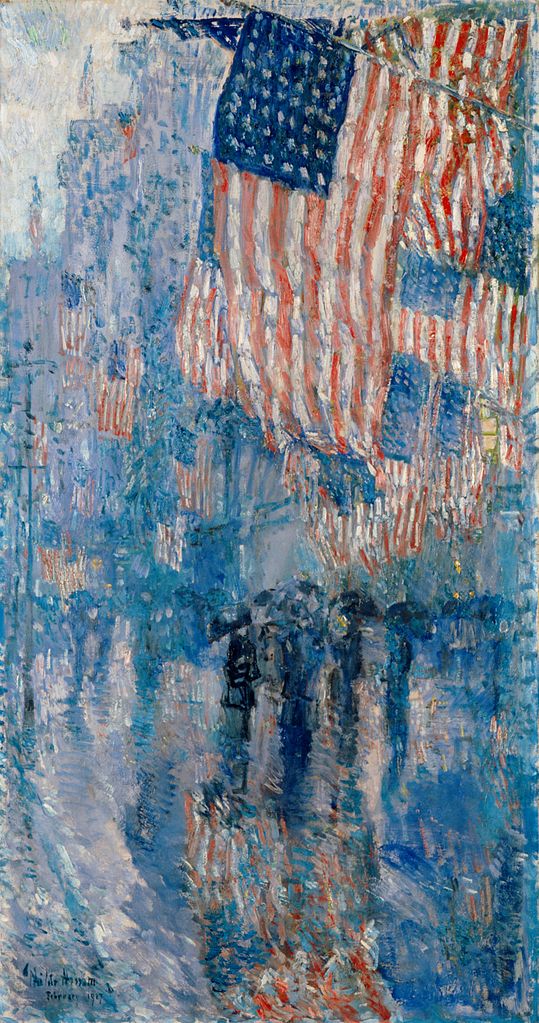
For Flag Day … 2023

I painted the flag series after we went into the war. There was that Preparedness Day, and I looked up the avenue and saw these wonderful flags waving, and I painted the series of flag pictures after that.

I was always interested in the movements of humanity in the street… There is nothing so interesting to me as people. I am never tired of observing them in everyday life, as they hurry through the streets on business or saunter down the promenade on pleasure.

The man who will go down to posterity is the man who paints his own time and the scenes of everyday life around him.

The portrait of a city, you see, is in a way like the portrait of a person… The spirt, that’s what counts, and one should strive to portray the soul of a city with the same care as the soul of a sitter.

These small shows were decidedly a success. The exhibitions were not too large to be seen easily. It was not an effort, as larger collections of pictures usually are.

The true impressionism is realism. So many people do not observe. They take the ready-made axioms laid down by others, and walk blindly in a rut without trying to see for themselves.

Childe Hassam on himself.

6.13.2023 -once ready to write

once ready to write
words flowed hands thinking, not a …
conscious process

“When you write something down you pretty well kill it,” he said. “Leave it loose and knocking around up there and you never know — it might turn into something.”

Once he was ready to write, he said, the words flowed.

“My hands do the thinking,” he said. “It is not a conscious process”

From Early Cormac McCarthy Interviews Rediscovered by Elizabeth A. Harris.

Elizabeth A. Harris writes about books and publishing for The Times.

Cormac McCarthy, the formidable and reclusive writer of Appalachia and the American Southwest, whose raggedly ornate early novels about misfits and grotesques gave way to the lush taciturnity of “All the Pretty Horses” and the apocalyptic minimalism of “The Road,” died on Tuesday at his home in Santa Fe, N.M. He was 89.

6.12.2023 – the awe that feels good

the awe that feels good
found in moments of wonder
and humility

Awe, Dr. Keltner explained, is that complex emotion we experience when encountering something so vast that our sense of self recedes.

It can be positive or negative (like the feelings that come from witnessing violence or death), but the awe that feels good is the type found in moments of wonder and humility.

From This Kind of Walk Is Much More Than a Workout by By Jancee Dunn.

Ms. Dunn writes:

This week, we’re exploring “awe walks,” outdoor rambles designed to cultivate a sense of amazement.

Jancee Dunn is the columnist for Well’s subscriber-only newsletter at The New York Times. She writes longer features as well, and spearheads special projects for the desk. Her work has appeared in many sections across The Times.

The idea for a walk with awe or a walk in awe brought to mind a Mary Oliver poem that my sister Lisa sent to me.

Gethsemane by Mary Oliver

The grass never sleeps.
Or the roses.

Nor does the lily have a secret eye that shuts until morning.
Jesus said, wait with me. But the disciples slept.
The cricket has such splendid fringe on its feet,
and it sings, have you noticed, with its whole body,
and heaven knows if it ever sleeps.

Jesus said, wait with me. And maybe the stars did, maybe the wind wound itself
into a silver tree, and didn’t move, maybe
the lake far away, where once he walked as on a
blue pavement,
lay still and waited, wild awake.

Oh the dear bodies, slumped and eye-shut, that could not
keep that vigil, how they must have wept,
so utterly human, knowing this too
must be a part of the story.

I have quoted this line before, but I like it so much.

As Alice Walker writes in her book The Color Purple,

“I think it pisses God off if you walk by the color purple in a field somewhere and don’t notice it. People think pleasing God is all God cares about. But any fool living in the world can see it always trying to please us back.”