7.19.2024 – confidence of

confidence of
ignorant youth seeps away
nothing takes its place

I felt thoroughly grown-up at twenty-one — more grown-up, indeed, than I have ever succeeded in feeling since. The confidence of ignorant youth seeps slowly, slowly away and to our astonishment no confidence of sapient age comes surging in to take its place.
From Here at the New Yorker by Brendan Gill, New York : Random House, 1975.

As Mark Twain is credited with saying “…when I was seventeen, I could hardly stand it to be with my father because he was was so ignorant, and at twenty I noticed that now and then, my father said a sensible thing, but at twenty-five I was simply amazed to discover how my father had improved in the last eight years.”

Sad to mention that according to the Quote Investigator,… the earliest known attribution to Twain occurs in 1915 and this is rather late because Twain died in 1910. To date, the saying has not been found in Twain’s writings, notebooks, or letters. Quotation experts and Twain scholars are skeptical of the attribution to Twain.”

Me at 21?

Back in 1981?

Just accepted to continue my studies at an institution of higher learning, I doubted there was anything left for me to learn.

My first lecture, I was seated at a long table in a room that looked out a window through the iconic columns of the landmark building on the campus of this institution.

The bell in the bell tower central to central campus was striking the hour.

I had arrived.

15 minutes into my first lecture with 4 pages of notes, my confidence started to leak out all over the floor of the room.

I was comforted by the looks on the faces on the other students, that they too, were feeling it.

Then a goofy thing happened.

Without raising their hand or waiting to be recognized, the student next to me called out to the Professor, “You really think that?”

The Professor paused and then started a 5 minute dialogue with the student and while the student did give in, the student was not at all convinced and the Professor picked up where he left off.

This was something new to me.

What had I got myself into?

Argue with a Professor?

Maybe even BE EXPECTED to argue with a Professor?

I am not sure how I resolved all my thoughts – most likely I just doubled my note taking speed.

I knew I had to get through this first lecture because being Mr. KNOW-IT-ALL, I had set up my class schedule like I was in high school.

I had three more lectures back to back to back that first morning.

And I was 21.

All grown up.

More grown-up!

More grown-up, indeed, than I have ever succeeded in feeling since.

And you know what?

The confidence of ignorant youth seeps slowly, slowly away and to our astonishment no confidence of sapient age comes surging in to take its place.

7.18.2024 – what new story heard

what new story heard
agreeable for telling
in conversation

Back in the day, Benjamin Franklin put together a club known as The Junto.

According to Wikipedia, The Junto, also known as the Leather Apron Club, was a club for mutual improvement established in 1727 by Benjamin Franklin in Philadelphia. The Leather Apron Club’s purpose was to debate questions of morals, politics, and natural philosophy, and to exchange knowledge of business affairs.

They Junto met on Friday nights and to get the debate started, Dr. Franklin put together a list of 24 starter questions.

Question number 2 asked, “What new story have you lately heard agreeable for telling in conversation?”

As this question asked about new stories, it should be no surprise that the Junto members realized they would need access to new books which led to the creation of the The Library Company of Philadelphia and libraries were established in America.

The Library Company of Philadelphia occupied the 2nd floor of what was called Carpenters Hall in Philadelphia.

In a room on the 1st floor of this building, the Continental Congress met and in 1776, signed the Declaration of Independence.

The Library Association is older than the United States.

Libraries and me have had a long association.

At Crestview Elementary School in Grand Rapids, Michigan, where I grew up, the library was where I had to spend ‘time-outs’ when my behavior in class made it desirable for the teacher for me to be someone where else.

In agreement with the Principal, I would spend 15 minutes or so by myself in the library.

Not a punishment and really, a bit of rewarding bad behavior, but it worked out for all those involved.

When I was 6 or so I got my first library card at the Creston Branch of the Grand Rapids Public Library.

But it was the summer of 1970, when I turned 10 that I got a new bike and the main branch of the Grand Rapids Public Library became available to me.

I would ride a route of back streets that required me to cross several busy streets and then navigate downtown Grand Rapids but I made it.

I would park my bike in the bike racks, didn’t need a lock back then and walk to the main entrance of the magnificent Grand Rapids Public Library Main Building.

I didn’t realize it at the time, but this building was pretty much brand new, having been opened in 1967.

Walking into the lobby in 1970, it still had that ‘new building’ smell.

The first thing that would hit was the air conditioning which, after my ride downtown, felt great.

It is hard to describe, but after getting downtown on my own, when I walked into that library I felt it was MY library.

Anyone else in the library was there at my sufferance.

Once in the library, there was a wall of double glass doors with the sign ADULT SECTION.

It would be a couple of years before I dared go through those doors if my Dad wasn’t with me.

When I could badger my Dad enough to take me downtown, he would go through those doors and then head upstairs to the Newspaper Room and read out of town newspapers while I looked at books.

When I had my books from the Youth Section, I felt confident enough to go into the Adult Section as I knew if someone challenged me, I could say I was getting my Dad.

BTW the Newspaper Room was in the original Main Building that had been built in 1904 and despite all their efforts, modern architects were not able to line up the floors of the new and old buildings.

To get to the old building, you took the stairs and then took a door off the landing to another inner kinda secret flight of stairs.

Just to know these stairs were there was pretty cool.

If you took the elevator, you would press the buttons with an R or 2R for the 2nd floor of the Ryerson Building, the original name of the main building and magically the elevator doors would open behind you.

As an aside, Mr. Ryerson of Chicago offered to build the library as a gift to City of Grand Rapids in memory of his pleasant memories of visiting family in Grand Rapids.

No one knows how much the building cost as Mr. Ryerson had all, and I mean ALL, the bills sent direct to him.

The day the Library opened, the Public Schools were closed for the day and all the kids and citizens of the city went to the Library where Mr. and Mrs. Ryerson received guests on the landing of the main marble staircase.

That’s my kind of rich benefactor.

It was always fun to get on the elevator, press 2R and then turn your back to the doors and watch the other patrons wonder what in the world you were doing.

But that was when I was there with my Dad.

It was years before I dared enter the Adult Section on my own and the first time I did, I waited to get nabbed and ordered out.

There was another sign over the doorway that said YOUTH SECTION with an arrow to the right.

That was my world.

I might walk in and start looking at the new titles.

Or I might walk back to the Civil War books to find something I hadn’t read.

I would greet the Librarian on staff who would often recognize and ask about my ride.

I walked through those aisles with seven league boots and took no prisoners and admitted no faults.

And I looked and looked at all those books and I wondered just what new stories they might contain that would be agreeable for telling in conversation.

And I did my best to find them all.

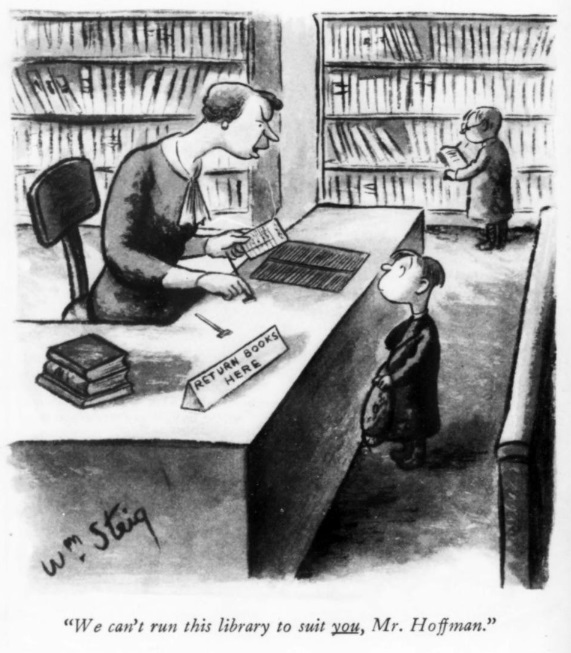
BTW – Was paging through old New Yorker Magazines when I came across this cartoon that appeared on December 12, 1932.

7.17.2024 – will you still need me?

will you still need me?
feed me? Who could ask for more?
when I’m sixty-four

Not sure how this happened, which seems to be a common feeling, but I start my 64th year today.

Because of family history and often told family stories, I know that was I born around noon so as I write this, I still have 5 hours to go.

I know it was around noon because I was born on a Sunday and my Mom planned a family dinner after church and while I interrupted her day, my Aunt Marion came over and pulled the dinner together so all my brothers and sisters were sitting around the table when my Dad came home from the hospital to announce it was a boy.

All the boys cheered and my sisters all cried as it would have been a tie game had I been a girl.

I was 8th in what would be a family of 11 kids.

When I was 4, my Dad got a place on the shore of Lake Michigan just south of Grand Haven where we spent out summers so my birthday was almost always celebrated out at the lake.

In 1966, my Mom and Dad took me into Grand Haven to WT Grants and said I could pick out anything I wanted for my birthday.

In my mind the toy aisle stretched out sight to the left and right and towered over me.

I am not sure how long it took as my Father was generous but not real patient, a buyer not a shopper, and I selected an orange truck with a working steam shovel type crane that I could raise and lower and scoop up sand.

I am sure I had Mike Mulligan and His Steam Shovel in mind when I picked out as I always liked Mike as we shared a first name.

Which, as I am sure I have mentioned before, brings me to the topic of my name.

See, Mike had already been used as a first name in my family.

My brother Tim was born back in 1956 and was named Mike … for about 3 days.

Then my Dad said, ‘Nope, he doesn’t look like a Mike‘ and when the paper work was filled, he became Timothy John.

4 years later when I showed up, my Dad decided I did look like a Mike and Michael James Hoffman was listed on my paperwork.

Not sure what that says or means, but it had to have messed up paperwork in the global accounting of life somewhere.

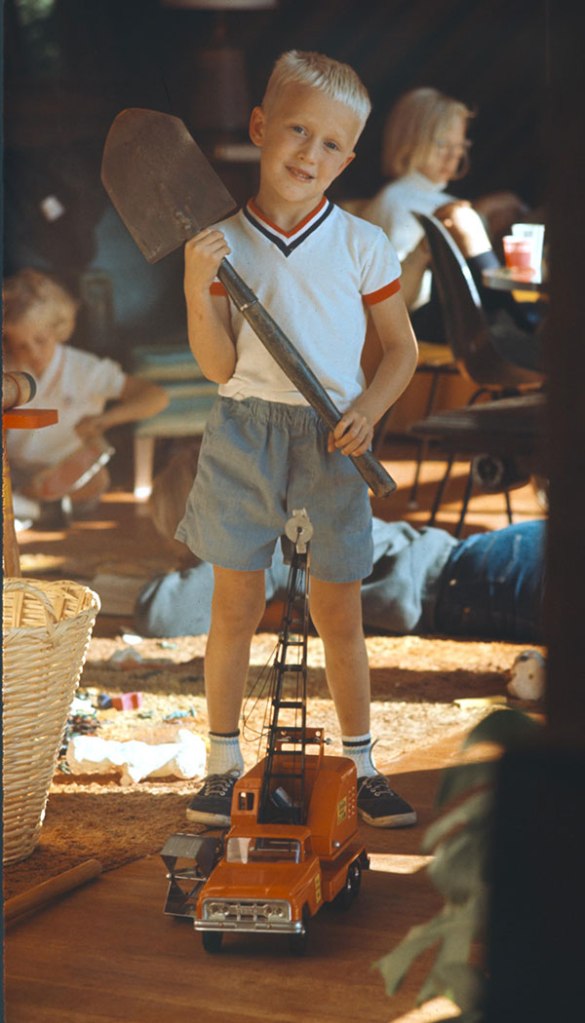
The moment I got my truck home was captured on film by my Dad with his Nikon camera.

I posed with an army shovel and my new truck, ready to take on the world and all the dirt and sand I could find.

Scrapes and bruises that any 6 year old would have acquired over a summer and one shoe untied, that’s me.

Behind me in the picture are my three sisters, Mary, Lisa and Janet, who are plainly thrilled by my new truck and that it was my birthday.

That was 58 years ago and with the help of the photos, I can feel it, I can smell it.

As Jim Harrison writes in his book, Sundog, “So much of the emotional content of our lives seems to occur before we are nineteen or twenty …

Now I am 64.

And by chance as I type this out at my desk near the ocean, the 3rd movement of Haydn’s Cello Concerto No. 2 starts playing on the radio and it is one of my favorites.

A piece of music impossible to listen to and not feel light and light hearted.

I will take it as a good omen for things yet to come.

It is my birthday.

What can I do but, and when will I ever get the chance again, to quote Sir Paul?

When I get older losing my hair
Many years from now
Will you still be sending me a Valentine
Birthday greetings bottle of wine

If I’d been out till quarter to three
Would you lock the door
Will you still need me, will you still feed me
When I’m sixty-four

You’ll be older too
And if you say the word
I could stay with you

I could be handy, mending a fuse
When your lights have gone
You can knit a sweater by the fireside
Sunday mornings go for a ride

Doing the garden, digging the weeds
Who could ask for more
Will you still need me, will you still feed me
When I’m sixty-four

Every summer we can rent a cottage
In the Isle of Wight, if it’s not too dear
We shall scrimp and save
Grandchildren on your knee
Vera, Chuck and Dave

Send me a postcard, drop me a line
Stating point of view
Indicate precisely what you mean to say
Yours sincerely, wasting away

Give me your answer, fill in a form
Mine for evermore
Will you still need me, will you still feed me
When I’m sixty-four

will you still need me?
feed me? Who could ask for more?
When I’m sixty-four

7.16.2024 – as at the moment

as at the moment
one is sure that all is lost,
look at what is gained!

… he had barely started to turn away from the house when Roxane Coss closed her eyes and opened her mouth. In retrospect, it was a risky thing to do, both from the perspective of General Alfredo, who might have seen it as an act of insurrection, and from the care of the instrument of the voice itself. She had not sung in two weeks, nor did she go through a single scale to warm up. Roxane Coss, wearing Mrs. Iglesias’s slacks and a white dress shirt belonging to the Vice President, stood in the middle of the vast living room and began to sing “O Mio Babbino Caro” from Puccini’s Gianni Schicchi. There should have been an orchestra behind her but no one noticed its absence. No one would have said her voice sounded better with an orchestra, or that it was better when the room was immaculately clean and lit by candles. They did not notice the absence of flowers or champagne, in fact, they knew now that flowers and champagne were unnecessary embellishments. Had she really not been singing all along? The sound was no more beautiful when her voice was limber and warm. Their eyes clouded over with tears for so many reasons it would be impossible to list them all. They cried for the beauty of the music, certainly, but also for the failure of their plans. They were thinking of the last time they had heard her sing and longed for the women who had been beside them then. All of the love and the longing a body can contain was spun into not more than two and a half minutes of song, and when she came to the highest notes it seemed that all they had been given in their lives and all they had lost came together and made a weight that was almost impossible to bear. When she was finished, the people around her stood in stunned and shivering silence. Messner leaned into the wall as if struck. He had not been invited to the party. Unlike the others, he had never heard her sing before.

The priest knew he committed the sin of pride and still he was overjoyed at having been able to play a role in bringing in the music. He was still too dizzy from the sound of Roxane’s voice to express himself properly. He looked to see if the windows were open. He hoped that Manuel had been able to hear a line, a note, from where he stood on the sidewalk. What a blessing he had received in his captivity. The mysteries of Christ’s love had never been closer to him, not when he said the mass or received communion, not even on the day he took holy orders. He realized now he was only just beginning to see the full extent to which it was his destiny to follow, to walk blindly into fates he could never understand. In fate there was reward, in turning over one’s heart to God there was a magnificence that lay beyond description. At the moment one is sure that all is lost, look at what is gained!

From the book Bel Canto by Ann Patchett. New York, Harper Collins, 2001.

What a blessing he had received in his captivity.

The mysteries of Christ’s love had never been closer to him, not when he said the mass or received communion, not even on the day he took holy orders.

He realized now he was only just beginning to see the full extent to which it was his destiny to follow, to walk blindly into fates he could never understand.

In fate there was reward, in turning over one’s heart to God there was a magnificence that lay beyond description.

At the moment one is sure that all is lost, look at what is gained!

What words about music have been more true?

I loved this book.

I don’t know that I could have ended it the way it ended but I can’t imagine it could have ended any other way.

7.15.2024 – something simple that

something simple that
is also beautiful and
extraordinary

Further north, the environmental claims stack up better. Sited across the roaring A1 from the Stade de France, and connected by a new pedestrian bridge (sadly closed off for the Games due to overcrowding fears), the €175m aquatics centre is a beacon of what this Olympics stands for: lean, green and a little understated. It will be a boon for an area with the lowest swimming proficiency in the country, where half of all 11-year-olds don’t know how to swim.

“It’s about doing better with less,” says Laure Mériaud of Ateliers 2/3/4, architects of the project with Dutch firm VenhoevenCS. “You can do something simple and efficient that is also beautiful and extraordinary.”

From the article, Plastic-bottle seats and wooden pools: can Paris deliver the leanest, greenest Olympics yet? by Oliver Wainwright, the Guardian’s architecture and design critic.

The Métropole du Grand Paris, has been awarded the “Technical Achievement” prize in the Construction Bois 2024 Regional competition.

On the VenhoevenCS website, the firm listed all the members or the design team, made up of folks from both VenhoevenCS and Ateliers 2/3/4/ and they include Cécilia Gross and Laure Meriaud, Ton Venhoeven, Arjen Zaal, Yves de Pommereau, Jos-Willem van Oorschot, Eraldo Brandimarte, Margot Lamazou, Tjeerd Hellinga, Arjan Pot, Louis van Wamel, Maria Boletou, Julie Fuchs, Yann Tregoat, Jeremy Cassin, Ivo Brandes, Rubing Xu, Nicolas Handtschoewercker, Timothée Pignoux, Wai Ming Lam.

I think a lot these people went to high school with me in West Michigan or at least their cousins did.

It’s about doing better with less!

Something simple and efficient that is also beautiful and extraordinary!