7.24.2024 – how … how bad is your

how … how bad is your
regular life, that you think …
know what would be fun?

“As far as wanting to go places, I can’t believe people do it for fun. When I’m in airports, and I see people going on vacations, I think, ‘How horrible could your life be? How bad is your regular life, that you think, you know what would be fun? Let’s get the kids, go to the airport, with thousands of pieces of luggage, stand in these lines, be yelled at by a bunch of morons, leave late, be squished all together—and this is better than our actual life.”

Fran Lebowitz in Netflix’s ‘Pretend It’s a City’.

My wife wanted to fly from South Carolina to Michigan.

She booked a flight that left on Monday at 10am and she would arrive around 4pm.

Then there was a software glitch and her airline couldn’t schedule a flight crew and they cancelled all their flights on Monday.

She booked a new flight on a new airline for Tuesday.

She would take off again around 11am, layover in Charlotte, NC, for 90 minutes and take off and arrive at 4pm.

I dropped her off and wasn’t more than 5 minutes into my drive to work when she called that her flight was delayed by one hour due to crew scheduling.

This reduced her layover time in Charlotte to 30 minutes.

I checked the Airport map and her arrival gate was in a terminal that at least was next to the terminal where the departure gate was.

She talked to the Airline people and they were confident she would make the connection.

From my desk I watched airplane arrival and departure times.

When the plane did leave it looked like she would have a somewhat doable 35 minutes to make her next flight.

The next text I got, she had landed in Charlotte during a lightning storm and since no ground crews could be out on the tarmac, no one was allowed to get off the plane.

Not to worry said, the pilot, no planes could take off either.

From the map, my wife’s current plane and the connecting plane were butt to butt but stuck there with her waiting to get off and the other plane, full of people, waiting to take off.

The airport cleared the Ground Stop when the storm blew over and she raced to the next gate.

The gate was closed.
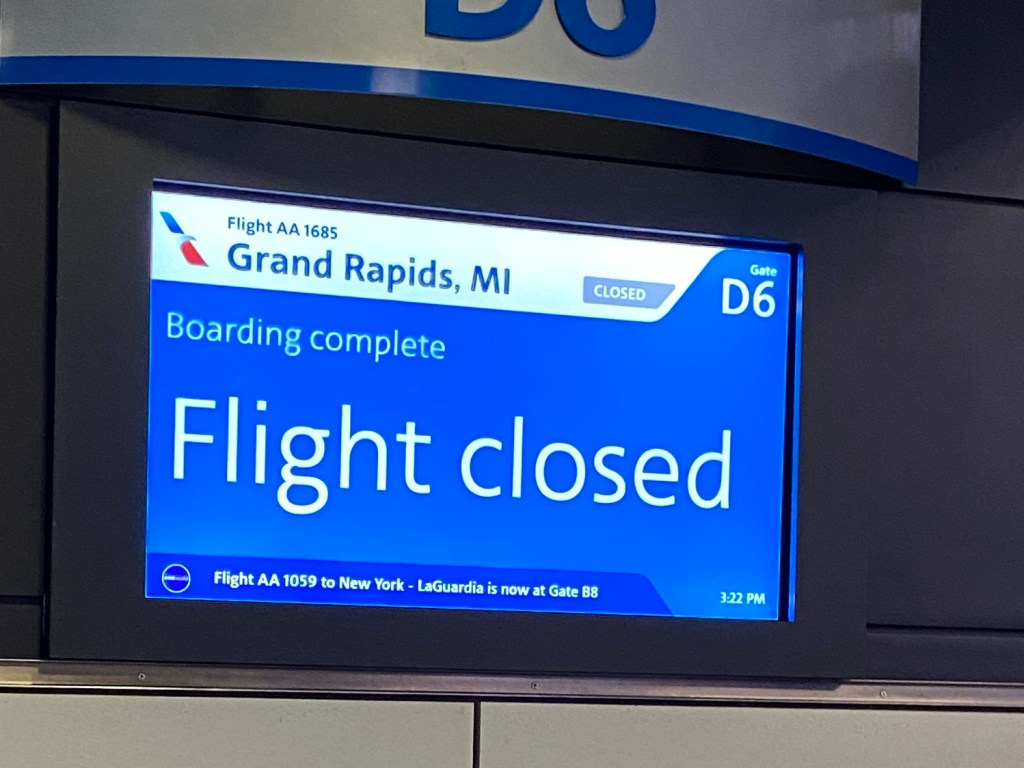
If that wasn’t bad enough, someone from the airline came along with two other passengers and let them board the flight.

Somehow they had been added to the manifest for the flight but my wife and another passenger where rejected as the flight plan had been filed with the existing passenger list.

Someone needs to explain to me how this works.

So my wife got another flight to Chicago that would connect with another flight.

She should arrive around 11pm with long waits in Charlotte and Chicago.

Finally getting on the plane to Chicago, another storm hits the windy city.

She lands there late.

No worries as O’Hare is also being delayed by the storm and who knows what else.

Her departure was set to 11:30pm.

Then we realized that was Central Time.

What ELSE could happen.

Then another passenger looks at my wife and says, ‘I hope this crew doesn’t time out …

But the crew didn’t time out and the last text I got was at 1:44am Wednesday Morning.

Landed‘ it said.

She should have been there around 4pm on Monday.

Just starting with her take off time on Tuesday, we could have driven there faster.

I am reminded of the time my Wife and I toured the Wright Brothers Cycle Factory in Greenfield Village in Detroit.

The docent gave us a sketch of the lives of the Wright’s and how they sold bikes during the day and worked on their airplane at night.

I asked, “Was it true that they custom designed their engine and that on the morning of that first flight, it took them a couple of hours to get the engine started and running correctly?

The docent said that yes, that was true.

So,” I said, “The Wright Brothers invented flight delay before they invented flight?

We need that on a postage stamp.

7.23.2024 – we will be known for

we will be known for
feelings of the heart – small, hard,
and full of meanness

We will be known as a culture that feared death
and adored power, that tried to vanquish insecurity
for the few and cared little for the penury of the
many. We will be known as a culture that taught
and rewarded the amassing of things, that spoke
little if at all about the quality of life for
people (other people), for dogs, for rivers. All
the world, in our eyes, they will say, was a
commodity. And they will say that this structure
was held together politically, which it was, and
they will say also that our politics was no more
than an apparatus to accommodate the feelings of
the heart, and that the heart, in those days,
was small, and hard, and full of meanness.

Of the Empire by Mary Oliver.

My sister Lisa and I try to connect and talk about once a month.

I’ll get asked, what do you talk about and I say, ‘Oh just stuff.

The thing is as I pass through my days and weeks and I see things and I hear things and feel things and I taste things and I read things, I think, I have to remember to tell this to Lisa.

And when we can, we just talk.

Beyond my understanding, my sister often reads these things I write and lets me know when something makes a point.

It was Lisa who connected me with the poems of Mary Oliver.

I find it interesting that Ms. Oliver wrote this poem, Of the Empire, back in 2008.

Maybe she saw this coming back then.

Maybe we aren’t so different from where we were in 2008.

It’s just that there are those today who can read this poem and say ‘so what?’

Nevertheless, Of the Empire, reads as an indictment, a description of today in a way that is chilling.

Painting with words that tingles in your toes.

I have to also that those last two sentences bring my sister Lisa to mind.

Not because it describes her but just the opposite.

I have known my sister my entire life.

And let me tell you, her heart?

Her heart has never been small.

Her heart has never been hard.

Her heart has never been full of meanness.

Her heart is huge, open and soft and full of love.

7.22.2024 – it was a problem

it was a problem
without other solution
than that of patience

It was a tantalizing problem that confronted us.

As long as we were vigilant, they could not escape; and as long as they were careful, we would be unable to catch them.

Charley cudgelled his brains continually, but for once his imagination failed him.

It was a problem apparently without other solution than that of patience.

It was a waiting game, and whichever waited the longer was bound to win.

To add to our irritation, friends of the Italians established a code of signals with them from the shore, so that we never dared relax the siege for a moment.

And besides this, there were always one or two suspicious-looking fishermen hanging around the Solano Wharf and keeping watch on our actions.

We could do nothing but “grin and bear it,” as Charley said, while it took up all our time and prevented us from doing other work.

From Tales of the Fish Patrol by Jack London, New York, Macmillan Company, 1905.

I was reminded of today’s political news cycle.

It was a problem apparently without other solution than that of patience

It was a waiting game, and whichever waited the longer was bound to win.

We can do nothing but “grin and bear it,” as Charley said, while it takes up all our time and prevents us from doing other work.

7.21.2024 – vividly to sense

vividly to sense
world’s precariousness and
the perils ahead

Based on the paragraph:

The subsequent fortnight has, of course, proved a very long time in geopolitics.

The UK has finally elected a grownup government;

France has perhaps temporarily averted the prospect of a far-right administration;

and Trump has dodged that bullet and raced ahead in the polls.

Having Applebaum’s book closely in mind through all those events is vividly to sense the underlying precariousness of our world, the perils immediately ahead.

In the article, Pulitzer-winning author Anne Applebaum: ‘Often, for autocrats, the second time in power is worse’ by Tim Adams in the Guardian on July 21, 2024.

The article is an interview with Anne Applebaum and a review of her latest book, Autocracy, Inc: The Dictators Who Want to Run the World.

I could comment on the content in the article but I think it speaks for itself.

I could comment on the context of the article but I won’t.

It is the words used to fill up the content that I want to focus on.

The focus of the interview, Ms. Applebaum, is renown for passages like:

“Nowadays autocracies are run not by one bad guy, but by sophisticated networks composed of kleptocratic financial structures, security services (military, police, paramilitary groups, surveillance), and professional propagandists.

Just on syllable count alone she wins.

But it is the words of Mr. Adams that I like.

First off, anyone who can get fortnight and even more wonderful how he used it the phrase, The subsequent fortnight , well Boy Howdy, I take my hat off to.

Then there was the use of vividly to sense.

With almost 5 years of high school and college Latin in my brain, the only grammatical error left (in the age of tweets and texts) is the dreaded split infinitive.

As Herman Wouk writes in his novel, The Caine Mutiny,… note that split infinitive in paragraph three. If you want a letter to sound official, split an infinitive.”

How easy would it have been for Mr. Adam to write, ‘to vividly sense.

Needless to say I was shocked, shocked I tell you, to read in Wikipedia, “In the 19th century, some linguistic prescriptivists sought to disallow the split infinitive, and the resulting conflict had considerable cultural importance. The construction still renders disagreement, but modern English usage guides have largely dropped the objection to it.

The split infinitive terminology is not widely used in modern linguistics. Some linguists question whether a to-infinitive phrase can meaningfully be called a “full infinitive” and, consequently, whether an infinitive can be “split” at all.”

It makes absolutely no difference in the history of the world or the happenings of today but for me and myself, but vividly to sense made my day.

7.20.2024 – had I not the right

had I not the right
dislike dislikable man
feeling to this day

“… because it was a portion of the only genius he possessed to make me feel guilty for disliking him. It was a guilt I had no reason to feel — had I not the right to dislike a dislikable man? — and yet I go on unreasonably feeling it to this day. I perceive that even writing about him now, so long after his death, will not diminish my guilt. He has me locked in an embrace that nothing as simple as his death or the passage of time can release me from. It was his gift to gather a person in against his will and then never let go”

From Here at the New Yorker by Brendan Gill, New York, Random House, 1975.