8.13.2024 – never known woman

never known woman
who could weep about her age
way men I know can
Well, the characteristic fear of the American writer is not so much that as it is the process of aging.

The writer looks in the mirror and examines his hair and teeth to see if they’re still with him.

“Oh my God,” he says, “I wonder how my writing is. I bet I can’t write today.”’

The only time I met Faulkner he told me he wanted to live long enough to do three more novels.

He was 53 then, and I think he has done them.

Then Hemingway says, you know, that he doesn’t expect to be alive after sixty.

But he doesn’t look forward not to being.

When I met Hemingway with John O’Hara in Costello’s Bar 5 or 6 years ago we sat around and talked about how old we were getting.

You see it’s constantly on the minds of American writers.

I’ve never known a woman who could weep about her age the way the men I know can.

From Interview: THE ART OF FICTION: JAMES THURBER.
Paris Review, 3 (Fall, 1955), 34-49. Illustrated

This snippet made laugh.

I could picture Thurber in his mid 50’s, sitting in a bar with Mr. Hemingway and Mr. O’Hara and that alone is a picture to make me smile.

And that they were worrying about how old they were getting and that Mr. Thurber thought it was funny to the point of saying “I’ve never known a woman who could weep about her age the way the men I know can,” is but itself funny enough to make me laugh out loud.

For sure Mr. Thurber, who was being interviewed for this interview by George Plimpton, was having a great time tossing off the names of Faulkner, Hemingway and O’Hara with the confidence that he COULD toss off these names.

(I am reminded of the a story of Hollywood Movie Director John Ford going on a duck hunt with Clark Gable and William Faulkner and the conversation got around to writing and Gable says to Faulkner, ‘Who are the best writers right now?” Faulkner replies, “Oh Hemingway, Fitzgerald, Steinbeck … and myself.” Gable says “Oh, Mr. Faulkner, do you write?” “Yes,” says Faulkner, “Mr. Gable … what do you do?” … The kicker is John Ford swore both were on the level.)

BUT I DIGRESS …

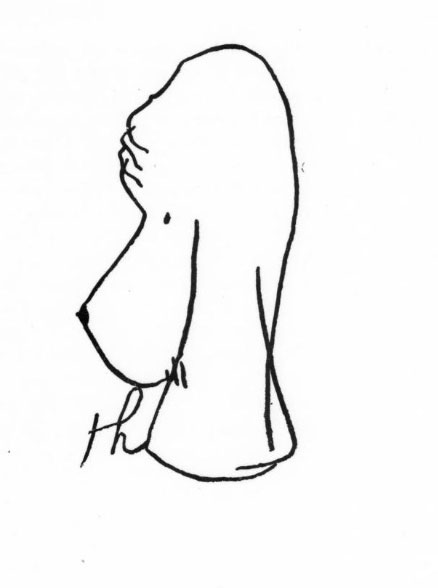
As a kind of post script to the James Thurber story, The Paris Review included this photo.

Notice the caption.

Notice it says CONSIDERABLY REDUCED.

By 1961, James Thurber was pretty much blind in both eyes.

One eye was damaged playing William Tell when he was a kid and the other eye went due to sympathetic eye syndrome.

When he died, EB White wrote in his New Yorker Magazine Obituary:

I am one of the lucky ones; I knew him before blindness hit him, before fame hit him, and I tend always to think of him as a young artist in a small office in a big city, with all the world still ahead. It was a fine thing to be young and at work in New York for a new magazine when Thurber was young and at work, and I will always be glad that this happened to me.

His mind was never at rest, and his pencil was connected to his mind by the best conductive tissue I have ever seen in action. The whole world knows what a funny man he was, but you had to sit next to him day after day to understand the extravagance of his clowning, the wildness and subtlety of his thinking, and the intensity of his interest in others and his sympathy for their dilemmas — dilemmas that he instantly enlarged, put in focus, and made immortal, just as he enlarged and made immortal the strange goings on in the Ohio home of his boyhood.

He was both a practitioner of humor and a defender of it. The day he died, I came on a letter from him, dictated to a secretary and signed in pencil with his sightless and enormous “Jim.” “Every time is a time for humor,” he wrote. “I write humor the way a surgeon operates, because it is a livelihood, because I have a great urge to do it, because many interesting challenges are set up, and because I have the hope it may do some good.” Once, I remember, he heard someone say that humor is a shield, not a sword, and it made him mad. He wasn’t going to have anyone beating his sword into a shield. That “surgeon,” incidentally, is pure Mitty. During his happiest years, Thurber did not write the way a surgeon operates, he wrote the way a child skips rope, the way a mouse waltzes.

Thurber looked in the mirror and asked I bet I can’t write today and then spit in the mirror and said I am going to write anyway.

And he did.
8.12.2024 – I was out for stars

I was out for stars
wouldn’t come in even if asked
and I hadn’t been.

As I came to the edge of the woods,
Thrush music—hark!
Now if it was dusk outside,
Inside it was dark.

Too dark in the woods for a bird
By sleight of wing
To better its perch for the night,
Though it still could sing.

The last of the light of the sun
That had died in the west
Still lived for one song more
In a thrush’s breast.

Far in the pillared dark
Thrush music went—
Almost like a call to come in
To the dark and lament.

But no, I was out for stars:
I would not come in.
I meant not even if asked,
And I hadn’t been.

From the poem, Come In, by Robert Frost as published in The Witness Tree, Henry Holt, New York, 1942

8.11.2024 – Then I look at you

Then I look at you
And the world’s alright with me
Just one look at you

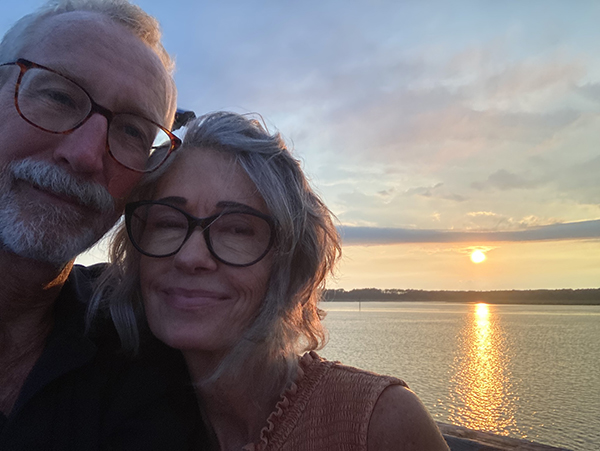
Still crazy … 35 years at sunset on Skull Creek on Hilton Head Island

35 years ago we got married.

35 years and a few days, we went over to our Church to meet with our Pastor for pre-marital counseling AND to meet with the church organist to go over the music.

Our Pastor was a no show so our Organist went over the music and then offered us some pre-marital advice for free.

Be nice to each other,” was all he said.

And never were more true words about being in a marriage ever spoken.

What he didn’t say was how hard that would be somedays.

Watching us from afar through facebook and social media, one may not realize that they are seeing the best of us, the stuff we wants folks to see about us.

But we have bad moments.

We have bad days.

We have bad weeks.

We have … well, you get the picture.

But we are still here.

When I started this essay I went searching for a quote that I wanted to use to illustrate our marriage.

It was a quote from the movie Apocalypse Now where Martin Sheen asks the Navy Chief if he wants to know where they are going and the Chief replies with something like, “One look at you and I know it’s going to be hot …”

My thought was to use that to point out that my wife had fair warning of what she was getting into by marrying me.

I searched, “One look at you” and The Google brought back the song Lovely Day by Bill Withers from back when I was in high school.

I read the lyrics and I said to myself that fits, that works, that is how I feel, in fact, that is how we feel.

We might not make it through the day feeling that way but we start out that way.

And that’s pretty good.

After 35 years, that’s not bad.

And tomorrow?

I can tell you, it is gonna be ….

Love you Leslie!.

Here are the Lyrics (BTW one on the comments on this song posted on You Tube says that “Rumour has it he’s up in heaven still holding that note!

When I wake up in the morning, love
And the sunlight hurts my eyes
And something without warning, love
Bears heavy on my mind

Then I look at you
And the world’s alright with me
Just one look at you
And I know it’s gonna be

When the day that lies ahead of me
Seems impossible to face
When someone else instead of me
Always seems to know the way

When the day that lies ahead of me
Seems impossible to face
And when someone else instead of me
Always seems to know the way

The world’s alright with me
Just one look at you
And I know it’s gonna be
A lovely day

8.10.2024 – share that this matters

share that this matters
today as it mattered three
centuries ago

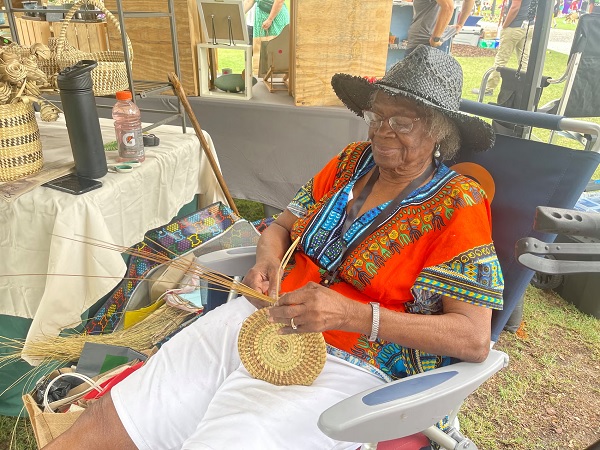
“Unfortunately there are elements of our nation that have taken a stand that history and culture are not important, this should not be taught, should not be introduced; that this is irrelevant. And so the work that we do now is even more steadfast because we have to really share with the nation and the world that this matters today as it mattered three centuries ago.”

Michael Allen, a Gullah Geechee co-founder of the annual Sweetgrass Festival quoted in the article, ‘It speaks of heritage’: South Carolina sweetgrass festival preserves Gullah Geechee culture” by Adira R. Wakjer in the Guardian.

The festival, held in Mount Pleasant, a suburb of Charleston and home to 14 Gullah Geechee communities, aims to promote and preserve the tradition of sweetgrass weaving, a centuries-long tradition started by enslaved people in the region and passed down to future generations.

8.9.2024 – most dangerous thing

most dangerous thing
normal person will do on
a daily basis

According Trooper Nick Pye of the S.C. Highway Patrol, in the Charleston Post and Courier article, Grace period is over for ‘Carolina Squat’ truck in SC. How many tickets have been issued? By Caitlin Byrd on July 29, 2024, who was quoted as saying, “Driving is the most dangerous thing a normal person will do on a daily basis.”

Let us say that all together …

Driving is the most dangerous thing a normal person will do on a daily basis.

Now let’s take the statement apart.

Driving …

We all know what that is and how difficult it is for some folks to do.

Daily Basis …

Something that happens daily and multiple times in any given day.

Most dangerous thing.

Like sharks, rattle snakes, high power lines, black ice and that person behind you in the McDonald’s drive through lane as time ticks down to the end of Breakfast Available.

We can come to a consensus on those terms.

Then that last one …

Normal people …

Normal people?

BOY HOWDY!

Pretty much a subjective term doncha think?

As Bernard Woolley said in the TV show, Yes Minister, about the word, “individualism … That’s one of those irregular verbs, isn’t it. I have an independent mind, you are an eccentric, he is round the twist.”

My feeling, and I count myself as being part of the Normal People group, is that driving is the most dangerous thing I do on a daily basis because so FEW of the other drivers aren’t normal.

Driving in Atlanta on a daily basis, I formed opinions about other drivers based on their license plates.

Georgia drivers were okay as they understood the first official rule of driving as issued by The Georgia Department of Transportation which was KEEP MOVING.

Drivers from up north I assumed were pretty much normal and just wanted to get through the city on their way to visit the Rat down in Orlando.

Drivers from Tennessee, Florida and Alabama should be avoided if possible because they were just bad drivers and often visitors to Atlanta and liable to drive across 5 lanes of traffic when their GPS told them to ‘Take the Exit.”

Then there were those drivers from South Carolina.

I learned to stay away, get away, back off or pass them as soon as possible because there was no way to figure out what they were doing and that there was the possibility that they would do anything including come to a stop at anywhere on the freeway.

Anything could happen with a South Carolina driver near you.

NOW I LIVE IN SOUTH CAROLINA.

Now I have a South Carolina plate.

Dangerous drivers are the norm!

Sometimes, the real heroes of our society are those people are those, who on any given day, back the car out of the garage and drive off to work.

The most dangerous thing a normal person does on a daily basis.