2.14.2023 – while I am I, and

while I am I, and
you are you, so long as the
world contains us both

Escape me?
Never —
Beloved!
While I am I, and you are you,
So long as the world contains us both,
Me the loving and you the loth,
While the one eludes, must the other pursue.
My life is a fault at last, I fear:
It seems too much like a fate, indeed!
Though I do my best I shall scarce succeed.
But what if I fail of my purpose here?
It is but to keep the nerves at strain,
To dry one’s eyes and laugh at a fall,
And, baffled, get up and begin again,
So the chase takes up one’s life, that’s all.
While, look but once from your farthest bound
At me so deep in the dust and dark,
No sooner the old hope goes to ground
Than a new one, straight to the self-same mark,
I shape me—
Ever
Removed!

Life in a Love by Robert Browning

2.13.2023 – neon abstractions

neon abstractions
give the illusion we have
dispelled puzzlement

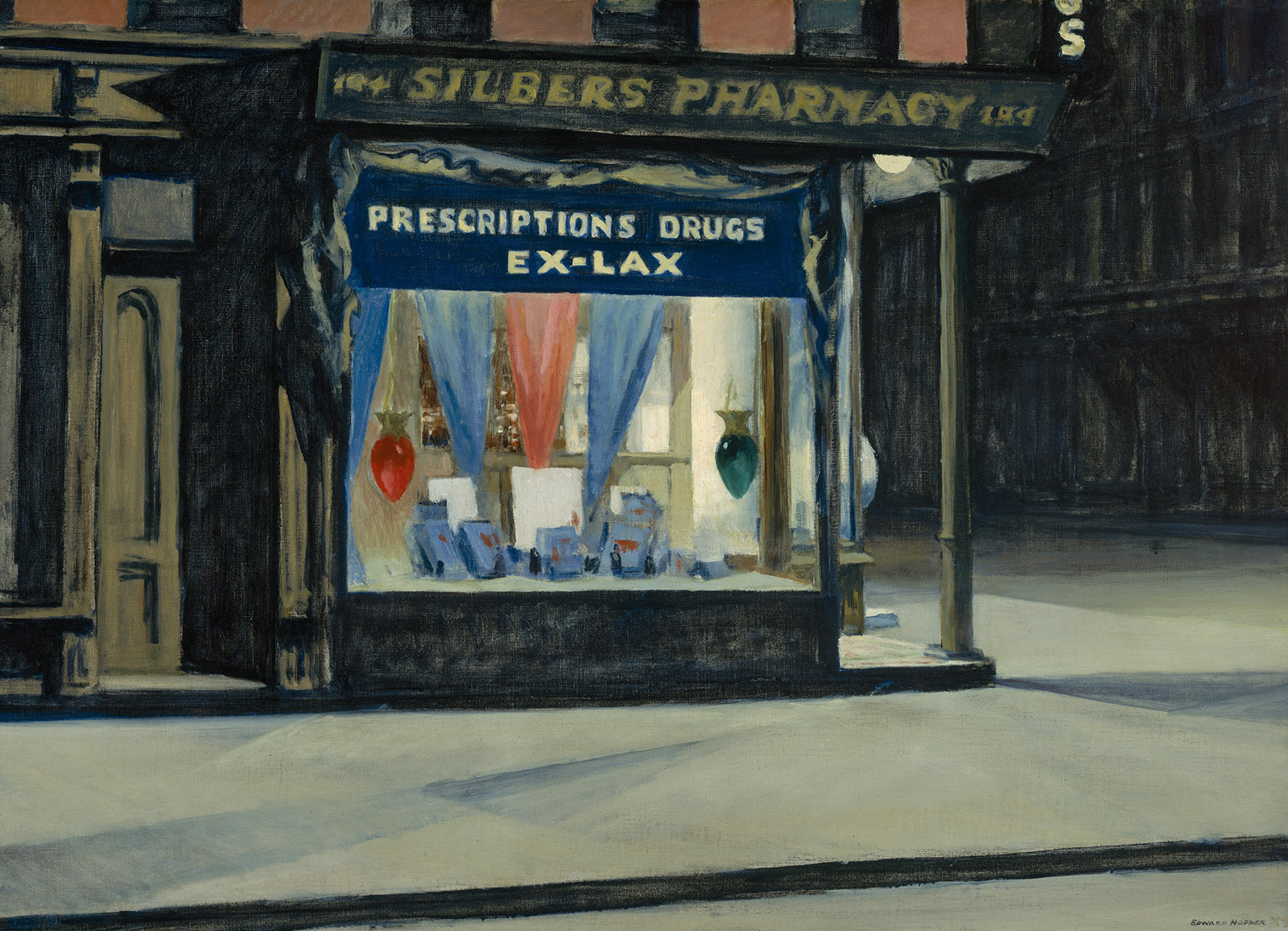
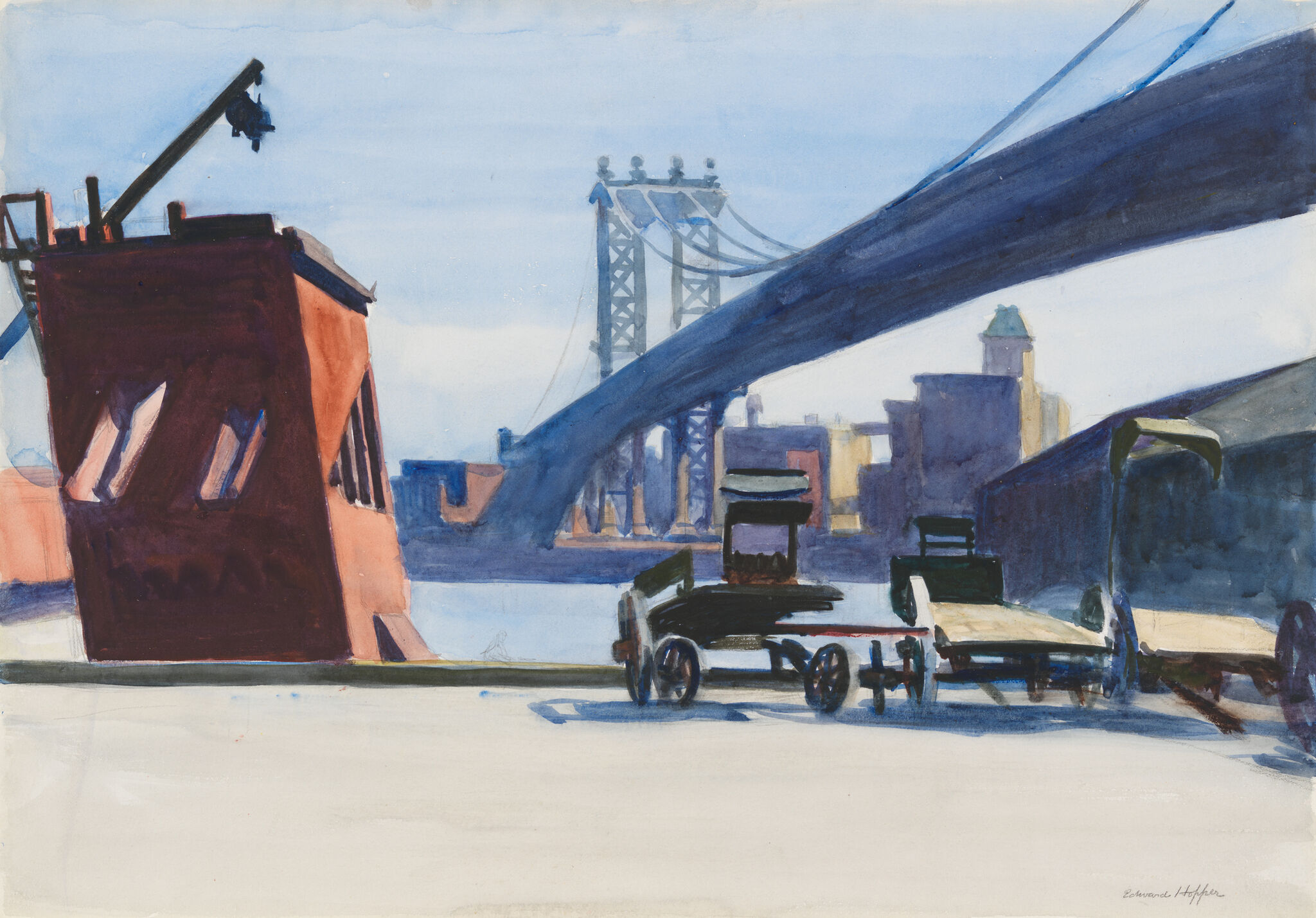
Edward Hopper’s New York, the sumptuous exhibition at the Whitney Museum of American Art, gives us one more chance to retire — at least for a decent interval — those once glamorous words that have come to dominate, and increasingly suffocate, our experience of Hopper’s paintings: alienation, loneliness, voyeurism, the uncanny.

Such neon abstractions give us the illusion that we have dispelled the puzzlement we often feel in front of Hopper’s strange compositions.

What they actually do is give us license to stop looking at the pictures, causing us to miss crucial aspects of his achievement, such as his pervasive and peculiar sense of humor.

A painter who features an ad for Ex-Lax in a moody nocturne of a corner drugstore isn’t just concerned with alienation.

From Buildings Come to Life, by Christopher Benfey in the New York Review of Books.

2.8.2023 – everybody trapped

everybody trapped
was a no-past no-future
state of existence

In a one page reminiscence, Mr. Zach Holland writes in the article, The Lost New Jersey Photographs of Henri Cartier-Bresson, in the New Yorker, (2/13/2023) about photographer, Henri Cartier-Bresson, and the effort made to follow and make documentary of the photographer as he tried to capture the essence of New Jersey with his camera.

This took place in 1975.

Why New Jersey?

“Because people make such a funny face when you mention New Jersey,” said Cartier-Bresson.

A man named Peter Cunningham was assigned to be Cartier-Bresson’s assistant and Mr. Cunningham recalled that New Jersey was “… was a no-past, no-future state of existence.

Mr. Holland writes that, “To Cartier-Bresson, a master of formal composition, the confinement appealed. “Everybody is trapped by something,” he told Evans.

“For me, liberty is a strict frame of reference, and inside that frame of reference all the variations are possible.”

The project fell apart as the documentary was to be on television and the producer said they would have to crop photographs to fit the 4×3 aspect ratio of the TV.

Cartier-Bresson felt that once he snapped the picture, the image was complete and any alteration was a “degeneration.”

The documentary was never made and the photographs have sat on a shelf since 1975 and are just now being released.

It is an odd thing about photographs is that I have long argued that the camera eliminated the need for mastering a craft like sculpture or painting.

The camera, as far as tools went, leveled the playing field between artists and others.

That’s the concept.

Somehow though the artist still makes a difference.

Is it that because the artist has the title, we look at the pictures created by the artist with a different respect?

I don’t know.

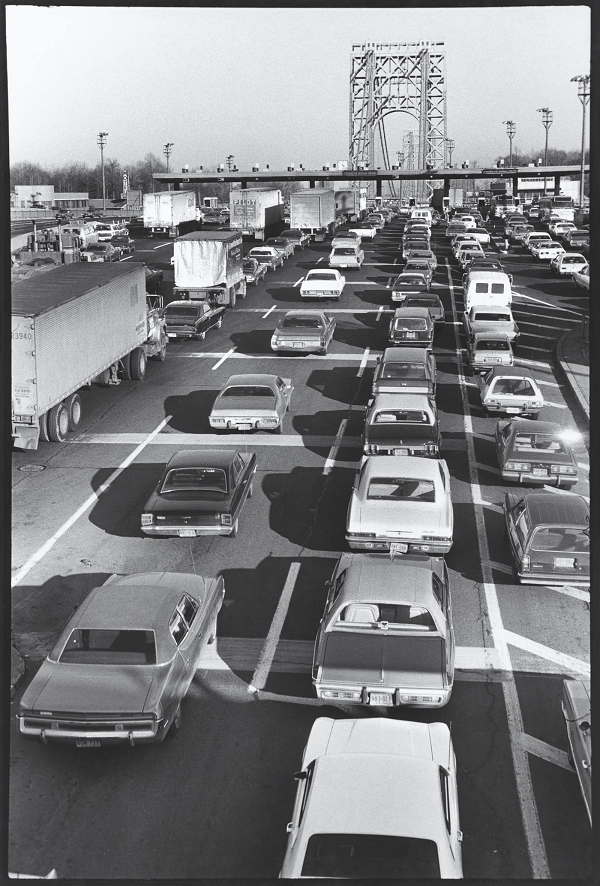
I look at this image of the cars waiting to cross the George Washington Bridge.

At the same time its just a picture of a bunch of cars and it is also a photograph by Henri Cartier-Bresson.

Henri Cartier-Bresson, the champion of the decisive moment.

I know what Henri Cartier-Bresson wanted to capture.

And I look at the photograph of the cars and I ask myself, what did Henri Cartier-Bresson see?

What makes this moment the decisive moment?

Here is expressed that liberty is a strict frame of reference, and inside that frame of reference all the variations are possible.

All these cars.

All these people in the cars.

Everyone trapped.

A no-past, no-future state of existence.

Its also a picture of a bunch of cars.

Maybe this is what is meant when they say and artist just holds up the mirror and you see what you bring in front of the mirror.

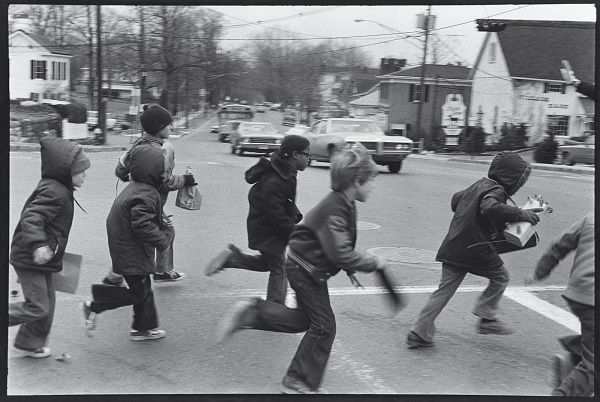
I count seven kids in the photo of the kids running across the street.

Seven kids.

Seven stories.

I want to know … what’s in the bag for lunch?

2.7.2023 sound, like the tone of

sound, like the tone of
that bell – then passing away …
a thing that was not

THERE are certain half-dreaming moods of mind, in which we naturally steal away from noise and glare, and seek some quiet haunt, where we may indulge our reveries and build our air castles undisturbed.

In such a mood I was loitering about the old gray cloisters of Westminster Abbey, enjoying that luxury of wandering thought which one is apt to dignify with the name of reflection.

I sought to take refuge from their noise by penetrating still deeper into the solitudes of the pile, and applied to one of the vergers for admission to the library.

How much, thought I, has each of these volumes, now thrust aside with such indifference, cost some aching head!

How many weary days!

How many sleepless nights!

How have their authors buried themselves in the solitude of cells and cloisters; shut themselves up from the face of man, and the still more blessed face of nature; and devoted themselves to painful research and intense reflection!

And all for what?

To occupy an inch of dusty shelf — to have the title of their works read now and then in a future age, by some drowsy churchman or casual straggler like myself; and in another age to be lost, even to remembrance.

Such is the amount of this boasted immortality.

A mere temporary rumor, a local sound; like the tone of that bell which has just tolled among these towers, filling the ear for a moment—lingering transiently in echo — and then passing away like a thing that was not.

From The Mutability of Literature A colloquy in Westminster Abbey by Washington Irving (1783-1859) in The Oxford Book of American Essays (NEW YORK, OXFORD UNIVERSITY PRESS, 1914).

Mr. Irving wrote this out after looking through the bookcase upon bookcase of books in the library at Westminster Abbey.

It came to mind as I walked through the aisle upon aisle of books at the Bookstore on the Hill in Richmond Hill, GA.

I met the owner but did not think to ask if the Bookstore on the Hill was in reference to the town of Richmond Hill or to the sermon of John Winthrop.

All those books.

To occupy an inch of dusty shelf — to have the title of their works read now and then in a future age, by some drowsy churchman or casual straggler like myself; and in another age to be lost, even to remembrance.

2.6.2023 – people who dream know

people who dream know
special happiness which world
of the day holds not

People who dream when they sleep at night, know of a special kind of happiness which the world of the day holds not, a placid ecstasy, and ease of heart, that are like honey on the tongue.

They also know that the real glory of dreams lies in their atmosphere of unlimited freedom.

It is not the freedom of the dictator, who enforces his own will on the world, but the freedom of the artist, who has no will, who is free of will.

The pleasure of the true dreamer does not lie in the substance of the dream, but in this: that there things happen without any interference from his side, and altogether outside his control.

Great landscapes create themselves, long splendid views, rich and delicate colours, roads, houses, which he has never seen or heard of.

Strangers appear and are friends or enemies, although the person who dreams has never done anything about them.

The ideas of flight and pursuit are recurrent in dreams and are equally enrapturing.

Excellent witty things are said by everybody.

It is true that if remembered in the day-time they will fade and lose their sense, because they belong to a different plane, but as soon as the one who dreams lies down at night, the current is again closed and he remembers their excellency.

All the time the feeling of immense freedom is surrounding him and running through him like air and light, an unearthly bliss.

From the book, Out of Africa (1937) by Karen Blixen (1885-1962).