3.8.2023 – independence and

independence and
irresponsibility
cannot co-exist

Adapted from a scene in the book, Commodore Hornblower, by C.S. Forester who writes that Hornblower:

Recalling himself to reality, he forced himself to remember with what a bubble of excitement he had received his orders back to active service, the light heart with which he had left his child, the feeling of – there was no blinking the matter – emancipation with which he had parted from his wife.

The prospect of once more being entirely his own master, of not having to defer to Barbara’s wishes, of not being discommoded by Richard’s teeth, had seemed most attractive then.

And here he was complaining to himself about the burden of responsibility, when responsibility was the inevitable price one had to pay for independence; irresponsibility was something which, in the very nature of things, could not co-exist with independence.

It is part of the Hornblower lore that when Gene Roddenberry created the Star Trek character of Captain James T. Kirk, he used Hornblower and the Hornblower books as a model.

3.7.2023 – sometimes a crumb falls

sometimes a crumb falls
from the tables of joy some
times a bone is flung

Pretty cheeky of me but this is adapted from the poem, Luck, by Langston Hughes, word for word.

Sometimes a crumb falls

From the tables of joy

Sometimes a bone

Is flung

To some people

Love is given

To others

Only heaven.

Angst?

Despair?

Some times for some people things fall, are flung, are given or found.

How can so much be packed into so few words?

I wonder what others might have made of this.

I also wanted a further attribution so I put the phrase, Sometimes a crumb falls in the google and was rewarded with a story that appeared in the New York Times on March 2, 1994.

In the article by Joe Sexton, Mr. Sexton reports on the New York City Transit authority was using ad space in the New York Subway system to display poetry in a program called Poetry in Motion.

On that day, March 2nd, in 1994, this poem was on display and Mr. Sexton rode along on the subway to ask commuters if they had noticed the poem, if they would read it, and want they thought it meant.

It is a fascinating read and a fabulous snapshot of a moment in the lives of several people who I am sure never once thought they might be talking to a reporter about Langston Hughes on the New York Subway.

For me, the poem might have its roots in the Bible story in Matthew 15:

The woman came and knelt before him. “Lord, help me!” she said.

He [Jesus] replied, “It is not right to take the children’s bread and toss it to the dogs.”

“Yes it is, Lord,” she said. “Even the dogs eat the crumbs that fall from their master’s table.”

Then Jesus said to her, “Woman, you have great faith! Your request is granted.”

I could go one with this thought of crumbs that fall, a bone that is flung, love found on earth or in Heaven but I won’t.

That thought of Biblical roots does not show up in the thoughts listed by the reporter as he interviewed commuters.

“I can’t express it, but I get it,” Ms. McNeil says of the poem.

“A crumb? A bone?” she [another commuter] asked. “What’s it got to do with heaven?”

“… To me, the poem means that you are lucky if you even find just some happiness.”

The story was headlined, Langston Hughes On the IRT; A Poem Arouses Many Feelings.

Whatever the feelings, I have to feel that Mr. Hughes would have been happy to learn that his poem, posted in the subway, where people might have a few seconds to ponder its message, had many feelings.

One more thing.

Those tables of joy.

Simple phrase you can consider in your mind and find it is 20 minutes later in your day.

3.5.2023 – my community

my community
pathologically lazy
rejoice with brisk walk

From the paragraph:

There’s (sedentary) rejoicing in my community, the pathologically lazy, at the news that only 11 minutes of brisk walking a day may save us from early death.

Of course, multiple caveats must accompany this statement, distilled from a Cambridge University-led meta-analysis of data on physical activity and heart disease.

We would have to be in the lucky 10%: only one in 10 early deaths could be avoided with a brief constitutional.

Exercise levels were also self-reported, meaning researchers had to make some assumptions about duration and intensity.

And 11 minutes is a neatly digestible take-home from analysing 196 studies with more than 30 million participants, not a magic bullet.

We like a magic-bullet figure though, don’t we?

In the article, An 11-minute walk can save you from an early death? That’s my kind of fitness regime by Emma Beddington in the Guardian, 3.6.2023.

I may have told the story how as an exercise with a big group of people, I was given a pack of 50 cards with a word on each card.

We had to divide the cards in half, choosing the words that best described ourselves.

Then we did it again.

Then we did again.

Then we did it until we were down to the last card, the last word, that was OUR word.

We had to go around the room and read our word out loud.

Electric!

Details!

Work!

My turn.

Lazy!

Kinda blew up the effect of the exercise.

3.3.2023 – the only books that

the only books that
millions readers have ever
actually read

In his guest opinion piece, The Truth About the ‘Censorship’ of Roald Dahl, Matthew Walther makes the point that:

Whatever Dahl’s place in the annals of 20th-century children’s fiction, it is striking that these culture war arguments somehow always revolve around authors like him and Dr. Seuss; one is forced to confront the distinctly horrifying possibility that “If I Ran the Zoo” and “James and the Giant Peach” are the only books that millions of Anglophone readers have ever actually finished.

I remember back in the day when I worked in a book store.

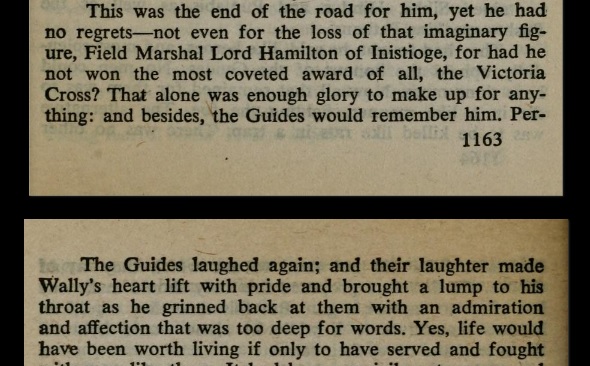
A young lady brought in a paperback copy of the book, Far Pavilions.

The book is around 1250 pages long.

The young lady had noticed that on page 1163, the text at the bottom of page was in mid sentence.

The text on the page 1164 started off with a new sentence.

She was curious in what was in the sentence that had been cut off.

She showed me the text in her book.

I went to the shelves and found 4 other editions.

All had the same problem.

She had a 2nd edition of the paperback.

I was checking the 15th edition.

It seemed that no one had ever noticed the broken sentence.

You can see the error in the paperback copies of the Far Pavilions at Archive.org.

No one had managed to get to page 1164 or at least get to page 1164 in a coherent state of mind that they might have noticed a broken sentence.

Well, there you are.

That was this one book.

Can I have doubts that one is forced to confront the distinctly horrifying possibility that “If I Ran the Zoo” and “James and the Giant Peach” are the only books that millions of Anglophone readers have ever actually finished.

Nope.

2.28.2032 – both diabolic

both diabolic
love and the unearthly hate
of the mysteries

A voice! a voice!

It rang deep to the very last.

It survived his strength to hide in the magnificent folds of eloquence the barren darkness of his heart.

Oh, he struggled! he struggled!

The wastes of his weary brain were haunted by shadowy images now — images of wealth and fame revolving obsequiously round his unextinguishable gift of noble and lofty expression.

My Intended, my station, my career, my ideas—these were the subjects for the occasional utterances of elevated sentiments.

The shade of the original Kurtz frequented the bedside of the hollow sham, whose fate it was to be buried presently in the mould of primeval earth.

But both the diabolic love and the unearthly hate of the mysteries it had penetrated fought for the possession of that soul satiated with primitive emotions, avid of lying fame, of sham distinction, of all the appearances of success and power.

From Heart of Darkness by Joseph Conrad.

Both the diabolic love and the unearthly hate of the mysteries.

Penetrated and fought for the possession of that soul satiated with those primitive emotions.

Lying fame.

Sham distinction.

All the appearances of success and power.

Oh, he struggled! he struggled!

It rang deep to the very last.

That unextinguishable gift of noble and lofty expression.

To drag Mr. Thoreau into it, that life of quiet desperation.

All much on my mind of late.

So many journey alone into the heart of darkness.

Some find their way back.

Their way back home.

Some do find their way back home.

Some get to find their way back home.

The lucky ones.