could sing all the songs were ever invented? Should then be contented?
The Savage by the Sea by Frances Cornford
If I could hang all the foam of the sea in my hair, If I could sing all the songs that were ever invented, If I could kiss all the pebbles that ever there were, If I could hang all the foam of the sea in my hair, If I could drink all the waves as they break over there, Should I then be contented? If I could hang all the foam of the sea in my hair? If I could sing all the songs that were ever invented?
Frances Cornford, née Darwin, (1886-1960) was a British poet and translator. She was the granddaughter of Charles Darwin. She was educated at home in Cambridge where she remained for most of her life. She married Francis Cornford a classical scholar in 1909. They had five children, the eldest John Cornford a poet was killed in the Spanish Civil War. She published her first volume of poems in 1910 and she followed this with eight more volumes over the next 50 years. Two of her poetry volumes were illustrated in woodcuts by Gwen Raverat who was a cousin. Her last volume, On a Calm Shore (1960), was illustrated by her son. Her poetry style is short and unpretentious, some elegiac and others humorous. Her triolet ‘To a Fat Lady Seen From a Train’ is often quoted. Her Collected Poems (1954) was the official choice of the Poetry Book Society and she won the Queen’s Medal for Poetry in 1959. (The Oxford Guide to British Women Writers)
fashionable world system works respectfully appointed distances
Adapted from the passage:
The place in Lincolnshire has shut its many eyes again, and the house in town is awake.
In Lincolnshire, the Dedlocks of the past doze in their picture-frames, and the low wind murmurs through the long drawing-room as if they were breathing pretty regularly.
In town, the Dedlocks of the present rattle in their fire-eyed carriages through the darkness of the night, and the Dedlock Mercuries, with ashes (or hair-powder) on their heads, symptomatic of their great humility, loll away the drowsy mornings in the little windows of the hall.
The fashionable world—tremendous orb, nearly five miles round — is in full swing, and the solar system works respectfully at its appointed distances.
As it appears on the book, Bleak House, by Charles Dickens.
shadows seemed to float down the stream with the current float unresisting
Adapted from the line:
Nick looked down into the pool from the bridge.
It was a hot day. A kingfisher flew up the stream. It was a long time since Nick had looked into a stream and seen trout.
They were very satisfactory.
As the shadow of the kingfisher moved up the stream, a big trout shot upstream in a long angle, only his shadow marking the angle, then lost his shadow as he came through the surface of the water, caught the sun, and then, as he went back into the stream under the surface, his shadow seemed to float down the stream with the current, unresisting, to his post under the bridge where he tightened facing up into the current.
As it appears in Big Two-Hearted River: I by Ernie Hemingway.
vibrant but distant world love unpredictable with equanimity
In the New Yorker (Yorker, May 29, 2023, Issue 14 Volume 99), At the Galleries used this line in a review of two Yvonne Jacquette shows,
… paintings (and drawings and prints) are vibrant but distant, expressing their love of the unpredictable world with equanimity.
According to the Merriam-Webster online dictionary, equanimity means evenness of mind under stress. equanimity suggests a habit of mind that is only rarely disturbed under great strain.
According to the Cambridge online dictionary, equanimity means a calm mental state, especially after a shock or disappointment or in a difficult situation.
According to the Merriam-Webster online dictionary, unpredictable means not predictable, such as not able to be known or declared in advance.
According to the Cambridge online dictionary, unpredictable means likely to change suddenly and without reason and therefore not able to be predicted.
Put it all together and you get:
… paintings (and drawings and prints) are vibrant but distant, expressing their love of the not predictable, not able to be known or declared in advance, likely to change suddenly and without reason, world, with an evenness of mind and a calm mental state.
Vibrant but distant,
expressing love of the not predictable,
not able to be known
or declared in advance,
likely to change suddenly
and without reason,
world,
with an evenness of mind
and a calm mental state.
Hmmmmmmm.
That’s not bad is it?
A bit of free-verse, imagistic poetry almost maybe worthy to stand by itself.
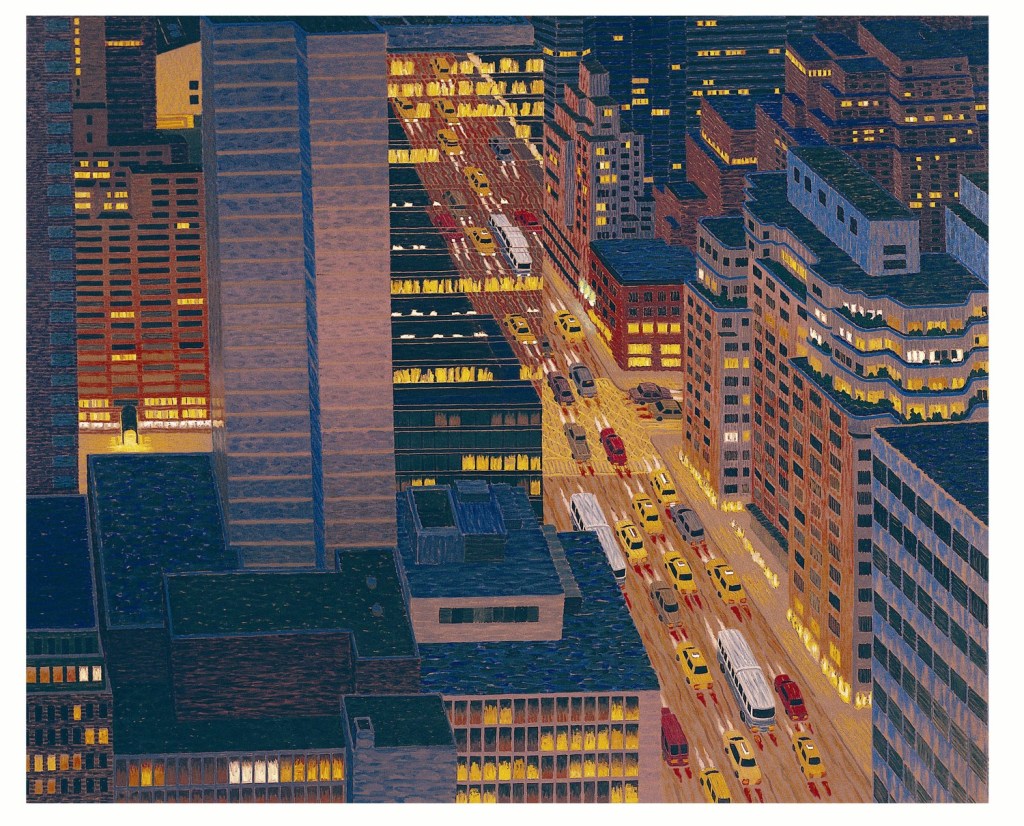
Third Avenue (with reflection) III (2004–5) Yvonne Jacquette
The complete review reads:
Since the late nineteen-seventies, the name Yvonne Jacquette has been synonymous with aerial landscapes: cities twinkling at night or patchwork rural expanses, seen from the high floors of skyscrapers or from low-flying planes.
These paintings (and drawings and prints) are vibrant but distant, expressing their love of the unpredictable world with equanimity.
Call the images realist if you insist, but their intricate patterns tilt toward abstraction, a reminder that paintbrushes aren’t cameras.
Two wonderful shows at the DC Moore gallery (on view through June 10) present very early and very late works by the American artist, who died in April, at the age of eighty-eight.
Instead of airborne perspectives, the show surprises with domestic vantage points, whether it’s a Maine meadow framed by floral curtains, from 1964, or the back of a billboard seen through the window of Jacquette’s Manhattan studio, from 2020. “Barn Ceiling” (above), from 1969, is a luminous, nearly seven-foot-tall interior that’s also a rigorous study in stripes (and, maybe, a post-and-beam riposte to Minimalism, then in its heyday).
Jacquette planned the exhibitions in recent months with her son (and fellow-painter), Tom Burckhardt.
One of the shows’ most touching moments is a rare still-life, from 2020 — film cannisters stored on shelves, their stacks suggesting miniature towers — that also reads as a portrait of Jacquette’s late husband, the Swiss filmmaker and photographer Rudy Burckhardt.