5.23.2023 – worse sinner ever

I’m worse sinner than
dared imagine and more loved
than ever dared hope

In the New York Times Opinion Piece / Obit titled, Tim Keller Taught Me About Joy, by David Brooks, Mr. Brooks writes about Mr. Keller:

On the cross, Tim wrote, Jesus was “putting himself into our lives — our misery, our mortality, so we could be brought into his life, his joy and immortality.”

He enjoyed repeating the saying “Cheer up! You’re a worse sinner than you ever dared imagine and you’re more loved than you ever dared hope.”

Another online source explained that last line this way.

The centerpiece and underpinning of Keller’s ministry was his teaching of the doctrine of the gospel, emphasizing the doctrines of total depravity, unmerited grace and substitutionary atonement. This teaching is summarized in his oft-used explanation, “The gospel is this: We are more sinful and flawed in ourselves than we ever dared believe, yet at the very same time we are more loved and accepted in Jesus Christ than we ever dared hope.

Mr. Brooks writes that:

He didn’t fight a culture war against that Manhattan world.

His focus was not on politics but on “our own disordered hearts, wracked by inordinate desires for things that control us, that lead us to feel superior and exclude those without them, that fail to satisfy us even when we get them.”

Tim’s happy and generous manner was based on the conviction that we are born wired to seek delight, and we can find it. “

Anybody who has tasted the reality of God knows anything is worth losing for this,”

Tim preached, “and nothing is worth keeping if I’m going to lose this.”

I have written before that I know salvation is to be worked out with fear and trembling.

As I am a worse sinner than I ever dared imagine, how could it be otherwise?

At the same time, bold will I approach the throne of grace through the gift OF grace through Jesus.

As I am more loved than I ever dared hope, how could it be otherwise.

Nothing is else is worth keeping.

I haven’t been much aware of Tim Keller.

Maybe I should have been.

Tim KellerCredit…James Estrin/The New York Times

5.21.2023 – what is the good of

what is the good of
putting stone reading ‘Here lies
Nobody Nowhere’

The Cat in the Lifeboat

A feline named William got a job as copy cat on a daily paper and was surprised to learn that every other cat on the paper was named Tom, Dick, or Harry. He soon found out that he was the only cat named William in town. The fact of his singularity went to his head, and he began confusing it with distinction. It got so that whenever he saw or heard the name William, he thought it referred to him. His fantasies grew wilder and wilder, and he came to believe that he was the Will of Last Will and Testament, and the Willy of Willy Nilly, and the cat who put the cat in catnip. He finally became convinced that Cadillacs were Catillacs because of him.

William became so lost in his daydreams that he no longer heard the editor of the paper when he shouted, “Copy cat!” and he became not only a ne’er-do-well, but a ne’er-do-anything. “You’re fired,” the editor told him one morning when he showed up for dreams.

“God will provide,” said William jauntily.

“God has his eye on the sparrow,” said the editor.

“So’ve I,” said William smugly.

William went to live with a cat-crazy woman who had nineteen other cats, but they could not stand William’s egotism or the tall tales of his mythical exploits, honors, blue ribbons, silver cups, and medals, and so they all left the woman’s house and went to live happily in huts and hovels. The cat-crazy woman changed her will and made William her sole heir, which seemed only natural to him, since he believed that all wills were drawn in his favor. “I am eight feet tall,” William told her one day, and she smiled and said, “I should say you are, and I am going to take you on a trip around the world and show you off to everybody.”

William and his mistress sailed one bitter March day on the S.S. Forlorna, which ran into heavy weather, high seas, and hurricane. At midnight the cargo shifted in the towering seas, the ship listed menacingly, SOS calls were frantically sent out, rockets were fired into the sky, and the officers began running up and down companionways and corridors shouting, “Abandon ship!” And then another shout arose, which seemed only natural to the egotistical cat. It was, his vain ears told him, the loud repetition of “William and children first!” Since William figured no lifeboat would be launched until he was safe and sound, he dressed leisurely, putting on white tie and tails, and then sauntered out on deck. He leaped lightly into a lifeboat that was being lowered, and found himself in the company of a little boy named Johnny Green and another little boy named Tommy Trout, and their mothers, and other children and their mothers. “Toss that cat overboard!” cried the sailor in charge of the lifeboat, and Johnny Green threw him overboard, but Tommy Trout pulled him back in.

“Let me have that tomcat,” said the sailor, and he took William in his big right hand and threw him, like a long incompleted forward pass, about forty yards from the tossing lifeboat.

When William came to in the icy water, he had gone down for the twenty-fourth time, and had thus lost eight of his lives, so he only had one left. With his remaining life and strength he swam and swam until at last he reached the sullen shore of a sombre island inhabited by surly tigers, lions, and other great cats. As William lay drenched and panting on the shore, a jaguar and a lynx walked up to him and asked him who he was and where he came from. Alas, William’s dreadful experience in the lifeboat and the sea had produced traumatic amnesia, and he could not remember who he was or where he came from.

“We’ll call him Nobody,” said the jaguar.

“Nobody from Nowhere,” said the lynx.

And so William lived among the great cats on the island until he lost his ninth life in a barroom brawl with a young panther who had asked him what his name was and where he came from and got what he considered an uncivil answer.

The great cats buried William in an unmarked grave because, as the jaguar said, “What’s the good of putting up a stone reading ‘Here lies Nobody from Nowhere’?”

MORAL: O why should the spirit of mortal be proud, in this little voyage from swaddle to shroud?

From Further Fables for Our Time by James Thurber, Hamish Hamilton, Ltd. 90 Great Russell Street, London, W.C.1

5.20.2023 – we read to have a

we read to have a
good time, not an easy time
necessarily

Martin Louis Amis (25 August 1949 – 19 May 2023) 

Back in 2020, the NY Times By The Book Review asked Martin Amis, How have your reading tastes changed over the years?

Mr. Amis said:

I find myself increasingly committed to the pleasure principle — first formulated by John Dryden in 1668.

We read for “delight and instruction,” while bearing in mind that literature “only instructs as it delights.”

In plainer terms, we read literature to have a good time.

Not an easy time, necessarily, but not a hard time and not a bad time.

So I like fiction that makes me welcome, and I’m quickly exasperated by the freakish, the introverted and above all the compulsively obscure.

For months now I’ve been trying to penetrate the bristling bastion of William Faulkner.

He is like Joyce — all genius and no talent; he just isn’t interested in pushing the narrative forward.

Well, I suppose his readers have enough to do anyway, trying to establish who is who and what (if anything) is going on.

5.2.2023 – expressionistic

expressionistic
or idiosyncratic
Georgia O’Keeffe

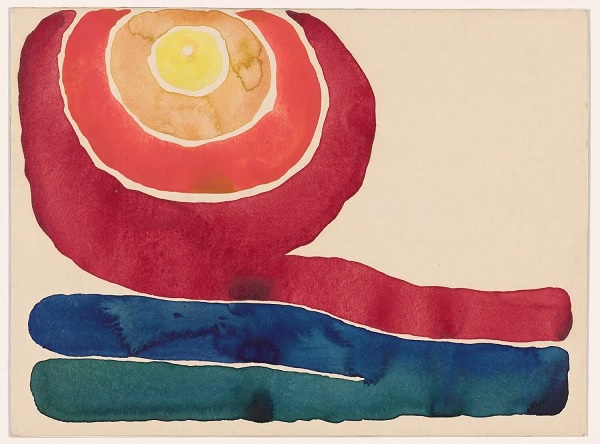
Georgia O’Keeffe’s “Evening Star No.III,” from 1917, in the exhibition “To See Takes Time.”
Credit…Georgia O’Keeffe Museum/Artists Rights Society (ARS), New York; via Museum of Modern Art

The O’Keeffe catalog raisonné, with its staggering wealth of art, makes two opposing points about the MoMA show. One is that there are several works whose inclusion would have shown the evolution in certain groupings, strengthening the curators’ notion of O’Keeffe’s “serial practice.”

The other is that the catalog raisonné presents a more diverse, less restrained and more unsettling O’Keeffe than is generally known — by turn expressionistic, akin to folk art or otherwise idiosyncratic. Some museum should throw caution to the wind and wrestle that O’Keeffe onto its walls. But it would take a degree of nerve, a love of visual impact and a reinvention of connoisseurship that few museums seem able to accommodate these days.

From the review, Georgia O’Keeffe, ‘Modernized’ by MoMA, by Roberta Smith.

And a catalogue raisonné is a comprehensive, annotated listing of all the known works of an artist either in a particular medium or all media.

Yep … I had to look it up.

I have always enjoyed the art of Georgia O’Keeffe.

Folks say that we all SEE the same things but we react or respond differently to what we see,

What I see in Ms. O’Keeffe is the color and the images.

My reaction, my response, is to sense, to feel the utter unbound freedom to feel.

I see her swoops and swirls and color and I can feel something in me gets unlocked.

When I was about 4 years old, I went through my sisters desk and found some magic markers.

In those days a magic marker was white and about 3 inches long with a short cap and a wrapper of the color that matched the color of marker.

I don’t know what the were made from but the colors they left defined the word ‘indelible’.

Once you got that marker on paper, or through the many pages of paper that the color leached through, or your fingers or whatever, it was there permanently.

There was also a strong smell, like mimeograph ink, to these markers.

These markers also had their own sound.

When you used one, they made a high pitched squeal or squeak as the tip was moved over the surface of whatever you were magically marking.

I know all this because when I found my sisters magic markers, I took them back to my bedroom that I shared with my two younger brothers and looked at the bedroom walls and saw a blank canvas.

I can still hear the squeal.

I can smell the smell.

I can still feel the utter unbound freedom as I covered the walls of my bedroom with swoops and swirls of magic marker.

I stood in front of that blank painted plaster and swung my short 4 year old arms in full circle after circle after circle.

I have never felt anything like it since but looking at the work of Ms. O’Keeffe, the I can hear the tintinnabulations of this moment.

I call also hear my Mom when she walked into the room.

I think you will understand that seeking to understand if what I did was expressionistic or idiosyncratic was not what went through my Mom’s mind when she saw her walls.

As I remember it, it took many many coats of paint to cover up my swoops and swirls.

That house is still standing and if I know anything about magic markers, those swoops and swirls are still there waiting to be restored.

I wonder about that sometimes.

And I enjoy the work of Georgia O’Keefe.