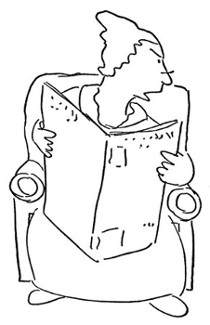
I declare I don’t
know how the world gets along
with men runnin’ it
Sorry folks but I got Mr. Thurber on the brain as I plan a possible visit to his home in Columbus, Ohio, where many of his stories took place.
Well, on the one hand I am sorry.
On the other hand, I am not sorry as I am re-reading and re-enjoying all over again the fun of his prose (with the wonderful editing of the Harold Ross so easily evident.)
I am fond of pointing out that Mr. Thurber is like so many Ohioans, Thomas Edison, The Wright Brothers, and Anita Baker, who achieved great and wonderful things, once they left Ohio.
To further the point, consider the list of Presidents from Ohio, Grant, Hayes, Garfield, McKinley, Taft and Harding.
I will not point out that this list includes 2 Presidents that were shot and 1 that was poisoned, it is said, by his wife.
If you ever see a photo of Florence Mabel Harding, you might be reminded of the famous exchange between Nancy Astor and Winston Churchill when Ms. Astor said, “Winston, if you were my husband, I would put poison in your coffee”, to which Mr. Churchill responded, “Nancy, if you were my wife … I’d drink it!”
But I digress.
For today, here is another one of my favorites that often is overlooked as while it IS a Columbus story, it is NOT included in My Life and Hard Times.
The Figgerin’ of Aunt Wilma
When I was a boy, John Hance’s grocery stood on the south side of Town Street, just east of Fourth, in the Central Market region of Columbus, Ohio. It was an old store even then, fifty-two years ago, and its wide oak floor boards had been worn pleasantly smooth by the shoe soles of three generations of customers. The place smelled of coffee, peppermint, vinegar, and spices. Just inside the door on the left, a counter with a rounded glass front held all the old-fashioned penny candies–gumdrops, licorice whips, horehounds, and the rest–some of them a little pale with age. On the rear wall, between a barrel of dill pickles and a keg of salt mackerel in brine, there was an iron coffee grinder, whose handle I was sometimes allowed to turn.
Once, Mr. Hance gave me a stick of Yucatán gum, an astonishing act of generosity, since he had a sharp sense of the value of a penny. Thrift was John Hance’s religion. His store was run on a strictly cash basis. He shared the cost of his telephone with the Hayes Carriage Shop, next door. The instrument was set in a movable wooden cubicle that could be whirled through an opening in the west wall of the store. When I was ten, I used to hang around the grocery on Saturday afternoons, waiting for the telephone to disappear into the wall. Then I would wait for it to swing back again. It was a kind of magic, and I was disappointed to learn of its mundane purpose–the saving of a few dollars a month.
Mr. Hance was nearly seventy, a short man with white hair and a white mustache and the most alert eyes that I can remember, except perhaps Aunt Wilma Hudson’s. Aunt Wilma lived on South Sixth Street and always shopped at Mr. Hance’s store. Mr. Hance’s eyes were blue and capable of a keen concentration that could make you squirm. Aunt Wilma had black agate eyes that moved restlessly and scrutinized everybody with bright suspicion. In church, her glance would dart around the congregation seeking out irreverent men and women whose expressions showed that they were occupied with worldly concerns, or even carnal thoughts, in the holy place. If she lighted on a culprit, her heavy, dark brows would lower, and her mouth would tighten in righteous disapproval. Aunt Wilma was as honest as the day is long and as easily confused, when it came to what she called figgerin’, as the night is dark. Her clashes with Mr. Hance had become a family legend. He was a swift and competent calculator, and nearly fifty years of constant practice had enabled him to add up a column of figures almost at a glance. He set down his columns swiftly on an empty paper sack with a stubby black pencil. Aunt Wilma, on the other hand, was slow and painstaking when it came to figgerin’. She would go over and over a column of numbers, her glasses far down on her nose, her lips moving soundlessly. To her, rapid calculation, like all the other reckless and impulsive habits of men, was tainted with a kind of godlessness. Mr. Hance always sighed when he looked up and saw her coming into his store. He knew that she could lift a simple dollar transaction into a dim and mystic realm of confusion all her own.
I was fortunate enough to be present one day in 1905 when Mr. Hance’s calculating and Aunt Wilma’s figgerin’ came together in memorable single combat. She had wheedled me into carrying her market basket, on the ground that it was going to be too heavy for her to manage. Her two grandsons, boys around my own age, had skipped out when I came to call at their house, and Aunt Wilma promptly seized on me. A young’un, as she called everybody under seventeen, was not worth his salt if he couldn’t help a body about the house. I had shopped with her before, under duress, and I knew her accustomed and invariable route on Saturday mornings, when Fourth Street, from Main to State, was lined with the stands of truck gardeners. Prices were incredibly low in those days, but Aunt Wilma questioned the cost, the quality, and the measure of everything. By the time she had finished her long and tedious purchases of fresh produce from the country, and we had turned east into Town Street and headed for Mr. Hance’s store, the weight of the market basket was beginning to pain my arm. “Come along, child, come along,” Aunt Wilma snapped, her eyes shining with the look of the Middle Western housewife engaged in hard but virtuous battle with the wicked forces of the merchandising world.
I saw Mr. Hance make a small involuntary gesture with his right hand as he spied Aunt Wilma coming through the door. He had just finished with a customer, and since his assistant was busy, he knew he was in for it. It took a good half hour for Aunt Wilma to complete her shopping for groceries, but at length everything she wanted was stacked on the counter in sacks and cans and boxes. Mr. Hance set deftly to work with his paper sack and pencil, jotting down the price of each article as he fitted it into the basket. Aunt Wilma watched his expert movements closely, like a hostile baseball fan waiting for an error in the infield. She regarded adroitness in a man as “slick” rather than skillful.
Aunt Wilma’s purchases amounted to ninety-eight cents. After writing down this sum, Mr. Hance, knowing my aunt, whisked the paper bag around on the counter so that she could examine his addition. It took her some time, bending over and peering through her glasses, to arrive at a faintly reluctant corroboration of his figgerin’. Even when she was satisfied that all was in order, she had another go at the column of numbers, her lips moving silently as she added them up for the third time. Mr. Hance waited patiently, the flat of his hands on the counter. He seemed to be fascinated by the movement of her lips. “Well, I guess it’s all right,” said Aunt Wilma, at last, “but everything is so dear.” What she had bought for less than a dollar made the market basket bulge. Aunt Wilma took her purse out of her bag and drew out a dollar bill slowly and handed it over, as if it were a hundred dollars she would never see again.
Mr. Hance deftly pushed the proper keys on the cash register, and the red hand on the indicator pointed to $.98. He studied the cash drawer, which had shot out at him. “Well, well,” he said, and then, “Hmm. Looks like I haven’t got any pennies.” He turned back to Aunt Wilma. “Have you got three cents, Mrs. Hudson?” he asked.
That started it.
Aunt Wilma gave him a quick look of distrust. Her Sunday suspicion gleamed in her eyes. “You owe me two cents,” she said sharply.
“I know that, Mrs. Hudson,” he sighed, “but I’m out of pennies. Now, if you’ll give me three cents, I’ll give you a nickel.”
Aunt Wilma stared at him cautiously.
“It’s all right if you give him three cents and he gives you a nickel,” I said.
“Hush up,” said Aunt Wilma. “I’m figgerin’.” She figgered for several moments, her mouth working again.
Mr. Hance slipped a nickel out of the drawer and placed it on the counter. “There is your nickel,” he said firmly. “Now you just have to give me three cents.”
Aunt Wilma pecked about in her purse and located three pennies, which she brought out carefully, one at a time. She laid them on the counter beside the nickel, and Mr. Hance reached for them. Aunt Wilma was too quick for him. She covered the eight cents with a lean hand. “Wait, now!” she said, and she took her hand away slowly. She frowned over the four coins as if they were a difficult hand in bridge whist. She ran her lower lip against her upper teeth. “Maybe if I give you a dime,” she said, “and take the eight cents… It is two cents you’re short, ain’t it?”
Mr. Hance began to show signs of agitation. One or two amused customers were now taking in the scene out of the corners of their eyes. “No, no,” said Mr. Hance. “That way, you would be making me a present of seven cents!” This was too much for Aunt Wilma. She couldn’t understand the new and preposterous sum of seven cents that had suddenly leaped at her from nowhere. The notion that she was about to do herself out of some money staggered her, and her eyes glazed for a moment like a groggy prizefighter’s. Neither Mr. Hance nor I said anything, out of fear of deepening the tangle. She made an uncertain move of her right hand and I had the wild thought that she was going to give Mr. Hance one of the pennies and scoop up the seven cents, but she didn’t. She fell into a silent clinch with the situation and then her eyes cleared. “Why, of course!” she cried brightly. “I don’t know what got into me! You take the eight cents and give me a dime. Then I’ll have the two cents that’s coming to me.” One of the customers laughed, and Aunt Wilma cut him down with a swift glare. The diversion gave me time to figure out that whereas Mr. Hance had been about to gain seven cents, he was now going to lose a nickel. “That way, I would be making you a present of five cents, Mrs. Hudson,” he said stiffly. They stood motionless for several seconds, each trying to stare the other down.
“Now, here,” said Mr. Hance, turning and taking her dollar out of the still open cash drawer. He laid it beside the nickel and the pennies. “Now, here,” he said again. “You gave me a dollar three, but you don’t owe me a dollar three–you owe me five cents less than that. There is the five cents.” He snatched it up and handed it to her. She held the nickel between thumb and forefinger, and her eyes gleamed briefly, as if she at last comprehended the peculiar deal, but the gleam faded. Suddenly she handed him his nickel and picked up her dollar and her three cents. She put the pennies back in her purse. “I’ve rung up the ninety-eight cents, Mrs. Hudson,” said Mr. Hance quickly. “I must put the dollar back in the till.” He turned and pointed at the $.98 on the indicator. “I tell you what. If you’ll give me the dollar, I’ll give you the nickel and we’ll call it square.” She obviously didn’t want to take the nickel or give up the dollar, but she did, finally. I was astounded at first, for here was the penny-careful Mr. Hance knocking three cents off a bill, but then I realized he was afraid of losing the dollar and was willing to settle for the lesser of two evils.
“Well,” said Aunt Wilma irritably, “I’m sure I don’t know what you’re trying to do.”
I was a timid boy, but I had to plunge into the snarl, if only on behalf of family honor. “Gee, Aunt Wilma,” I told her, “if you keep the nickel, he’s giving you everything for ninety-five cents.”
Mr. Hance scowled hard at me. He was afraid I was going to get him in deeper than he already was. “It’s all right, son,” he said. “It’s all right.” He put the dollar in the till and shoved the drawer shut with a decisive bang, but I wasn’t going to give up.
“Gee whizz, Aunt Wilma,” I complained, “you still owe him three cents. Don’t you see that?”
She gave me the pitying glance of a superior and tired intelligence. “I never owed him three cents in my life,” she said tartly. “He owes me two cents. You stay out of things you don’t understand.”
“It’s all right,” said Mr. Hance again, in a weary voice. He was sure that if she scrabbled in her purse again for the three pennies, she would want her dollar back, and they would be right where they had started. I gave my aunt a look of disenchantment.
“Now, wait!” she cried suddenly. “Maybe I have the exact change! I don’t know what’s got into me I didn’t think of that! I think I have the right change after all.” She put back on the counter the nickel she had been clutching in her left hand, and then she began to peck at the coins in her purse and, after a good minute, arranged two quarters, four dimes, Mr. Hance’s nickel, and three pennies on the counter. “There,” she said, her eyes flashing triumph. “Now you give me my dollar back.”
Mr. Hance sighed deeply, rang out the cash drawer by pushing “No Sale,” and handed her the dollar. Then he hastily scraped up the change, deposited each coin in its proper place in the till, and slammed the drawer shut again. I was only ten, and mathematics was not my best study, but it wasn’t hard to figure that Mr. Hance, who in the previous arrangement had been out three cents, was now out five cents. “Good day, Mrs. Hudson,” he said grimly. He felt my sympathetic eyes on him, and we exchanged a brief, knowing masculine glance of private understanding.
“Good day, Mr. Hance,” said Aunt Wilma, and her tone was as grim as the grocer’s.
I took the basket from the counter, and Mr. Hance sighed again, this time with relief. “Goodbye, goodbye,” he said with false heartiness, glad to see us on our way. I felt I should slip him the parsley, or whatever sack in the basket had cost a nickel.
“Come on, child,” said Aunt Wilma. “It’s dreadfully late. I declare it’s taken hours to shop today.” She muttered plaintively all the way out of the store.
I noticed as I closed the door behind us that Mr. Hance was waiting on a man customer. The man was laughing. Mr. Hance frowned and shrugged.
As we walked east on Town Street, Aunt Wilma let herself go. “I never heard of such a thing in all the born days of my life,” she said. “I don’t know where John Hance got his schooling, if he got any. The very idea–a grown man like that getting so mixed up. Why, I could have spent the whole day in that store and he’d never of figgered it out. Let him keep the two cents, then. It was worth it to get out of that store.”
“What two cents, Aunt Wilma?” I almost squealed.
“Why, the two cents he still owes me!” she said. “I don’t know what they teach you young’uns nowadays. Of course he owes me two cents. It come to ninety-eight cents and I give him a dollar. He owed me two cents in the beginning and he still owes me two cents. Your Uncle Herbert will explain it to you. Any man in the world could figger it out except John Hance.”
I walked on beside her in silence, thinking of Uncle Herbert, a balding, choleric man of high impatience and quick temper.
“Now, you let me explain it to your Uncle Herbert, child,” she said. “I declare you were as mixed up as John Hance was. If I’d of listened to you and given him the three cents, like you said, I’d never of got my dollar back. He’d owe me five cents instead of two. Why, it’s as plain as day.”
I thought I had the solution for her now, and I leaped at it. “That’s right, Aunt Wilma,” I almost yelled. “He owed you a nickel and he gave you the nickel.”
Aunt Wilma stabbed me with her indignation. “I gave him the nickel,” she said. “I put it on the counter right there under your very eyes, and you saw him scoop it up.”
I shifted the market basket to my left arm. “I know, Aunt Wilma,” I said, “but it was his nickel all the time.”
She snorted. “Well, he’s got his precious nickel, ain’t he?” she demanded. I shifted the basket again. I thought I detected a faint trace of uneasiness in her tone. She fell silent and quickened her cadence, and it was hard for me to keep up with her. As we turned south into Sixth Street, I glanced up and saw that she was frowning and that her lips were moving again. She was rehearsing the story of the strange transaction for Uncle Herbert. I began to whistle. “Hush up, child,” she said. “I’m figgerin’.”
Uncle Herbert was sitting in the living room, eating an apple. I could tell from his expression that he was in one of his rare amiable moods. Aunt Wilma grabbed the basket away from me. “Now, you let me explain it to your uncle,” she said. “You wait till I get back.” She sailed out of the room on her way to the kitchen.
A little breathlessly, I told Uncle Herbert the saga of Aunt Wilma’s complicated financial quandary. He was chuckling when she came back into the room.
Uncle Herbert’s amusement nettled her. “The boy got it wrong,” she said accusingly. “He didn’t tell it right. He was ever’ bit as mixed up as John Hance.” Uncle Herbert’s chuckling increased to full and open laughter. Aunt Wilma glared at him until he subsided. “Now, Herbert, you listen to me,” she began, but he cut in on her.
“If Hance ever gives you that two cents he owes you, Wilma,” he said, “I tell you what you have to do to square accounts. Someday you’re going to have to give him a dime for three cents.” He began to laugh again.
Aunt Wilma Hudson stared at each of us in turn, with a look of fine, cold scorn, and then she raised both her hands and let them fall helplessly. “I declare,” she said, “I don’t know how the world gets along with the men runnin’ it.”
From Alarms and Diversions by James Thurber, 1957, Hamish Hamilton Ltd., 90 Great Russell Street, London, W.C.1.


 No Haiku For You