8.21.2023 – thinking of death but

thinking of death but
dressing it in the raiment
lyric, metaphor

Most of the people I like, or love, or can barely stand are between the ages of forty-five and sixty-five, give or take a year or two at either end, and only about three of them are capable any longer of achieving what was once casually called, and is now wistfully called, a good night’s rest.

For ours is the age of the four “A”s: anxiety, apprehension, agonizing, and aspirin.

People are smoking more and enjoying it less, drinking more and feeling it more, and waking around three in the morning to lie there gloomily staring at the mushroom-shaped ceiling, listening for the approaching drone of enemy bombers, and thinking of death but dressing it in the raiment of lyric or metaphor: the gate in the garden wall, the putting out to sea, the mother of beauty, the fog in the throat, the ruffian on the stair, the man in the white coat, the sleep that rounds our little lives.

From The Watchers of the Night in Lanterns & Lances by James Thurber.

For ours is the age of the four “A”s:

Anxiety,

Apprehension,

Agonizing,

and Aspirin.

Change Aspirin to Advil and change mushroom-shaped ceiling to and waking around three in the morning to lie there gloomily staring at the ceiling fan and counting the blades as they go around and you got me, nearly 70 years after Thurber wrote these lines.

I agonize about my apprehension over my anxiety so I take an Advil.

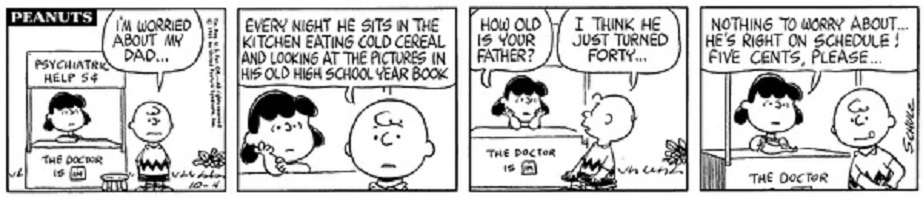
Then though, reading this, I seem to be right on schedule.

One less thing to agonize over.

One thing to feel apprehension over.

One less thing to fuel my anxiety.

One less Advil to take.

I am right on schedule!

8.20.2023 – when Carl Sandburg sings

when Carl Sandburg sings
I know a lover of all
the living sings then

In his autobiography, The Big Sea, Langston Hughes writes about his time a Cleveland Central High School:

Ethel Weimer discovered Carl Sandburg for me. Although I had read of Carl Sandburg before—in an article, I think, in the Kansas City Star about how bad free verse was—I didn’t really know him until Miss Weimer in second-year English brought him, as well as Amy Lowell, Vachel Lindsay, and Edgar Lee Masters, to us. Then I began to try to write like Carl Sandburg.

Little Negro dialect poems like Paul Lawrence Dunbar’s and poems without rhyme like Sandburg’s were the first real poems I tried to write. I wrote about love, about the steel mills where my step-father worked, the slums where we lived, and the brown girls from the South, prancing up and down Central Avenue on a spring day.

… about Carl Sandburg, my guiding star, I wrote:

Carl Sandburg’s poems
Fall on the white pages of his books
Like blood-clots of song
From the wounds of humanity.
I know a lover of life sings
When Carl Sandburg sings.
I know a lover of all the living
Sings then

8.15.2023 – matters not only

matters not only
what you see, but how and with
what eyes you see it

Non tantum quid videas, sed quemadmodum, refert; animus noster ad vera perspicienda caligat.

So wrote Lucius Annaeus Seneca the Younger, usually known mononymously as Seneca, who was, according to wikipedia, a Stoic philosopher of Ancient Rome, a statesman, dramatist, and in one work, satirist, from the post-Augustan age of Latin literature.

Neither here nor there but one day I am going to establish a mononymous hall of fame for all those folks known for just their first name. I digress but I have to point out that having a really good first name gets you off to good start. I mean Elvis means Elvis and he left the building a long time ago but does Michael mean Michael Jackson or Michael Jordan.

Anyway, back to Non tantum quid videas, sed quemadmodum, refert; animus noster ad vera perspicienda caligat.

This is a line from the Ad Lucilium epistulae morales also known as the Moral Epistles and Letters from a Stoic, a collection of 124 letters that Mr. Seneca wrote at the end of his life.

Seneca was one of those fellers who was motivated to write down things that could be repeated as maxims or rules for one self to make one self a better person.

I think it is too much to say that he was writing the Hallmark Cards of his era and I don’t want to say that but once I thought it, I had to say it.

Maybe its because so many thoughtful quotes from Seneca end up on T shirts and coffee mugs though no one has a clue to why it was said or who said it in the first place.

I mean if someone touched a hot stove and then said, once burned twice shy, you would understand how that someone came to understand that once touching a hot stove and getting burned, you would think twice about touching a hot stove.

Unless, like the feller in the story told by Minnie Pearl who dropped a red hot horseshoe.

Ms. Pearl quoted the blacksmith as saying to the feller, ‘Burned you! Didn’t it!

“No,” says the feller, “It don’t take me long to look at a horseshoe.”

But Non tantum quid videas, sed quemadmodum, refert; animus noster ad vera perspicienda caligat?

According to the  1930 Harvard University Press translation of the Epistulae Morales, it means:

It matters not only what you see,

but with what eyes you see it;

our souls are too dull of vision to perceive the truth.”

Which is good.

However I put that Latin into the google translator and I got, It matters not so much what you see, but how; our mind is clouded to see the truth.

I like that.

It matters not so much what you see, but how.

Our mind is clouded to see the truth.

On the one hand, this can touch on what I wrote about yesterday that most folks have already made up their mind and what they see is what they want to see.

Maybe that is the why are souls are too dull of vision and our mind is clouded to truth.

On the other hand, maybe this was the point that the teacher character in the movie Dead Poets Society was after (played by Robin Williams) when he had his class stand on their desks just to see something from a different angle.

I thought that was a weird sad movie (less than half the class climbs up on their desks in the final scene) but it had an impact on me.

You want to raise other people’s awareness, try running through an office by jumping from desk to desk.

The times I did that, boy oh boy, did people have a new way how they looked at life, even if just for a minute.

It matters not so much what you see, but how.

One person sees the glass half full.

The other person sees the glass half empty.

I see a glass and I say, ohhhhhhhhhhhhhhhh man, when does it tip over?

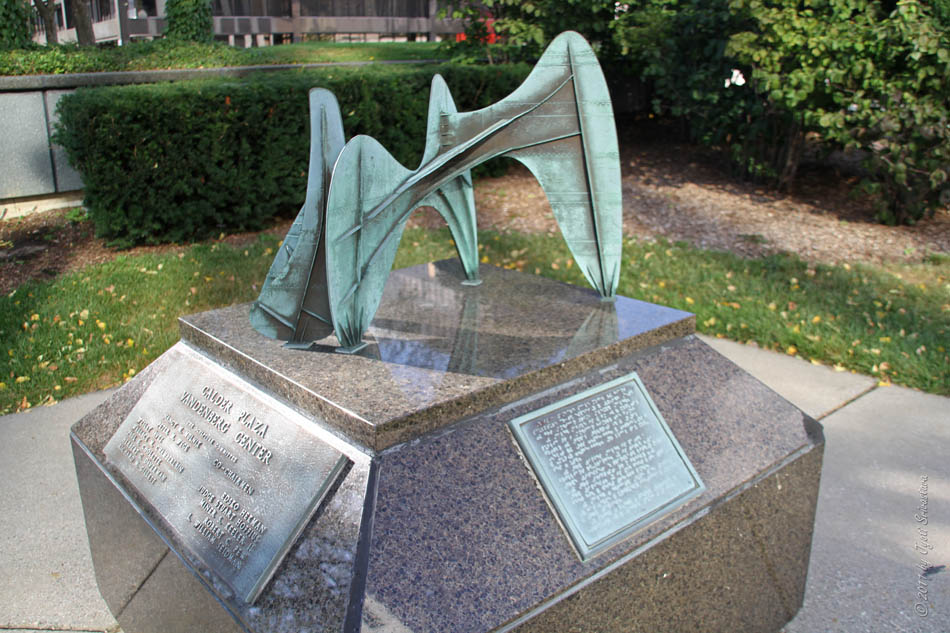
The picture above?

It’s a small sculpture just up the street from the original sculpture that is big, bright red and three stories high in downtown Grand Rapids, Michigan, where I grew up.

The big sculpture is known as ‘The Calder.’

The little version has a special name.

It is known as ‘The Calder … for the Blind.

It matters not so much what you see, but how.

8.14.2023 – don’t spread false reports

don’t spread false reports
don’t help a wicked man by
malicious witness

Based on the Bible verse, Exodus 23:1 – “Do not spread false reports. Do not help a guilty person by being a malicious witness.”

I intend to do nothing here but hold up a mirror and you can see what you brought.

There are those who will say that this verse applies to a figure in the news today who is being assailed … ASSAILED … on all sides by lies, by fraud, by cheating, by evil government and governors who are dedicated to the downfall of this figure. The extent to which the system has lined up so many false charges, bad Judges and officials and other malicious false witnesses against this figure only goes to PROVE the rightness of the person and his cause.

There are those who will say that this verse applies to this same figure in the news, along with the people who support him. who ignore any and all evidence that, in any way shows that, this person is guilty, to the point that, those people who feel this way, feel that those who do not feel this way, have lost their minds.

I am not making any comment as to either of these points of view.

As I said, I am just holding up a mirror and you will see what you want to see.

So why this haiku then?

I’ll tell you why.

According to the Online Encyclopaedia Britannica, the book of Exodus was perhaps written as early as 950 BCE. 

Or about 3000 years ago.

My point is that, 3000 years, folks had to be told, Do not spread false reports. Do not help a guilty person by being a malicious witness.

Plus ça change plus c est la même!

I have to add one last.

In quoting the the verse I used the latest online version which states:

Do not help a guilty person by being a malicious witness.

For my haiku, I am using my old OXFORD SCHOLFIELD NIV from 1984 which says:

Do not help a wicked man by being a malicious witness.

Hmmmmmmmmmmmmmmmmmmmmmmmmmmmmmmmmmm.

Interesting.

N’est-ce pas?

8.11.2023 – collecting titles

collecting titles
enduring satisfaction
the wonderful books

Until moving them became a problem bigger than having them, I had a large personal library.

Never able to get books that were, by themselves, worth something other than their content (I mean autographed or rare books) the books in my library were there to be read.

Still, to read about ‘Unparalleled treasure trove’ of 16th-century texts worth $25m up for auction, I know what the feller, T Kimball Brooker, means when he is quoted saying, “collecting the titles had ‘been an enduring source of satisfaction and enjoyment‘ and that he had ‘mixed feelings‘ about parting with the ‘wonderful books.‘”

There were always be book people.

People who would rather have a book in hand over a book on a device.

At this time and place, I go both ways.

And time and place do not support a larger personal library at this time and I am okay with that.

I have access to more books than I could ever read.

But being in a room filled with books is as much a splendor as almost any view.

I have known many book collectors.

I have known many book collectors who got older and wondered more and more, what would happen to their books.

One friend told me they had donated a lifetime collection of Early American fiction to Grand Valley State Library thinking it would go into their collection, only to be told that friends found books with his bookplate in them at the Friends of the Library sales and it about broke his heart.

I had another friend who had collected a great library on the American West in general and General Custer in particular and the thought of it being broken up when he passed bothered him a great deal.

In his case, I was able to put him touch with the Special Collections at the University of Michigan which is well known for 1) accepting such collections and 2) guaranteeing that the collection will be kept together.

But what I think of most is a story told to me in passing by a Professor I had in college.

By chance we walked out of a building together and out on to the diag in the center of campus in Ann Arbor when some sort of crowd demonstration was going on.

We stopped to watch.

He looked around and pointed how the police had left one path out of the central campus open.

He said he remember that tactic from his days at Harvard in the ’60s.

Give the crowd a way out.

He then remarked, that like today, he had watched an anti war demonstration back when he was student, in the Harvard Square, standing next to his Professor.

I asked what did his Professor say?

My Professor laughed and told how the crowd was screaming and the cops were advancing and tear gas started flying and his Professor, a much older man, turned to him, shrugged and said, “Well, this time my library is insured.”

My Professor said he looked at his Professor and asked what he meant, “This time my library is insured.”

The Professor looked at him and shrugged again and said that when the Russians kicked the Jews out of Russia, he lost his library.

Then when the German’s kicked the Jews of Germany, he lost his library.

But this time, and pointed at the ‘demonstration’ and smiled, the library is insured!

Never took my library, big or small, paper or electronic, for granted after that.

Those books.

Those wonderful books.

They have been an enduring source of satisfaction and enjoyment.

Those wonderful books have.