9.7.2023 – that rare malady

that rare malady
cure fully known costs little
so hard to achieve
Social isolation is the rare malady whose cure is fully known and costs relatively little, yet is still so difficult to achieve.

In the 21st century, we are a social species living atomized lives; even when living in a high-rise apartment building in a densely inhabited city, surrounded by people in every direction, we can easily feel bereft and melancholy.

From the Opinion Piece .. We Know the Cure for Loneliness. So Why Do We Suffer? by By Nicholas Kristof.

Mr. Kristof writes, “As for physical infrastructure to address loneliness, one example is the “chatty bench,” adopted in the United Kingdom, Sweden and Australia. This is a park bench with a sign encouraging strangers sitting there to chat with each other; in a Northern Ireland town, the sign says: “Sit here if you are happy to chat with passers-by.”

There are also “talking cafes,” where people are encouraged to gab with other coffee drinkers. There are “libraries of things,” where you can mingle with neighbors to borrow camping equipment or a carpet cleaner or lend out your own gear.

My wife and I, we talk to people.

Try to catch their eye and say hello.

If we are looking for anyone to talk back, it is usually little kids.

Little kids gravitate to my wife as they have been raised to ‘not to talk to strangers’ and they rarely meet anyone stranger than me.

More times than not, when a little kid gets brave enough to talk to me, they will say, “Do you know you have a gold tooth?

To which I immediately look over one shoulder and lower my head and confide that, well, see … I’m a pirate.

Which usually delights them and they turn to their Mom and say, “Mom, Mom, this guy’s a PIRATE!!!!!”

Which goes mostly to reinforce Mom’s thoughts to have that ‘no talking to strangers‘ lecture one more time.

But that doesn’t do much for the topic at hand does it.

Social isolation is the rare malady whose cure is fully known and costs relatively little, yet is still so difficult to achieve.

In the 1941 film, Meet John Doe, Gary Cooper as John Doe catches on nationwide with a movement based on the phrase, Be a Better Neighbor.

Be a better neighbor …

Maybe it’s a lost cause.

But in the 1939 film, Mr. Smith Goes to Washington, Jimmy Stewart as Mr. Smith says:
I guess this is just another lost cause Mr. Paine.

All you people don’t know about lost causes.

Mr. Paine does.

He said once they were the only causes worth fighting for and he fought for them once. For the only reason any man ever fights for them.

Because of just one plain simple rule.

Love thy neighbor.

(BTW Frank Capra directed both pictures.)

Love thy neighbor.

A lot longer ago than 1939 and before there were films, one of the Pharisees, an expert in the law as it is says, asked Jesus, ‘which is the greatest commandment?’

Jesus replied: ‘Love the Lord your God with all your heart and with all your soul and with all your mind.’ This is the first and greatest commandment … And the second is like it: ‘Love your neighbor as yourself.’

Love your neighbor.

And when Jesus was asked what or who was a neighbor, Jesus told the story of the Good Samaritan.

We are told that the numbers of church goers is dropping at an accelerated rate.

People are moving fast to disassociate themselves from the ‘Chosen Frozen.’

Maybe if we tried to be better neighbors.

Mr. Kristof writes: “Solutions to loneliness are like that — little nudges to encourage us to mingle the way we evolved to. They’re so easy, and loneliness seems so debilitating, that we should be doing more.

We Americans, atomized and polarized, addicted and distressed, are a lonely crowd. Overwhelming evidence suggests that for the sake of our happiness and well-being, we need one another.”
9.6.2023 – dreamed the pins fell out

dreamed the pins fell out
of all the stars, and the stars
fell into his cap

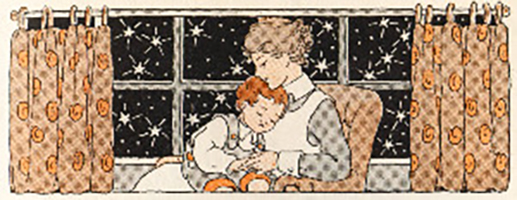
A little boy was dreaming
  Upon his mother’s lap,
That the pins fell out
        of all the stars,
  And the stars fell into his cap.

So when his dream was over,
  What did that little boy do?
He went and looked inside his cap,
  And found it was not true.

The Little Boy’s Dream from The Canadian Readers Book I, A Primer And First Reader, Authorized For Use In The Public Schools Of Manitoba, Saskatchewan, Alberta, And British Columbia, (Toronto, The Macmillan Company Of Canada Limited, 1931)

The book contains this appendix.

This book provides easy material of an interesting nature for the purpose of teaching young children to read. It contains the kind of literature which the child loves and which is his rightful heritage. It includes in simplified form many of the children’s classics—Mother Goose Tales, Nursery Rhymes, Stories about Children, Animals, Birds, Flowers, etc. These seize his interest, stimulate his imagination, and arouse in him the desire to read. Interest and pleasure in the story is the motive for mastering the vocabulary.

For Mother Goose, the line, “It contains the kind of literature which the child loves and which is his rightful heritage” sounds a bit … well, I’m not going to say it, but that last pronoun does stick out today and as for rightful heritage??

I will say that the Story of the Three Little Pigs ends in a way I love:

Down came the wolf “Splash” into the big pot of hot water

And that was the end of the big, bad wolf.

When dealing with a wolf, one can always hope for a happy ending.

As for our hero in the haiku?

Who hasn’t looked for the dreamed results of a dream and come away empty in the morning.

I will still check my cap in the morning.

You never know.

9.5.2023 – take various paths

take various paths
sky is door never closed
sun moon aren’t doorknobs

I’m trying to create an option for all
these doors in life. You’re inside
or out, outside or in. Of late, doors
have failed us more than the two-party system
or marriages comprising only one person.
We’ve been fooled into thousands of dualisms
which the Buddha says is a bad idea.
Nature has portals rather than doors.
There are two vast cottonwoods near a creek
and when I walk between them I shiver.
Winding through my field of seventy-seven
large white pine stumps from about 1903
I take various paths depending on spirit.
The sky is a door never closed to us.
The sun and moon aren’t doorknobs.
Dersu Uzala slept outside for forty-five years.
When he finally moved inside he died.

Doors by Jim Harrison.

I drove out to my workplace for the first time in a month due to construction on the workplace.

The last time I drove, I drove my car into the rising sun.

Today, I drove in the dark.

I take various paths to work as the light changes as the Earth tips.

The path is the same but at least seems different.

And I always end up in the same place.

9.3.2023 – comfortable in

comfortable in
your own skin, impossible
to be underdressed

“He didn’t identify with fashion statements per se,” said Kevin McLaughlin, a co-founder of the prep wear mini-empire J. McLaughlin and driving force behind the re-envisioned heritage label Quaker Marine Supply. “But he set a standard and had an influence in that if you’re cool and you’re comfortable in your own skin, it’s almost impossible to be underdressed.”

From the article, Don’t Underestimate Jimmy Buffett’s Influence on Style, by Guy Trebay, in the New York Times.

Mr. Trebay writes: “Our industry rewards elegance and style,’’ said Mr. McLaughlin. “Jimmy took the reverse approach, based on a level of self-confidence.’’

Call it nonchalance, sprezzatura or swagger — that offhand assurance is a quality too little appreciated by contemporary fashion, where the benchmark of critical success is often looking overdressed, overthought, overwrought.

8.29.2023 – misapprehension

misapprehension,
willfully blind, plausibly
ignorant of facts

I had to hammer out some of these words to fit into what I self style a haiku.

The words should have been:

> misapprehension of facts

> willfully blind

> plausible ignorance

These are all terms used in recent newspaper articles to describe legal defenses or legal avenues that can be used to explain the actions of defendants in a this big lawsuit in Georgia.

Nowhere does anyone seem to suggest saying, “I didn’t do it.”

Because they did.

But, with the right wording, what they did was not wrong.

Right wording like a misapprehension of facts.

Right wording like willfully blind.

Right wording like plausible ignorance.

Hard to believe but back in the day I was a 4th grade Sunday School teacher.

I was asked to a be a summer fill in and it lasted 10 years.

(I know that means that if ever I am charged with any type of crime the headline will read, “ONE TIME SUNDAY SCHOOL TEACHER CHARGED WITH …”)

I would do a series of lessons based on the 10 Commandments and I would ask the boys if they tried to follow the 10 commandments.

SURE – YOU BET – OF COURSE they would answer.

Then I would describe a simple scenario for the kids in my class where they, the kids, were at home on a Sunday Morning and their Mom had left a candy bar on the kitchen counter and told them to not touch the candy bar.

In the story the Mom leaves the room and the kid eats the candy bar and when the Mom comes back and asks what happened to the candy, the kid says to himself a certain cuss word and then says out loud, “I don’t know.”

I then said that the kid …

Coveted the candy bar.

Stole the candy bar.

Took the Lord’s name in vain.

Lied about taking the candy bar.

Did not honor his parents.

And since it was on a Sunday, did not honor the Sabbath.

In five minutes, said kid broke 6 of the 10 commandments.

Not bad for a 4th grader.

Then I gave them this scenario.

Same kid and this time, his parents are going out and they say, DO NOT GO TO THE PARK.

The parents leave and the kid rides his bike to the park.

Later when the parents come home, they ask DID YOU GO TO THE PARK?

And the kid says with care, I went for a bike ride.

I would then ask the class, did the kid lie?

The kid DID go for a bike ride.

The kid DID NOT say I DID NOT GO TO THE PARK.

Did the kid lie?

I then pointed out that the commandment says, DO NOT BEAR FLASE WITNESS.

The truth, the whole truth and nothing but the truth.

And I let those 4th graders think about it.

Of course the Court Case in Georgia is not about 4th graders but adults.

Adults who maybe should know better.

Adults who probably know about and push the 10 commandments.

As Huckleberry Finn said, and I quoted this just the other day, “Right is right, and wrong is wrong, and a body ain’t got no business doing wrong when he ain’t ignorant and knows better.