10.23.2023 – reviewed interval

reviewed interval
with its tale of eventless
monotonous days

Adapted from the passage:

He reviewed the short interval with its tale of eventless and monotonous days as he sat smoking a thoughtful pipe in the shady coco-nut grove that encompassed the hamlet, letting his thoughts travel back anon to a more distant and eventful past, and all the while keeping an attentive eye on a shabby-looking brigantine that was creeping up from the south. It was not, perhaps, a very thrilling spectacle, but yet Osmond watched the approaching vessel with lively interest. For though, on that deserted coast, ships may be seen to pass up and down on the rim of the horizon, two or three, perhaps, in a month, this was the first vessel that had headed for the land since the day on which he had become the owner of the factory and the sole representative of European civilization in Adaffia. It was natural, then, that he should watch her with interest and curiosity, not only as a visitor from the world which he had left, but as one with which he was personally concerned; for if her people had business ashore, that business was pretty certainly with him.

From A Certain Dr. Thorndyke by Richard Austin Freeman, Made and Printed in Great Britain for Hodder and Stoughton Limited, London, by Hasell, Watson & Viney, Ltd., London and Aylesbury, 1927

10.19.2023 – there was light good light

there was light good light
but what I consider dawn …
darker than all that

How Dark the Beginning

All we ever talk of is light—
let there be light, there was light then,
good light—but what I consider
dawn is darker than all that.

So many hours between the day
receding and what we recognize
as morning, the sun cresting
like a wave that won’t break
over us—as if light were protective,
as if no hearts were flayed,
no bodies broken on a day
like today. In any film,
the sunrise tells us everything
will be all right. Danger wouldn’t
dare show up now, dragging
its shadow across the screen.

We talk so much of light, please
let me speak on behalf
of the good dark. Let us
talk more of how dark
the beginning of a day is.

… by Maggie Smith.

According to Wikipedia, Maggie Smith is an American poet, freelance writer, and editor who lives in Bexley, Ohio.

Wikipedia also mentions that, In January 2022, when the board of trustees of McMinn County Schools in Tennessee, in a 10-0 decision, removed the Pulitzer Prize-winning Holocaust graphic novel Maus from its curriculum for 8th grade English classes, overriding a State curriculum decision, Smith was critical of the decision. She tweeted: “We’ve lost our damn minds if we think that to keep kids safe in school, we need to ban books, not assault weapons”.

10.17.2023 – he wrote, never print

he wrote, never print
anything that a scrub-woman
cannot understand

‘no paper of mass appeal could afford to be without a staff astrologist or a palmist who could tell you how to improve your fortune’. ‘The space we devote to politics is a dead loss in circulation.’ He wrote ‘Never print anything that a scrub-woman in a skyscraper cannot understand’, a statement paralleled by R. D. Blumenfeld in England ‘never to forget the cabman’s wife’.

So said Emile Gauvreau in his book, My Last Million Readers (New York, 1941) as quoted by Harold Adams Innis in his book, The Press: A Neglected Factor in the Economic History of the Twentieth Century (Oxford University Press, London, 1949).

Mr. Innis writes: “In the intense competition for circulation and for advertising success was won by the use of reading matter and picture appeal in competition with the magazines and by the use of features which emphasized gossip about movie stars.

That year again?

1949.

10.13.2023 – I took ideas people

I took ideas people
understood, gave in way they
did not understand

“It was just something I wanted to do,.”

“It wasn’t anything thought out. It was just personal to me … I wanted to make sure I took ideas people understood and gave it to them in a way they just did not understand.”

So says designer Thom Browne in an article about him titled, Fashion designer Thom Browne: ‘Men should be able to wear anything’ by Edward Helmore in the Guardian.

The theme of his collection this year, according to the article is:

The theme of his collection this season is Moby-Dick, because he read it as a boy. It includes a dark green, below-the knee Harris tweed skirt for men. It’s a manifesto, something to wear to a corporate office. “I think we live in a world where men should be able to wear anything,” he says. “I don’t really care if anybody wants to wear it, but I think it looks good, and it’s an interesting proposition for anyone who does.”

Read that last bit over again.

It includes a dark green, below-the knee Harris tweed skirt for men.

“I think we live in a world where men should be able to wear anything.”

Well boy howdy if he wanted to take something I thought I understood and give it in a way I did not understand Mr. Browne achieved that with his skirt for men.

On the other hand, had he called it a kilt, it would only be about 1000 behind the times.

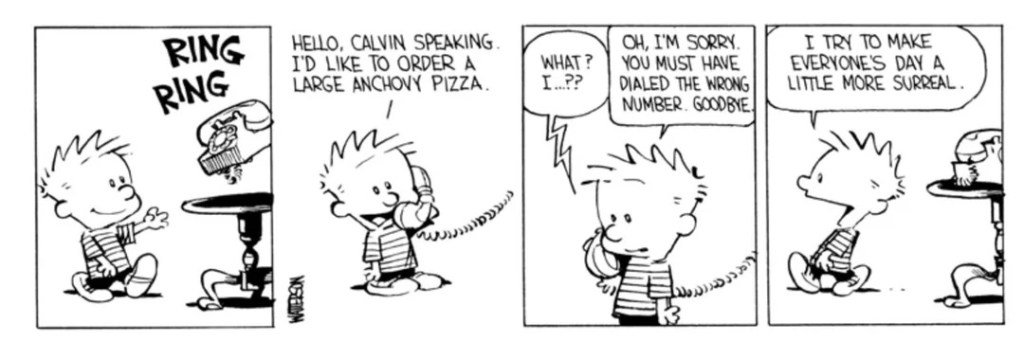
For some reason, the entire article brought this Calvin and Hobbs comic strip to mind.

Why do I write?

I think I can embrace both thoughts here.

I want to take ideas people understood and give it back to them in a way they just did not understand.

And …

I just want to make your day a little more surreal.

So remember this.

If you send a chocolate back in time just 15 minutes, it means that 15 minutes ago you had two chocolate bars.

Since you might have been in your lab messing around with time travel, and you got a chocolate bar when you already had one, you would know that in 15 minutes, you had to send that chocolate bar in time.

What happens if you eat that chocolate bar?

Or, consider this, if John Conner had been a woman, she could have been pregnant with herself.

10.11.2023 – computers often

computers often
in reality too dumb to
avoid hurting us

Inspired by the guest Opinion Essay, “Autonomous Vehicles Are Driving Blind” by Julia Angwin a contributing Opinion writer to the New York Times and an investigative journalist and the passage, “There’s an irony here: So many headlines have focused on fears that computers will get too smart and take control of the world from humans, but in our reality, computers are often too dumb to avoid hurting us.”

Ms. Angwin writes, “For all the ballyhoo over the possibility of artificial intelligence threatening humanity someday, there’s remarkably little discussion of the ways it is threatening humanity right now. When it comes to self-driving cars, we are driving blind.”

Ms. Angwin explains, “The National Highway Traffic Safety Administration regulates the hardware (such as windshield wipers, airbags and mirrors) of cars sold in the United States. And the states are in charge of licensing human drivers. To earn the right to drive a car, most of us at some point have to pass a vision test, a written test and a driving test. The A.I. undergoes no such government scrutiny before commanding the wheel.”

I am reminded of The Glass in the Field by James Thurber from Fables for Our Time and Famous Poems Illustrated: as in appeared in The Thurber Carnival.

A short time ago some builders, working on a studio in Connecticut, left a huge square of plate glass standing upright in a field one day. A goldfinch flying swiftly across the field struck the glass and was knocked cold. When he came to he hastened to his club, where an attendant bandaged his head and gave him a stiff drink. “What the hell happened?” asked a sea gull. “I was flying across a meadow when all of a sudden the air crystallized on me,” said the goldfinch. The sea gull and a hawk and an eagle all laughed heartily. A swallow listened gravely. “For fifteen years, fledgling and bird, I’ve flown this country,” said the eagle, “and I assure you there is no such thing as air crystallizing. Water, yes; air, no.” “You were probably struck by a hailstone,” the hawk told the goldfinch. “Or he may have had a stroke,” said the sea gull. “What do you think, swallow?” “Why, I–I think maybe the air crystallized on him,” said the swallow. The large birds laughed so loudly that the goldfinch became annoyed and bet them each a dozen worms that they couldn’t follow the course he had flown across the field without encountering the hardened atmosphere. They all took his bet; the swallow went along to watch. The sea gull, the eagle, and the hawk decided to fly together over the route the goldfinch indicated. “You come, too,” they said to the swallow. “I–I–well, no,” said the swallow. “I don’t think I will.” So the three large birds took off together and they hit the glass together and they were all knocked cold.

Moral: He who hesitates is sometimes saved.