11.30.2023 – these are tawny days

these are tawny days
bashful mornings hurl gray mist
on stripes of sunrise

These are the tawny days your face comes back
The grapes take on purple the sunsets redden early on the trellis.
The bashful mornings hurl gray mist on the stripes of sunrise.
Creep, silver on the field, the frost is welcome
Run on, yellow halls on the hills, and you tawny
pumpkin flowers, chasing your lines of orange
Tawny days and your face again

Tawny by Carl Sandburg in his book, Smoke and Steel, New York: Harcourt, Brace and Co., (1920).

The website, https://www.vocabulary.com/, defines tawny as an adjective meaning of a light brown to brownish orange color; the color of tanned leather.

The online Merriam-Webster says that tawny is from the Middle English, from Anglo-French tané, tauné, literally, tanned, from past participle of tanner to tan and that the first recorded use of the word is from the 14th century.

The book of Genesis, Chapter 1, verses 2-5 state:

And God said, “Let there be light,” and there was light. God saw that the light was good, and he separated the light from the darkness. God called the light “day,” and the darkness he called “night.” And there was evening, and there was morning—the first day.

For myself, when the Bible reports he separated the light from the darkness, I think that God set up what we know as the planet earth and when he separated the light from the darkness, God gave the planet a push that started it in motion so that on the planet, day was separated from night by the rotation of the planet.

From that moment all laws of what we now know as physics came into play.

Neither here nor there, that means, for me anyway, that God had a timer running as the earth revolved on its axis and when the Bible reports “… the first day”, God knew just what he meant, but I digress.

Anyway, at the end of that first day, the light sank below the horizon and on the morning of the 2nd day the light came up.

I am betting that when that light came, it was a tawny day and anyone who might be there to see it would see that the bashful mornings hurl gray mist on the stripes of sunrise.

My wife is not fond of these sunrise pictures I take with my iPhone because she knows that to take them, I am driving one handed, with my other hand holding my iPhone as I cross the Cross Island Bridge on Hilton Head Island.

I know it’s goofy but what can one do?

We live in the low country and it is flat.

There are few views to be had anywhere.

The Cross Island Bridge is one of few places you can see anything of the area.

And, as Augustus McCrae said the book Lonesome Dove, “, and “…if he missed sunrise, he would have to wait out a long stretch of heat and dust before he got to see anything so pretty.”
11.28.2023 – ask the question …

ask the question …
want to be helped, heard or hugged?
positive action

From the article, When Someone You Love Is Upset, Ask This One Question by Jancee Dunn.

Ms. Dunn writes that she was talking with her sister who is special-education teacher at an elementary school in upstate New York.

“What do you do when a kid is emotionally overwhelmed?” I asked. Many teachers at her school, she told me, ask students a simple question: Do you want to be helped, heard or hugged?

The choice gives children a sense of control, which is important when they’re following school rules all day, Heather said. “And all kids handle their emotions differently,” she explained. “Some need a box of tissues, or they want to talk about a problem on the bus, and I’ll just listen.”

It struck me that this question could be just as effective for adults.

The article got me to thinking because it sounded so good and so simple.

The part that reads:

Each option — an embrace, thoughtful but solicited advice or an empathetic ear — has the power to comfort and calm.

Receiving a hug from your partner increases levels of oxytocin, the bonding hormone, and helps dial down stress.

There’s evidence that being heard, known as “high-quality listening,” can reduce defensiveness during difficult and intimate conversations.

And some research suggests that couples who give each other supportive advice have higher relationship satisfaction.

Just makes so much sense.

But still something bothered me.

If we are talking about folks with whom we are in a close relationship with, shouldn’t I know the answer to the question before or without needing to ask?

Shouldn’t I know when someone close to me needs a hug, an ear, or advice?

Maybe …

Maybe not …

Ms. Dunn does write, “Now, when one of us is upset about something (if I’m honest, it’s usually me), the other will ask that question. It has been a game changer over the last few months. It clarifies needs. It de-escalates swirling emotions. It helps us take positive action.

Maybe you need to set some ground rules about when to ask the question.

So I puzzled it someone and I realized something.

There are times when I myself am emotionally overwhelmed.

If someone asked me if I wanted to be helped, heard or hugged, I wouldn’t know what to say.

Anywhere from ALL THREE to AGGGGHHHHHH JUST LEAVE ME ALONE.

Don’t get me wrong, Do you want to be helped, heard or hugged? is a great question to ask.

It helps us take positive action.

Do I want to be helped, heard or hugged? is just as good a question … and maybe the place to start.

11.24.2023 – stand surf-tormented shore

stand surf-tormented shore
is all we see, seem but a
dream within a dream?

Adapted from the poem, A Dream within a Dream, by Edgar Allan Poe.

The poem was first published in the March 31, 1849, edition of the Boston-based story paper The Flag of Our Union, so says Wikipedia and I am too lazy today to challenge the statement so I will just cite it and be done with it.

Wikipedia also says, The poem dramatizes the confusion felt by the narrator as he watches the important things in life slip away. Realizing he cannot hold on to even one grain of sand, he is led to his final question whether all things are just a dream.”

Wikipedia cite’s that statement’s source as Dawn B. Sova’s book, Edgar Allan Poe: A to Z. (New York: Checkmark Books, 2001).

May all things are dreams and as Big Bill has Prospero say, “We are such stuff as dreams are made on … ” (The Tempest, Act 4 Scene 1)

Which I guess leads to the question, which comes first, the dreamer or the dream?

For the photo and something I may use later:

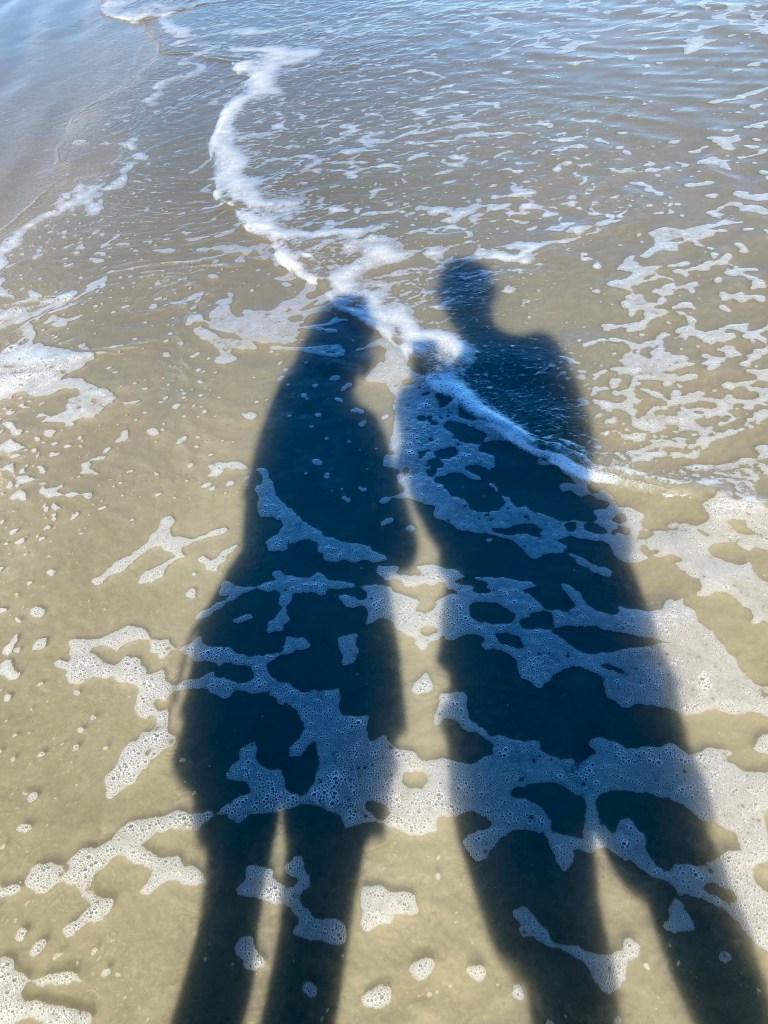
Shadows on the waves
frozen on the phone moments
caught once forever

Here is Mr. Poe’s poem.

A Dream within a Dream

Take this kiss upon the brow!
And, in parting from you now,
Thus much let me avow —
You are not wrong, who deem
That my days have been a dream;
Yet if hope has flown away
In a night, or in a day,
In a vision, or in none,
Is it therefore the less gone?
All that we see or seem
Is but a dream within a dream.

I stand amid the roar
Of a surf-tormented shore,
And I hold within my hand
Grains of the golden sand —
How few! yet how they creep
Through my fingers to the deep,
While I weep — while I weep!
O God! Can I not grasp
Them with a tighter clasp?
O God! Can I not save
One from the pitiless wave?
Is all that we see or seem
But a dream within a dream?

11.22.2023 – ataraxia

ataraxia
understand what can be and
what can’t be controlled

Today in the Guardian, Brigid Delaney, a onetime columnist for Guardian Australia, posted the story, Six ways to make your life easier and more peaceful – by using stoic principles asked the question:

… how could I still be informed while staying sane? Could I feel at peace when there seemed be an increasing amount of global instability?”

And she answered, “Then, I discovered the ancient Greek and Roman philosophy of stoicism.

According to wikipedia, “Stoicism is a school of Hellenistic philosophy that flourished in Ancient Greece and Ancient Rome. The Stoics believed that the practice of virtue is enough to achieve eudaimonia: a well-lived, flourishing life. The Stoics identified the path to achieving it with a life spent practicing certain virtues in everyday life such as courage or temperance and living in accordance with nature.”

The article was interesting and worth the 5 minutes that the website decided it might take me to read it.

I really liked her section being relaxed.

Relaxed is something I have always aspired to.

Relaxation is something I rarely find.

I guess I should have been a runner.

Not a jogger.

But a runner.

A sprinter.

As Sam Mussabini says in the movie, Chariots of Fire, “... a short sprint is run on nerves. It’s tailor-made for neurotics.

Ms. Delaney writes under the heading, Be Relaxed:

The Greeks had a word for the state of mind we need to cultivate to remain calm: ataraxia.

Ataraxia is a state where you are free from distress and worry. Ancient philosophers believed achieving ataraxia created an emotional homeostasis, where the effect wouldn’t just be a more stable base-level mood, but one that would hopefully flow out to the people around you.

If you are more tranquil, you will be less likely to react or combust if something doesn’t go your way.

Imagine that your flight is delayed because of bad weather. You could react and take out your anger and frustration on the airline staff (who have no power to change the weather) or you could accept that the situation is out of your control – and remain calm and chilled.

With ataraxia, not only do you not ruin your own day, you avoid ruining other people’s too. In a tranquil state you may even make better decisions.

Ideally, someone in a state of ataraxia is not gripped by high emotions – such as lust, envy or fear. Rather, they have used the control test to understand what they can control, and what they can’t.

I had to look up how ataraxia is pronounced.

Say anorexia but swap Atar for Anor and you’ve got it.

Can’t wait until I tell someone I am embracing ataraxia and wait for them to want to check my weight.

I really like that last sentence.

Ideally, someone in a state of ataraxia is not gripped by high emotions – such as lust, envy or fear. Rather, they have used the control test to understand what they can control, and what they can’t.

More to the point, the last part of the last sentence.

understand what they can control, and what they can’t.

I am not sure that those Stoic fellers in ancient Greece ever met Dutch people.

I won’t say that the Dutch part of me isn’t happy unless I am worrying about something whether I can control that thing or not but I will say, it sure feels like it sometime.

If nothing else to worry about, there is the weather.

And if the weather is nice, then, like the joke goes, Calvinism is the concern that someone somewhere in the world is having a good time.

Ataraxia.

understand what they can control, and what they can’t.

In his book, That Time of Year (Arcade Publishing, New York, 2020), Garrison Keillor wrote:

My classmate Margaret Keenan, who became a psychiatrist and psychoanalyst. She didn’t claim to heal people but to lead them toward some sort of understanding. I never heard her speak with contempt or derision about anyone, not even Death, whom she saw coming a long way off and met with serenity.

She didn’t claim to heal people but to lead them toward some sort of understanding.

That, for me, was about the best description of therapy I had ever read.

Lead them toward some sort of understanding.

And one of those things needed to be understood is what we can control and what we can’t.

Accept that the situation is out of your control – and remain calm and chilled.

I am not good at this.

Also if I am making that effort to remain calm and chill, forces outside my control seem to demand that I make an effort at gaining control of out of control situations whether such control is possible or not or maybe even if advisable or not.

Sometimes a level of plausible deniability is a good thing.

But I want to try.

And I will try.

I will shoot for achieving ataraxia.

A level of ataraxia that creates an emotional homeostasis, where the effect wouldn’t just be a more stable base-level mood, but one that would hopefully flow out to the people around me.

Ataraxic I guess.

Why not?

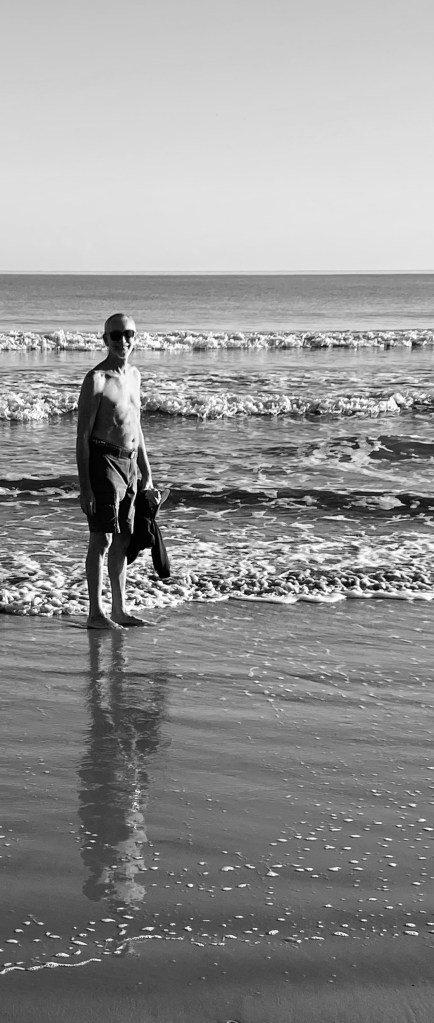
Hey, after the beach, who wants to go for a beer?

Just a November Day in the Low Country and looking ataraxic!

11.21.2023 – true believers just

true believers just
don’t see things the way they are
because if they did …

Belief is a virus, and once it gets into you, its first order of business is to preserve itself, and the way it preserves itself is to keep you from having any doubts, and the way it keeps you from doubting is to blind you to the way things really are.

Evidence contrary to the belief can be staring you straight in the face, and you won’t see it…

True believers just don’t see things the way they are, because if they did, they wouldn’t be true believers anymore.

Philip Caputo in Acts of Faith, Vintage, 2005.

I am not pointing any fingers at anyone who anyone might be thinking of when they think of anyone who thinks they are the True believers.

Far be it from me to suggest that anyone who might be able support the candidacy of a person who is, shall we say, under the cloud of some 90 plus criminal indictments and at the same time is making a public claim of fraud where over 60 court cases have investigated and found no fraud, truly must be believing something.

To paraphrase Mr. Caputo, evidence contrary to the belief can be staring them straight in the face, and they won’t see it.

The act of not seeing marks them as the true believers far more accurately than anything I could accomplish with a little finger pointing.