12.15.2023 – into the winter

into the winter
night as if we heard the sound
of far-off trumpets

Every year, on the night before Christmas, or sometimes on the last Sunday night before Christmas, the tallest balsam that could be got into the church was erected on the raised platform where the choir ordinarily sat, and it was covered with homemade decorations: looped chains made of colored paper, white popcorn threaded on long strings, tinsel stars, metal clips holding lighted candles, and so on.

We had no electric lights for Christmas trees in those days; we simply used candles with open flames, burning within inches of drying evergreen needles, and the fire hazard must have been considerable.

I should think a few houses would have burned down every year, but it never seemed to happen. Anyway, the church was filled with people.

It was imperfectly lighted, and its interior seemed immense, larger than life, dominated by the great tree that reached up to the shadows just beneath the rafters, its tiny flames all twinkling. Just to be in the place was to partake of a mystery.

The services were extremely simple.

There were carols, prayers, readings of the gospel story of the first Christmas, a few quiet remarks bv the minister, distribution of candy canes and molasses-and-popcorn balls to the small children, and a final hymn: and when the wheezy organ (pumped vigorously by a sweating young man behind a screen) sounded off with “Joy to the World,” and the doors opened to let us out into the winter night, it was as if we heard the sound of far-off trumpets.

From Waiting for the Morning Train by Bruce Catton.
Not sure how old I was, 9 or 10, but one day my grandfather came in the back door of our house asking for me.

It had to be a Friday as it was on Friday night that my Grandpa and Grandma Hendrickson, my Mom’s parents, came to ‘pay a call’ on our family.

Every once in awhile my Dad might try to arrange a date night with my Mom since he knew they were coming, but most often we would just sit and visit and watch TV.

But this night, Grandpa Hendrickson came in asking for me.

He had a book for me.

He said that their church library was throwing out a bunch of books and he rescued one volume that was a book on the Civil War.

He said that he had a grandson who would want that book so they gave it to him.

I was, as I said, about 9 or 10.

Grandpa called for me when they walked in and with some satisfaction handed me a battered copy of Mr. Lincoln’s Army by Bruce Catton.

It was the first Catton book I ever read.

It was the first ‘adult book with chapters’ I ever owned.

I still have it.

The book was most likely over my head at the time and as it started out medias-res it screwed up my timing of the Civil War for years.

But the stories told and the way Catton told them have stayed with me forever.

I have a very solid memory of one summer when late at night, my older brother, Jack, read me the chapter on Crackers and Bullets.

Catton’s words were magic and magically arranged.

I know that my Grandpa’s gift made a big impression on me and maybe shaped my future.

I never ever doubted there was a book I couldn’t read after that.

It also made a big impression on my Mom and she remembered it.

See Bruce Catton grew up in Michigan, up in Benzonia (in Upper Lower Michigan) before he was a world famous Pulitzer prize winning author and Editor the American Heritage magazine of history.

My Mom remembered that Mr. Catton had written that book the her Dad had given to me.

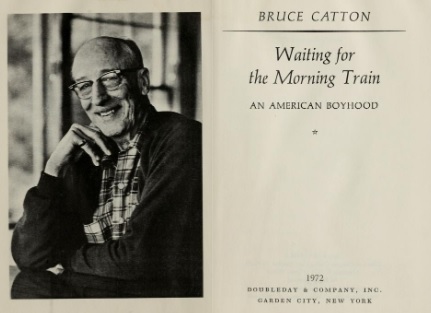
Later in 1972, Mr. Catton came out with his autobiography titled, Waiting for the Morning train: A Michigan Boyhood.

At least that was the title when it was first released.

Later editions changed it to An American Boyhood but us Michigander’s knew the truth.

Mom knew that the book was the perfect Christmas present for her Dad and she picked up a copy.

Sorry to say that my Grandpa died that year in the middle of December, just before Christmas.

My Mom came up to me some time after Christmas with the book in her hands.

She said she had bought it for Grandpa but it seemed appropriate that I should have it.

I got the book and I got a hug.

And I got a book that she had inscribed to her father.

Thanking him for all the years of love and the interest in Mike.

That Mike she wrote about was me.

She signed it, ‘with love, LorraineChristmas 1972

I still have that book too.

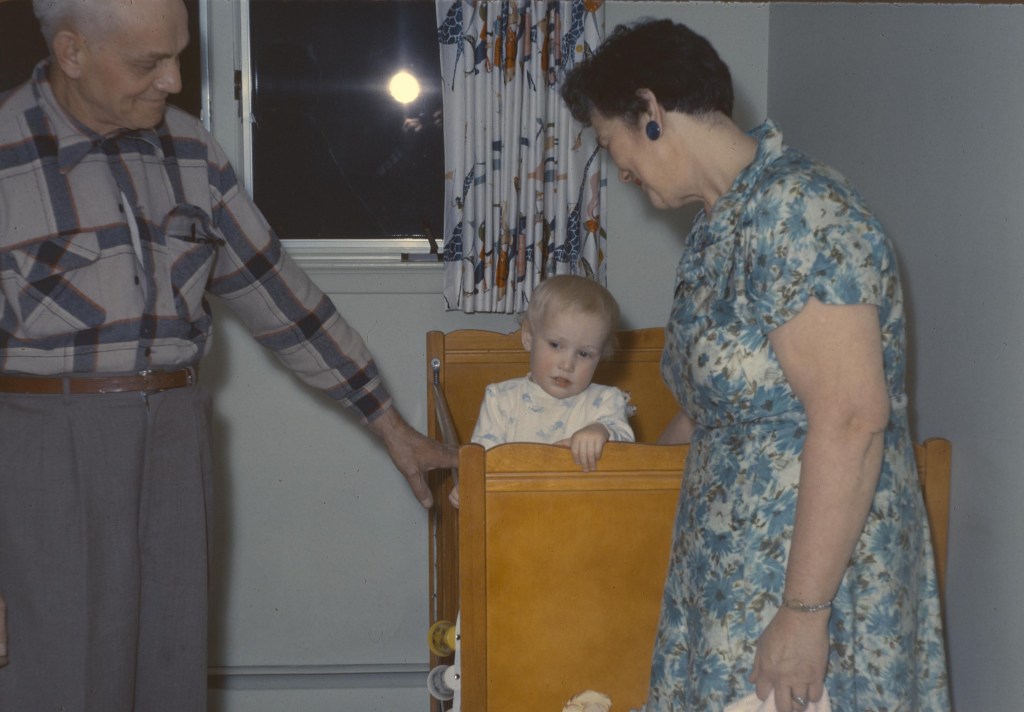
(Me and my Grandparents a few years before this story.)
12.13.2023 – words muddled effect

words muddled effect
on my mind seldom caused
any afterthoughts

Adapted from, “There was no doubt that I had a fondness for books — especially old ones. But my reading was desultory and unassimilative. Words made a muddled effect on my mind while I was busy among them, and they seldom caused any afterthoughts. I esteemed my books mostly for their outsides. I admired old leather bindings, and my fancy was tickled by the thought of firelight flickering on dim gilt, autumn-coloured backs—rows and rows of them, and myself in an arm-chair musing on the pleasant names of Addison and Steele, Gibbon and Goldsmith. And what wonderful bargains were to be discovered in the catalogues of second-hand booksellers at Birmingham!”

In Memoirs of a Fox-hunting Man (The Memoirs of George Sherston #1) by Siegfried Sassoon, Doubleday, Doran & Company, Inc., 1928.

For me, words make a muddled effect on my mind while I am busy among them, and they often cause afterthoughts.

My problem is remembering what I read and where.

Desultory?

No sir.

Unassimilative?

Nope.

Fondness?

Guilty!

12.6.2023 – in a hat, drinking

in a hat, drinking
sherry, reading poems, dream
long long dreams of youth

Daise Terry
North Brookline, Maine
14 December, 1938

Dear Miss Terry

Would you have your office order me a copy of “Last Poems” by A. E. Housman?

I want to give it to Roger for Christmas.

He asked for Housman poems, a bottle of Amontillado, and a top hat.

I can only assume that he is going to sit around in the hat, drinking the sherry, reading the poems, and dreaming the long long dreams of youth.

Yr distant friend
E. B. White

From the Letters of E.B. White by E. B. White, collected and edited by Dorothy Lobrano Guth, 1976, New York : Harper & Row.

I am still dreaming the long long dreams.

Maybe I am younger than I think.

Age loses some objectivity when you move to resort town.

Here where I live in Bluffton, SC, the median age is around 32 and I am far above that.

If I drive out on the Island where I work, the median age goes up to 60 and I am once again, middle aged.

It is a miracle of youth to rival anything found by Ponce de León and not controlled by Prestor John and I can get right back into the dreaming those long long dreams.

Let’s play two!

12.4.2023 – it is silly stuff

it is silly stuff
that has some relevance with
nothing happening

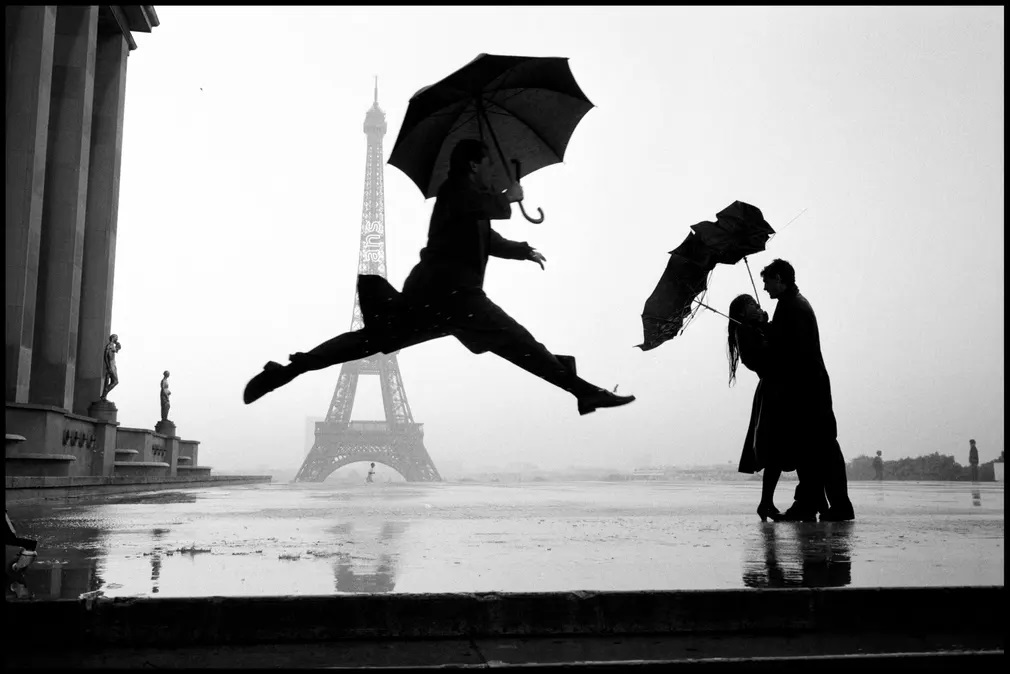
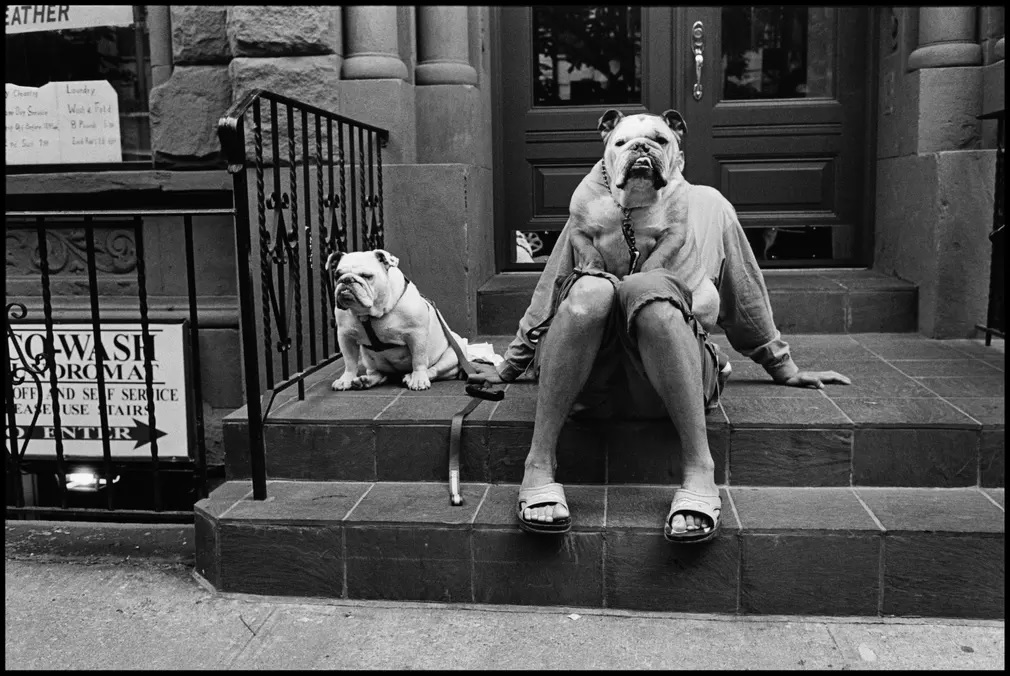
Erwitt downplayed his role as a photographer, often shrugging off pretension or chalking it up to happenstance: “It is silly stuff that I think has some relevance with nothing really important happening, but somehow being able to communicate some kind of fun,” he once said. There’s a lightness of touch that characterises even his most serious images, and he was a master of ironic juxtapositions and comic charm.

From the obit for photographer Elliott Erwitt, Nixon, Monroe and cheeky male buttocks: the soul-affirming photography of Elliott Erwitt, by Charlotte Jansen.

Erwitt worked into his 90s, and was ever practical about his art. “Photography is pretty simple stuff. You just react to what you see, and take many, many pictures,” he told the Guardian in 2020

11.30.2023 – these are tawny days

these are tawny days
bashful mornings hurl gray mist
on stripes of sunrise

These are the tawny days your face comes back
The grapes take on purple the sunsets redden early on the trellis.
The bashful mornings hurl gray mist on the stripes of sunrise.
Creep, silver on the field, the frost is welcome
Run on, yellow halls on the hills, and you tawny
pumpkin flowers, chasing your lines of orange
Tawny days and your face again

Tawny by Carl Sandburg in his book, Smoke and Steel, New York: Harcourt, Brace and Co., (1920).

The website, https://www.vocabulary.com/, defines tawny as an adjective meaning of a light brown to brownish orange color; the color of tanned leather.

The online Merriam-Webster says that tawny is from the Middle English, from Anglo-French tané, tauné, literally, tanned, from past participle of tanner to tan and that the first recorded use of the word is from the 14th century.

The book of Genesis, Chapter 1, verses 2-5 state:

And God said, “Let there be light,” and there was light. God saw that the light was good, and he separated the light from the darkness. God called the light “day,” and the darkness he called “night.” And there was evening, and there was morning—the first day.

For myself, when the Bible reports he separated the light from the darkness, I think that God set up what we know as the planet earth and when he separated the light from the darkness, God gave the planet a push that started it in motion so that on the planet, day was separated from night by the rotation of the planet.

From that moment all laws of what we now know as physics came into play.

Neither here nor there, that means, for me anyway, that God had a timer running as the earth revolved on its axis and when the Bible reports “… the first day”, God knew just what he meant, but I digress.

Anyway, at the end of that first day, the light sank below the horizon and on the morning of the 2nd day the light came up.

I am betting that when that light came, it was a tawny day and anyone who might be there to see it would see that the bashful mornings hurl gray mist on the stripes of sunrise.

My wife is not fond of these sunrise pictures I take with my iPhone because she knows that to take them, I am driving one handed, with my other hand holding my iPhone as I cross the Cross Island Bridge on Hilton Head Island.

I know it’s goofy but what can one do?

We live in the low country and it is flat.

There are few views to be had anywhere.

The Cross Island Bridge is one of few places you can see anything of the area.

And, as Augustus McCrae said the book Lonesome Dove, “, and “…if he missed sunrise, he would have to wait out a long stretch of heat and dust before he got to see anything so pretty.”