3.28.2024 – bellum omnium

bellum omnium
contra omnes, the war
of all against all

From the Praefatio of De Cive or The Philosophicall Rudiments Concerning Government and Society. Or, A Dissertation Concerning Man in his severall habitudes and respects, as the Member of a Society, first Secular, and then Sacred. Containing The Elements of Civill Politie in the Agreement which it hath both with Naturall and Divine Lawes. In which is demonstrated, Both what the Origine of Justice is, and wherein the Essence of Christian Religion doth consist. Together with The Nature, Limits and Qualifications both of Regiment and Subjection By Thomas Hobbes (1642).

… ostendo primo conditionem hominum extra societatem civilem, quam conditionem appellare liceat statum naturae, aliam non esse quam bellum omnium contra omnes; atque in eo bello jus esse omnibus in omnia.

Or in english* …

… I demonstrate, in the first place, that the state of men without civil society (which state we may properly call the state of nature) is nothing else but a mere war of all against all; and in that war all men have equal right unto all things.

The state of men without civil society (which state we may properly call the state of nature) is nothing else but a mere war of all against all.

And in that war all men have equal right unto all things.

A state of nature were all have equal rights to all.

A mere war against all against all.

Mr. Hobbs wrote that in 1642.

Today we all got a gun.

Someone better say a prayer for our democracy.

*BTW it is recorded in History that Judge Augustus Woodward wrote the Territorial Constitution of the Territory of Michigan in Latin and when folks complained he reissued it with two columns. Latin on the left and English on the right with the sub heading, ‘For the lesser Educated.’ Judge Woodward (as in Woodward Avenue in Detroit) went on to found what became the University of Michigan.

3.27.2024 – imagination

imagination
and sentiment delimit
the novelist’s realm

Imagination and sentiment, which quite properly delimit the dimensions of the novelist’s realm, are a dangerous medium, however, through which to approach the subject of battle.

Historians, traditionally and rightly, are expected to ride their feelings on a tighter rein than the man of letters can allow himself.

From The Face of Battle by John Keegan, Pimlico, 2004.

Historians, traditionally and rightly, are expected to ride their feelings on a tighter rein than the man of letters can allow himself.

Hmmmmmmm.

Imagination and sentiment, which quite properly delimit the dimensions of the novelist’s realm, are a dangerous medium, however, through which to approach the subject of battle.

Hmmmmmmmm.

It happened so with a group of Sheridan’s scouts, who captured a Captain Stump, famous as a Rebel raider, a man they had long been seeking. He had been wounded, and when he was caught they took his weapons away and brought him to Major Young, who commanded the scouts, and Major Young had a certain respect for this daring guerilla, so he told him:

“I suppose you know we will kill you. But we will not serve you as you have served our men—cut your throat or hang you. We will give you a chance for your life. We will give you ten rods’ start on your own horse, with your spurs on. If you get away, all right… . But remember, my men are dead shots.”

Captain Stump was bloody and he had been hurt, but he was all man. He smiled, and nodded, and rode a few feet out in front of the rank of his captors—skinny young men, 130 pounds or less, unmarried, the pick of the Yankee cavalry. Major Young looked down the rank, and called out: “Go!”

A cavalryman wrote about it afterward:

“We allowed him about ten rods’ start, then our pistols cracked: and he fell forward, dead.”

From A Stillness at Appomattox by Bruce Catton.

According to Wikipedia, Oliver Jensen, who succeeded Catton as editor of American Heritage, wrote that “No one ever wrote American history with more easy grace, beauty and emotional power, or greater understanding of its meaning, than Bruce Catton… There is a near-magic power of imagination in Catton’s work [that] almost seemed to project him physically onto the battlefields, along the dusty roads and to the campfires of another age.”

There is a near-magic power of imagination in Catton’s work that while it traditionally and rightly, is expected to ride their feelings on a tighter rein than the man of letters can allow himself, imagination and sentiment, seems to project him physically onto the battlefields, along the dusty roads and to the campfires of another age.

3.26.2024 – spectracality

spectracality
dream-like nature of enriched
acute sensations

This life-long, almost physical sensation of the spectracality and dream-like nature of life was enriched also from another set of morbidly acute sensations. Carlyle’s exacerbated sense of hearing made him acutely sensitive to sound; and perhaps no writer since the Hebrew prophets made such constant use of audible sensations in the phrases and metaphors of his writing.

From THE REMBRANDT OF ENGLISH in Reperusals and Re-collections Logan Pearsall Smith, Published by Harcourt Brace and Company. First American edition, New York, 1937.

A collection of nineteen essays, many first published in the Times Literary Supplement and New Statesman; subjects include: Proust’s first novel, Jane Austen, Montaigne, English aphorists, Gertrude Jekyll and Sainte-Beuve.

The Rembrandt of English is about Thomas Carlyle.

I like any word that make spell check check and spectracality or the quality of being spectral or ghostly did on my spell check.

The idea that he was acutely sensitive to sound; and perhaps no writer since the Hebrew prophets made such constant use of audible sensations in the phrases and metaphors of his writing find fascinating.

I will have to take another crack at Mr. Carlyle.

There are some movies I watch just to hear and watch the actors act.

There are some passages I read just to hear the words.

This passage from Huck Finn comes to mind.

We catched fish, and talked, and we took a swim now and then to keep off sleepiness.

It was kind of solemn, drifting down the big still river, laying on our backs looking up at the stars, and we didn’t ever feel like talking loud, and it warn’t often that we laughed, only a kind of low chuckle.

We had mighty good weather, as a general thing, and nothing ever happened to us at all, that night, nor the next, nor the next.

If I could write something close to the majesty of these slow words read out loud I would feel I wouldn’t have to ever do anything again.

After that, well sir, nothing ever happened to us at all.

3.25.2024 – substantially blots

substantially blots
out skepticism, reason
and criticism

That intensity of emotion, and the way it substantially blots out skepticism, criticism, and reason, explains a pathological technology’s persistence across time: it endures because rational thought is virtually powerless against it. The potent force of emotion also explains the third defining characteristic of a pathological technology: its proponents regularly and systematically underplay its downsides, risks, unintended negative consequences, and even blatantly obvious dangers.

Thus began the Delirium.

The Delirium was a mass hallucination, shared psychosis, or induced delusional disorder. This strange phenomenon amounted to a nationwide folie à deux*, one that affected all age groups, both sexes, and all classes of society: rich and poor, rustics and urbanites, royals and commoners. It was as if a universal mass drugging had occurred.

What a marvelous parade of words!

Now, guess …

Go on.

Go on and guess what the title of the book is where that passage came?

Guess the topic if the title is too hard.

Give up?

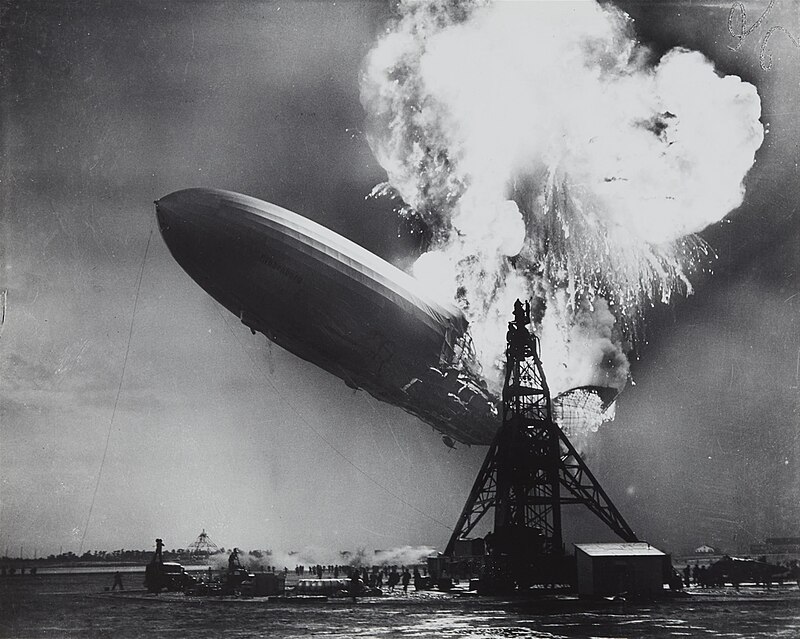
I was reading Monsters: The Hindenburg Disaster and the Birth of Pathological Technology by Edward Regis, Basic Books, September 8, 2015

Mr. Regis, through the story of dirigibles, an airship this is lighter-than-air aircraft that can navigate through the air under its own power, tells the story of Pathological Technology or bad ideas that keep going.

More specifically, German dirigibles, or Zeppelins, named for their Chief designers and cheerleader Count Ferdinand von Zeppelin.

Mr. Regis points at that almost all Zeppelins ever built, caught fire, exploded and burned.

Yet Germany as a whole was sized by a delirium that kept Zeppelins flying until the Hindenburg caught fire, exploded and crashed.

Yes, Zeppelins were used as bombers in Word War I, about which Winston Churchill remarked, “I rated the Zeppelin much lower as a weapon of war than almost anyone else. I believed that this enormous bladder of combustible and explosive gas would prove to be easily destructible.”

When Great Britain experiment with 2 Dirigibles of there own before giving up after they both crashed, Rear Admiral Sir Doveton Sturdee, checked over the wreckage, and said : “The work of an idiot!

But it took another 20 years and the crash of the Hindenburg before the German People would give up there Zeppelins.

Delerium.

What a great word.

A great word to describe what this Country is going through right now.

A Delirium.

A mass hallucination, a shared psychosis, or induced delusional disorder.

A strange phenomenon amounting to a nationwide folie à deux, one that has affected all age groups, both sexes, and all classes of society: rich and poor, rustics and urbanites, royals and commoners.

As if a universal mass drugging has occurred.

*shared psychosis or shared delusional disorder 

3.23.2024 – quiet⁠ — and yet a

quiet⁠ — and yet a
voice forever against the
timeless walls of time

Let’s go see old Abe
Sitting in the marble and the moonlight,
Sitting lonely in the marble and the moonlight,
Quiet for ten thousand centuries, old Abe.
Quiet for a million, million centuries.
Quiet⁠ — and yet a voice forever
Against the timeless walls of time,
Old Abe.

Lincoln Monument from Poetry. compiled from poems published between 1921 and 1928 by Langston Hughes.