3.2.2024 – further furthermore

further furthermore
moreover meanwhile and
additionally

This morning I read the article, ‘We knew this was coming’: western US hunkers down amid avalanche warnings and gale-force winds” by Nina Lakhani and Dani Anguiano in the Guardian (March 1, 2024) and I got hung up by the quote from the National Weather Warning that stated:

There is a high chance (over 70%) of substantial, long-lasting disruptions to daily life in the higher elevations of the Sierra Nevada Mountains Friday-Saturday, where blizzard conditions and 5+ feet of snow are expected.

I liked the idea of … a high chance of substantial, long-lasting disruptions to daily life … through Saturday.

And I wrote this haiku:

high chance substantial,
long-lasting disruptions to
daily life expected

I guess that it means that the substantial, long-lasting disruptions to daily life could HAPPEN through Saturday but the substantial, long-lasting disruptions to daily life could LAST much longer than just through the weekend.

On the other hand, my wife pointed out that 24 to 48 hour power/cellphone/internet/TV outage WAS a substantial, long-lasting disruption to daily life for a lot of people today.

I went and read the complete Short Range Public Discussion Weather Statement from the NWS.

As this blog and these haiku are meant to be about words, I have to take my hat off and applaud those folks at the National Weather service for the all inclusive text in their Short Range Public Discussion.

The Short Range Public Discussion consists of 4 bullet points and seven paragraphs.

The first paragraph starts out with, “A second winter storm will impact the West Coast …”

The following six paragraphs start as follows:

Furthermore, the storm will …

Moreover, in addition to …

In addition, the …

Further, cold air will …

Meanwhile, upper-level energy …

And finally, Additionally, upper-level energy moving …

With a “Also, on Friday …” tucked into the last paragraph.

I don’t know but there something hypnotic, something Shakespearian, like a bass note in a Bach fugue as each new aspect of this storm is introduced into the Short Range Public Discussion of the weather.

I can easily imagine it as a rant of someone in a movie or tv show spouting off on all the things that went wrong on their weekend off.

It was Oscar Wilde who said, “Conversation about the weather is the last refuge of the unimaginative.”

Well!

Mr. Wilde never met the United States National Weather Service.

PS – OH AND, here is the complete Short Range Public Discussion as it appeared on Thursday, February 29, 2024 at 2:58AM (EST).

Short Range Forecast Discussion
NWS Weather Prediction Center College Park MD
258 AM EST Thu Feb 29 2024

Valid 12Z Thu Feb 29 2024 – 12Z Sat Mar 02 2024

…Heavy snow over parts of the Cascades, the Northern Intermountain

Region, Northern Rockies, Northern California, and Sierra Nevada
Mountains…

…Heavy lake-effect snow southeast of Lake Ontario and over the Upper
Great Lakes…

…Rain from the Gulf Coast to parts of northern Mid-Atlantic and shower
and thunderstorms along the Central Gulf Coast and Southeast…

A second winter storm will impact the West Coast on Thursday and Friday. The storm will create heavy mountain snow that will affect many passes. Multiple feet of snow are likely (over 80% chance) for higher elevations, especially above 5000 feet, including many Cascade and Sierra Nevada Mountain passes. Extremely heavy snow rates surpassing 3 inches per hour are likely.

Furthermore, the storm will produce blizzard conditions in the Sierra Nevada Mountains. In detail, strong winds will cause significant blowing/drifting snow and whiteout conditions, making travel impossible in the Sierra Nevada Mountains. There is a high chance (over 70%) of substantial, long-lasting disruptions to daily life in the higher elevations of the Sierra Nevada Mountains Friday-Saturday, where blizzard conditions and 5+ feet of snow are expected.

Moreover, in addition to the snow, coastal rain will develop over parts of the Pacific Northwest Thursday into Saturday. Coastal rain will develop over parts of California Thursday morning, continuing into Saturday.

In addition, the widespread damaging wind will develop over the Western U.S. Wind gusts of 55+ mph are forecasted across much of the West, particularly across higher elevations and the Intermountain West, where 75+ mph gusts are possible. These winds would likely down trees and power lines, resulting in power outages across affected areas.

Further, cold air will lower snow levels Friday into Saturday. As the storm moves south, snow levels will lower into some Northern California and Sierra Nevada Mountain foothill communities. Much colder air is forecast for Saturday, with temperatures 10-20 degrees below normal.

Meanwhile, upper-level energy moving across the Great Lakes into the Northeast will create lake-effect snow over the northeast portion of the U.P. of Michigan, with the heaviest lake-effect snow southeast of Lake Ontario on Thursday.

Additionally, upper-level energy moving over the Southern Rockies will move eastward to the Mid-Atlantic by Saturday, producing rain and higher-elevation snow over the Southern Rockies Thursday. Overnight Thursday, showers and thunderstorms will develop over parts of the Southern Plains, moving into the Lower Mississippi, Tennessee, and Southern Ohio Valleys and parts of the Southeast by Friday. The showers and thunderstorms will continue over parts of the Southeast through Saturday. On Friday, rain will move into parts of the Mid-Atlantic and Ohio Valley, moving into parts of the Northeast by Saturday. Also, on Friday, scattered pockets of rain/freezing rain will develop over the highest elevations of parts of the Central/Southern Appalachians.
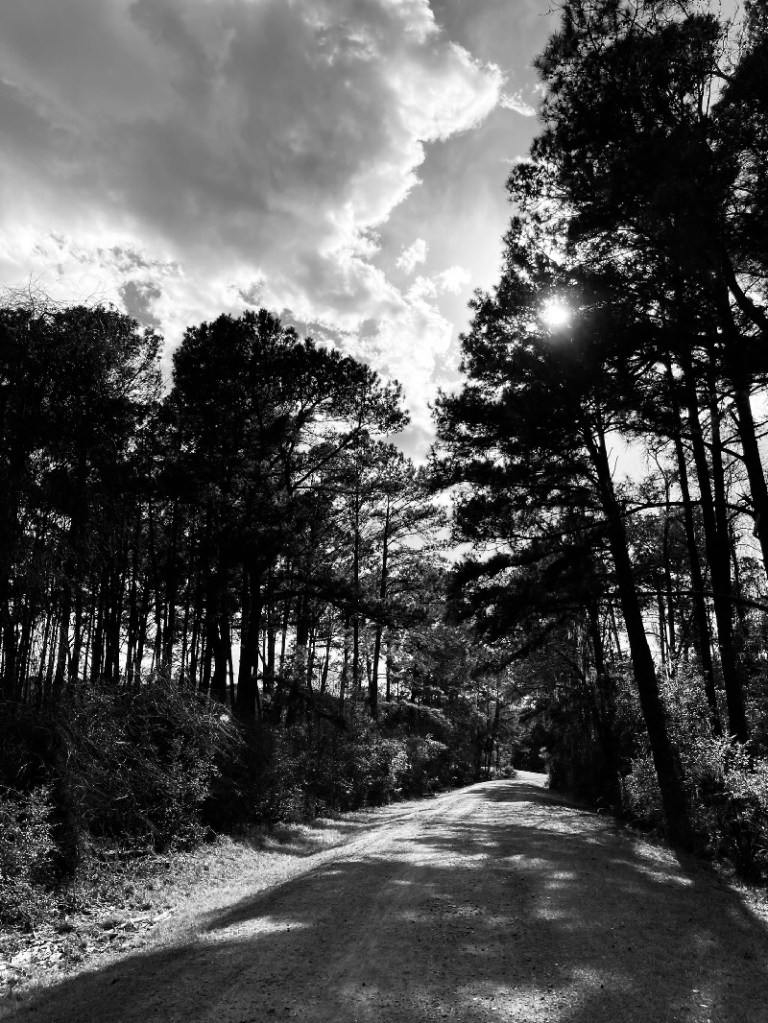
2.26.2024 – last light of the sun

last light of the sun
that had died in the west still
lived for one song more

As I came to the edge of the woods,
Thrush music — hark!
Now if it was dusk outside,
Inside it was dark.

Too dark in the woods for a bird
By sleight of wing
To better its perch for the night,
Though it still could sing.

The last of the light of the sun
That had died in the west
Still lived for one song more
In a thrush’s breast.

Far in the pillared dark
Thrush music went—
Almost like a call to come in
To the dark and lament.

But no, I was out for stars:
I would not come in.
I meant not even if asked,
And I hadn’t been.

Come In by Robert Frost in A Witness Tree, Henry Holt and Company, New York, 1942.

The scene is the island road on Pinckney Island, South Carolina.

The Pinckney Island National Wildlife Refuge is a 4,053-acre (16 km2) National Wildlife Refuge located in Beaufort County, South Carolina between the mainland and Hilton Head Island.

The refuge is one of seven refuges administered by the Savannah Coastal Refuges Complex in Savannah, Georgia.

In a partial review on Wikipedia, Harriet Monroe of Poetry Magazine noted that Frost is most interested in “showing the human reaction to nature’s processes.

But no, I was out for stars:
I would not come in.
I meant not even if asked,
And I hadn’t been.

2.25.2024 – errors from feeble

errors from feeble
interactions can mimic
destructive effects

Yet quantum superpositions are skittish creatures. Measure a qubit in a superposition state and it will collapse to either 0 or 1, wiping out any computation in progress. To make matters worse, errors stemming from feeble interactions between qubits and their environment can mimic the destructive effects of measurement. Anything that rubs a qubit the wrong way, whether it’s a nosy researcher or a stray photon, can spoil the computation.

From Never-Repeating Tiles Can Safeguard Quantum Information by Ben Brubaker, Quanta Magazine, Feb. 24, 2024.

I am not sure what it means either but it sounds really really bad and I really liked how the words rolled out.

On the other hand, I am not sure what other fields from Cooking to Politics to Relationships that the idea, errors stemming from feeble interactions between … (insert field here ie:) Cooking and their environment can mimic the destructive effects.

Anything that rubs a qubit the wrong way, whether it’s a nosy researcher or a stray photon, can spoil the computation.

Well …

Anything that rubs anything the wrong way, whether it’s a nosy researcher or a stray photon, can spoil anything.

2.24.2024 – twice two makes four is

twice two makes four is
an excellent thing, makes five is
sometimes charming too

But man is a frivolous and incongruous creature,

and perhaps, like a chess player,

loves the process of the game,

not the end of it.

And who knows (there is no saying with certainty),

perhaps the only goal on earth to which mankind is striving lies in this incessant process of attaining,

in other words,

in life itself, and not in the thing to be attained, which must always be expressed as a formula,

as positive as twice two makes four,

and such positiveness is not life, gentlemen,

but is the beginning of death.

Anyway,

man has always been afraid of this mathematical certainty,

and I am afraid of it now.

Granted that man does nothing but seek that mathematical certainty,

he traverses oceans,

sacrifices his life in the quest,

but to succeed,

really to find it,

he dreads, I assure you.

He feels that when he has found it there will be nothing for him to look for.

When workmen have finished their work they do at least receive their pay,

they go to the tavern,

then they are taken to the police-station —

and there is occupation for a week.

But where can man go?

Anyway,

one can observe a certain awkwardness about him when he has attained such objects.

He loves the process of attaining,

but does not quite like to have attained,

and that,

of course,

is very absurd.

In fact, man is a comical creature;

there seems to be a kind of jest in it all.

But yet mathematical certainty is after all,

something insufferable.

Twice two makes four seems to me simply a piece of insolence.

Twice two makes four is a pert coxcomb who stands with arms akimbo barring your path and spitting.

I admit that twice two makes four is an excellent thing,

but if we are to give everything its due,

twice two makes five is sometimes a very charming thing too.

From Notes from the Underground by Fyodor Dostoevsky, first published in the journal Epoch in 1864.

It is well documented that when Winston Churchill spoke publicly in the House of Commons, he would have his speeches on paper 8 by 4 inches with a hole punched in the upper corner and a string through the holes to keep the speech in order.

The words would be typed out in short phrases that lent the words to pausing, hesitation and emphasis as Mr. Churchill delivered the speech.

Insiders referred to this style as Churchill’s Psalm form and once you know about it, you cannot help picture the prepared text as you hear the words.

Unconsciously or sub consciously as well as by design, I have adapted this style into my writing of short phrases and sentences.

I don’t know that I could write a paragraph if I had too.

The short  staccato AP style of one line, one thought also lurks in my background especially as the news writing I did the most were with stories that were meant to be READ out loud by a reporter or presenter.

So ends my confessional.

Considering all that, I think this bit of Mr. Dostoevsky’s writing works quite well when read out loud in the fashion in which I present it.

But what is Mr. Dostoevsky saying?

And I ask this in a the latest edition of ‘In a World Gone Crazy’.

And I put it to you that as now, so little makes sense from what it used to mean that truly, twice two makes four is the beginning of death.

And that twice two makes five is sometimes a very charming thing.

But beware of those who tell you twice two makes five.

In the end, it always comes out four.

Boy, Howdy! but man is one frivolous and incongruous creature.

2.23.2024 – wilderness of waves

wilderness of waves,
dip and dive, rise and roll, hide
a desert of waves

The sea is a wilderness of waves,
A desert of water.
We dip and dive,
Rise and roll,
Hide and are hidden
On the sea.
Day, night,
Night, day,
The sea is a desert of waves,
A wilderness of water.

Long Trip by Langston Hughes, in Poetry, compiled from poems published between 1921 and 1928.