3.26.2024 – spectracality

spectracality
dream-like nature of enriched
acute sensations

This life-long, almost physical sensation of the spectracality and dream-like nature of life was enriched also from another set of morbidly acute sensations. Carlyle’s exacerbated sense of hearing made him acutely sensitive to sound; and perhaps no writer since the Hebrew prophets made such constant use of audible sensations in the phrases and metaphors of his writing.

From THE REMBRANDT OF ENGLISH in Reperusals and Re-collections Logan Pearsall Smith, Published by Harcourt Brace and Company. First American edition, New York, 1937.

A collection of nineteen essays, many first published in the Times Literary Supplement and New Statesman; subjects include: Proust’s first novel, Jane Austen, Montaigne, English aphorists, Gertrude Jekyll and Sainte-Beuve.

The Rembrandt of English is about Thomas Carlyle.

I like any word that make spell check check and spectracality or the quality of being spectral or ghostly did on my spell check.

The idea that he was acutely sensitive to sound; and perhaps no writer since the Hebrew prophets made such constant use of audible sensations in the phrases and metaphors of his writing find fascinating.

I will have to take another crack at Mr. Carlyle.

There are some movies I watch just to hear and watch the actors act.

There are some passages I read just to hear the words.

This passage from Huck Finn comes to mind.

We catched fish, and talked, and we took a swim now and then to keep off sleepiness.

It was kind of solemn, drifting down the big still river, laying on our backs looking up at the stars, and we didn’t ever feel like talking loud, and it warn’t often that we laughed, only a kind of low chuckle.

We had mighty good weather, as a general thing, and nothing ever happened to us at all, that night, nor the next, nor the next.

If I could write something close to the majesty of these slow words read out loud I would feel I wouldn’t have to ever do anything again.

After that, well sir, nothing ever happened to us at all.
3.25.2024 – substantially blots

substantially blots
out skepticism, reason
and criticism

That intensity of emotion, and the way it substantially blots out skepticism, criticism, and reason, explains a pathological technology’s persistence across time: it endures because rational thought is virtually powerless against it. The potent force of emotion also explains the third defining characteristic of a pathological technology: its proponents regularly and systematically underplay its downsides, risks, unintended negative consequences, and even blatantly obvious dangers.

Thus began the Delirium.

The Delirium was a mass hallucination, shared psychosis, or induced delusional disorder. This strange phenomenon amounted to a nationwide folie à deux*, one that affected all age groups, both sexes, and all classes of society: rich and poor, rustics and urbanites, royals and commoners. It was as if a universal mass drugging had occurred.

What a marvelous parade of words!

Now, guess …

Go on.

Go on and guess what the title of the book is where that passage came?

Guess the topic if the title is too hard.

Give up?

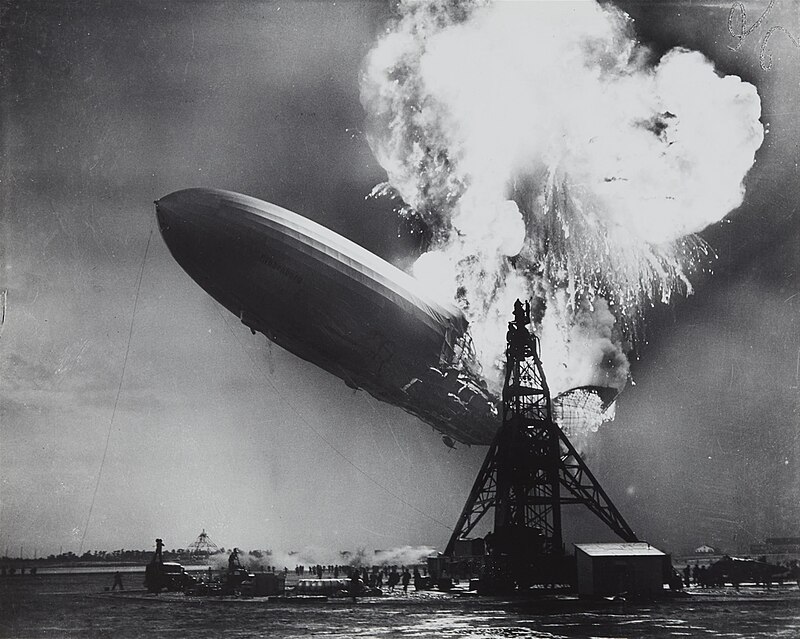
I was reading Monsters: The Hindenburg Disaster and the Birth of Pathological Technology by Edward Regis, Basic Books, September 8, 2015

Mr. Regis, through the story of dirigibles, an airship this is lighter-than-air aircraft that can navigate through the air under its own power, tells the story of Pathological Technology or bad ideas that keep going.

More specifically, German dirigibles, or Zeppelins, named for their Chief designers and cheerleader Count Ferdinand von Zeppelin.

Mr. Regis points at that almost all Zeppelins ever built, caught fire, exploded and burned.

Yet Germany as a whole was sized by a delirium that kept Zeppelins flying until the Hindenburg caught fire, exploded and crashed.

Yes, Zeppelins were used as bombers in Word War I, about which Winston Churchill remarked, “I rated the Zeppelin much lower as a weapon of war than almost anyone else. I believed that this enormous bladder of combustible and explosive gas would prove to be easily destructible.”

When Great Britain experiment with 2 Dirigibles of there own before giving up after they both crashed, Rear Admiral Sir Doveton Sturdee, checked over the wreckage, and said : “The work of an idiot!

But it took another 20 years and the crash of the Hindenburg before the German People would give up there Zeppelins.

Delerium.

What a great word.

A great word to describe what this Country is going through right now.

A Delirium.

A mass hallucination, a shared psychosis, or induced delusional disorder.

A strange phenomenon amounting to a nationwide folie à deux, one that has affected all age groups, both sexes, and all classes of society: rich and poor, rustics and urbanites, royals and commoners.

As if a universal mass drugging has occurred.

*shared psychosis or shared delusional disorder 

3.23.2024 – quiet⁠ — and yet a

quiet⁠ — and yet a
voice forever against the
timeless walls of time

Let’s go see old Abe
Sitting in the marble and the moonlight,
Sitting lonely in the marble and the moonlight,
Quiet for ten thousand centuries, old Abe.
Quiet for a million, million centuries.
Quiet⁠ — and yet a voice forever
Against the timeless walls of time,
Old Abe.

Lincoln Monument from Poetry. compiled from poems published between 1921 and 1928 by Langston Hughes.

3.21.2024 – trying to escape

trying to escape,
and as you know, this is no
world for escapists

The Rabbits Who Caused All the Trouble


Within the memory of the youngest child there was a family of rabbits who lived near a pack of wolves. The wolves announced that they did not like the way the rabbits were living. (The wolves were crazy about the way they themselves were living, because it was the only way to live.) One night several wolves were killed in an earthquake and this was blamed on the rabbits, for it is well known that rabbits pound on the ground with their hind legs and cause earthquakes. On another night one of the wolves was killed by a bolt of lightning and this was also blamed on the rabbits, for it is well known that lettuce-eaters cause lightning. The wolves threatened to civilize the rabbits if they didn’t behave, and the rabbits decided to run away to a desert island. But the other animals, who lived at a great distance, shamed them, saying, “You must stay where you are and be brave. This is no world for escapists. If the wolves attack you, we will come to your aid, in all probability.” So the rabbits continued to live near the wolves and one day there was a terrible flood which drowned a great many wolves. This was blamed on the rabbits, for it is well known that carrot-nibblers with long ears cause floods. The wolves descended on the rabbits, for their own good, and imprisoned them in a dark cave, for their own protection.

When nothing was heard about the rabbits for some weeks, the other animals demanded to know what had happened to them. The wolves replied that the rabbits had been eaten and since they had been eaten the affair was a purely internal matter. But the other animals warned that they might possibly unite against the wolves unless some reason was given for the destruction of the rabbits. So the wolves gave them one. “They were trying to escape,” said the wolves, “and, as you know, this is no world for escapists.”

Moral: Run, don’t walk, to the nearest desert island

By James Thurber as published in The Thurber Carnival, Random House, New York, NY, 1957

3.20.2024 – to reawaken

to reawaken
keep ourselves awake by
dawn’s expectations

We must learn to reawaken and keep ourselves awake, not by mechanical aids, but by an infinite expectation of the dawn, which does not forsake us in our soundest sleep.

I know of no more encouraging fact than the unquestionable ability of man to elevate his life by a conscious endeavor.

It is something to be able to paint a particular picture, or to carve a statue, and so to make a few objects beautiful; but it is far more glorious to carve and paint the very atmosphere and medium through which we look, which morally we can do.

To affect the quality of the day, that is the highest of arts.

Every man is tasked to make his life, even in its details, worthy of the contemplation of his most elevated and critical hour.

If we refused, or rather used up, such paltry information as we get, the oracles would distinctly inform us how this might be done.

Henry David Thoreau in the book, Walden, from the Oxford University Press Edition, Oxford University Press, Great Clarendon Street, Oxford, 1997.

Nope, not going to tell the joke.

I’ll just tell you the punch line.

“Ralph, what are you doing OUT there?”

The joke is about Ralph Waldo Emerson, another of these three barreled named fellers that populated New England literature, talking to Henry David Thoreau (see) about being in jail.

Most folks, I think, have heard of Thoreau but I am pretty sure they don’t know why anymore.

With a little agitation of folks memories, they might just remember that Thoreau went to jail.

But I am pretty sure they don’t know why.

Back in the day, citizens had to pay a poll tax for the right to vote and whether they voted or not, the tax had to be paid.

At the time the United States of America was at war with Mexico over Texas which, as an independent country was looking to ban slavery so them fellers in the US Government who came from the south and who didn’t want a new, none slave holding country on the border, decided the United States should take Texas in as a State, a slave holding State and to do so, Mexico had to be warred off.

Anyway, Mr. Thoreau was against the war and any war at that, so he refused to pay his poll tax and spent the night in jail.

The people of the town of Concord were pretty upset that such a public defiance was taking place in their town so the folks who had some influence got on the case of Mr. Emerson who was famous for being famous and saying famous things before anyone else said them and Mr. Emerson went down to the jail and asked Mr. Thoreau, “Henry, what are doing in there?”

I have already told you Mr. Thoreau’s response.

It got me to thinking, all these folks with a burr up their butt about something that they don’t like that they US Government has done or is doing.

Well Sir, if they are so mad and so sure of their protest, let them stop paying their taxes.

As Mr. Thoreau might say, “I know of no more encouraging fact than the unquestionable ability of man to elevate his life by a conscious endeavor. “

Set let them folks make a conscious endeavor to elevate their argument not through news sound bites and social media posts but in defiance of the government by not paying taxes.

To affect the quality of the day, that is the highest of arts.

Yeahhhhhhhhhhhhhhh sure.

Somehow, I don’t think this is what Mr. Thoreau meant when he wrote these thoughts down.

But that is where I am today I guess.

Every man is tasked to make his life, even in its details, worthy of the contemplation of his most elevated and critical hour.