we, we shall be as a city upon a hill all eyes are on us
We shall be as a city upon a hill, the eyes of all people are upon us.
According to Wikipedia, this phrase was cited at the end of Puritan John Winthrop’s lecture or treatise, “A Model of Christian Charity” delivered on March 21, 1630, at Holyrood Church in Southampton, before his first group of Massachusetts Bay colonists embarked on the ship Arbella to settle Boston.
In quoting Matthew’s Gospel (5:14) in which Jesus warns, “a city on a hill cannot be hid,” Winthrop warned his fellow Puritans that their new community would be “as a city upon a hill, the eyes of all people are upon us”, meaning, if the Puritans failed to uphold their covenant with God, then their sins and errors would be exposed for all the world to see: “So that if we shall deal falsely with our God in this work we have undertaken and so cause him to withdraw his present help from us, we shall be made a story and a byword through the world.”
We shall be as a city upon a hill, the eyes of all people are upon us.
The eyes of all people are upon us.
Still trying to get there.
That was first said in relation to this country or the beginnings of this country in 1630.
In 1961, JFL said, “History will not judge our endeavors—and a government cannot be selected—merely on the basis of color or creed or even party affiliation. Neither will competence and loyalty and stature, while essential to the utmost, suffice in times such as these. For of those to whom much is given, much is required ...”
Ronald Reagan said in 1980″… visitors to that city on the Potomac do not come as white or black, red or yellow; they are not Jews or Christians; conservatives or liberals; or Democrats or Republicans. They are Americans awed by what has gone before, proud of what for them is still… a shining city on a hill.”
Still a hard road with lots of mistakes.
In 2006, Barack Obama said, “I look out at a sea of faces that are African-American and Hispanic-American and Asian-American and Arab-American. I see students that have come here from over 100 different countries, believing like those first settlers that they too could find a home in this City on a Hill—that they too could find success in this unlikeliest of places.”
We shall be as a city upon a hill, the eyes of all people are upon us.
our time has seen that impulse going to war – seen the circle complete
North and South they assembled, one cry and the other cry, And both are ghosts to us now, old drums hung up on a wall, But they were the first hot wave of youth too-ready to die, And they went to war with an air, as if they went to a ball.
Dress-uniform boys who rubbed their buttons brighter than gold, And gave them to girls for flowers and raspberry-lemonade, Unused to the sick fatigue, the route-march made in the cold, The stink of the fever camps, the tarnish rotting the blade.
We in our time have seen that impulse going to war And how that impulse is dealt with. We have seen the circle complete. The ripe wheat wasted like trash between the fool and the whore. We cannot praise again that anger of the ripe wheat.
This we have seen as well, distorted and half-forgotten In what came before and after, where the blind went leading the blind, The first swift rising of youth before the symbols were rotten, The price too much to pay, the payment haughty in kind.
So with these men and then. They were much like the men you know, Under the beards and the strangeness of clothes with a different fit. They wrote mush-notes to their girls and wondered how it would go, Half-scared, half-fierce at the thought, but none yet ready to quit.
From John Brown’s Body by Stephen Vincent Benét, (Garden City, N. Y., Doubleday, Doran and Company, 1928).
That line there about the flowers.
About the flowers and raspberry lemonade.
Painting with words and scents and tastes in a way that anyone can feel it.
Not imagine it, but feel it.
The cool glass, the sweet liquid on the tongue, the smell of the flowers and pretty girls.
Back in the day when I worked in the Public Library I was cataloging a small collection of letters of one Byron Root Piece.
Dr. Pierce was a Dentist in Grand Rapids, Michigan back in the 1860’s.
I have always been attracted to Dr. Pierce as my Dad was also a Dentist from Grand Rapids, Michigan and ended up a Dentist in the Army of the United States in World War 2.
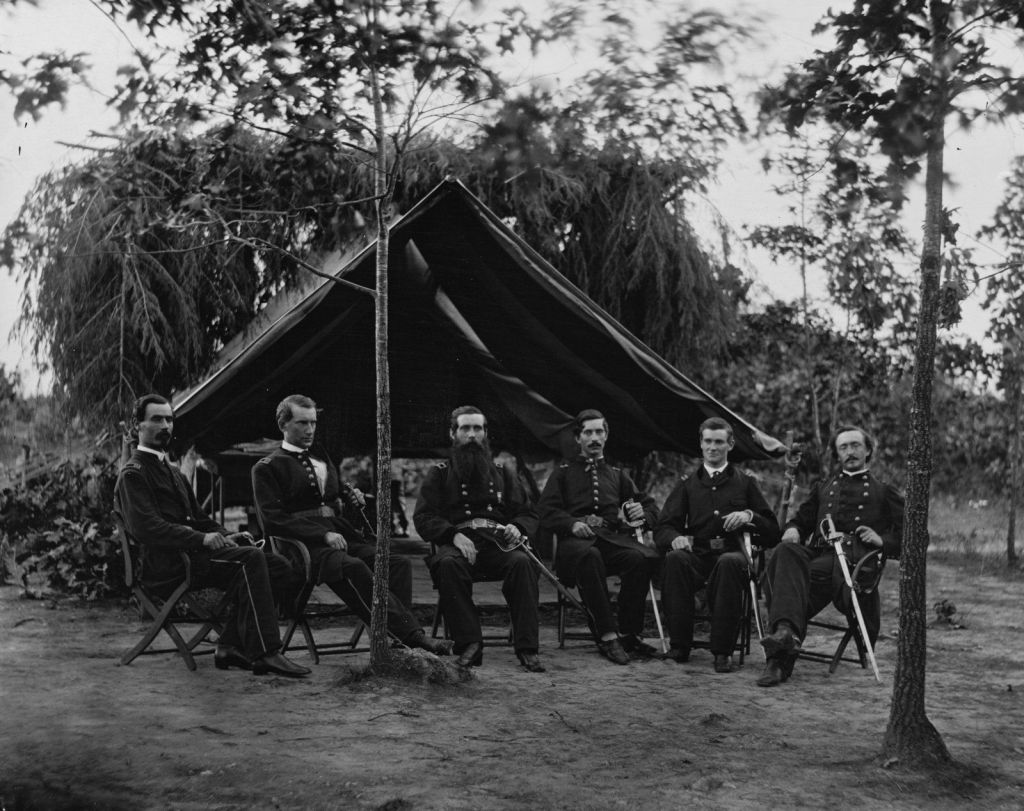
Dr. Pierce was also a captain of a militia company, the Valley City Light Guard and when Mr. Lincoln’s call for volunteers came, the company joined up and became part of the 3rd Michigan Volunteer Infantry.
Capt. Pierce served with distinction through the war with the Army of the Potomac and ended his career in the army as a Major General of Volunteers.
His grave in Fulton Street Cemetery in downtown Grand Rapids is marked with a small red flag with the two stars of a Major General.
He became a fixture of Decoration Day in Grand Rapids and he lived to the age of 95 and was Michigan’s last Civil War General when he died in 1924.
And I was transcribing letters written by him and too him during the Civil War.
The letters were mostly chatty and about nothing in particular.
Some gossip about Grand Rapids, some thoughts about life in the Army.
There was this one letter from General Pierce’s brother written sometime in the Spring of 1863.
The brother wrote the lines of, “Sorry you missed Sunday Dinner at Fathers. The dessert was Strawberry Shortcake. I did a double duty and ate yours for you.”
Understand this was written in the days before refrigerators or ice boxes.
The strawberries could not have been more than a day off the vine, if not picked that Sunday morning and still warm from the sunshine.
The biscuits could have been, might have been, hot out of the oven.
The cream was from cows milked that morning.
More than 100 years later, John Thorne would write about Strawberry Shortcake: “A bite of real strawberry shortcake is a mouthful of contrast. The rich, sweet cream, the tart juicy berries, and the sour, crumbly texture of hot biscuit all refuse to amalgam into a single flavor tone, but produce mouth-stimulating contrasts of flavor — hot and cold, soft and hard, sweet and tart, smooth and crumbly. The mouth is alert and enchanted at once.”
Painting with words that let you not just imagine it, but feel it.
Flowers and Raspberry Lemonade.
Strawberry Shortcake.
So then the contrast with the next stanzas of Mr. Benét’s poem can hit hard.
So with these men and then. They were much like the men you know.
Half-scared, half-fierce at the thought, but none yet ready to quit.
Painting with words that let you not just imagine it, but feel it.
Some thoughts on Memorial Day Weekend, 2024.
General Pierce, a Dentist from Grand Rapids, Michigan – Center with beard
chief item in the little library of hours away from our lives
Recently reading The receptionist : an education at the New Yorker by Janet Groth (Chapel Hill, N.C. : Algonquin Books of Chapel Hill, 2012), I came across this passage where Ms. Groth reflects on her relationship with poet John Berryman.
Ms. Gorth writes: Since I could not watch John make his poems, the next best thing was to watch him teach. As a poet-teacher he so invested his ego in his work that he was ego-free, a fleshless, selfless lover and sharer of enlightenment, pure spirit. This part of him is neither personal nor notorious nor recorded anywhere at all except in his poems and in the memories of his students, where he exists as the chief item in the little library of hours we’ve brought away from our lives in the university.
I liked that last line, “ … and in the memories of his students, where he exists as the chief item in the little library of hours we’ve brought away from our lives in the university.“
Or more specifically, “… the little library of hours we’ve brought away from our lives.”
I am reminded of Mr. Bernstein in the movie Citizen Kane.
Mr. Thompson, the reporter digging into the life of Charles Foster Kane questions Mr. Bernstein’s thoughts that maybe ‘Rosebud’ was some girl Mr. Kane met.
Mr. Thompson says, “It’s hardly likely, Mr. Bernstein, that Mr. Kane could have met some girl casually and then, fifty years later, on his death bed —“
And Mr. Bernstein says (Note* if you haven’t seen the movie, read this passage slowly – pause after each line to get the effect of an old man thinking back 50 years):
Well, you’re pretty young, Mr…er…Mr. Thompson.
A fellow will remember a lot of things you wouldn’t think he’d remember.
You take me.
One day, back in 1896, I was crossing over to Jersey on a the ferry and as we pulled out there was another ferry pulling in.
And on it there was a girl waiting to get off.
A white dress she had on.
She was carrying a white parasol.
I only saw her for one second. and She didn’t see me at all.
But I’ll bet a month hasn’t gone by since that I haven’t thought of that girl.
The little library of hours we’ve brought away from our lives.
That little library of hours we’ve brought away from our lives.
in truth that which could no longer be described was no longer noticed
The literature of the eighteenth century in England is an admirable and most enjoyable thing …
The way to write real poetry, they thought, must be to write something as little like prose as possible; they devised for the purpose what was called a ‘correct and splendid diction’, which consisted in always using the wrong word instead of the right, and plastered it as ornament, with no thought of propriety, on whatever they desired to dignify. It commanded notice and was not easy to mistake; so the public mind soon connected it with the notion of poetry and came in course of time to regard it as alone poetical.
It was in truth at once pompous and poverty-stricken. It had a very limited, because supposedly choice, vocabulary, and was consequently unequal to the multitude and refinement of its duties. It could not describe natural objects with sensitive fidelity to nature; it could not express human feelings with a variety and delicacy answering to their own. A thick, stiff, unaccommodating medium was interposed between the writer and his work. And this deadening of language had a consequence beyond its own sphere: its effect worked inward, and deadened perception. That which could no longer be described was no longer noticed.
From The Name and Nature of Poetry, A. E. Housman, Cambridge, Cambridge University Press, 1933
That last line, That which could no longer be described was no longer noticed.
I can’t describe the current cycle of political news.