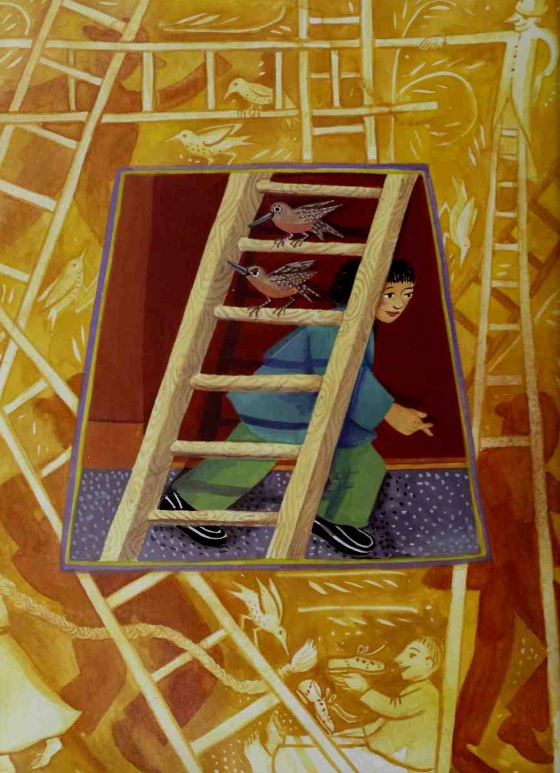
sometimes need to walk under a ladder but what about the bad luck
Lord knows you can’t avoid it sometimes, you need to walk under a ladder —
but what about the bad luck? Try this, if you have faith: They say
spit on your shoes and let the spit dry and you are safe to walk on through.
I believe it. Sort of. Do you?
Ladder by Janet S. Wong as published in the book, Knock on wood : poems about superstitions written by Janet S. Wong; illustrated by Julie Paschkis (Margaret K. McElderry Books, New York, 2003).
Something for Friday the 13th.
Wikipedia says:
Any month that starts on a Sunday contains a Friday the 13th, and there is at least one Friday the 13th in every calendar year.
There can be no more than three Friday the 13ths in a single calendar year; either in February, March, and November in a common year starting on Thursday (such as 2015 or 2026), or January, April, and July in a leap year starting on Sunday (such as 2012 or 2040)
According to the Stress Management Center and Phobia Institute in Asheville, North Carolina, an estimated 17–21 million people in the United States are affected by Paraskevidekatriaphobia (fear of Friday the 13th), making it the most feared day and date in history. Some people are so paralyzed by fear that they avoid their normal routines in doing business, taking flights or even getting out of bed. It has been estimated that US$ 800–900 million is lost in business on this day. Despite this, representatives for both Delta Air Lines and Continental Airlines (the latter now merged into United Airlines) have stated that their airlines do not suffer from any noticeable drop in travel on those Fridays.
way is plain, peaceful, generous, just – if followed God forever bless
According to Wikipedia, The 1862 State of the Union Address was written by the 16th president of the United States, Abraham Lincoln, and delivered to the 37th United States Congress, on Monday, December 1, 1862, amid the ongoing American Civil War.
This address was Lincoln’s longest State of the Union Address, consisting of 8,385 words.
In the closing paragraphs of this address, Lincoln penned words which have been remembered and quoted frequently by presidents and other American political figures. Lincoln’s concluding remarks were as follows:
The dogmas of the quiet past are inadequate to the stormy present.
The occasion is piled high with difficulty, and we must rise with the occasion.
As our case is new, so we must think anew and act anew. We must disenthrall ourselves, and then we shall save our country.
Fellow-citizens, we can not escape history.
We of this Congress and this Administration will be remembered in spite of ourselves.
No personal significance or insignificance can spare one or another of us.
The fiery trial through which we pass will light us down in honor or dishonor to the latest generation.
We say we are for the Union.
The world will not forget that we say this.
We know how to save the Union.
The world knows we do know how to save it.
We, even we here, hold the power and bear the responsibility.
In giving freedom to the slave we assure freedom to the free — honorable alike in what we give and what we preserve. We shall nobly save or meanly lose the last best hope of earth.
Other means may succeed; this could not fail.
The way is plain, peaceful, generous, just —a way which if followed the world will forever applaud and God must forever bless.
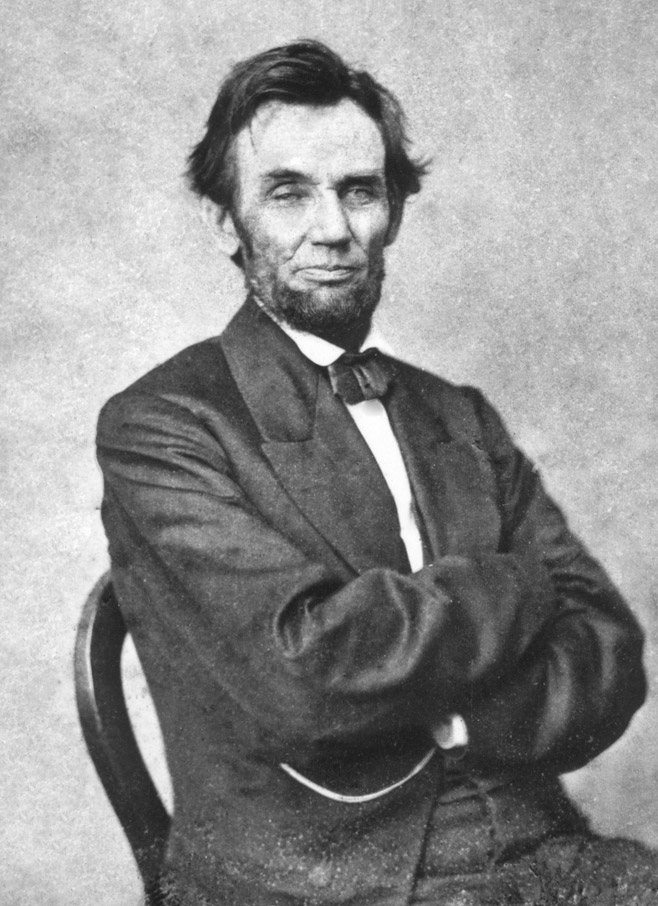
Can’t pass by Mr. Lincoln on his birthday.
It used to be a big day.
Probably still should be.
More so not that other people have elevated the office of President of the United States.
But that other people have demonstrated the depths to which the office can sink.
I think of what Alistair Cooke wrote about Mr. Lincoln in his book, America:
“It is difficult, and in some quarters thought to be almost tasteless, to talk sense about Lincoln.
But we must try.
For the holy image and the living man were very far apart, and keeping them so does no service either to Lincoln or to the art of government.
Like all strong characters, he was well hated, and like most frontiersmen who have come to high office—like Harry Truman and Lyndon Johnson—he was ridiculed for his directness and country manners.
The London Times called him “the Baboon.”
Lincoln had a gangling gait, a disturbing fondness for rough stories, and a maddening habit of being, in a kind of tooth-sucking way, wiser and sharper than you. (To make it worse, most of the time he was.)”
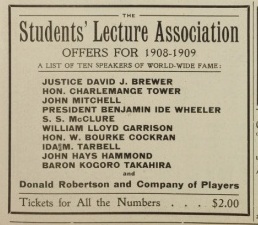
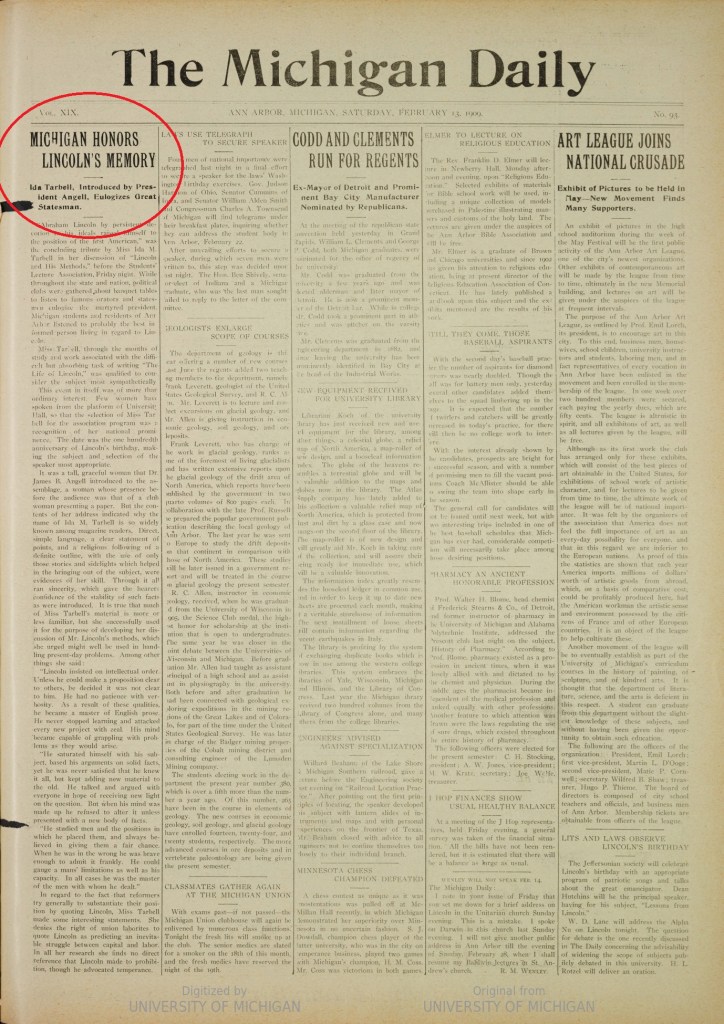
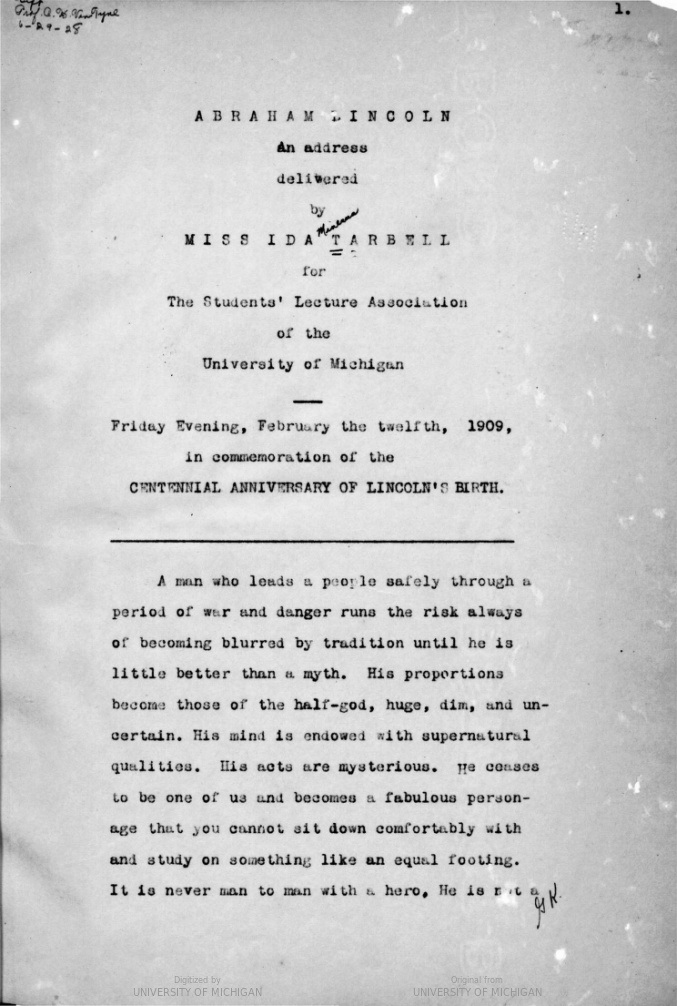
On the 100th anniversary of Mr. Lincoln’s birth, biographer Ida Tarbell spoke at the University of Michigan on the topic, “Abraham Lincoln : an address the Centennial anniversary of Lincoln’s birth.”
Ms. Tarbell’s address was part of 1908-1909 schedule of speakers arranged by the Students’ Lecture Association of the University of Michigan.
I was fascinated to see the Hon. W. Bourke Cockran also on the list.
He is the Bourke Cockran in this oft told story of Mr. Churchill … “Adlai Stevenson, himself a notable speaker, often reminisced about his last meeting with Churchill. I asked him on whom or what he had based his oratorical style. Churchill replied, “It was an American statesman who inspired me and taught me how to use every note of the human voice like an organ.” Winston then to my amazement started to quote long excerpts from Bourke Cockran’s speeches of 60 years before. “He was my model,” Churchill said. “I learned from him how to hold thousands in thrall.”
It must have been an interesting lecture to attend.
Ms. Tarbell spoke in University Hall, a hall that held 2500 people in a building that stood where Angell Hall now stands on the UofM campus.
She was introduced by the President of the University, James Angell and gave a lecture that, as stated in The Michigan Daily account, was made by the “probably the best informed person living in regard to Lincoln.”
Her final words on the subject?
It is doubtful if this country, if any country, has produced a man so worthy of our study and our following as is Abraham Lincoln.
Who indeed is there so fit to guide us in that highest of tasks – the giving of service?
Whoever saturated himself so with his subject?
Whoever trusted more utterly to the integrity of his logic, and to the appeal for the sense of human justice?
Whoever put aside with more contempt all the tricks of his trade – appeals to emotion simply to stir emotion, wit simply to arouse a laugh, subterfuges and evasion to escape valid objection?
Whoever handled with more honesty and respect his tasks?
Whoever struggled harder to understand not only with his head but with his heart and understanding, wrestled more to make others understand?
Whoever looked more deeply, more gently, into the hearts of men, and having looked, put into more moving words what he had seen? He has no parallel.
He stands in a towering lonely figure – a man who, by the persistent and reverential following of his own highest instincts, unaided, raised himself from the soil to place of the First American.
Now, 217 years after Mr. Lincoln’s birth … well, its beyond belief isn’t it.
once rhetorical exaggerations feeling less hyperbolic
Adapted from a paragraph in the article in the Guardian, The world heard JD Vance being booed at the Olympics. Except for viewers in the US by Bryan Armen Graham in Milan where Mr. Graham writes with a lot of wonderful words:
But there is a difference between contextual pressure and visible reality distortion.
When global audiences can compare feeds in real time, the latter begins to resemble something else entirely: not editorial judgment, but narrative management.
Which is why comparisons to Soviet-style state-controlled broadcasting models – once breathless rhetorical exaggerations – are starting to feel less hyperbolic.
It’s been a year without joy.
Really/
Think about it.
Bright spots to be sure.
Got two new grand kids for one.
But the bright spots have been few and far between the low spots and the daily drudge is more drudge like every day.
It got me to thinking about history.
Dark periods in history.
World War II
What was it like at home?
I am sure there were birthdays and graduations and new grand kids.
But in the back of your mind, there had to be that nagging feeling that being too happy, feeling too good … just wasn’t right.
There was a shadow over all other experiences.
A shadow that could not be erased.
There were reminders for the people at home.
Gas was rationed.
Not because there wasn’t gas but because one, there wasn’t rubber for tires, and two, it reminded folks there was a war on.
Food was rationed.
And there were those flags with blue and gold stars in windows of homes and businesses.
If your household had someone on active service, you put a flag with a blue star in your window.
If that someone died, you put a flag with a gold star in your window.
This is where those Blue Star Memorial Highway signs and the Association of Gold Star Mothers comes from.
Daily reminders that all was not right with the country and with the world at large.
I am told that the church my family attended had a banner made with 34 blue stars on it.
How would like to be looking at that during your Sunday prayers?
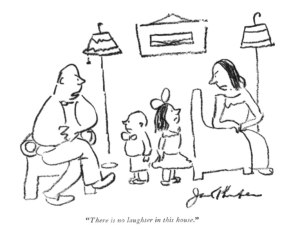
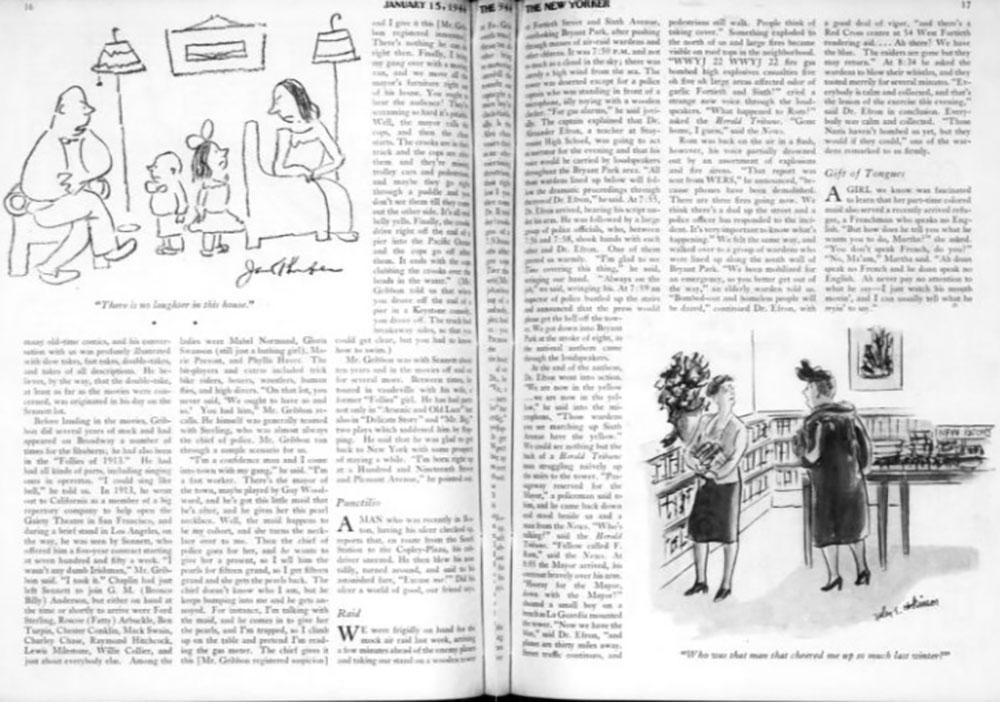
This drawing by James Thurber appeared in the New Yorker Magazine on January 15, 1944 after two years of war.
The caption reads, “There is no laughter in this house.”
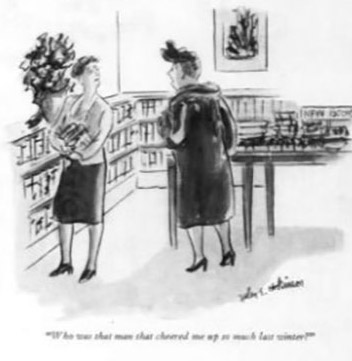
On the opposite page from this drawing was another one.
The caption here is, “Who was that man that cheered me up so much last winter?”
The ladies are in a bookstore, looking for relief.
The New Yorker is a magazine of humor.
But it was a time without joy.
Daily reminders that all was not right with the country and with the world at large.
Today, this past year, everyday it’s something new.
Something new and somehow, something worse than yesterday.
And daily, more and more predictions on how it is going to get worse.
Predictions just a year ago, would have been dismissed out of hand.
Not possible.
Not going to happen.
Not in America.
Which is why comparisons to Soviet-style state-controlled broadcasting models – once breathless rhetorical exaggerations – are starting to feel less hyperbolic.
Breathless rhetorical exaggerations – are starting to feel less hyperbolic.
Daily reminders that all was not right with the country and with the world at large.
I embrace weeping may endure for a night, but joy cometh in the morning (Psalms 30:5) …
I have never been really planetary since … farewell, my lovely
Back before Christmas I was in a Barnes & Noble bookstore.
Haven’t been in one in years but my wife had requested a couple of recently published books and she likes to have the book in her hand.
I walked in and felt pretty much at home.
My first job ever was working in a bookstore in a local mall.
I started working at Waldenbooks in the North Kent Mall in the spring of 1979 and I worked for this company until the spring of 1992 and then I went to work for the public library.
Today neither Waldenbooks or North Kent Mall is around.
But I still felt at home in the Barnes & Noble but … out of place.
I looked around and found the fiction section okay but it hit me that the shelves held only Hardcover and over sized paperbacks, what we called Trade editions.
Where were the paperbacks?
I wondered if maybe there was a paperback section but couldn’t find one.
I asked a clerk and she looked puzzled.
I tried to explain and asked ‘you know, the Mass Market editions.’
She shook her head.
This store not only didn’t have any ‘mass-market books’ but she had never heard of ‘mass-market books.’
Well there you are I thought and I bought two oversize paperbacks and more or less forget about the exchange.
Then this morning, I swiped through the New York Times on my tablet to see the headline, “So Long to Cheap Books You Could Fit in Your Pocket” by Elizabeth A. Harris, who covers books and the publishing industry .
The sub headline was, “The mass market paperback, light in the hand and on the wallet, once filled airport bookstores and supermarket media aisles. You may never buy a new one again.”
The gist of the article stated:
After almost a century in wide circulation, the mass market paperback is shuffling toward extinction. Sales have dropped for years, peeled away by e-books, digital audiobooks and even more expensive formats like hardcovers and trade paperbacks, the mass market’s larger and pricier cousin. Last year, ReaderLink — the country’s largest distributor of books to airport bookshops, pharmacies and big-box stores like Target and Walmart — announced that it would stop carrying mass markets altogether.
“You can still find them in some places,” said Ivan Held, the president of Putnam, Dutton and Berkley, publishing imprints that once did brisk business in mass markets. “But as a format, I would say it’s pretty much over.”
Wow.
For those 13 years I had worked in bookstore, paperbooks were a major part of the books we sold.
Getting them out, setting them up, selling them and returning them made up most of the work week.
They would arrive in boxes and if the title was big enough, they would come in a pre-made ‘dump’ which was a cardboard standup display that held about 48 copies of the book along with a header on top that featured a blow up of any cool cover art.
Fans of the author or if it was a movie tie-in, fans of the movie, would ask us if they could have those headers and we would write names and phone numbers on the back to call them when the display came down.
All the walls of the book store were covered with wire racks that were filled with paperbacks and the walls were divided into sections of fiction, mystery and what have you.
When we got a new delivery of books, it was a days work to shelve the books into place (alpha by author) shifting the stock back and forth and then remembering where all these books were when asked for a title by a customer.
I started work in the days before computer cash registers and we had to compute the Michigan 4% sales tax in our heads and to this day I can rattle off the final price of paperbacks –
$1.95 came to $2.03 $2.95 came to $3.07 $3.95 came to $4.11 $4.95 came to $5.15 $5.95??? There were no $5.95 paperbacks
I can remember those numbers as so many of the sales in this bookstore were to readers who stopped in quick to grab just one book for the week.
It was that type of mall.
I can still hear the voice of a good friend I worked with who was originally from Kentucky and the way she pronounced $4.11 in a sweet southern accent with this pause between the 4 and the eleven and this Australian like rising last syllable on the eleven.
Then there were the returns.
From time to time we would get printed lists of titles to pull off the shelves and send back.
Well, kinda send back.
Mass market paperbacks were so cheap to produce that it didn’t pay to return the entire book to publishers.
As Ms. Harris writes in her article about paperbacks:
“Such low prices required inexpensive production. Because mass market spines were glued together instead of sewn, the covers often came off, or pages fell out. Libraries rarely bought them, in part because they were too fragile.
What we did was take all the returned copies to the backroom and rip the cover off and throw the rest of the book, now known as a ‘strip’, in the trash.
The covers were sorted and returned to the publisher for credit but that left us with stacks of coverless paperback books.
This was tricky as we were required by the publishers to destroy the book or make it unreadable.
For myself, I felt that taking boxes of strips to the trash compacter and pressing the button was good enough.
One manager I knew would pour water over them before taking them to the trash.
Still that left these books of strips all over the place.
I mean, how much can a box of books be compacted.
People were often coming into the store with an armload of strips, saying they found them in the trash (don’t ask me) and did we want them back?
In a short story, Garrison Keillor writes about walking down a street in New York City and being asked by a pan handler if he wanted to buy a book a $1.00.
The book didn’t have a cover but you could read it okay said the pan handler.
The pan handler was selling strips that he had found in the trash.
What made the story was that the pan handler had offered Keillor a copy of his own ‘Lake Wobegon Days‘ and when Keillor told the pan handler he had written the book, the pan handler was so pleased, he asked Keillor to autograph it.
Which Keillor did and as he walked away and down the street Keillor heard the pan handler offer the book to the next person for $2.00 … as it had been signed by the author.
Before I ever worked in a bookstore, paperbacks were huge in my life.
I have abibliophobia which is, according to Wikipedia: ” … the fear of running out of reading material, often causing anxiety in avid readers when their supply of books runs low. It is a relatively new, largely informal term derived from Greek, describing a common “bookworm” behavior of hoarding, over-packing for trips, or panicked reading. It is often treated by stockpiling books, using digital readers, or visiting libraries.”
I digress but one of the benefits of working in a bookstore was that so many of the people you worked with as well as many of the customers also had abibliophobia. You could see the kinship just in their body language. You were among friends and people who understood.
Paperback books went a long way to keeping my abibliophobia under control.
I never went anywhere and I mean ANYWHERE without something to read.
When my Mom took me to find a new spring coat or winter jacket, I brought along a book to read just in case and to make sure the new coat had at least one pocket the book would fit it.
Scholastic Book Day at my school was a monthly day created just for me.
We would come in from recess to see a big box on the teachers desk and know that the books we had ordered a few weeks before with our ‘Scholastic Book Money’ had arrived.
When orders were handed in, we would line up and hand over our orders and the quarters, dimes and nickels needed to pay for our order.
I was the only one who handed in their order with a check from their Mom.
When the box was opened, the teacher would look at the order list and call out names and hand out the books.
The teacher would save me for last and then hand me the box half filled with my books.
I have mentioned it before, but my parents never ever questioned handing over money to buy books for me.
Anything that might keep me quiet for an hour was worth gold to them.
Those paperback books.
You could take then anywhere and read them everywhere and I did.
Ms. Harris writes: “It was one of the most brilliant technologies in the history of the world,” Rabinowitz said, “precisely because you could shove it in your purse or your pocket.”
Physically I might be in the back of the car on a trip to Chicago but mentally I was fighting Napoleon with Horatio Hornblower or marching to city called Gettysburg with the Iron Brigade when the line of men in blue came over the top of ridge and the wind caught the flags and the sun made the buttons shine so that other soldiers watching had to stand and cheer in a scene described by Bruce Catton on flimsy, pulpy gray pages of paper.
I still have abibliophobia.
My collection of ‘devices’ helps a lot.
I also travel with a solar power USB battery charger just in case.
The number of paperbacks on my shelves is small.
My wife and I call them ‘beach books’ because they are small work well at the beach.
But in my mind …a world without paperbacks?
I cannot imagine.
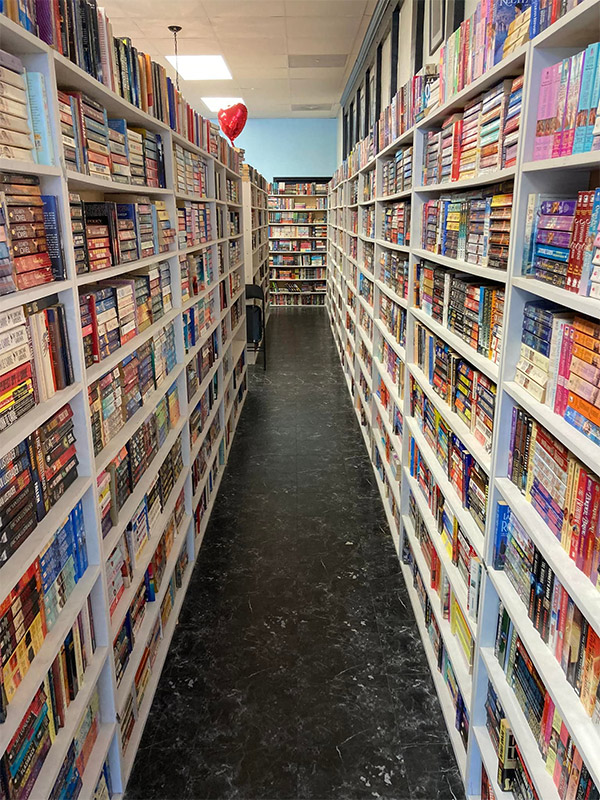
I started by saying I don’t get to Barnes & Noble too often but there are a handful of used books stores – like this one in nearby Richmond Hill, GA, that we frequent which makes me think the paperback will be around for awhile yet.
And I am reminded of an essay by E. B. White titled, Farewell, my Lovely.
It was White’s fond remembrances of the Model T Ford.
To close the essay, White writes: The days were golden, the nights were dim and strange. I still recall with trembling those loud, nocturnal crises when you drew up to a signpost and raced the engine so the lights would be bright enough to read destinations by. I have never been really planetary since. I suppose it’s time to say good-bye. Farewell, my lovely!
Please allow me to paraphrase.
The days were golden, the nights were dim and strange.
I still recall with trembling those loud, nocturnal crises when you were stuck in a car at night and you weren’t allowed anything that made a light bright enough to read by.

 No Haiku For You