Carols at Christmas Words seemingly carved in stone New lyrics? Now wait!
I am willing to be old as I really don’t have a choice.
I am willing to be old fashioned in many things by choice.
In too many things if you ask my wife.
Last couple of weeks, Church has performed songs for the Christmas season.
Songs which I would have called traditional Christmas Carols.
But the tradition ended with the 2nd and 3rd verses of these traditional songs.
New, modern, evangelical lyrics replaced the old words.
The gears in my brain went out of sync.
I was a little bit shocked and a lot bit dismayed.
This wasn’t wrong.
But this wasn’t right either.
I thought some things were beyond the wrecking ball of time.
I never sang a Christmas Carol that I thought that the words or the meaning could be improved.
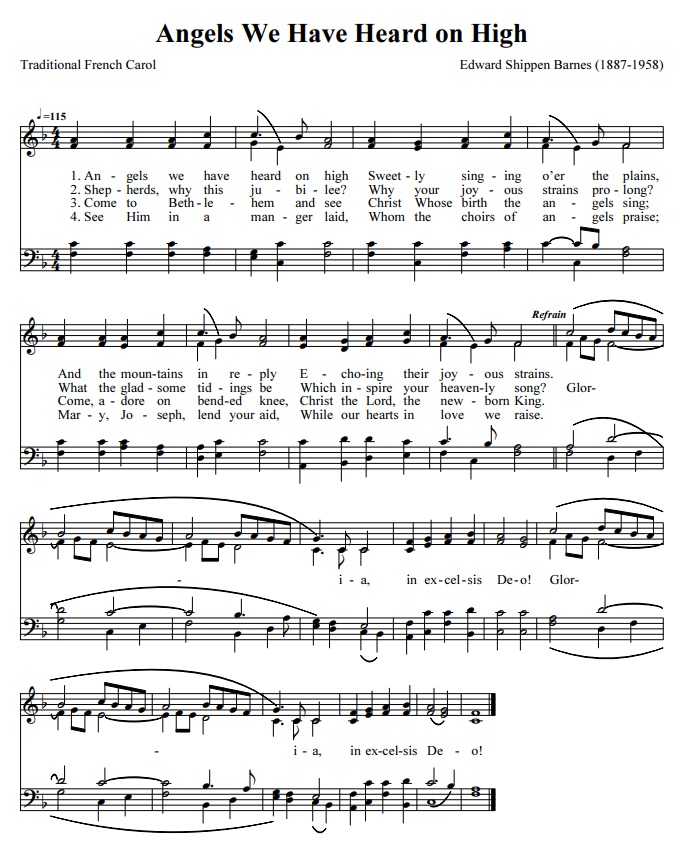
Well there was that year I was teaching the 4th Grade Boys Sunday School class and I told the boys that when we sang ‘Angels We Have Heard on High’ for the Church Christmas Program, instead of GLOOOOOO-OOOOOOOOOOOOOO-OOOOOOOO -OOOOOOOOOOOORIA, we could get away with OOOOOOOOOOO-OOOOOOO-OOOOOOOOO-OOOOOOO-REOS (and we did too) but I digress.
I find it hard to imagine anyone sitting back, looking at a piece of sheet music to O Come All Ye Faithful, looking at the new lyrics they just added and saying, ‘There, that’s better!’.
According to the Macmillan Dictionary Blog, Carol is a very old word, dating back at least to 1300. It originally meant a circle dance, and came from Old French carole, and possibly ultimately from Greek and Latin, but its etymology is obscure.
The first OED citation for the current meaning – “A song or hymn of joy sung at Christmas in celebration of the Nativity. Rarely applied to hymns on certain other festal occasions” – comes from 1502:
Speaking of Oh Come All Ye Faithful, yes, I know it was Adeste fideles læti triumphantes in the Latin and it was changed into english somewhere along the line.
And I know Tempora mutantur, nos et mutamur in illis (The times change and we change with the times.)
If you ask me, some things shouldn’t be, don’t need to be changed.
My glasses, as always, were murky and splattered with gunk.
I took them off to clean them up with my shirt tail so I could get a better look at the painting.
Digression: I love 100% long sleeve cotton shirts that I wear untucked. I wear them untucked just to have something handy with which to clean my glasses.
As I was polishing my glasses, I leaned in close to the painting.
History of Art was my minor in college.
I enjoyed the lectures and the stories about the painters and paintings.
I had a hard time going along with the concept that art could be assigned to genre and schools and such.
I found out the History of Art was a field of study conceived and taught first in Germany.
Then it all made sense.
Can’t have all this art just lying around, there must be order!
But again I digress.
One of the professors I had took the class on a tour of the Detroit Institute of Art.
And he explained ‘How to go to an art museum.’
Perspective: Sit on the floor about 10 to 15 feet in front of the work to get the artist’s perspective. (Doggone it but he was right).
Light: You MUST visit any museum three times. In the morning, for morning light. In the afternoon for afternoon light and at night for electric light as the art changes. (Doggone it but he was right again).
AND MOST IMPORTANTLY, The Guards: He said to embrace that we were students of art, not just visitors. When we entered a gallery, we should first walk up to any guard and introduce yourself and just let them know you were a student.
On this day, I had introduced myself to the guard and said I was an art student.
He turned ever so slowly and looked me in the eye and just barely nodded.
And in I went and found myself in front the Van Gogh, polishing my glasses.
I am very very very near sighted.
I can see my hand in front of face at about 3 inches.
BUT the detail I see at the distance just drives me nuts as it lets me realize just how bad my eyes are.
Anyway, as I polished my glasses, I leaned in closer and closer to bring the painting into focus.
When I could see the painting clearly, I was so close, I was probably seeing a section of the painting that that was 4 by 6 inches.
My brain went click or something.
In that 4 x 6 inch section of the painting, viewed from about 3 inches away, with my glasses off, focus was so sharp, there was as much detail in the entire painting.
I could see brush stokes on brush strokes.
I could see the edges of a palate knife.
I could see lines of SINGLE HAIR of a brush.
I could could whorls and swirls of oil paint that looped and hooked like white cap waves on Lake Michigan.
Layer upon layer of color threads and trails.
I felt I was inside the painting.
I swear I could look UP at the peaks of oil paint.
Surrounded by Vincent’s impressions of the view of the field.
The painting is big.
About 2 feet by 3 feet.
I had to see the entire thing.
And I slowly moved over the entire surface from 3 inches away.
My eyes must have been where Vincent’s hand had been.
I was gone.
I was gone from the world that the art gallery was in.
I am not sure where I was.
Seems like I stopped breathing but I could not have as I stood there for about 20 minutes.
Like one of those time-space sequences in a movie, this moment came to an end and I was sucked back out of the painting in a tunnel of streams of light.
I straightened up and stepped back.
And came back into to this world.
I put my glasses back on.
Looked around.
That guard was right behind me.
The entire time, he had been guiding people around me.
He let me have those moments.
Maybe he knew I had left the room.
Maybe he had seen the effect on others.
I caught his eye and nodded.
He nodded back.
Words were not necessary.
Not sure a week goes by that I don’t think of this moment.
I ran across confabulate in a wonderful paragraph in my reading the other day.
In the Social Animal, David Brooks writes, “The unconscious mind merely confabulates stories that try to make sense of what the unconscious mind is doing of it own accord.”
I liked the word confabulate.
I was pretty sure I had heard it before.
I was pretty sure I knew what it meant.
I looked it up to make sure.
The first definition, engage in conversation; talk, seemed to apply to Brooks’ use of the word.
There was a 2nd definition listed.
PSYCHIATRY fabricate imaginary experiences as compensation for loss of memory
That definition demanded more investigation.
My question, is the confabulator making things up on purpose?
Telling a lie in other words?
Or are these imaginary memories born out of frustration for lack of real memory?
Or are these imaginary memories there because that is how the confabultor really remembers them?
The online Merriam-Webster dictionary gives this use of the word, ” A major characteristic of brain-damaged patients is the tendency to confabulate—to hide and dissemble about their damage.”
To me that sounds like its all made up except that it refers to brain damaged people?
Merriam-Webster also states, ” Confabulate is a fabulous word for making fantastic fabrications. Given the similarities in spelling and sound, you might guess that “confabulate” and “fabulous” come from the same root, and they do – the Latin fabula, which means “conversation, story.” Another “fabula” descendant that continues to tell tales in English is “fable.” All three words have long histories in English: “fable” first appeared in writing in the 14th century, and “fabulous” followed in the 15th. “Confabulate” is a relative newcomer, appearing at the beginning of the 1600s. “
entire life learning how to communicate, still wrong words are chosen
According to a quick google search, the Second Edition of the 20-volume Oxford English Dictionary contains full entries for 171,476 words in current use (and 47,156 obsolete words).
The odds are stacked against me that in any given situation, I will say the right thing or use the right words.
With texting or posting or any form of writing, audio emphasis or how the words are said out loud has to be supposed, or pre-supposed.
I have long said that most texts and emails are read in the same voice that I would read a note that said, “Report to Principal’s Office NOW!”
Is that fair to the person emailing me?
What do the words mean?
We have the audio recording of Neil Armstrong’s first words when he stepped on the moon.



 No Haiku For You