1.17.2022 – so you may master

so you may master
the intricacies of the
English language
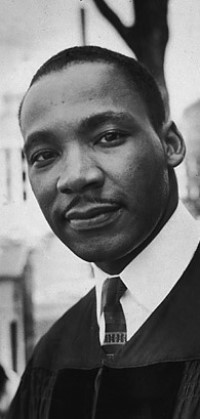
In his famous sermon, Paul’s Letter to American Christians Delivered at Dexter Avenue Baptist Church, Montgomery, Alabama, on 4 November 1956, Dr. Martin Luther King, Jr. said, “So American Christians, you may master the intricacies of the English language. You may possess all of the eloquence of articulate speech. But even if you “speak with the tongues of man and angels, and have not love, you are become as sounding brass, or a tinkling cymbal.”

In a famous documentary of Frank Lloyd Wright, Architect Philip Johnson says that he doesn’t know how Wright designed his buildings.

Mr. Johnson then says, “If I knew how it did it, I would do it.”

Listening and reading the speeches of Dr. Martin Luther King, Jr., I say to myself, how did he do that?

Listening and reading the sermons of Dr. Martin Luther King, Jr., I say to myself, how did he do that?

If I knew, I would do it.

I ask myself, what must it have been like to be a regular at the Ebenezer Baptist Church when Dr. King was in the pulpit.

I grew up Dutch in West Michigan.

I also grew up Baptist.

That meant church twice on Sunday, Wednesday Meeting, Tuesday Bible Club and Monday Awana.

I heard a lot of preaching growing up.

I often felt that Sheriff Andy Taylor’s assessment of the preaching in Mayberry when he says that he, ” … holds with Rev. Tucker. But he can be as dry as dust,” could apply to my years growing up Baptist.

The church I grew was strongly associated with both the Grand Rapids Baptist College and Grand Rapids Baptist Seminary.

Both places still exist but now that the word ‘Baptist’ is a determent to marketing, they are known as Cornerstone University and Grand Rapids Theological Seminary.

My Church did not so much have ‘Preaching’ as it had ‘Teaching’.

If ever in need of what was known as ‘Pulpit Supply’, the Church leaders would turn to the Seminary for someone to preach on Memorial Day Weekend, Labor Day Weekend or in the event that the Church was without a Preacher.

Once when searching for a new Pastor, Dr. Leon Wood of the Seminary spoke for two years using his course and latest book on the Prophet Daniel as the basis for his Sunday sermons.

Dr. Wood’s style was to teach, word by word, through each verse, and explain in detail, the meaning, history and use of the word.

My Dad used to remark on how many verses of the Book of Daniel that Dr. Wood might cover in a Sunday Sermon.

The average was about 2.

I was 10 and when I was told about the upcoming Sunday Sermons, I was excited because the Book of Daniel had those great stories of Daniel in the Lion’s Den and Shadrach, Meshach, and Abednego.

I was so excited, my Mom got me his book for my birthday.

I loved the gift.

I loved that I GOT a gift.

I loved that my Mom remembered.

But what was really cool about that gift was how it came about.

Every summer, my Dad would take a week off and we would take a State of Michigan vacation.

This meant Sleeping Bear Dunes, Mackinaw or Michigan’s Upper Peninsula.

This vacation also usually happened around my Birthday on July 17th.

That meant my birthday was celebrated on the road.

For me, this was (as Jim Harrison writes in his book “The Big Seven”) the kind of injustice that weighs heavily on children who collect injustices for later possible use.

That year we were in Eagle Harbor Michigan up in the Keweenaw Peninsula of Michigan’s Upper peninsula, on my birthday and we trooped into a restaurant for lunch and with about 10 or 12 of us, we took three tables of 4.

Understand that by car, Eagle Harbor Michigan was a far away from Grand Rapids as Washington, DC,

Check a map, it is a LONG way there to get there.

I sat with Mom and Dad and probably little Stevie who would have been about 6.

Not sure why, but it seems like I always got to sit with Mom and Dad.

And most likely I was moping about it being my birthday and no cake or celebration as I was not going to let such an opportunity to whine get by when my Mom reached into her purse and pulled out a wrapped present.

She had packed it away and kept it hidden from me the entire trip.

Few gifts through out my life have been more a surprise.

And it was Dr. Wood’s book on Daniel.

I did read it – or at least tried to read it but I was just 10 years old and I still have it my shelf all these years later.

But I digress.

Dr. Wood, as I remember it, spent three weeks of Sunday Services dissecting the word, word history and meanings of the word ‘pulse’.

(For those who weren’t there, pulse is the veggie diet that Daniel asked for in place of the royal food’s that had been offered up before the Babylonia gods)

Where was the lion’s den?

Where was Shadrach, Meshach, and Abednego?

Daniel’s 70 weeks?

And the missing week?

Minutes seemed like hours.

And hours seemed like days.

Years later, moving to the south, my wife and I (she grew up the same church) decided that anyone who attend our church when we did should be award a M.Div degree from the Seminary AND if anyone, and I mean ANYONE, had tried to preach any of those sermons in the south, biblical stoning would have made come back.

And I have to wonder why.

To be sure, Dr. King had a gift.

But was there anything else?

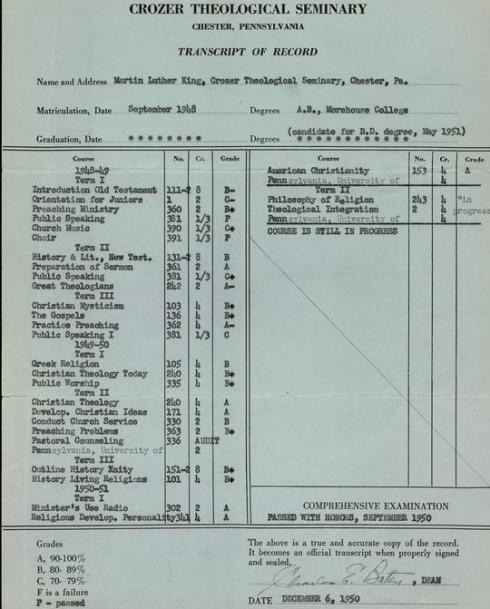
Dr. King after attending Morehouse in Atlanta, went off to post graduate work at Crozer Theological Seminary in Chester, Pennsylvania to work on a Bachelor’s of Divinity degree in 1948.

Dr. King took some 35 courses.

Of those 35 course, 11, almost 1/3 of the course of study, were classes on HOW TO PREACH or other pulpit skills.

Dr. King took the following courses.

Preaching Ministry of the Church
Public Speaking (twice)
Public Speaking I
Preparation of the Sermon
Practice Preaching
Preaching Problems
Conduct of Church Services
The Minister’s Use of Radio
Church Music
Choir

Thinking about my experiences with sermons and preaching, I checked the current catalog list of required courses for a Master of Divinity or M.Div at the Grand Rapids Theological Seminary.

There are 32 required classes.

BBL-501 Biblical Hermeneutics
BBL-510 Greek I
THE-501 Program Introduction
BBL-511 Greek II
THE-540 Systematic Theology I
MIN-500 Christian Spiritual
MIN-543 Christian Formation in the Church
MIN-545 Teaching & Learning
THE-640 Systematic Theology II
MIN-560 Global Impact
BBL-516 Hebrew I
BBL-672 NT I: Introduction to Exegesis. 3
THE-641 Systematic Theology III
BBL-517 Hebrew II
BBL-601 Experiencing the Ancient World of the Bible (Israel)
BBL-677 NT II: The Gospels
MIN-685 Ministry Residency I
MIN-510 Organizational Leadership General Elective
BBL-640 OT I: Intro to Hebrew Exegesis
BBL-678 NT III: Hebrews to Revelation. 3
Ministry Specialization Course
MIN-686 Ministry Residency II
BBL-641 OT II: Exegesis in the Pentateuch
Historical Theology Elective
Ministry Specialization Course
MIN-781 Ministry Residency III
MIN-711 Program Completion
MIN-782 Ministry Residency IV
BBL-642 OT III: Exegesis in the Prophets and Writings
THE-676 Apologetics and Moral Issues in Christian Ministry
Historical Theology Elective
Ministry Specialization Course

For specialization in Pulpit Ministry, Homelitics (the art of preaching or writing sermons) I & II are recommended Specialization courses.

Otherwise, nothing on how to speak or preach.

Boy Howdy!

That course list reads like a list of sermon titles I have sat through.

I held with the preaching, but it was dry as dust.

Now I am not saying that just the study of preaching and the classes that Dr. King took might have helped but I will say it wouldn’t hurt.

How much did it help Dr. King?

That is hard to say.

According to his transcript, Dr. King got a C’s in public speaking.
1.16.2022 – there are certain things

there are certain things
can only say in english
(but not fiction)
because fiction flows

This haiku went off the rails in regard to the original arrangement of the words.

So I broke the rules which was easy as this is my blog and I make the rules and I added the non-boldface words in parenthesis so you read them but don’t see them.

I was working from the quote, “You know, I find that I forget how to talk in Spanish, because there are certain things that I only say in English. I can write nonfiction in English, but fiction, no, because fiction flows in a very organic way. It happens more in the belly than in the brain.

The quote appears in the online article “Isabel Allende: I still have the same rage.

Isabel Allende is reported, by Wikipedia, to be the “the world’s most widely read Spanish-language author.”

And I have not heard about her.

I was also drawn to the quote:

I have three things that all writers want: silence, solitude and time. But because of the work my foundation does with people at risk, I’ve been very aware that there is despair and violence and poverty.

Maybe its time to see what the spanish speaking world has been reading.

11.22.2021 – memory depends

memory depends
have we intentionally
apprehended it

My cousin Joy has been on my mind since I stole a photograph of hers to use in yesterday’s haiku,

In the discussion about that haiku I commented on the camera versus memory when seeing things today.

I quoted from the author, Alain de Botton that using a camera blurs the distinction between looking and noticing, between seeing and possessing.

Mr. de Botton makes the point that the camera gives us the option of true knowledge, but it may also unwittingly make the effort of acquiring that knowledge seem superfluous

That is a great discussion for the here and now.

Having a camera with you in the here and now.

But what about the then?

The back then.

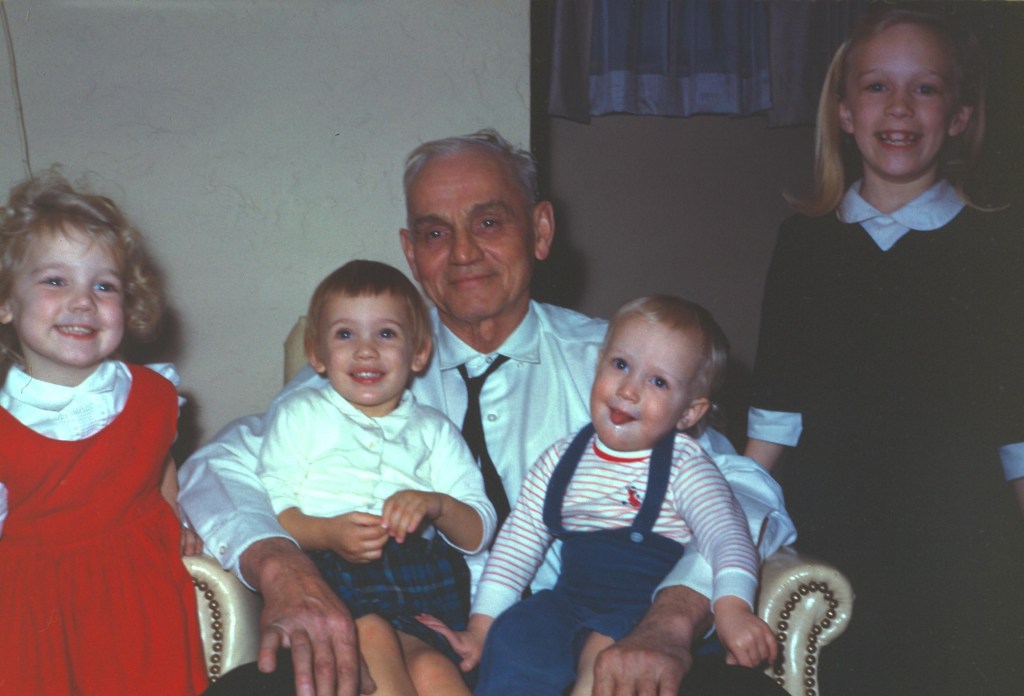
Here is a snapshot of sometime in 1962.

It is me and my cousin, Joy, sitting together on our Grandfathers lap.

My sister’s Lisa and Janet stand an either side.

I have NO memory of this photograph being taken.

I have NO Memory of seeing this photograph in the many many nights watching family slides.

Recently a nephew of mine digitized the family slides allowing us to travel back in time.

Otherwise I would have NO memory of this at all.

But I remember, with the help of the photograph, everything in the photograph.

My cousin and I we are the same age.

Our Mom’s were sisters.

I was my Mom’s 8th kid.

Joy was her Mom’s, my Aunt Mernie, 1st.

They were visiting from New Jersey.

This must have been a Sunday Dinner at my Grandma Hendrickson’s house.

Someone, my Dad most likely, arranged us altogether and said SMILE.

My character, even at age 2, seems to be pretty much set.

I can look at this picture and tell you what it smells like.

My Grandma’s house at that kinda moth-ball/natural gas smell due to the gas stove with no pilot light so you turned on the gas and lit the burner with a match.

As it was Sunday dinner it also smelled of my Grandma’s famous Pork and Beef roasts together in the same pan.

We were a meat and potatoes family to be sure.

But to be more accurate we were a mashed potatoes and GRAVY family.

Our parents would fill our plates and then cover everything on our plates with this pork-beef gravy that was what gravy was all about.

My Grandfather, that solid dutch guy (notice all the BLUE EYES??) in the picture, could eat mashed potatoes and gravy like it was an Olympic event.

Want to know the real kicker to this photograph?

Today, my cousin Joy and I are about the same age our Grandpa was when this photograph was taken.

I love this photograph and the memories it brings to mind ALONG with the memories it creates.

I have no memory of this day.

Looking I the photograph I remember everything.

Using the photograph, reseeing the scene, I can repossess the memory and the knowledge of the day.

It’s an effort.

Through the snapshot, I intentionally re-apprehend to my memory.

It is anything BUT superfluous.

*Adapted from the book, The Art of Travel (2002, Vintage Books) by Alain de Botton, and the passage:

True possession of a scene is a matter of making a conscious effort to notice elements and understand their construction.

We can see beauty well enough just by opening our eyes, but how long this beauty will survive in memory depends on how intentionally we have apprehended it.

The camera blurs the distinction between looking and noticing, between seeing and possessing; it may give us the option of true knowledge, but it may also unwittingly make the effort of acquiring that knowledge seem superfluous.

Adapted from the book, The Art of Travel (2002, Vintage Books) by Alain de Botton.

According to the website, GOOD READS, Any Baedeker will tell us where we ought to travel, but only Alain de Botton will tell us how and why.

As I said in the section on Architecture , what I find irresistible in reading Mr. de Botton is his use of language.

I get the feeling that if you made a spread sheet of all the words, adverbs and adjectives used by Mr. de Botton, you just might find that he used each word just once.

Neat trick in writing a book.

If I knew how to do that, hey, I would.

** More from the category TRAVEL — click here

11.10.2021 – Never afraid to

Never afraid to
take a stand mom reads comments
so take it easy

Reading a sports story in the Seattle Times I got to bottom of the page to see that the paper had added a little blurb about the writer.

The blurb stated:

Matt Calkins joined The Seattle Times in August 2015 as a sports columnist after three years at the San Diego Union Tribune.

Never afraid to take a stand or go off the beaten path, Matt enjoys writing about the human condition every bit as much as walk-offs or buzzer-beaters.

His mom reads the comments so take it easy on him.

Can’t remember what the story was.

But I felt sorry for Mom.

11.9.2021 – view from the narrow

view from the narrow
window was dreary lonely
inexpressibly

From Chapter 1, Page 1 of The Crime at Black Dudley by Margery Allingham (1904-1966) (published by William Heinemann Ltd, London, 1929).

How you start writing a novel when in your first line, you admit the view was dreary and inexpressibly lonely is beyond my poor power to add or detract.

I have to admire any author who describes a scene with the word ‘inexpressibly’ and then goes on to describe it.

I love and enjoy the writing of the 1930s.

That those writers thought, wrote and inexpressibly expressed themselves like this, leaves me grasping for the now non existent thesaurus.

I came across the writing of Margery Allingham in a search for something to read.

What you say?

Nothing to read?

Let me explain.

Something happened to writing or maybe editing or something over the years.

The influence of TV.

The rise of the word processor.

I miss the lack of narrative.

Watch TV and the narrative is visual but all over the place.

A segment opens with a plane landing or a car driving down a road and words appear on the screen like ‘London’ or ‘Monday 3AM’ or the ever popular ‘3 Days Later. (the first three years of Sponge Bob are the best)’

Without these ‘establishing’ shots, the viewer has NO CLUE as to where they are.

It seems this has become the style in modern American fiction.

Thinking of Tom Clancy here of course but without his section headings, you would never know where you were.

You go from section heading to section heading, sometimes paragraphs at a time are broken up.

I also blame the word processor for some of this as it is so easy to save any short burst of prose and then hammer it by shear force of will somewhere, anywhere, into the narrative and then add the section heading to help the reader understand why this ugly plank is sticking up in the floor.

Read Gone with the Wind (Very Very politically incorrect but for this argument) and NOT ONCE is the setting set by anything but the narrative.

If you know the history of the WRITING of Gone with the Wind, Margaret Mitchell dumped two suitcases of manila envelopes filled with stories and an editor, a very capable editor, transformed Ms. Mitchell’s pages into one long story.

If you get a chance, watch the little watched movie, GENIUS.

Its a great period piece about the author, Thomas Wolfe and his editor, Max Perkins and how the book, Look Homeward Angel was created.

ANYWAY, I guess what I am saying is, they don’t write ’em like this anymore.

And I know there are those who will say, THANK GOODNESS.

For me.

I do like reading writing as much for HOW it is written as for what is written.

I have three or four devices FILLED with the latest fiction.

For me, I can click on a book, read or start reading the first pages and say outloud, ‘NOPE.’

And that’s that for that one.

Sometimes I will have hope and push on through the first pages.

But folks, I know when reading becomes a salmon swimming upstream.

Sometimes no problem.

Sometimes the current the other way is swift.

Sometimes there is dam (what did the salmon say when it hit a concrete wall? DAMN!)

AND SOMETIMES THE RIVER IS BLOCKED BY NIAGRA FALLS.

My point is that I feel I give these authors a fair chance, but I can tell, fairly quickly, when its a no go.

So I search for something to read.

This search led me to the website, https://www.fadedpage.com.

A Canadian website where books, whose CANADIAN copyright has expired, have been scanned and put online for download for FREE!

Got to love those Canadians.

Browsing through this website, I came across the writing of Margery Allingham and the Albert Campion Mystery series.

Ms. Allingham starts the first book with :

The view from the narrow window was dreary and inexpressibly lonely.

Miles of neglected park-land stretched in an unbroken plain to the horizon and the sea beyond. On all sides it was the same.

The grey-green stretches were hayed once a year, perhaps, but otherwise uncropped save by the herd of heavy-shouldered black cattle who wandered about them, their huge forms immense and grotesque in the fast-thickening twilight.

In the centre of this desolation, standing in a thousand acres of its own land, was the mansion, Black Dudley; a great grey building, bare and ugly as a fortress. No creepers hid its nakedness, and the long narrow windows were dark-curtained and uninviting.

The man in the old-fashioned bedroom turned away from the window and went on with his dressing.

‘Gloomy old place,’ he remarked to his reflection in the mirror. ‘Thank God it’s not mine.’

For me, reading this is like watching a skilled piano player.

Fingers on keys, almost effortlessly calling notes out of the piano.

Fingers on keys almost effortlessly calling words out of typewriter.

Nothing forced.

The notes, the words flow easily.

Worth reading.

Worth the time spent reading.

I wish I could do this with words but I can’t.

But I can read the words.

So I am.

Search over for now.